Midsummer on the Landing Book Shelves

This post returns us to the original idea behind the blog, reading or re-reading some of the books on the (admittedly former) Landing Book Shelves. I was prompted into this after we went to see this summer’s Shakespearian production from the Balally Players. This year it was A Midsummer Night’s Dream, an obvious choice for this season. It was just a pity that the weather refused to play along with the idea, as were almost rained off at one point in the performance. All credit to the company for carrying on regardless (and the audience sticking it out!) A cup of coffee and a slice of lemon drizzle cake at the interval helped us to cope with the resulting dampness.

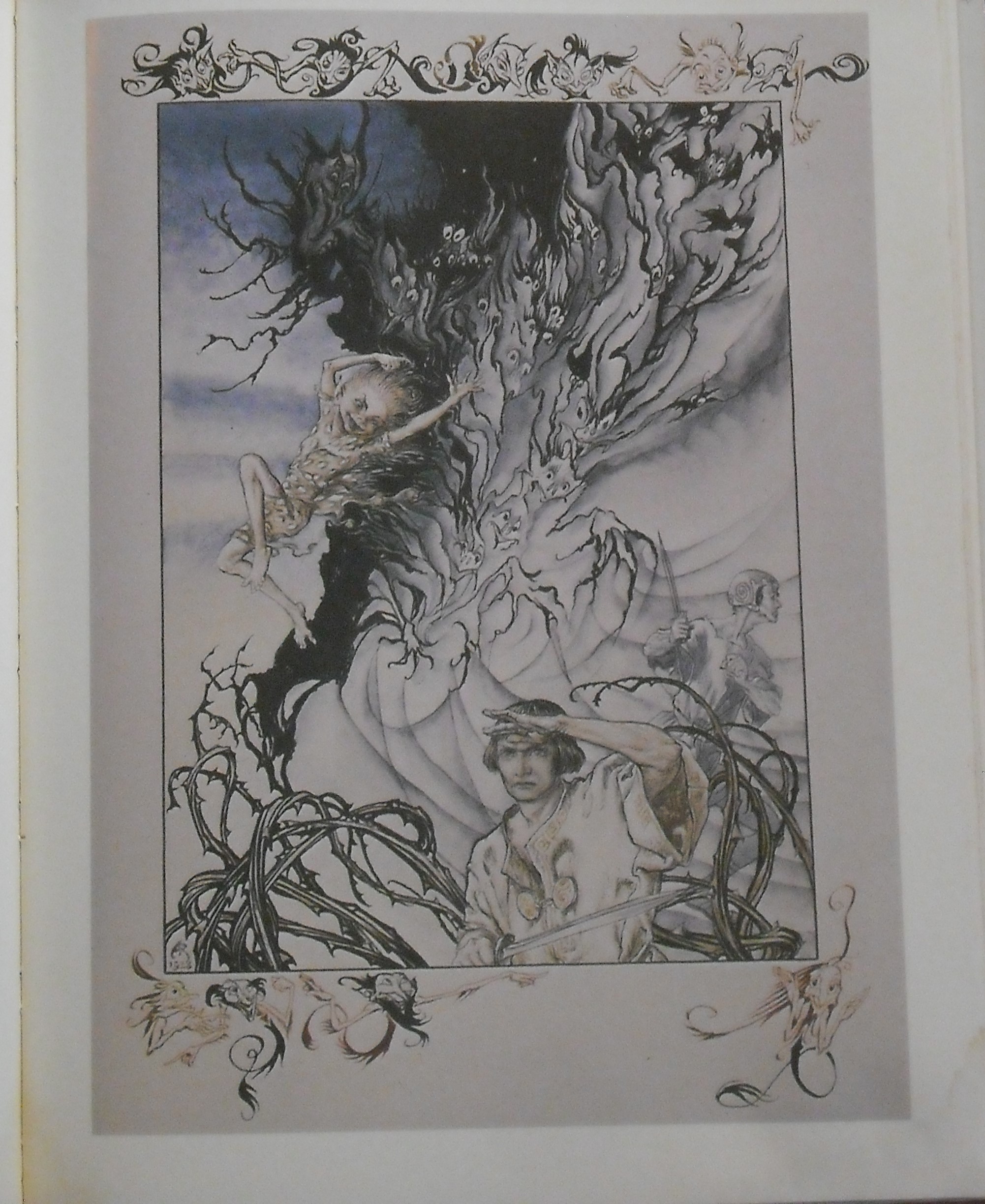
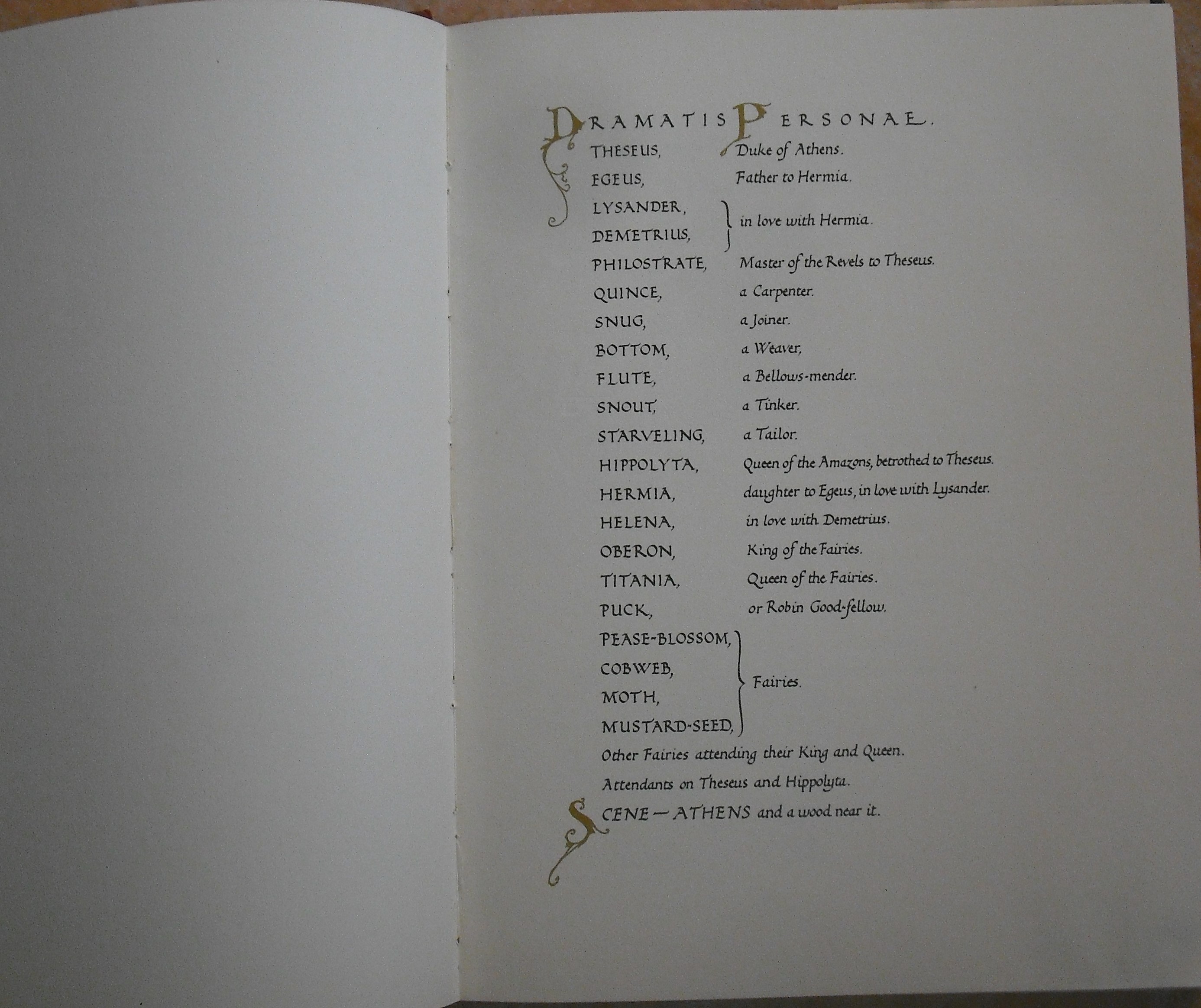
Anyway, the upshot is that afterwards, I had a ferret around on the bookshelves, braving the inevitable dust, to retrieve a copy of the very play. I have had this edition for many years and at this stage its origins are lost in the mists of time. As you can see from my photos, it is an edition beautifully illustrated by Arthur Rackham (1867-1939). Sadly, the jacket is not in the best condition at all. It wasn’t perfect when I acquired it, but several house moves over the years probably have not helped. However, the book itself is still in very good condition and is a lovely book to handle and to read. Suffice to say that although this is a first edition, I doubt if it will make my fortune.

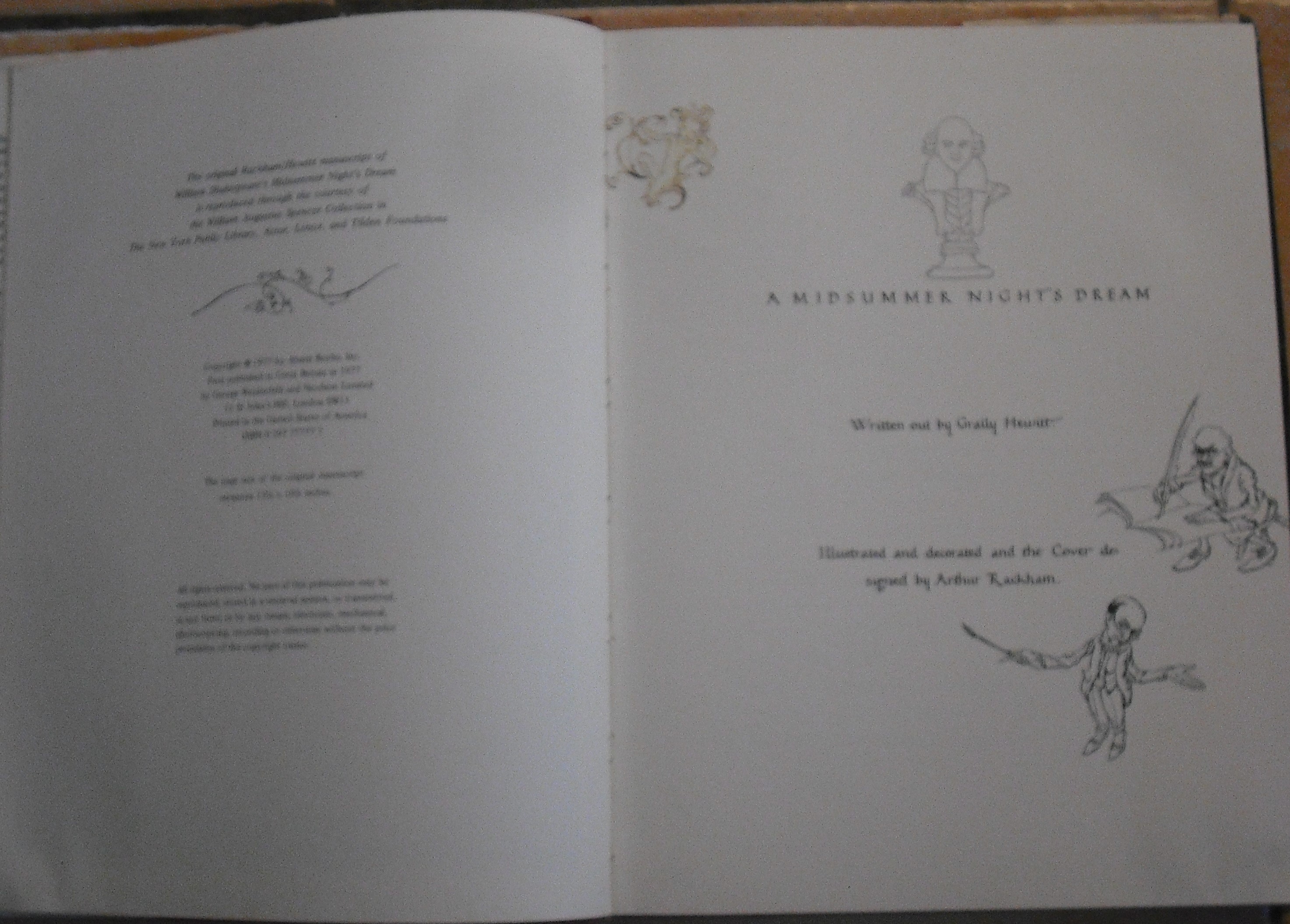
This edition was published from a book commissioned from Rackham by the New York Public Library’s William Augustus Spencer Collection in 1929. Calligrapher and novelist Graily Hewitt (1864-1952) produced the text, while Rackham designed the cover, page decorations and colour plates. The work was released for publication by the Spencer Collection in 1977, published in the US by Abaris Books and in the UK by Weidenfeld and Nicolson. If you want to know more about the gorgeous items in the Spencer collection, the NYPL blog has lots of information.
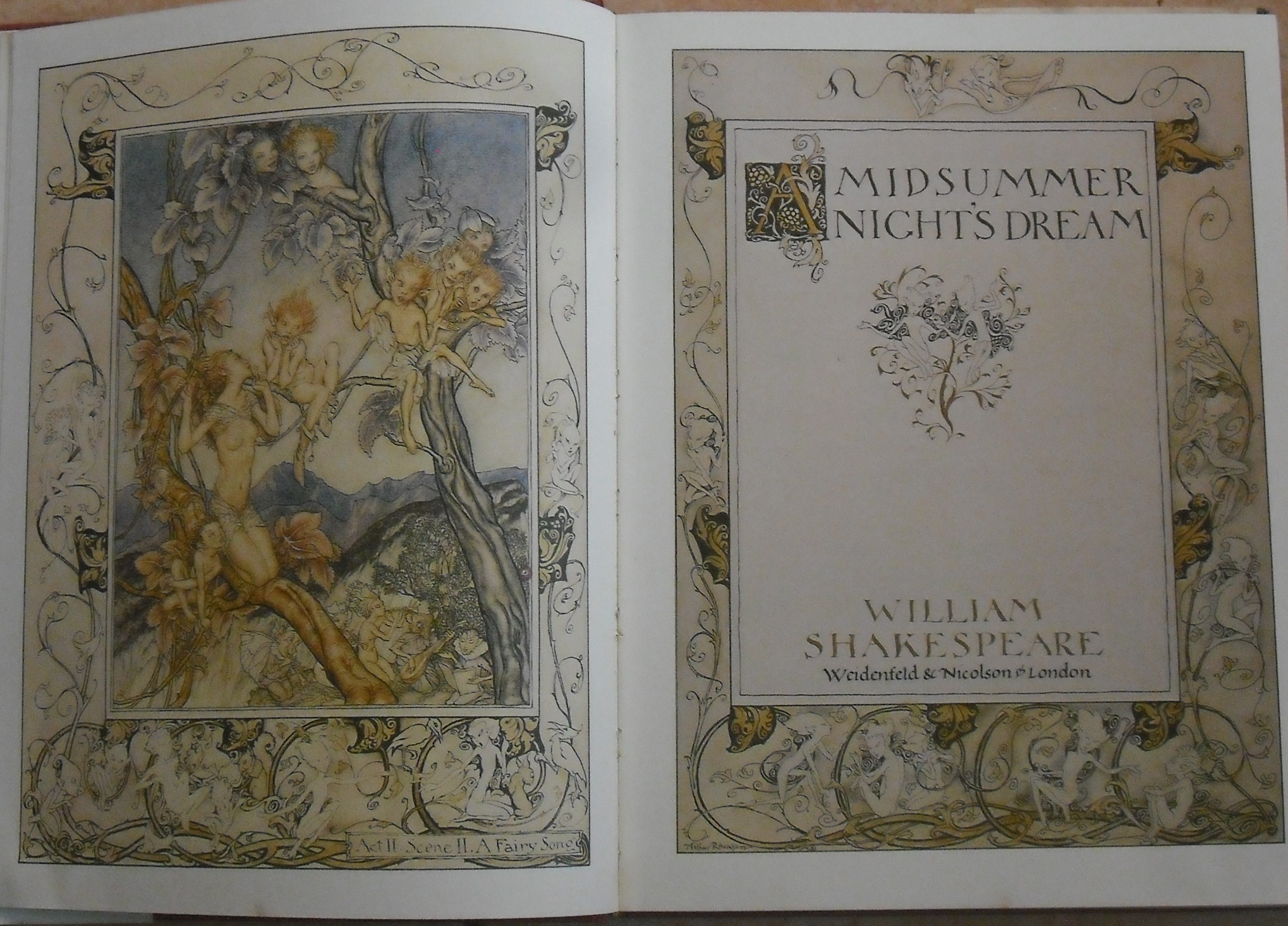
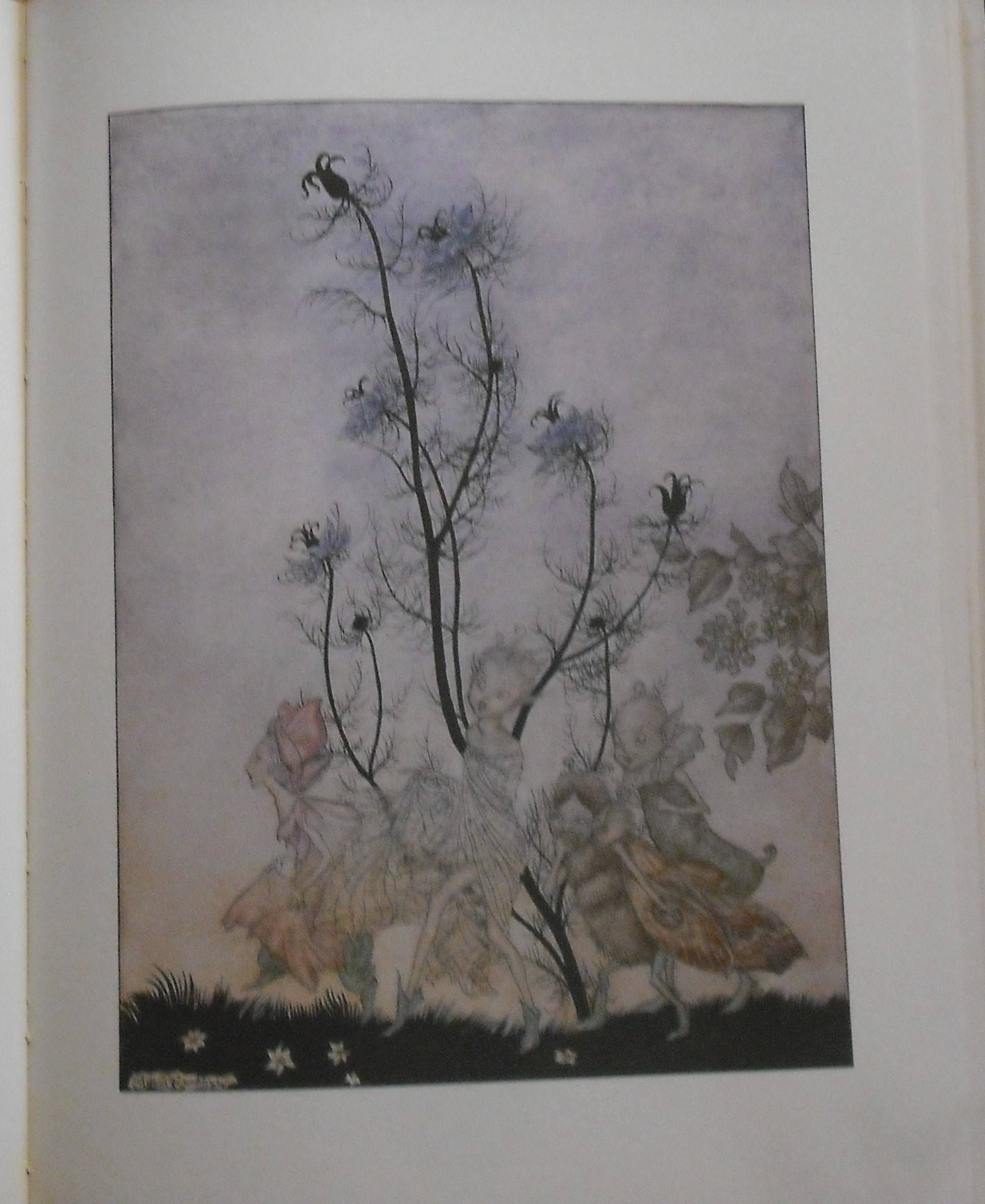
This is rather a large book to read curled up on the sofa, so resting it on a table is the best approach. The calligraphy is so beautiful to read that it adds much to the experience of reading Shakespeare’s words. Of course, re-reading while the production was still fresh in my mind was an added bonus. I am just going to indulge myself by quoting a few lines from Puck (or Robin Good-fellow) at the end of the play, to close this post.

And I will just mention that I have not forgotten my new crime theme for the blog. More of this goodly matter anon.

If we shadows have offended,
Think but this, and all is mended, –
That you have but slumbered here,
While these visions did appear.

So, good night unto you all.
Give me your hands, if we be friends,
And Robin shall restore amends. [Exit]
Groucho Marx: Detective

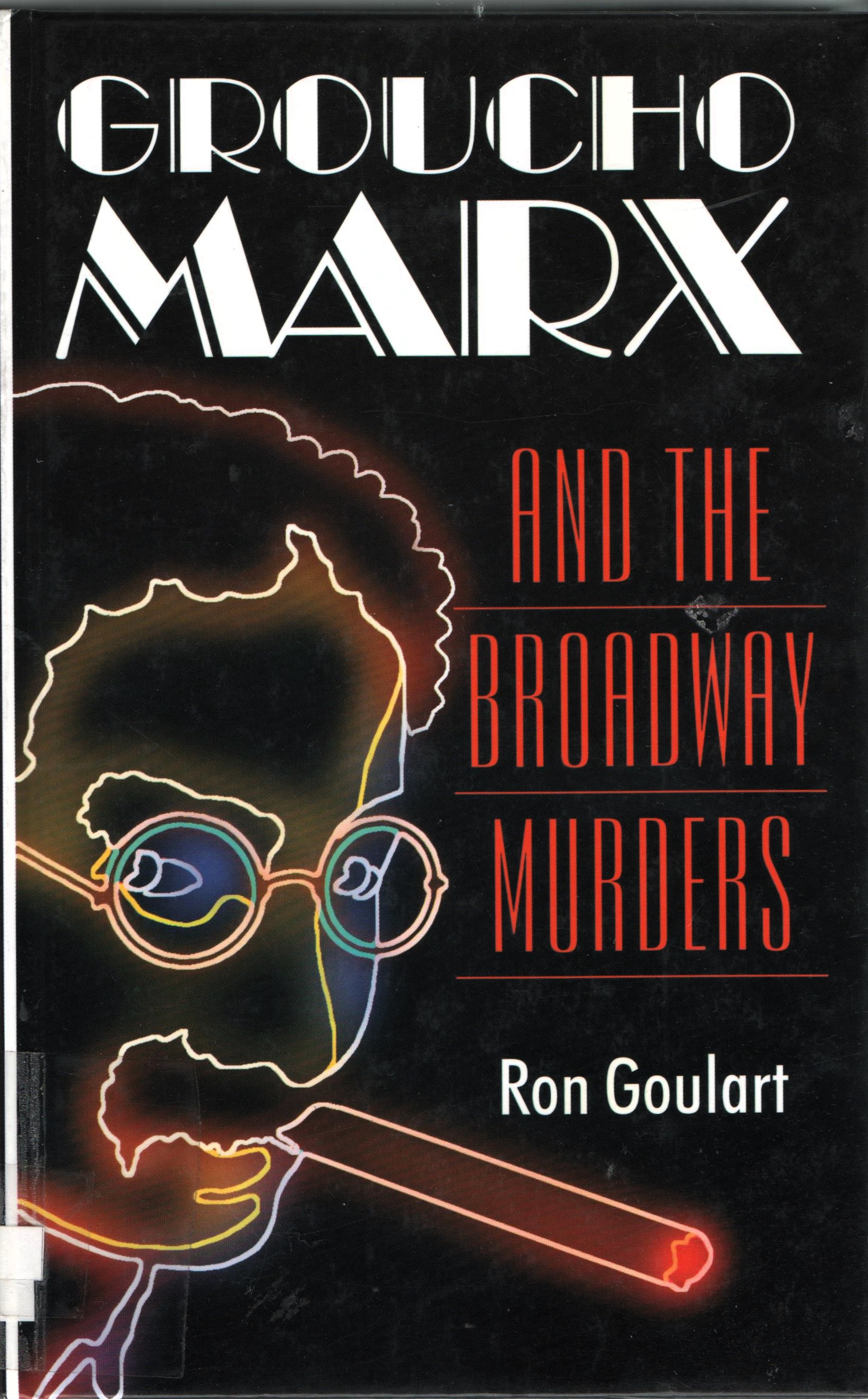
Front cover of Groucho Marx & the Broadway Murders.

Previously, dear readers, I left you to wonder who was going to be my first example of famous person as crime-solver in my new occasional blog series. I can now reveal that my eye has fallen on none other than erstwhile star of stage and film, Groucho Marx (1890-1977). The famed comedian has featured in a short series of crime novels by the American writer Ron Goulart (1933-2022). The idea of a writer using Marx as a crime buster sounded so bonkers that I just had to get hold of one or two of the novels to satisfy my curiosity. And, I have to say that the story that I did get hold of was an entertaining read and Groucho was a surprisingly plausible character. But that is skipping ahead.

In his sideline as a detective, true to literary tradition Marx has his own Dr Watson figure (who also functions as the ‘straight man’ that all comedy double acts need) in the person of crime reporter turned scriptwriter Frank Denby. Naturally there are wisecracks aplenty despite the grave task of solving murder cases:

‘We’re as good as the Thin Man, Philo Vance and Charlie Chan rolled into one,’ Groucho maintained. ‘Although why anyone would want a five-hundred-pound detective is beyond me.’

The series is a rarity in the Irish library system, but I did manage to order one of the titles, albeit in a large print version. I suppose sacrifice in the interests of research has to be made sometime. At least that meant that I didn’t need my glasses to read the book! Groucho Marx and the Broadway Murders (2001, 2002) is the fourth book in a series of six crime adventures staring Julius ‘Groucho’ Marx. At this point the Marx brothers have finished making the movie At the Circus (1939), which included the song ‘Lydia the Tattooed Lady’ performed by Groucho. He quips to Denby that the experience of hearing it might be ‘compared to Caruso in his prime.’

Original poster for the film At the Circus starring the Marx Brothers.

But to the crime details: A murdered mobster named Nick Sanantonio at first seems to have nothing to do with our intrepid duo, but his boss Vince Salermo sees things differently. He wants the guys to investigate, as he does not think that the murder was a gangland killing. This is an enticing assignment that they politely decline due to pressing engagements out of town. Both are due to head to New York, so this is true but also very convenient. Is this crime a red herring or will Sanantonio’s name crop up again?

The plot then sees Marx and Denby discovering the attempted murder of a Hollywood producer on the long-distance sleeper train from Los Angeles to Chicago. Could this be a nod to Agatha Christie’s Murder on the Orient Express? Especially as the passenger list contains more than a few members of the entertainment industry who could have a motive. The detectives are keen to investigate despite the victim and his associates not being similarly keen. Inevitably of course a murder does later occur in New York, rather dramatically during a Broadway show first night which Groucho is attending.

On first reading this novel, I did struggle to hear Groucho’s voice, as I remember it from those Saturday afternoon films on the BBC. That of course could be mere passage of time. But perhaps I am forgetting to allow for the fact that Groucho was the name of the stage persona of Julius Marx. So, the figure we are encountering in the books is really Goulart’s representation of the ‘real’ Groucho I suppose (similarly to Elizabeth MacKintosh’s Josephine Tey literary persona as interpreted by Nicola Upson). Or is that getting too confusing? Marx certainly did seem to be fond of those cigars offstage too (assuming that that is a genuine personality trait) judging from this novel. And the Groucho patter and one liners are very well done; I feel that this series must have been great fun for the author to write. But why I wonder, do authors pick unlikely characters to play detective? Is it the sheer unlikeliness that attracts perhaps? A literary challenge to make a credible detective character?

As I said above, this was an enjoyable book, though not particularly taut or thrilling, being played more for laughs. I liked the character of Groucho Marx, sometime detective, and his relationship with Denby and his cartoonist wife Jane. The historical detail is good too. I also learnt, somewhat to my surprise that Marx was a Gilbert and Sullivan fan, with a yen to play in The Mikado. As a humorous, easy read I would certainly choose another one in the series, if I could lay my hands on a library copy.

Now, I just need to come up with a fresh subject for my foray down this avenue of crime fiction. Until next time…