A Sonnet: Elizabeth Barrett Browning

Sonnet (number XLIII) by Elizabeth Barrett Browning

How do I love thee? Let me count the ways.

book jacket of Poems by Heart

To love and remember

I love thee to the depth and breadth and height
My soul can reach, when feeling out of sight
For the ends of Being and Ideal Grace.
I love thee to the level of everyday’s
Most quiet need, by sun and candlelight.
I love thee freely, as men strive for Right;
I love thee purely, as they turn from Praise.
I love thee with a passion, put to use
In my old griefs, and with my childhood’s faith.
I love thee with the love I seemed to lose
With my lost saints, – I love thee with the breath,
Smiles, tears, of all my life! – and, if God choose,
I shall but love thee better after death.

I did mention yesterday that I was thinking of choosing one of Shakespeare’s sonnet’s before opting for some verses from a play, so today I have indeed given you a sonnet. This one by Elizabeth Barrett Browning (1806-1861) was originally written in 1845 and published in 1850 as part of a collection called Sonnets from the Portuguese. I have taken the sonnet from the small but beautifully chosen anthology published by Penguin Classics (2009) and selected by Laura Barber that is pictured above. I think I bought this originally as an ideal travelling companion as it is neat enough to fit in pocket or bag.

Elizabeth Barrett had been writing and translating poetry and essays for several years before she was introduced to her future husband Robert Browning in 1845, who later persuaded her to publish her love sonnets. My first awareness of Barrett Browning had been though the story of the couple’s love affair and elopement which was set against a background of parental disapproval and Barrett Browning’s invalid status. The film The Barretts of Wimpole Street (1934 version) made a great impression on me, as Charles Laughton was so terrifying as Mr Edward Barrett. All this for me, initially overshadowed her values and achievements. She wrote in support of the anti-slavery movement (her family money came from Jamaican plantations) and also of child labour reform legislation. By the time Robert Browning asked to be introduced to her, she was a very well-known and critically acclaimed writer.

If you want to know more about Elizabeth Barrett Browning’s life and work I can recommend a biography by Margaret Forster (1989) and also Lady’s Maid (1990) in which Forster went on to explore the life of Barrett Browning’s devoted maid Lily Wilson. For something more unusual, but well worth reading try Virginia Woolf’s Flush: a biography (1933) told from the point of view of  Barrett Browning’s pet dog which was given to Elizabeth by the writer Mary Russell Mitford. Finally, I have discovered that there is a Browning Society which promotes and discusses the work of both Elizabeth Barrett and Robert Browning.


MGM poster of Norma Shearer, Frederic March and Charles Laughton

Original film poster

More tomorrow!

(Film poster taken from Wikipedia)

More Fairies: Shakespeare

My choice of Shakespeare today is in honour of the Trinity Dublin Shakespeare Festival which is being held this week from 3-8 June. I have been to a couple of events so far and hope do more by the end of the week. My original plan for today was to select a sonnet, but I decided to pursue the theme of summer instead. Here, therefore is a short magical snatch from the action in

A Midsummer Night’s Dream:

Act II (Scene I)  – A wood near Athens     

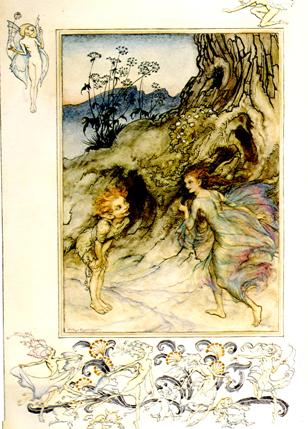
Puck and the fairy by a tree

Puck and the fairy


Enter from opposite sides, a fairy and Puck

PuckHow now, spirit, whither wander you?  

FairyOver hill, over dale
Thorough bush, thorough brier,
Over park, over pale,
Thorough flood, thorough fire,
I do wander everywhere,
 Swifter than the moony sphere;
And I serve the fairy queen,
To dew her orbs upon the green:
The cowslips tall her pensioners be;
In their gold coats spots you see,
Those be rubies, fairy favours,
In those freckles live their savours;
I must go seek some dew-drops here,
And hang a pearl in every cowslip’s ear.
Farewell, thou lob of spirits; I’ll be gone:
Our queen and all her elves come here anon.

I have had this illustrated edition for many years but sadly can’t remember where it came from, other than that I think it was probably from a book fair in the Birmingham area. That would put it around fifteen or more years ago, which is a scary thought.

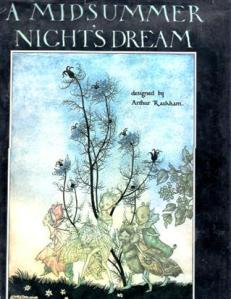
The illustrations are all by Arthur Rackham (1867-1939) and the text was written by calligrapher Graily Hewitt (1864-1952). The work was originally done in 1929 at the invitation of the Spencer Collection (New York Public Library)  This particular edition was published in 1977 by Weidenfeld and Nicolson Ltd and reproduced from the 1929 manuscript. I love Arthur Rackham’s work and maybe one day I might get to see his original drawings and watercolours. There is an Arthur Rackham Society if you want to discover more information about his work.

I hadn’t heard of Graily Hewitt before I owned this book but I have discovered that the Victoria and Albert Museum have holdings of his work. He was a very important figure in the world of calligraphy and typography and wrote The Pen and Type Design (1928) and Lettering (1930). The latter was last re-printed by Dover Publications in 1993 though it looks as if it is out of print now. This reminds me that Dover are a brilliant publisher for classic reprints and that perhaps I should do a post on their work sometime.

Apologies if the images don’t look as good as they might. I had problems scanning due to the size of the book.

Almost a week of poetry and poets so far….let me know your favourites so far!

Titania's fairies

Front of jacket


Grand Canal Dublin: Patrick Kavanagh

I shall say straightaway that you will have to overlook the mention of July in this poem when it is so clearly still June. The lovely sunny weather, so perfect for a stroll and then a quiet rest on the canal side has inspired this choice from Patrick Kavanagh (1904-1967). His was such a modest commemorative request and such a wise one, as one’s thoughts would always turn to the person named on the bench. A sure way to be remembered and perhaps also a way to be discovered by new readers.

Lines Written on a Seat on the Grand Canal, Dublin

book jacket with portrait of Kavanagh

Hardback edition, Allen Lane 2004

O commemorate me where there is water,
Canal water preferably, so stilly
 Greeny at the heart of summer. Brother
Commemorate me thus beautifully
 Where by a lock Niagarously roars
The fall for those who sit in the tremendous silence
Of mid-July […]
O commemorate me with no hero-courageous
Tomb – just a canal-bank seat for the passer-by.

As many of you will know, Kavanagh was indeed commemorated with a bench on the bank of Dublin’s Grand Canal which was set in place on the south bank in 1968. This bench was the result of a collaboration between Patrick Kavanagh’s friends and was funded by contributions from many sponsors.

I came across a website edited by Liam Brady, telling the story of the wood and granite memorial bench, which of course is not to be confused with the 1991 memorial bench by John Coll (on the north bank) featuring the bronze statue of the man himself taking his ease by the canal. A memorial gathering has been held at the original bench on St Patrick’s Day ever since 1968.

My partner (also known as He Who Put the Shelves Up) is to thank for Patrick Kavanagh’s collected edition which he bought for me a few years ago after we moved to Dublin. I haven’t read enough of the poems as I would like, but eventually I will become familiar with more of them.

I hope you liked today’s choice of verse, more tomorrow… 

Belloc’s Beasts: Cautionary Verse

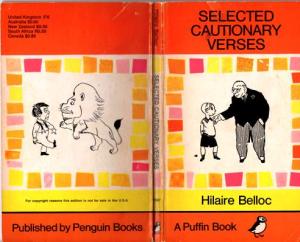
orange and yellow book jacket and poem characters

A couple of likely lads…

I know that this will be two children’s poems in a row, but I suppose that the excitement of having some sustained sunshine has addled my brain a little. In fact I’m beginning to suspect that this #PoetryinJune challenge may end up featuring rather a lot of light-hearted or comic verse. As summer is finally on the horizon, there may be just cause to steer clear of sad or tragic poetry (though that doesn’t mean I will eschew sadness completely).

Having decided on comic verse, you can’t do much better than to choose one of Hilaire Belloc’s wonderful Cautionary Verses. The problem then, was which Cautionary Verse to choose for my featured poem. After much deliberation I decided on the following. This was solely on the basis that suffering from a sore throat as I was, I rather liked the thought of it being as the result of purple and pink microbes.

The edition I have here is a selected edition (mine is a 1968 reprint) taken from the illustrated album edition published in 1940 by Gerald Duckworth & Co. I dare not even consider how much you would pay for a first edition (381 illustrations and cloth gilt cover) these days. The illustrations of Belloc’s verses are by Nicholas Bentley and B.TB. (Basil Temple Blackwood).

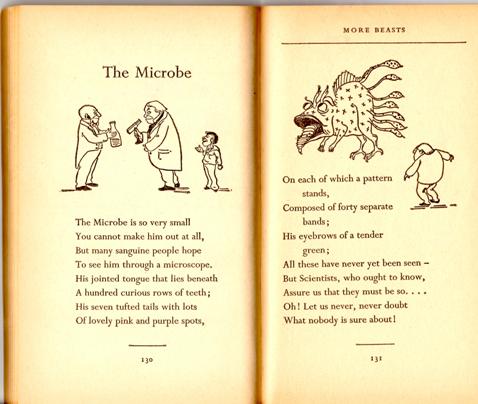
text and illustration of poem The Microbe

A jolly purple microbe…

The above poem comes from More Beasts for Worse Children which was first published in 1910 as a separate book and later included, along with Cautionary Tales for Children (1907) in the album I mentioned. The drawings for ‘The Microbe’ are from B.T.B.

Now, I will see if I can become a little more serious for tomorrow….  

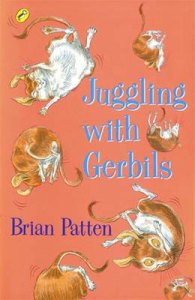
Gerbil Juggling with Brian Patten

This is a really silly verse to celebrate the June Bank Holiday (well, it’s a holiday if you happen to be in Ireland anyway). Juggling with Gerbils is the title poem of a Brian Patten collection published by Puffin Books in 2000. Illustrations (and not only of gerbils) are by Chris Riddell. Even though I have been a gerbil owner myself I still find this poem funny. And before you ask, I have never tried it myself. Honest. Patten’s collection found its way onto The Landing a few years ago via a library sale in Dundrum, Dublin and has been read many times over. I somehow doubt if we’ll ever grow too old for gerbil juggling!

Juggling with Gerbils

book jacket with seven gerbils

Do not try this at home…


Don’t juggle with a gerbil
No matter what the thrill
For gerbils when they’re juggled
Can end up feeling ill.
It makes them all bad tempered
And then they’d like to kill
Those gerbil-juggling jugglers
Juggling gerbils till they’re ill.

(Do not try this at home)

Brian Patten  was born in Liverpool in 1946 and formed the Liverpool Poets with Roger McGough and Adrian Henri in the 1960s, bringing out The Mersey Sound in 1967. His first solo collection was also published in that year, Little Johnny’s Confessions and has written extensively both for adults and children since then.

For more information here is a link to Brian Patten’s website. Now where’s that gerbil gone…

Wendy Cope

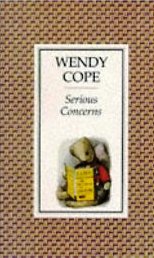
New Season by Wendy Cope (born 1945) is taken from Serious Concerns (Faber 1992) which was her second collection of verse, the first being Making Cocoa for Kingsley Amis (Faber 1986). I was given Serious Concerns by a customer when I worked in Birmingham in the late 90s and I went on to buy the first collection on the strength of reading it. Attentive readers will recall that I included one of Wendy Cope’s seasonal verses as an Advent post last year. If I was to try to sum up Cope’s work, I couldn’t do better than Dr Rowan Williams who said “Wendy Cope is without doubt the wittiest of contemporary English poets, and says a lot of extremely serious things”.

It was very difficult to make a selection from Serious Concerns, but finally I plumped for this one because it serves to remind me of life’s endless possibilities. It is something that we all probably need reminding of from time to time; I know I do. It is slightly late in the season to use this one, as the chestnuts are already in leaf, but I hope you will overlook that minor technicality.

New Season

book jacket with teddy bear

I also love the jacket..

No coats today. Buds bulge on chestnut trees,
and on the doorstep of a big, old house
a young man stands and plays his flute.

I watch the silver notes fly up
and circle in blue sky above the traffic,
travelling where they will.

And suddenly this paving-stone
midway between my front door and the bus stop
is a starting-point.

From here I can go anywhere I choose.

Of course I also just wanted an excuse to feature the Posy Simmonds drawing of the very studious bear on the front cover. I think that you will find almost as many illustrators as poets mentioned on The Landing this month. But then that can’t be a bad thing, can it?

If you liked this poem here is more information on her work from the Poetry Archive web site.

Rose Fyleman

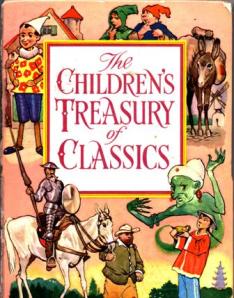
book cover with Aladdin, Pinoccio, Don Quixote

A childhood favourite

For the first of my ‘Poetry in June’ features I delved into the past –  to the Children’s Treasury of Classics that I mentioned in the last post . I have had the book (published by The Children’s Press) since I was a child, though I don’t remember if it was new when I had it. It is undated, though there is a pencilled price of 7/6 on the inside cover. The Treasury is now rather battered and the pages are yellowed.

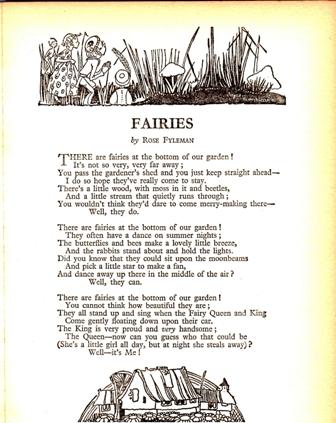
I have picked out a poem by Rose Fyleman (1877-1957) which was originally published in Punch magazine in May 1917. Fyleman published many stories and verses for children over a very productive life. Her poems still appear in children’s collections today.

There is a nice continuity for me as this poem also happens to be one of our daughter’s favourite poems. And anyway, fairies in the garden seems to me to be a nice way to begin June. I have scanned in the page since I think the illustrations (by Joyce Plumstead 1907-1986) add to the piece, so I hope the text will be legible across different platforms and browsers. Drop a comment in the box if it doesn’t work for you.


text of Rose Fylman's poem Fairies

An old favourite…

I hope you enjoy the first day’s PoetryinJune choice. See you tomorrow!

Flaming June is Poetry Month #PoetryinJune

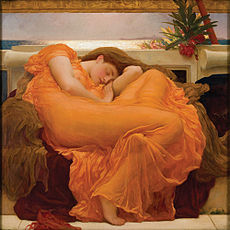
Woman in orange dress asleep on couch

Flaming June, Frederick Leighton, 1895

If you all cast your minds back to last December, you will recall that I set myself the daunting challenge of writing a seasonal posting every day during Advent. Somewhat to my surprise, I did indeed manage to do just that very thing. Ever since then I have in mind to attempt a similar challenge later in the year. Well, dear reader(s) that time has now arrived with the advent of spring (or what passes for spring in these parts at any rate).

To a great fanfare (well you’ll just have to imagine that bit) I am hereby announcing that the month of June will be Poetry Month (#PoetryinJune) on The Landing. I have been scouring the shelves here and blowing the dust off a few volumes that I have not looked at in a while. My intention is to put together a mixture of old and new(ish) poems, which will include a few childhood favourites too. My grand plan is to work out a complete list ready for June 1st but I may end up flying by the seat of my pants part of the way through the month.

I belatedly caught up with the poetry readings at the National Gallery of Ireland, which are run in association with Poetry Ireland. This has also helped to spur me into action and to include a sizeable chunk of poetry on the blog. Yesterday I was listening to Peter Sirr reading from both his own poems and his translations. One of the translations he read was Maison á Vendre (House for Sale) by André Frénaud both versions of which you can find on Sirr’s blog The Cat Flap.

I will have to apologise in advance if my choices for next month are not your choices but I will try to put together a reasonable mixture culled from our shelves. In fact, I have to come clean and admit that I never manage to read as much poetry as I would like. I am much more likely to pick up a novel or short story collection if I’m browsing and in need of something to read. Last year was supposed to be my year of reading more poetry so I picked up a couple of Faber volumes in a book sale to try and broaden my range but they are still languishing on the shelf.

Next month may then prove to be a voyage of discovery for me as there are clearly poetry books on our shelves that I have barely even opened. However, I will certainly feature a few poems from my childhood that have been read many times over and that are still enjoyed. This will, I hope even the balance a little and perhaps remind me of a time when I was more poetry minded than I am now. I used to have a Puffin collection of children’s poems and a Children’s Treasury containing stories and poetry. The latter still survives so I will choose a favourite memory from its rather battered pages for one of my blog entries.

At last Wednesday’s Poetry Ireland reading by Michael Krüger I jotted down his assertion that ‘a day without reading a poem is a lost day’. Let’s see what I can do about that during the course of next month.

Let me know about your favourites if you have time to drop me a line (use #Poetryinjune on Twitter).

(Picture Credit: Wikipedia – original painting in the Ponce Museum of Art, Puerto Rico)

Landing Author: Sam Hawksmoor

Today’s post is given over to a guest blog spot, this time featuring YA author Sam Hawksmoor. I have known Sam (in a virtual sense) since long before I ever had a Twitter persona or a blog to call my own. As well as writing teen fiction, Sam has edited a great writer’s website called Hackwriters since 1999 and he has kindly published several of my pieces on books and bookselling over the last few years.
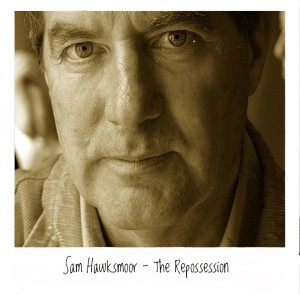
Sam HawksmoorAccording to his author website, Sam has taught creative writing, he wrote for radio and screen, travelled widely and has even done the odd bit of gold prospecting in British Colombia. All of this experience led up to  becoming a fully fledged kids’ writer, with two brilliant sci-fi thrillers  The Repossession and its sequel The Hunting being published by Hodder last year. The two main protagonists, Genie and Rian weathered many storms together and I’m sure that I’m not the only reader to hope for the ending they deserve in the final volume of their adventure. I was pleased to see that The Repossession has been shortlisted for two book awards, The Leeds Book Awards (May 2013) and the Amazing Book Awards (July 2013).

Sam has gone on to publish a time travel adventure this year, The Repercussions of Tomas D which is as yet only available as an ebook (thus challenging my technological skills). It was worth grappling with the Kindle app, to follow Tomas’ experiences as he inexplicably finds himself in the middle of World War II as Britain struggles to keep going during The Blitz. We may have fantasies about being able to time travel, but what might the consequences be if we could travel in time? Tomas and his not-exactly-girlfriend Gabriella are plunged into a whole new world as a result.

I asked Sam if he would write a piece for The Landing about how he got started writing for teens, how he chooses what to write, what approach he takes to the subjects.

In other words: The ‘Nuts and Bolts’ about writing for a YA audience:

I can say precisely when I decided to write young fiction.  It happened the very day that a friend and I were held up at gunpoint at his apartment in Hollywood.  They tied us up as they robbed everything he had.  I was only visiting, so they had nothing to steal from me.  Remember dial phones?  Try dialling 911 with the tip of your tongue.  A SWAT team arrived real fast but of course the baddies were long gone.   But that very evening I had the sudden inspiration to write The Bears You love – a girl, her robot bear, an evil relative who wanted her money and her flight into a desolate climate changed America.  That was a long time ago.  I wrote it.  Couldn’t find a single publisher who’d read it, let alone reject it.  Lot of heartache in that book, lying in a suitcase somewhere rotting.  Writing for kids wasn’t fashionable back then.  And don’t think I was an amateur just having a go.  At the time I had two adult novels in print and was working on a third.  Just the very idea of writing ‘for kids’ was not really on the radar and a tough story about mega cities of the rich surrounded by scavengers surviving by diving into the city dumpsters wasn’t ‘cute’.  ‘Completely wasting your time writing juvenile fiction.’ Said my then publisher at Sphere.
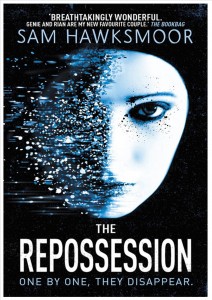
Cover of The Repossession

Every writer has tales like these.  I have a lot of ‘as yet to sell’ novels awaiting daylight.  Who’d be a writer anyway huh?  Yet, once you have the idea, you have to put it down and if you’re going to put it down you have to get the end and then… what stick it on Smashwords?   Hmmm.  After the Bear episode, I was distracted by writing screenplays.  If you think selling kids books is hard, trying getting a script made.  Yes I had a few optioned, but after knocking my head on many walls I finally realised, hell I need a real job.  A salary – a life – before it’s too late.  Nothing like teaching students to put you off writing forever it seems.  I had to begin at the bottom.  No one was interested that I had published anything, especially fiction, (which is sneered at in academic circles I discovered). Real writing was what they did for obscure academic journals peer-reviewed by similar narrow-minded obscurists and the less readable it was the higher the esteem it gained.  Anything remotely accessible was clearly garbage.   When I finally got to run something (Falmouth Post Grad) I brought my enthusiasm for children’s writing to it.

Times had changed.  Someone called J K Rowling was gaining attention.  Philip Pullman was respectable and brilliantly written.  It was OK to talk about literary values in children’s fiction, study it even.  Later I was running courses in Children’s Writing at Portsmouth University and they were massively oversubscribed.  Everyone wanted to write for kids and there was a lot of talent there (if not the necessary staying power).  I took it further into the MA that I ran there.   I decided that here I was discussing all this exciting material, but I wasn’t writing it.  My first attempt was something called Mean Tide set in Greenwich, written under a pseudonym and although it was mentored by Beverley Birch at Hodder, it didn’t get through the hoops there.  I learned something important though; keep it focussed on the kids.  My adults got a lot of equal time in that book, a mistake it seems.  I still have a fondness for it, so I put it out on Lulu as a calling card.  The Repossession and The Hunting came out of my screenwriting days.  I had been working in Vancouver at the time and a number of incidences that my wayward niece and her friends would get up to was kind of shocking to me.  How little they thought of their own safety and just how many kids disappeared and how little their families seemed to care.
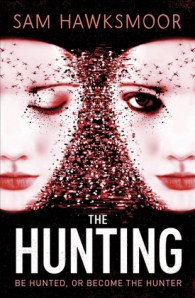
cover of The Hunting

The central character Genie is based on someone I know.  In fact I wrote it for her and she would await each chapter and give me quite harsh notes that I had to take on board.  (Yes someone really was forced to live behind bars at home when they came back from school each day – I saw it with my own eyes).  The mother was a teacher! Did it turn out all right?  No.   What happens in those two books and the concerns the kids have follows from observations and talks with Canadian teens.  The schools they go to are huge, it’s hard to stand out.  Kids work to pay bills.  It’s very different to the UK.  My nephew’s best friend was blown away – shot at point-blank range – they were just walking from a coffee shop and wham.  No reason.  Social media is like viral poison.  Huge numbers can gang up on you, destroy lives.  There is no restraint.  I don’t try to adopt their language.  Couldn’t even if I tried. It moves on too swiftly.  But issues such as love, doubt, fear, peer pressure are universal and tapping into that puts me back in my own school days.  It was harsh, yet somehow I survived – and if I could survive, then today’s kids can.  That’s how I see it.  So when I write fiction for teens I put myself in their shoes.  The world doesn’t make sense.  Yet more often than not the kids are good, ambitious, want to be something and usually the opposite of whatever is happening at home.

Is the subject difficult?  Well putting a kid through teleportation experiments isn’t pretty, especially when you know it’s not going to work.  It’s fantastical, but rooted in the tradition of experimental science.  I’m trying to keep my feet on the ground, rather than write something that couldn’t be believed.  In Repercussions of Tomas D, I’m playing with time travel.  In time stories you can spend a lot of time building a machine and all that.  But I rather liked what happened in ‘The Butterfly Effect’ and for my ‘hero’ Tomas D it’s something that happens to him, not a choice.  I like the idea too that in creating a ‘hero’ that stops the war, he automatically becomes the greatest traitor that ever lived.  The fun in writing comes with the consequences of the situations you create.  Tomas D’s girlfriend is left behind and discovers the day after Tomas disappears that she is the only person in her school who remembers that Germany didn’t win the war.

To be honest that’s the fun part of writing, inventing a new present for young Gabriella to live in.  Dealing with the past is about research. But here again I draw upon two personal experiences.  One is the beach I frequent each year in France where the German gun emplacements are still intact. 70 plus years on, there is a visible reminder of war every hundred yards or so along the French coast.  That and finding a picture of my grandfather buried up to his neck in rubble – still alive – from a German air raid on Lincolnshire.  This was the second time he had been bombed.  The first time was in 1914 when a German Zeppelin dropped a bomb on his home killing his brother and parents.  There’s a photo of him in his pyjamas standing in his bedroom with the front of the house blown off.   So for Tomas D to have this nightmare about being buried alive by German bombs  – it comes from a reality.
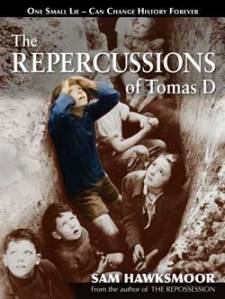
cover of The RepercussionsHow will this appeal to teens or young readers?  Hmm.  In doing my talks to schools, I am acutely aware of how little history is taught and how varied.   Increasingly the names Hitler and Churchill mean nothing (unless it is a nodding dog on TV) so the story of a boy going back in time and altering everything really only appeals to a kid who knows something about our Island story. (I should send a copy to Michael Gove).  This is why publishers increasingly are wary of publishing ‘historical fiction’ I guess.  I would argue that history – especially ‘economic’ history should be a much bigger part of curriculum’s to provide a better understanding of how society works and where it is going.  I am but a straw in the wind on this.  I am in progress on a number of works.  All YA fiction.  One survival story set again in Canada, the second in a parallel London at war with the French.  I live in hopes they will see the light of day.

I take the business of writing for kids very seriously.  Some of the best fiction ever written is I would argue for kids.  Incarceron by Catherine Fisher for example. Clever on so many levels and stretches the imagination.  Never dumbed down and it’s inspirational.  Ship Breaker by Paulo Bacigalupi one of the most vivid and yet plausible visions of our future on this planet. Hopefully one day I’ll find a way to do that myself.

Sam Hawksmoor 2013

Sam Hawksmoor … until recently was the Course Leader for the MA in Creative Writing at Portsmouth University and a similar programme in Falmouth, Cornwall. He is the joint-editor of Hackwriters.com. Sam is the author of ‘The Repossession’ and ‘The Hunting’ with Hodder Children’s Books.  Sam currently lives in windswept Lincolnshire but misses Vancouver, the mountains and the coffee bars, the setting for several of his YA novels.

Credits: author photo and bio taken from Leeds Book Awards site; other pictures from author’s own site.

V.S.Naipaul’s Family Letters

I’ve actually still not begun to read my latest Landing Eight novel due to being drawn to dipping into a volume of letters between V.S (Vido) Naipaul and his father Seepersad (addressed as ‘Pa’). The collection is entitled Letters Between a Father and Son and was first published in 1999, more than twenty years after In a Free State. The bulk of the letters in this collection were written when Naipaul left Trinidad in 1950 to take up a place at Oxford.  The volume does also contain letters written to and from Naipaul’s elder sister Kamla so the title is slightly misleading. Sadly, Seepersad died in October 1953 while Naipaul was still in England, having acquired his BA in July of that year. The collection closes with letters charting Naipaul’s first major literary success.

Letters Between a Father and Son

Family letters

As readers of this blog will know, I love reading letters and diaries so when my other half drew my attention to this collection I was happy to be distracted. In an age of email, Skype and Facebook it is hard to imagine what it must have been like to leave your family behind and travel to a completely new country and just to have to rely on weekly or fortnightly letters for news. The collection begins with letters between Vido and Kamla, as she was the first to leave home, travelling to India to study. In the first letter, Vido describes to Kamla his efforts to organise his university application photographs, not being at all satisfied with the results: ‘I had hoped to send up a striking intellectual pose to the University people, but look what they have got. And I even paid two dollars for a re-touched picture’. 

After this humorous comment, Naipaul goes on to discuss his recent reading material, earning my profound disapproval by being extremely dismissive of Jane Austen’s writing. I had previously come across a reference to a speech that Naipaul made in 2011 in which he claimed that women writers (Austen included) were not the equal of men (and certainly not equal to him). This opinion clearly goes back some years as he seemed to have formed it at the tender age of seventeen and never revised it, saying then, ‘if she had lived in our age she would undoubtedly have been a leading contributor to the women’s papers’.  Rather damming I must say, though I assume he meant that at the very least, Austen would have written for a superior sort of women’s paper since even he admitted that ‘her diction was fine, of course’.

I have read contradictory opinions on Naipaul’s character, beliefs and attitudes as well as references to a whole slew of literary spats. If that’s not enough, you can also become embroiled in the question of his behaviour towards women.Without being familiar with his novels, non-fiction or life story, I’m not yet in a position to offer any comment other than to reflect upon what I have gleaned from the letters. Having reached the point at which Vido is a year or so into his studies, I’ve become much more attracted to Seepersad’s personality, both as a person and as a father offering help and advice. Seepersad at this point is working for the Trinidad Guardian and regularly offers wise advice on writing, studying and coping with life at Oxford, ‘Sometimes in our very loneliness you will produce that which will be something new and which you otherwise could not produce. Spot your drones and microbes among your fellow-creatures, but do not let them put you out of your centre [….] meanwhile be a man and cringe to none’.

I was intending merely to skim this collection of letters, but I have found myself reading on and following Naipaul’s early career as well as Kamla’s experiences in India and those of various family members who regularly pop up in the correspondence. I would like to know more about their mother, Droapatie Capildeo but so far, having reached January 1952 she remains (though clearly loved) very much a secondary figure. In one letter to Kamla in 1951, Vido writes ‘She is worthy of all we can give. We oughtn’t to disappoint her. She is the type who suffers in silence, poor dear! I love her; but who has shaped my live [sic], my views, my tastes? Pa.’ This sentiment seems rather sad, loving with faint praise, as it were. But maybe the picture will change further on. Perhaps the letters will shed also some light upon his views of the opposite sex in general. I will read on.

Meanwhile, as a Naipaul novice I would be interested in your thoughts. Till next time…