The Birmingham Art Book

In this post, I’m featuring a new resident on the Landing Book Shelves, a Christmas gift no less. The book is the Birmingham Art Book: The City Through the Eyes of its Artists edited by Emma Bennett (who also created the cover art and wrote the preface). Joe Lycett has contributed a foreword, setting the tone for the book by declaring, ‘Birmingham, as I’m sure you’re aware, is the best city in the world. And the art here is the best in the world too.’

Front cover of The Birmingham Art Book, showing an image of the Council House by Emma Bennett

This book is the seventh title in a series of city art books published by UIT Cambridge Ltd. I hadn’t come across this series before, but I notice that Dublin and Edinburgh are included, so I might have to explore further. If you remember, I did a post some while ago about the Silent Traveller in Edinburgh, so I am following a favourite city theme here. It could build into a whole new sub-collection (as if I needed another one).

The Birmingham Art Book features the work of sixty-one artists, some having more than one piece included creating a collection of wonderful images of the city. The views included here are depicted in a wide range of styles and media, giving the collection a very vibrant feel. It’s a book for dipping into over and over again as each time you browse the images, another detail from the Birmingham landscape is revealed. I’m a Brummie born and bred and despite having moved away years ago, I do go back to visit regularly. This book is a lovely souvenir to have, a reminder of all the myriad buildings, parks and features that make up the city. It’s also a very nice addition to my Brummie collection. I haven’t added to it since buying This is Not Your Final Form, a poetry collection from Emma Press.

Back cover of the Birmingham Art Book, showing some images from the book and other titles in the series.

But of course, I never get chance to mooch around the city as much as I would like. I therefore found that the book’s city depictions had a huge nostalgia value for me. I kept spotting things that made me exclaim, ‘Ooh, I remember that!’ However, I have also been scratching my head at other images, not being quite able to place something that I feel I ought to remember. I’m also reminded of places that I haven’t re-visited in ages, such as the Barber Institute and the Electric Cinema.  

It is nice to see that the suburbs get a look in too. More nostalgia here; Cadbury’s, Kings Heath, Moseley and Cannon Hill Park. There are so many great images in this collection that it would be hard to pick out a shortlist of favourites. I will just name check a few though I could easily end up listing the entire contents:

  • I smiled at the close-up depiction of the gargoyles on St Martin’s Church looking with what seems to be an expression of amazement at the Selfridges Building (Graham Leonard King).  
  • Robert Geoghegan’s picture of Cannon Hill Park full of Canada Geese. The tagline on the painting reads: ‘Today:Cannon Hill Park. Tomorrow: The World’. I also like his portrait of ‘Old Joe’ at the University of Birmingham, The Owl and the Clocktower. I love the owl!
  • Alexander Edwards (Brumhaus) has a graphic-style view of the Jewellery Quarter, especially pleasing to me, as I was around that area for the first time in ages before Christmas.
  • I include in my picks a couple of city centre views, as I was busy spotting buildings that I recognised: Bird’s Eye New Street by Chris Eckersley and Memories of Birmingham by Martin Stuart Moore.
  • And finally, a mention for the travel poster/Art Deco inspired peices by Milan Topalović. The view of China Town is gorgeous.
  • And finally, finally let’s not forget the differing depictions of the Library of Birmingham, the Rotunda, the canal scenes, the Floozie in the Jacuzzi, The Bull and the Grand Central.

Highly recommended to Brummies past and present! Go out and buy one (and no, I’m not on commission).
The Benefactress by Elizabeth von Arnim

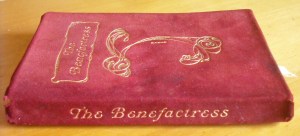
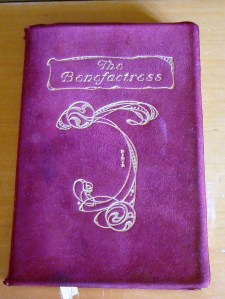
The Benefactress front cover showing gilded title & decoration

The Benefactress

I have been searching around on The Landing to find ideas for a new series of blog posts. Obviously, at this stage my projected spring Renaissance has turned into a pre-Christmas Renaissance. So here goes…

As I was scouring the shelves, I once again realised that we have a nice selection of older books, quirky titles and interesting finds. Some of these are books for dipping into merely, others for a straightforward read. In the latter category I have picked out a book that I acquired many years ago and I am ashamed to say, that I have not got around to reading before now. This is a lovely 1911 pocket-sized edition of The Benefactress by Elizabeth von Arnim.

For the sake of the honour of The Landing I decided that it was about time to remedy the omission and read The Benefactress. The snag with reading something so old (and to me rather precious) is that I felt that I dare not just shove it in my bag to read at lunchtime. And as for my fondness for reading in the bath…well some things are just not very wise. Not that I have actually yet dropped a book in the bath (maybe dipped the odd corner here and there) but there’s always a first time. Reading an older book does give a different quality of experience, due to the touch and feel of the book. I’ll just say a few words about this edition before telling a little about The Benefactress for those of you who don’t know the story.

This little book goes back to my Birmingham days, so I’ve had it for well over twenty years, but sadly I can’t remember what book fair or shop this volume came from. Its cover is very similar to that of a poetry chapbook that I have mentioned in a previous post, a sort of suede like texture but I don’t think it is actually leather. Maybe someday I will take it to an expert who will be able to tell me something about the material and how best to care for it (I may have mentioned before that dusting is not my strong suit). I love the elegant gilt swirl of the cover design, which is echoed on the end papers. Unfortunately, the ribbon marker has seen better days, but I still keep it out of a sense of completeness. The page edges have browned with age and there is gilt on the top edges but not the others. I don’t think it’s rubbed off; rather it looks as if they were never gilded in the first place. Judging from the publishing details this edition was published by MacMillan as part of its 7d series (1911), with the first edition being 1901.

But now to the story: The lovely and charming Anna Lestcourt is twenty-five when the story opens and should be full of all of the optimism of youth. However, Anna is financially dependent upon her rich sister-in-law (wife to her brother Sir Peter), a former Miss Susie Dobbs of Birmingham. As was not unusual at the time, there was a trading of new money for an ancient name and family home. All of this leaves Anna on Susie’s hands to marry off successfully, but so far to no avail. Anna remains resolutely unmarried, but not for the want of trying on Susie’s part. Anna’s fortunes take a turn for the better when her late mother’s brother comes on a visit from Germany and takes a liking to his niece. Subsequently he bequeaths her one of his estates, along with its income, which he hopes will secure her a good German husband.  Anna, however has other ideas, not being much sold on the good German husband idea. She forms the plan of opening up her new abode to several distressed gentlewomen, (who would live at her expense) much to Susie’s bafflement. Once in Germany, Anna makes the acquaintance of her new overseer, the local pastor and her nearest neighbour, Axel Lohm, with mixed results. Perhaps not surprisingly, the plan to fulfil the role of a benefactress does not go entirely according to plan, but I won’t plot spoil. Suffice to say that human nature will out. I will leave you to discover whether or not the marriage to a GGH comes to pass.

As I was reading the first part of the book, I found myself developing a certain sympathy for Anna’s sister-in-law Susie. Now this may have been a case of Brummie lasses sticking together, but I felt aggrieved on her behalf as Von Arnim portrayed her in a definitely unflattering light:

And the Dobbses were one and all singularly unattractive—a race of eager, restless, wiry little men and women, anxious to get as much as they could, and keep it as long as they could, a family succeeding in gathering a good deal of money together in one place, and failing entirely in the art of making friends.

Clearly, one could not come from the mercantile classes in Birmingham and be in any way cultured, socially adept or indeed philosophical (her husband was a philosopher). At the same time of course, her money came in very useful to save the aristocratic Lestcourt family from penury and to restore the family pile. Naturally too, Anna deplored Susie’s vulgar taste in furnishings. Thankfully Von Arnim did give Susie the occasional good line, “Really,” added Susie, twitching her shoulder, “you might remember that it isn’t all roses for me either, trying to get someone else’s daughter married.”

And she has a point; who would want to be trying to marry off a sister-in-law who doesn’t even want to be co-operative. It must have been particularly galling for Susie, since it was Anna who had all of the social cachet that she lacked.

Anna Lestcourt is however a far from heartless girl, who does come to understand that Susie’s position is not a happy one, seeing as she does that, ‘No one cared for her in the very least. She had hundreds of acquaintances, who would eat her dinners and go away and poke fun at her, but not a single friend.’ Yet at the same time, Anna resents been required to do the one thing that that might bring some cheer into Susie’s lonely life. Poor Susie would have loved a wedding to plan for and access to all of those elite hostesses who have so far snubbed her efforts.Front cover & spine showing gilded title & decoration

In The Benefactress, Von Arnim has given us a fascinating mix of characters with decidedly mixed moral standards, from whom Anna learns much in the course of her social experiment. It’s a long time since I read any von Arnim books, the most recent being The Solitary Summer, read a couple of years ago and this is a very different read. I did enjoy the story, possibly enhanced by the delights of finally reading my delightful little edition (despite my misgivings about Von Armin’s rather cruel characterisation of Brummie Susie) and I will no doubt read it again in about twenty years.

I’m not going to promise another blog post soon, though I will try to get back on track. But in the meantime, happy reading!

This is Not Your Final Form: Emma Press

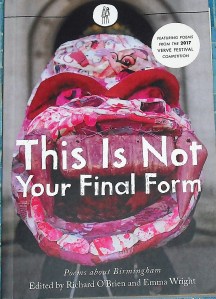
Cover of This is Not Your Final Form For this post I am having a change of direction and featuring a poetry book as I have not done so for a quite a while (sadly remiss of me). The collection This is Not Your Final Form (edited by Richard O’Brien and Emma Wright) is comprised of entrants and winners from the Birmingham based 2017 Verve Festival Poetry Competition. This book isn’t a long term Landing Book Shelves item as it only took up residence on my bedside table a few months ago and I did start reading it straightaway. I was browsing on the Emma Press website and as a Brummagem lass now based in Dublin, this collection was too tempting to pass up, so dear reader, I bought a copy. The back-cover blurb says this is ‘a tough, unsentimental love letter to the Midlands metropolis, which finds beauty in concrete and unity in contradiction’. And there is certainly a lot of concrete in Birmingham to inspire conflicting emotions, especially as Birmingham never seems to achieve its ‘final form’. I suspect it never will.

Canals and stories

There are so many poems that I like in this anthology, that it is difficult to know what to feature in a short article such as this. I am simply going to pull out a few themes from the collection that particularly resonated with me, starting with that old saying about Birmingham having more canals than Venice. I think that one cropped up in three poems altogether. Here’s an extract from ‘Birmingham – some advice’ by Rob Walton which amused me, as it suggested that we should change the saying to better attract tourists to Birmingham:

Seems you have ‘more canals than Venice’,
but surely ‘more canals than roads’ would be more impressive.
And wetter. Which could lead to more souvenir towel sales.
I got soaked in Birmingham! How about you?

I like the sound of the idea, but would it work I wonder? Let’s have your tea towel designs on a postcard please! Kibriya Mehrban’s poem takes as its title ‘More Canals than Venice’ and links the man-made waterways of Birmingham with rivers, tears and the currents that brought her family to Birmingham from Kashmir:

We were washed into this world,
soaking it with our colour.
Some stood, splattered, scandalised,
while others called us sisters and brothers,
offered us cloud cover.

When my grandfather first saw a girl in a hijab
working at the local post office,
he cried this city a river.

Mehrban’s poem tells us her family’s story though different generations and experiences. How they found a home in Birmingham despite the hostility of some people. This collection serves to remind us that Birmingham has been the scene of many family stories, some sad, some happy, during its long history. Birmingham also played a crucial role in the story of the modern nation. Rishi Dastidar’s lines say it all:

The middle is where the future started –
our modern world was invented here.
Minds, steam, capital met in manner uncharted –
the middle is where the future started.

An unsolved mystery

Continuing with the theme of story, what place would be complete without at least one unsolved mystery? The one featured in this collection was somewhat macabre and has proved endlessly fascinating to later generations as this poem proves. ‘Who put Bella in the Wych Elm Tree?’ by Helen Rehman is about a 1940s murder that remains unsolved to this day. In 1943, four boys were poaching in Hagley Wood when they discovered a skeleton, later found to be that of a female, hidden within a tree trunk. To cut a long story short, there have been many theories and stories around the discovery. These were partly fuelled by the appearance of graffiti that gave a possible name to the dead woman. The poem title references one version of the provocative question, which appeared on locations around the Midlands after the remains were found.

As the last verse tells it, time has moved on, the remains can no longer be located and the mystery endures:

The skeleton’s mislaid, the experts can’t agree,
the boys are grown and gone and lost to history;
she haunts the city’s dreams and grows a mystery.
I wonder who put Bella in the wych elm tree.

Brummie-isms

I move onto what is possibly my favourite poem in the book as it references some of the Brummie expressions that I grew up with and still fondly remember. The strange thing about local quirks of language is that you accept them while young and it never occurs to you to ask where/why/how these expressions came about. Here’s a snippet from ‘Never in a rain of pig’s pudding’ by Jill Munro:

You can take the girl out of Brummagem,
let her leave behind old Winson Street.
dress her in some bostin Southern glad rags,
marry her to a yampy Cockney with some ackers

But don’t throw this babby out with the bathwater,
for so long as it’s a bit black over Bill’s mother’s
you’ll never take the Brummagem out of the girl –
even way down south, she’ll always be Our Kid.

I like the last line, it reminds me of my uncle calling my dad ‘Our Kid’ even though dad was the eldest brother. If anyone wants an explanation of some of the terms in the verses quoted, there is a handy guide on the Birmingham Live website, giving you fifty Brummie and Black Country words and phrases to chew over. Not all the phrases given necessarily originated in or are exclusive to Brum as language travels as people move around the country.

I’m going to finish with my own contribution to the topic of language with one of my Paragraph Planet pieces from 2016, with some of my Brummagem memories.

Hepserus: a 75 word piece from Paragraph Planet

I’ll just note that whereas Jill Munro’s poem has ‘faces as long as Livery Street’, I grew up with ‘arms as long as…’. Which just goes to show the adaptability of the local lingo.

That’s it for now and I hope it won’t be too long before I dig another poetry book out of the Landing Book Shelves!  

A Pre-Raphaelite Summer (Reading part 2)

As you will probably have guessed, this art-themed post is to be the second part of my belated round up of summer reading. Very belated, considering that Halloween is upon us as I write. Again, I propose a quick nod to three more of the books on my recently accomplished list, but just drop me a line if you want a little more information on anything. This blog post fails to do justice to some fascinating books, but I hope that at least by mentioning them, the inspiration to explore further may strike someone reading the post. I still want to mention the remainder of the summer reads, but I will pop those in here as and when I can, so that I may begin writing about my autumn reading (at this rate I will never catch up!)

To continue with the list in reading order (which again is also following a roughly chronological trajectory) I begin with Desperate Romantics: the Private Lives of the Pre-Raphaelites (Franny Moyle, John Murray, 2009). This I bought in 2009, having heard of, but not watched the television series loosely based on the book. I was curious to read it after having heard about the rollicking television series, but clearly my curiosity faded, as the book remained un-read until this year. I am glad however that finally I got around to reading Moyle’s book, which draws on the wealth of research available on the Pre-Raphaelite Brotherhood (PRB). She explores the tangled relationships of Dante Gabriel Rossetti, William Holman Hunt, John Everett Millais and their models, wives, lovers and artistic colleagues. The champion of Pre-Raphaelitism, John Ruskin; Rossetti’s one time teacher Ford Maddox Brown and later PRB members William Morris and Edward Burne-Jones all have parts in the painterly drama.

Desperate Romantics inspired a re-read of Lizzie Siddal: the Tragedy of a Pre-Raphaelite Supermodel (Lucinda Hawksley, Andre Deutsch, 2004, 2005). This is an excellent account of Lizzie Siddal’s life, but I think the subtitle was an unfortunate choice. As Hawksley makes clear, Siddal had her own artistic ambitions, both as a painter and a poet and was not merely Dante Rossetti’s model (and lover). Not surprisingly, the book jacket features Lizzie Siddal’s most famous modelling role, that of Ophelia for Millais’ painting of that name. However, Lizzie had ambitions for herself and renowned critic John Ruskin considered Lizzie talented enough to become her patron. I knew that Lizzie Siddal had painted (see below) but I had had no idea that she wrote too. Apparently, the poetic bent was not enough to endear Siddal to Dante’s poet sister Christina Rossetti who saw nothing to admire in her and disapproved of her relationship with Dante.

Ending my Pre-Raphaelite binge was Pre-Raphaelite Women Artists (Jan Marsh and Pamela Gerrish Nunn, Thames and Hudson, 1998). Manchester City Art Galleries originally published this book in 1997 to accompany its exhibition, which I saw in 1998 when it travelled to Birmingham Museum and Art Gallery. Some of Lizzie Siddal’s work was on show at the exhibition, such as Pippa Passes (pen and ink drawing) and Lady Clare (watercolour on paper). For some reason I never bought the catalogue at the time so I was delighted to receive this copy as a Christmas present last year. Both the exhibition and the book highlighted women whose work was part of the wider Pre-Raphaelite tradition. As was pointed out in the book, Pre-Raphaelitism was a collegiate movement and female artists were able to benefit from support between men and women (Pamela Gerrish Nunn). Perhaps not surprisingly, several women featured came from artistic families and were able to count on that support to aid their artistic growth. Ford Maddox Brown’s two daughters Lucy and Catherine painted, taught by their father. Also coming from artistic families were Rebecca Solomon, Rosa Brett and Emma Sandys all of whom had brothers who became professional painters.

It was great to re-discover this book and to browse the artworks again. I will leave you with a sentence from Gerrish Nunn’s essay, which sums up for me the whole purpose of the exhibition and catalogue:

Woman – the object, icon, motif and motive of whom and from whom Pre-Raphaelitism is said to have been made – has perversely, masked the presence within the movement of women – active, executive autonomous subjects making Pre-Raphaelitism.

I hope you have enjoyed that snapshot of my Pre-Raphaelite summer reading. Do let me know if you have an interest in this area. I’d love to hear from you!

A Library Digression

Early Harborne Libary

An old print of Harborne Library

With all of the debate about the future of libraries going on after huge service cuts in Britain, (though Ed Vaizey says it’s not as bad as we think it is!) I have been casting my mind back to my own experiences of public libraries. First as a child and later, as a parent, I have always taken libraries for granted. I cannot remember a time when I did not have a library ticket for a library, often for more if you count academic libraries. As any reader of this blog knows, I regularly sneak library reads into my TBR Pile schedule. At present, I hold tickets for Dublin City and DLR County Council libraries, which gives me oodles of possibilities. I also often take advantage of the new (ish) online Libraries Ireland portal for reserving books at no extra cost. In short, I love libraries, whether in Britain or Ireland, and still use them a great deal. It’s a pity that Ed Vaizey has no real grasp of what libraries can and do mean to many people.

My library love affair began many years ago, growing up in Birmingham. My mum registered me at our local library when I was pre-school age; and in turn, our daughter had her own library ticket before she could even read, from Hereford library. I grew up with a library routine that saw us exchanging our books every Saturday morning. As teenager, I used to take my younger sisters for the regular Saturday library trip, borrowing endless (or so it seemed to me) Topsy and Tim adventures every week. Amongst my own reading then was Agatha Christie, Conan Doyle and Georgette Heyer. I was a big fan of RJ Unstead’s history books and Henry Treece’s adventures of ancient Britain. And let’s not forget my teenage swashbuckling hero, the Scarlet Pimpernel rescuing the innocent (and of course les aristos were always simply misunderstood) from Mademoiselle Guillotine. I do occasionally ponder on how many books I would never have read, had I not had ready access to a library. We always had books for Christmas and birthdays, but with four children, there was always going to be a limit on book buying. As I grew older, I saved up pocket money to buy paperbacks, but they were more than likely books by authors whom I had first discovered in the library.

Harborne Libary

Harborne Library

The earliest library I remember was an old building, a former Masonic Hall, in Harborne High Street. The library steps were where I remember waiting to see Father Christmas drive past in his sleigh one chilly December evening (no November appearances in those days). The children’s section was a treasure trove of books, up an imposing flight of stairs with a curving banister. Funnily enough, it looked much larger when I was a child. Also upstairs was the Reading Room, a mysterious chamber only accessible to grownups. Alas, I discovered on a recent visit that it no longer exists so I never managed to penetrate its solemn interior. The adult section was downstairs, all dark wood shelving and creaking floors. At that time, library cards were still just the brown cardboard variety. I think we had four cards each (I seem to recall that children’s cards were blue) so that was all the books you could borrow. When you took out a book, the librarian took the coloured slip from a pocket inside the front cover and tucked it inside one of your library tickets, which was then filed until your return visit. The plastic bar-coded cards simply don’t have the same magic about them.

Quinton Library

Quinton Library

When we moved house to a different suburb of Birmingham, we also moved to a new library. Quinton library was awaiting re-development. In consequence, we spent time choosing books in a dingy temporary building while all the exciting work went on next door. What finally emerged from the rubble was a shiny new library and community centre with more glass than walls and big comfortable sofas. In my memory, the overriding impression is that of a large space filled with books and bright orange furniture, but I may be mistaken about the colour. In sum, I remember it as very 70s in its bright and breezy welcoming style. All apart from the head librarian, who was a very scary woman and not at all welcoming in manner (well, not to children anyway). The mystery was that she didn’t look as though she ought to be terrifying, not being an archetypical ancient custodian of the books, but a comparatively young woman. She obviously didn’t really want to be lending the books, or at least not to children!

Despite the best efforts of the intimidating head librarian, I loved going to the library and devoured my regular quota of books. For quite a few years, I cherished a dream of becoming a librarian after leaving school. When I was younger, I even created my own library cards and made tickets to stick in my own books. In the fifth form, I went along to a careers advice talk and was sure of my vocation to be a librarian. At some point however, I abandoned that dream and settled for being a lifelong library user instead.

I suppose I should get back to the TBR Pile now…

Picture Credits: http://www.libraryofbirmingham.com/ – with thanks