Advent Reading Challenge: Tolkien Letters

3rd December

A christmas Classic..

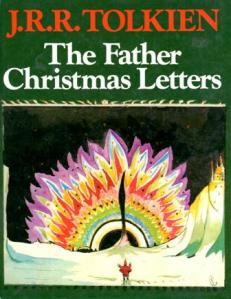
The Father Christmas Letters

The Father Christmas Letters by JRR Tolkien, edited by Baillie Tolkien (George Allen & Unwin Ltd, 1976). I have had this book for many years, though it was not bought new. Within its pages lurks a newspaper cutting on a new edition of Tolkien’s book from The Birmingham Post 23rd December 1995. I never did get around to buying a newer edition of The Father Christmas Letters

Tolkien wrote the first letter to his children in 1920, and for over twenty years continued to regale them with the goings-on at the North Pole. Father Christmas’ main helper was the Polar Bear, along with an assorted cast of characters including the bear’s nephews Paksu and Valkotukka.

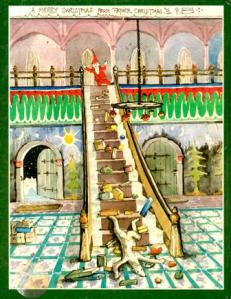
This is such a wonderful book that it was difficult to select a passage to quote here. I was about to resort to the time honoured tactic of letting the book fall open and picking a piece at random, when my daughter pointed out that it would be a good idea to choose the piece that featured on the back cover. Tolkien’s illustration captures the poor old Polar Bear’s accident beautifully. Parcels scattered down the stairs, Polar Bear sprawled at the foot and a rather vexed Father Christmas at the head of the stairs.

Polar Bear falling down the stairs

Polar Bear’s accident – one of Tolkien’s brilliant illustrations

Thursday December 20th 1928

‘What do you think the poor dear old bear has been and done this time?…Only fell from from top to bottom of the main stairs on Thursday! We were beginning to get the first lot of parcels down out of the store-rooms into the hall. Polar Bear would inist on taking an enormous pile on his head as well as lots in his arms. Bang Rumble Clatter Crash! awful moanings and groanings:

Never fear, it all turned out right in the end!

Advent Reading Challenge: Christmas Pudding

2nd December

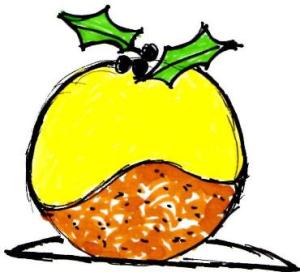
A rather rotund pudding...

A rather rotund pudding…

Pudding Charms, a seasonal poem  by Charlotte Druitt Cole

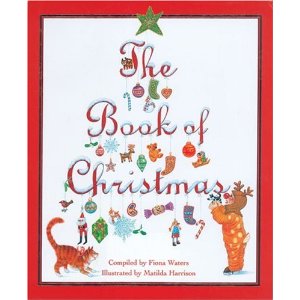
I found this poem in a children’s poetry collection The Book of Christmas, complied by Fiona Waters and illustrated by Matilda Harrison (Chrysalis Chilidren’s Books, 2004).

The Book of Christmas a was a gift to my daughter from my parents in 2007.  I hadn’t come across it before, but it has become a mainstay of our Christmas reading. Fiona Waters’ book is a wonderful collection of seasonal poems and stories and Matilda Harrison’s accompanying drawings are bright and lively.

I hope to feature one or two more poems from the compilation later in the month. Food is such an important part of the festive season, particularly Christmas pudding that I thought I should give over enough space to mouth watering goodies. Just the thought of all that sugar, spice and candied peel being mixed up ready for cooking. Druitt Cole also mentions the traditional charms that go into the pudding…a little bit of magic.

Here is a snatch from Charlotte Druitt Cole’s Pudding Charms:

Currants and raisins, and sugar and spice,

Orange peel, lemon peel – everything nice

Mixed up together, and put in a pan.

And out of her pocket a thimble she drew,

A button of silver, a silver horse – shoe,

And, whisp’ring a charm in the pudding pan popped them,

Then flew up the chimney directly she dropped them.

Hope you like today’s food related piece – edibles will surely feature again…

(illusration Chris Mills, 2012)

Christmas on the Landing: Advent Announcement

It can hardly have escaped anyone’s attention that we are edging ever closer to a certain celebratory time of the year, though I refuse to pay too much attention to the ‘x days shopping days left’ kind of pressure. Anyway, working in retail as I do it tends to be other people’s shopping that occupies most of my efforts during December. Christmas-itis generally strikes me at about halfway through the month and I just want to run away screaming. I generally just about manage to get around to my own purchases before the close of play on Christmas Eve.

The Book of Christmas

The Book of Christmas

Bearing all of that in mind, I have decided to devote December on the Landing Book Shelves to a seasonal Literary Challenge in an attempt to induce calmness. After much prowling of the bookshelves with a thoughtfully furrowed brow, I have come up with the (possibly not very original) idea of putting a Landing related Advent Calendar/Advent Reading Challenge together. I have compiled a list of Christmas poems and episodes in fiction and plan to post a mini blog each day in Advent.

My inner child has carried me away a little so this Advent Challenge feature will be entirely composed of snippets from children’s books lurking on our shelves. I have to admit to stretching the notion of Landing Book Shelves just a tad, as some of the Yuletide goodies live in either the loft or my daughter’s bookshelves. But I hope you will overlook that minor fudge in the cause of Christmastide.

I should point out however, that you will have to improvise a little for yourselves. My technological skills are not up to creating opening virtual doors so you will simply have to pretend. Of course if you follow this blog, then opening your email will, I feel, simulate the door opening bit quite satisfactorily. Each day should bring to you a seasonal literary morsel with a suitable illustration by way of accompaniment.  Well, that is the plan (and the challenge) anyway so fingers crossed that it all works out successfully.

Keep checking back during December to see what you find…(apologies in advance for the lack of chocolate in the Landing Advent Challenge Calendar).

A Tale of Four Sisters: revisiting Little Women

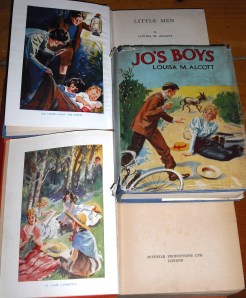
colour illustrations of the March sisters

The March family

A few posts ago, I mentioned that I had bought a biography of Louisa May Alcott at the Trinity College Book Sale. This book by Martha Saxton conveniently ties in with my Landing Project since Alcott’s best-known novel Little Women and its sequels are residents on the landing. Little Women was written in 1868 and Good Wives, the second volume in 1869. Both stories were published together in 1880 as Little Women. Alcott continued the saga in Little Men (1871) and Jo’s Boys (1886). Sadly, none of my volumes dates from that early on so they have no financial value. I think I bought all of them in second bookshops several years ago to replace my original childhood copies. They are from a series called Juvenile Library and all have a colour plate in the front depicting the characters. Only Jo’s Boys still retains its illustrated dust jacket. As you can (just) see from the photograph the girls are depicted as rather more glamorous than is consistent with the novels.

In common with so many other teenagers, I read and loved Little Women and I am sure that I was not the only one to identify with and be inspired by, the lively, tomboyish character of Jo March. In sharp contrast, Meg was too good and youngest sister Amy was too fine and fussy. Poor saintly Beth died after illness and decline, which would not have inspired anyone a great deal. I also remember being deeply disappointed that Jo eventually married Professor Bhaer instead of Laurie, the wealthy boy next door. I wanted fun, romance and frivolity but got practicality and companionship instead.

It is strange to pick up an old childhood favourite to re-read and then perhaps to revise long held memories of a cherished book. I started to read the opening chapters of Little Women, revisiting the March sisters as they prepare for their Christmas festivities. After such a lengthy passage of years, I now find myself not particularly in sympathy with the constant striving for goodness and selflessness on the part of the girls. While I can appreciate the solid work ethic and the ability of making the best of what they had, so much virtuousness is hard to take. The emphasis on womanly attributes and virtues is of course strange from a twenty first century perspective. During the progress of the novel, poor Jo is urged to put away her boyish ways and become a woman; an angel of the home. This is in contrast to the eldest sister Meg who is already well on the way to conventional, domestic womanhood.

Until I picked up Martha Saxton’s biography, I had not read anything about Alcott’s life. I had always assumed that her own family inspired the March family portrayed in her work. Which indeed it did, but there was much more to the story than a straightforward re-working of her family life. The March sisters were fictional versions of Louisa and her sisters: Anna (Meg March), Louisa (Jo March), May (Amy March) and Elizabeth (Beth March). Similarly, Bronson and Abba Alcott inspired the characters of Mr and Mrs March; but Louisa’s relationship with her parents was much more problematic than her fictional counterpart’s was with her parents.

I would like to return to Louisa Alcott and her family in a future post, but meanwhile please let me know which was your favourite March sister and why…

Stories and Storytellers: the importance of stories

While tidying up some old files I came across a piece I had written for a guest blog spot (see note below) on the topic of stories. As it seemed to fit with the theme of my own blog, I offer a tweaked version here:

I have been thinking recently about stories, storytellers and the importance of stories to both children and adults alike. At present, these musings are rather random but I would like to turn them into something more substantial. I give you here some of my tangled thoughts in the hope that it might make them somewhat clearer to me….

Of interest to me is what makes a good story; which stories can be said to have stood the test of time and why this should be so. In addition, books that once fell out of fashion and that have since been rediscovered and reprinted. For example, Persephone Books now have a long list of fascinating reprints of once forgotten twentieth novels by women writers (I loved Miss Pettigrew Lives for a Day by Winifred Watson).
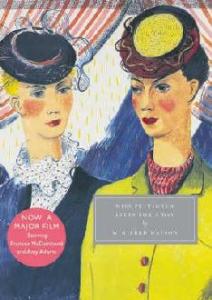
Book cover of Miss Pettigrew Lives for a Day featuring two fashionable ladies

Miss Pettigrew Lives for a Day

Moreover, what about children’s stories? Before Christmas, I was pulling together ideas for an article on Christmas gifts. Having recently been to an entertaining reading by Frank Cottrell Boyce in the company of a very critical nine year old, I added his latest book Cosmic to my list. At the event, Boyce talked to his young audience about how stories are told, retold and then retold some more. Each time storytellers add new elements. He regaled the children with variations on the theme of finding treasure and the (often-fatal!) consequences. It is a simple enough plot, yet there is enormous potential for exploring a range of actions and emotions. Great comic material too as Boyce proves in his novel Millionaires. There is a good chance that at least some kids reading it will have caught the lifelong story bug

I was initially thinking about the written as opposed to the spoken story but many authors also can spin a good yarn if doing a live session. And in Ireland, where there is a fine tradition of oral story telling I have been to many sessions that can be enjoyed by all ages. Think of in particular, Niall de Burca, Eddie Lenihan and Jack Lynch who can hold audiences in the palms of their hands with their wonderful (and often very tall) tales.

Children’s writers do a fantastic job of creating an imaginary world but story telling can be just as important to adults too. One book in particular that started me thinking about the vital effect a storyteller can have is Tahar Ben Jelloun’s This Blinding Absence of Light. In this novel, based on real events Selim, enduring the horror of imprisonment in Tazmamart, a secret prison in Morocco, becomes a storyteller to his fellow prisoners. He has no books, nor paper and pen so he draws upon his memories to retell old tales and even movie plots to them.
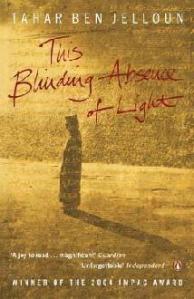
Cover of This Blinding Absence of Light with a figure in desert landscape.

This Blinding Absence of Light

Telling stories is a means of assisting him (and them) to survive, to keep his brain working and to keep up morale amongst the prisoners. They are all in tiny individual cells and it is a way of communicating through the walls, darkness and fears that surround them. The book is a moving testimony to the power of the storyteller. Those are of course extreme circumstances. Even so, people have often used stories in extremis, to come to terms with, and to make sense of events beyond control. Sometimes even to find humour in an otherwise difficult situation.

Well, those are some of my musings….now I am off to curl up with a box of chocolates and a good story.

This piece dates from 2nd January 2011 and this is an edited version of a blog entry for Hand and Star (now apparently defunct but formerly edited by Tom Chivers)  

As a postscript to this piece, there is a connection with my previous piece on Georgette Heyer in that one of her novels Friday’s Child became a symbol of survival for a group of Romanian women political prisoners. One of the women told and retold the story from memory and later, after spending twelve years in prison was able to write and thank the author (in 1963)  from the safety of the United States.

Never underestimate the power of a good story or a great storyteller – if you have any particularly favourite stories that you would like to share, just drop a line in the comment box. I’d love to hear about them!