Penguin Books ‘Great Loves’ series: Leo Tolstoy and The Kreutzer Sonata

Today’s post on Leo Tolstoy means a return to my occasional Russian theme, though yet again it is a digression from the TBR Pile. There is however, a good reason for the latest diversion from the straight and narrow as it resulted from my first ever visit to The Secret Book and Record Store in Dublin. As with so many things, I can’t believe that it has taken me years to get around to exploring this treasure trove of books (I haven’t yet tackled the record stock). Of course, I couldn’t come out without buying anything could I? Not only that, I had to fetch The Bookworm and show her what I had discovered, so yet more book buying occurred that day.
The Kreutzer Sonata

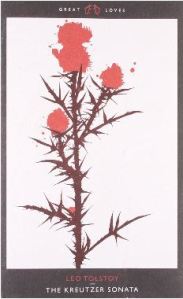
A striking jacket…

One of my finds was a novella by Tolstoy, The Kreutzer Sonata published as one of Penguin’s Great Loves series of twenty examples of ‘the most seductive, inspiring and surprising writing on love in all its infinite variety.’ The book, originally written in 1889 apparently drew on Tolstoy’s own marriage (1862) to Sofya Andreyevna, which by all accounts was a rather stormy relationship. The introduction states that ‘together they had thirteen children’. The writer fails to point out that the brunt of that would have been borne (pun intended) by poor Sofya. Sadly, of the thirteen children that she bore, only eight survived to adulthood.

In The Kreutzer Sonata, Tolstoy sets out his case against marriage and carnal love, with the story of a marriage that went disastrously wrong. The narrator of the sad tale is a train passenger called Pozdnyshev, who begins to relate the story of his life and marriage to a fellow passenger, after a disagreement between the travellers about love, marriage and divorce. I won’t go into too much detail about the plot, for those who haven’t read the book. Suffice to say that it isn’t a very cheerful read, as the main character can see no justification for marriage, or indeed any sexual relationship between men and women, as the result of his experiences with women. Pozdnyshev’s theory is that it is impossible to maintain a long-term relationship and that love and attraction does not last:

But when, as is most often the case, the husband and wife accept the external obligation to live together all their lives and have, by the second month, come to loathe the sight of each other, want to get divorced and yet go on living together, it usually ends in that terrible hell that drives them to drink, makes them shoot themselves, kill and poison each other.

If that was Tolstoy’s view, based on his own experience, then you can see why Sofya was not impressed that he chose to use that material in his book. But to be fair to Tolstoy, he seems to be saying, through his tormented fictional character, that marriage was not particularly good for women either, in particular so-called love matches. He goes as far as to compare the process whereby young women were taught to use their arts and finery to attract to a husband as immoral, saying that ‘As a rule we may say that while short-term prostitutes are generally looked down upon, long-term prostitutes are treated with respect’. Pozdnyshev goes on to say that ‘a woman is like a slave in a market or a piece of bait for a trap’. He rails against the idea of choice in a match, rather than the old-fashioned way of a matchmaker making a bargain. He maintains that it was fairer to both parties that way; less degrading than the prospective brides’ mothers parading them before men to take their pick.

Pozdnyshev then goes on to explain to his companion that the problems stem from women being so dominant. His fellow traveller is sceptical and asks how this can be so, when men have ‘all the rights and privileges’. Pozdnyshev puts forward his theory that this is to do with voting and has nothing to do with sexual rights, which is where the real issue, as he see it, lies.

No, it has to do with the fact that in sexual relations, she’s not the man’s equal. She doesn’t have the right to avail herself of the man or abstain from him, according to her desire, to select the man she wants rather than be the one who’s selected…And, in order to compensate for this, she acts on the man’s sensuality, so that he’s only formally the one who chooses… And once she has mastered this technique, she abuses it and acquires a terrible power over men.

And what do the wicked woman do to facilitate their seduction and domination of men? Well briefly, they go shopping. They are consumers of luxury goods, ‘keeping nine tenths of the human race in servitude, doing hard labour’ and have ‘turned themselves into such effective instruments for acting on [men’s] senses that [the men] can’t even speak to them with equanimity.’ So, in case you missed something there, what Tolstoy, through his mouthpiece Pozdnyshev, appears to be saying is that men are such poor weak creatures that they are unable to resist women’s lures. In other words, it’s all the fault of those pesky women using their fancy frocks (not to mention flesh) to get what they cannot get by legal and above-board means.

As you can probably imagine, the narrator’s marriage did not end well, but I won’t go into details and give away the ending. In The Epilogue to The Kreutzer Sonata (1890), Tolstoy explained his view on carnal love and marriage thus:

Let us stop believing that carnal love is high and noble and understand that any end worth our pursuit — in service of humanity, our homeland, science, art, let alone God — any end, so long as we may count it worth our pursuit, is not attained by joining ourselves to the objects of our carnal love in marriage or outside it; that, in fact, infatuation and conjunction with the object of our carnal love (whatever the authors of romances and love poems claim to the contrary) will never help our worthwhile pursuits but only hinder them.

I cannot help thinking that it was a pity he didn’t discover this view of carnal love before he caused his wife to endure childbirth thirteen times. It was rather late to get to be so high-minded about carnality.

After my Russian period, I’m not sure where I’m heading for my next post, but I will promise to try to stick to the TBR Pile…
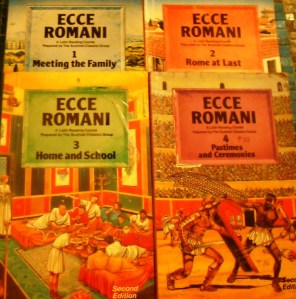
 

Romans on The Landing: Ecce Romani

Today’s post is about a studious little side-project to my TBR Pile endeavours, though I am not sure whether it will be a long-lasting one or not. I have begun to tackle a cherished ambition to have a go at learning Latin, a language that I never studied at school. My impetus for this ambition fulfilment is that The Bookworm is taking Latin classes so I thought that I would keep her company. Now, to be absolutely clear about this, she is in her second year of Latin study, so it has taken me long enough to screw my courage to the sticking place and get on with a spot of conjugating. So, without even a thought of New Year resolutions, I have acquired a new Reading Challenge.

Ecce Romani

Four to go…

I am working from Ecce Romani: A Latin Reading Course, which was passed on to us by a friend, so I need not feel too guilty if this doesn’t work out. At least I won’t have spent a fortune on my texts. The edition I have is an older version rather than the more recently updated one, but I don’t think it will make much difference. After all, the language can hardly change, can it? The Scottish Classics Group wrote the series, originally published in 1971 (Oliver and Boyd, an imprint of the Longman Group). Longman reprinted the series many times, the edition I have being the seventeenth impression (2000). I am sure that many people must have memories, both good and bad, of studying along with Marcus, Sextus, Cornelia and Flavia. It reminds me of the Peter and Jane reading books from my school days.

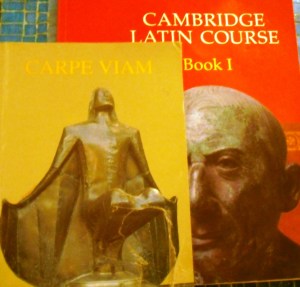
I have Ecce Romani books one to four to work through and then I will see where to go from there (assuming I make it that far). Alongside, I thought that I might dip into the Cambridge Latin Course (Cambridge School Classics Project) series from time to time, as this is the text used by The Bookworm. Cambridge also has online activities to tie in with the books, which might be handy for vocabulary testing. Finally, if I feel truly brave I will tackle some poetry from the poetry anthology called Carpe Viam (The Classical Association of Ireland, 1993, 1998). I am not sure whether I will get as far as the Latin poetry any time soon but I do have good intentions.

Cambridge Latin

How far will I get?

On with the next chapter of my challenge…

Gladys Mitchell Crime Capers

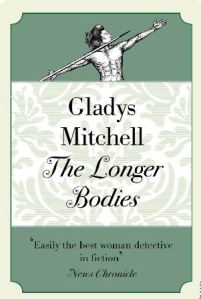
Gladys MitchellI’m afraid that today’s post about Gladys Mitchell (1901-1983) is going to be another digression from my mammoth Landing Book Shelves task. It is I admit a direct result of wandering into a charity shop for a casual browse. I know that I should avoid these temptations, but it truly is nigh on impossible to pass up the chance to poke around on a bookshelf. I had just popped into Oxfam to scan the paperbacks on my way home from shopping and, lo and behold, a crime novel caught my eye almost straightaway. My searching gaze lighted on The Longer Bodies, one of Gladys Mitchell’s early crime novels. Victor Gollancz originally published the novel in 1930 and it has been through several reprints from different publishers over the years. The Longer Bodies (2014)  is one of a recent series of Vintage reprints and the stylish theme to the jacket seems entirely appropriate to their glittering heyday.The Longer Bodies

After enjoying the twists and turns of the plot in The Longer Bodies, I am baffled as to why it has taken me until now to get around to reading Gladys Mitchell. I had heard of her before, in connection with other ‘Golden Age’ women crime writers such as Dorothy L Sayers and Agatha Christie, but serendipity has never thrust one of Mitchell’s books into my hands until now. It won’t be plot spoiling to mention that the title refers to bodies located in the village of Longer, and not bodies stretched on a torture frame to extreme length (I’ve clearly read too many historical novels).  Although as vigorous training for a field athletics event features in the plot, perhaps the title was intended to have a second meaning.

The Longer Bodies provides the third case for Mitchell’s unusual private detective Beatrice Adela Lestrange Bradley. Mrs Bradley is a ‘small, thin, unattractive, and intrepid’ woman, a ‘psychoanalyst with a flair for sleuthing’. She also appears to have a flair for extraordinary combinations of colour and design in her attire, but I suppose that doesn’t make her either more or less of a detective. She wouldn’t have been able to work undercover though, judging by this description of her while on the Longer case:

The only remarkable thing about her was the almost indecent hue of the mustard-coloured sports coat which she was wearing, with terrible effect, on top of a tomato-red dress. The costume was set off…by a small cloche hat which boasted a single, straight aggressive feather. The feather shot insolently into the air for a matter of twenty inches or so…

The other aspect to Mrs Bradley’s personal appearance is the oft remarked upon resemblance to a predatory reptile. Gladys Mitchell created a female sleuth as unlike Miss Marple or Miss Silver as it was possible to be, as may be judged by this none too fluffy description of her social manner,

With what was intended to be a whimsical smile, but which approached more nearly to the kind of grin with which an alligator on the banks of the Nile might view the coming of a chubby but careless baby.

Presumably, a wise criminal would steer well clear of that reptilian smile of Beatrice Bradley’s, as I’m sure it boded no good. Mitchell also gave her detective ‘yellow claw like fingers’, which is rather disconcerting as I keep thinking of chicken’s claws whenever her hands are mentioned. To complete the picture, Mrs Bradley was prone to fiendish cackles or screeches of laughter, but in complete contrast had a surprisingly mellifluous speaking voice, ‘which gave the lie to her whole appearance’.

Mrs Bradley is in a very literal sense a rather uncomfortable person to have around as she has a penchant for poking her companions in the ribs with her umbrella. This piece of equipment is the weapon of choice of another of my favourite female detectives, Amelia Peabody, but Mrs Bradley appears to be much more ruthless in making her point (sorry!) with her ferule. It has to be noted that it is her young male sidekicks who often suffer the rib poking, in the course of their duties on the case.When Last I Died

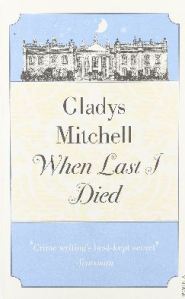
I have since had a minor binge on Mrs Bradley, having obtained a couple more of her cases, When Last I Died (1941) and The Saltmarsh Murders (1932) from the library. Though I’ve not yet managed to get hold of Mrs Bradley’s first outing  (Speedy Death). All have been very enjoyable, and I think that overall Gladys Mitchell plays reasonably fairly with the reader’s chances of solving the crime. In other words, I guessed the culprit in The Longer Bodies and I should really have spotted the criminal in The Saltmarsh Murders, because the clues were there. Having re-read the last section of When Last I Died more carefully, I can see the groundwork being laid, so again I would have to admit that I didn’t work hard enough on my detecting.

Mrs Bradley is such as fascinating character, that I would love to come back to her as a future blog post topic. She is not a particularly endearing person, but she is highly intelligent, determined and deliciously eccentric. I think I was particularly touched by her compassion and search for justice for the murder victims in When Last I Died (I won’t plot spoil, but if you read it you will see what I mean).  If you want to learn more about Gladys Mitchell and Beatrice Bradley, there is a well researched tribute site that is worth checking out:  http://www.gladysmitchell.com by American writer Jason Half.

If you read the clues correctly, you will reason that I will be borrowing/buying another Mrs Bradley case as soon as possible…

Picture Credits: All taken from Amazon this time, including the book jackets as I didn’t get around to scanning them from my own copies.

JB Priestley: A Yorkshire Grumbler’s Delights

JB Priestley

1894-1984

After my break from reading essays to tackle Vanity Fair (inspired by the John Sutherland essay collection), I am now reading yet another essay collection, having been inspired to do so by reading a novel. A nice bit of circular inspiration I feel. To make all clear, I recently read JB Priestley’s Angel Pavement that I bought second-hand in Blessington, which reminded me that I had his essay collection Delight tucked away on our shelves, unread since 2009. After finishing Angel Pavement, I had an urge to re-read something of Priestley’s (English Journey perhaps) but then remembered I had the essays. As always, it’s amazing how often serendipity comes into play when deciding what to read next. At least, by reading Delight, I am actually reducing the TBR Pile (which of course, I had previously increased by buying Angel Pavement etc). At this rate, there will always be a humongous TBR Pile (but then you knew that already, didn’t you?)

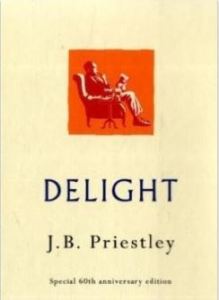
To return to the book in question however, Delight is a collection of short essays, originally published in 1949 by Heinemann. The edition I have is an attractive sixtieth anniversary edition, published by Great Northern Books with an introduction by Priestley’s son Tom. There are 114 short pieces, varying from three to just one page in length. The background to the essays is that Priestley wanted to write something to help to cheer up the post-war gloom. He also had something to prove to his family and friends about the perception that he never found pleasure in anything. JB Priestley’s preface is subtitled ‘The Grumbler’s Apology’ and he goes on to explain how he acquired a reputation for being a bit of grumbler.

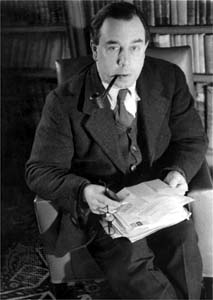
I have always been a grumbler. All the records, going back to earliest childhood, establish this fact. Probably I arrived here a malcontent, convinced that I had been sent to the wrong planet. (And I feel even now that there is something in this.) I was designed for the part, for I have a sagging face, a weighty underlip, What am I told is ‘a saurian eye’, and a rumbling but resonant voice from which it is difficult to escape. Money could not buy a better grumbling outfit.

In the West Riding of Yorkshire, where I spent my first nineteen years, all local customs and prejudices favour the grumbler. To a good West Riding type there is something shameful about praise, that soft Southern trick. But fault-finding and blame are constant and hearty. The edge of criticism up there is sharpened every morning…I have grumbled all over the world, across seas, on mountains, in deserts. I have grumbled as much at home as abroad, and so I have been the despair of my womenfolk.

As I don’t hail from Yorkshire, but the Midlands I was intrigued by this portrayal of the Yorkshire attitude. I have always viewed Yorkshire folks as a no-nonsense breed and the idea that they were sparing of praise makes sense to me. But any Yorkshire people out there are welcome to put me straight. Since I’m not of ‘soft Southern’ breeding either, I will keep out of the argument. The only thing I will add is that I do feel that having a good old grumble can be quite therapeutic in its effect. Oh, and furthermore, that I tend not to go overboard on praise either (‘not too bad’ is high praise in my book); but whether that is a Midlander’s trait or not I cannot say with any certainty. I can say that I enjoyed roving through Priestley’s many and varied delightful experiences.Delight

In Delight then, Priestley set out to prove that despite being a right old Yorkshire grumbler, he was still able to find pleasure in many things. Not only that, his aim was to share his ‘Box of Delights’ with the post-war readers who wanted something to smile about. The collection of short essays mainly focuses on the small, simple things in life that give us delight. A Guardian review of the reprint points out that some of the ‘delights’ would most likely be lost on a modern audience, but that many would still resonate. I’m not sure I agree with that, after all I have never been a pipe smoker but I can appreciate Priestley’s fondness for choosing just the right tobacco mixture.

Part of the pleasure in reading in these pieces comes from a sense of recognising and sharing the emotion caused by the sight of fountains, waiting for the curtain to go up or buying books. I can also understand and share Priestley’s delight in the pleasure of unearned income, whether it is a small windfall or his profit from selling review copies to a local bookshop. The rest of the pleasure comes from Priestley’s writing style, which is clear and simple but not ‘dumbed-down’. His voice has humour lurking just behind it as he talks about the comparatively ordinary delights of life. This humour may however, harbour a spike should the occasion demand it, such as in recalling a critic who told Priestley that his writing ‘always seems to me too simple’. Priestley referred to this man as a ‘youngish fellow whose personality (though not his values) I respect’. He went to say that to the critic and his ilk, ‘Writing that was hard to understand was like a password to their secret society’.

Priestley genuinely wanted to be able to reach anyone and everyone with his ideas and clearly felt that writing in a clear style that excluded nobody, was the way to do it. He wrote, ‘Some contemporary critics would be better occupied solving chess problems and breaking down ciphers. They are no customers of mine, and I do not display my goods to catch their eye’. Well, you can’t say fairer than that, I suppose that’s the Yorkshire sharpness coming out. Priestley seems to have written for real readers and not fashionable literary critics who thought that you couldn’t be an intellectual without making things complicated. He sounds like my kind of man (and writer) despite the grumbling…


Additional picture credits: Wikipedia, with thanks

Vanity Fair and Queen Semiramis

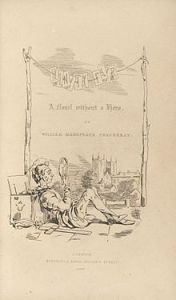
Title page Vanity Fair

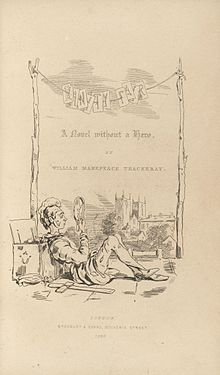
Original title page

I was all prepared to give the readers of The Landing blog my thoughts upon reading Vanity Fair, when one of the minor female characters, Miss Pinkerton, side tracked my intentions. I ended up delving into Brewer’s Dictionary of Phrase and Fable and Wikipedia for a bit of research into Thackeray’s historical allusions relating to the character. Finally, I came to the conclusion that this particular Thackeray creation bears a startling resemblance to a formidable maiden aunt in one of my favourite children’s stories.

Now read on….

Vanity Fair opens in the Pinkerton Academy for Young Ladies, when two of the main protagonists in the story are preparing to leave for the wide world. The two girls were Amelia Sedley and Becky Sharp, but for me, the redoubtable principal Miss Barbara Pinkerton (an ‘austere and godlike woman’ who was ‘as tall as a grenadier) stole the opening chapter. She is shown here parting from Becky Sharp, her least favourite pupil, who has the audacity to address the principal in perfect French:

Miss Pinkerton did not understand French; she only directed those who did: but biting her lips and throwing up her venerable and Roman nosed head (on the top of which figured a large and solemn turban), she said, ‘Miss Sharp, I wish you a good morning.’ As the Hammersmith Semiramis spoke, she waved one hand by way of adieu, and to give Miss Sharp an opportunity of shaking one of the fingers of the hand which was left out for that purpose.

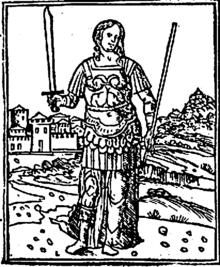
Semiramis Regina

A no-nonsense kind of a woman…

That was the second time that Thackeray referred to Miss Pinkerton’s affinity with Semiramis, the first being at the opening of the chapter, where we are told ‘that majestic lady: the Semiramis of Hammersmith’ had been a friend of celebrated literary luminaries Dr Samuel Johnson and Mrs Hester Chapone. Now, I have to confess that I had only a vague recollection that Semiramis had been a queen or possibly a goddess of some sort, hence the dive into Brewer’s Dictionary of Phrase and Fable. The entry describes a legend about a woman who was the daughter of the goddess Derceto and an un-named Assyrian who went on to marry Ninus, King of Assyria. Brewer points out that this and many other legends grew up around a real Assyrian princess who lived circa 800 BC.

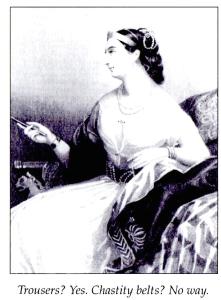
I assumed that Thackeray was comparing his redoubtable principal to the historical princess (who married King Shamsi-Adad V of Assyria), rather than the mythological Semiramis, but it is hard to say. Murder and suchlike heinous goings on were some of the activities of the legendary queen, so maybe it was a bit of a stretch to use her as a role model. However, the real Semiramis (ruled 810-806 BC) according to Vicki León in Uppity Women of Ancient Times was quite a strong capable ruler so perhaps she is a more likely source. The illustration from this book portrays the queen in soft woman-hood mode, so I can’t see her as an indomitable leader, but apparently she was. Apart from the questionable claims that she invented trousers for women and chastity belts for men, Semiramis achieved great things:Uppity Women of Ancient Times

Under her leadership, a new system of canals and dikes irrigated the flatland between the Tigris and Euphrates Rivers, and the twin cities of Nimrud and Nineveh became the bright lights of Assyria. A true power player, Semiramis led military expeditions against the Medes as far afield as India, and forged tactical alliances as far west as Turkey.

Semiramis

Not a weapon in sight…

Perhaps we may safely assume that Miss Pinkerton ran her school with the authority, determination and majesty of an Assyrian Queen. The mythological Semiramis was rumoured to have slept with her son after her husband’s death, which would not have been at all a respectable thing for a principal of a select girls’ school, especially since Semiramis had put Ninus to death in the first place. I cannot help wondering if this was a joke on Thackeray’s part. Would his readers have been aware of the two aspects of Semiramis I wonder? She was obviously as proud as any queen, but I presume that contemporary readers would have been familiar with the Semiramis comparison.

I also gleaned from Brewer’s Dictionary that a couple of European female monarchs were honoured with the nickname ‘Semiramis of the North’. One of these was Catherine II of Russia, (1729-1796) whose deeds were a little murky; the other was Margareta of Norway, Sweden and Denmark (1353-1414) who seems to have been a capable ruler, without the vexatious tendency to murder her relatives. Clearly, Miss Pinkerton is one of a very select band of inspiring rulers whose achievements know no bounds.

Talking about inspirational, magisterial rulers, I will finish by bringing you a wonderful creation from

Aunt Fidget

Enough to terrify anyone…

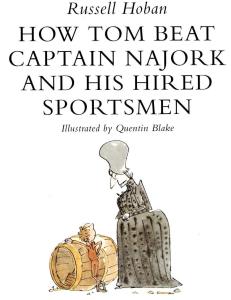
Russell Hoban, brilliantly illustrated by Quentin Blake, called Miss Fidget Wonkham-Strong. This is the character I mentioned in my introduction. I am sure that you will see instantly her kinship with both the aforementioned school principal, Miss B Pinkerton and Queen Semiramis herself. As I was reading Vanity Fair, Blake’s drawing of  remarkable Aunt Fidget popped into my head and wouldn’t go away. Hoban describes her thus, ‘She wore an iron hat and took no nonsense from anyone’. She was as assured of the benefits of regular reading of the Nautical Almanac as Miss Pinkerton was of Dr Johnson’s Dictionary. However, I do hope that Miss Pinkerton never said ‘Eat your mutton and your cabbage-and-potato sog’ to her pupils, or fed them with greasy bloaters as Aunt Fidget was fond of doing.

I seem to have come some distance from Thackeray, via an Assyrian Queen and Quentin Blake, but I hope you enjoyed the journey!

Credits: additional images from Wikipedia, with thanks.

Vanity Fair: Next on the List

Title page Vanity Fair
Original title page

Here is a little holding post while I finish reading Vanity Fair, (William Makepeace Thackeray) which I mentioned in a previous post as a future TBR Pile target. I haven’t seen any filmed versions of the book but I thought I’d watch this 2004 film with Reese Witherspoon once I have digested the original story. I have a feeling that the BBC did a series a few years ago but I haven’t checked yet.

I am over half-way through and really enjoying the book, though I could do with an edition that has notes to explain some of the references that nineteenth century readers would have easily understood. Look out for a more detailed post soon!

Credit: Trailer video from YouTube, uploaded on July 18, 2006 by The Adventures of Ricey (with thanks)  

Book Temptation in Blessington

This will be a brief post, its purpose to illustrate just how difficult my task of reading around the Landing Bookshelves is going to be. The difficulty, I am forced to add, is entirely of my own making as I find it almost impossible to pass the ‘Just Returned’ or ’New Titles’ shelves in any library that I happen to visit. In this case, my little difficulty was in discovering a new bookshop on a recent trip to Blessington. Not one, but two bookshops can Blessington boast, one being the lovely Blessington Bookstore and cafe and the other, a second hand and antiquarian emporium.

Four Books

Too tempting to resist!

We had been in the former, where we enjoyed a browse, a beverage and some yummy cake at the end of our day trip to the Blessington Lakes. We were waiting at the bus stop over the road, when I spied what I thought was a sign saying ‘Books’ over in the as yet unexplored shopping centre. At that distance, despite my long sightedness I could have been seeing ‘Boots’ but I wasn’t about to take any chances. As the bus timetable declared a wait of more than thirty minutes, there was certainly time to explore the potential bookshop. Off we trotted in eager anticipation.

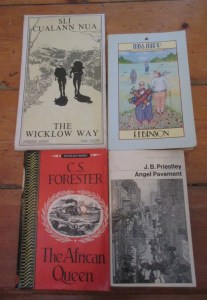
I am here to inform you that it was indeed a bookshop (Broadford Books), one that we didn’t even get inside of before we had found three books (plus an old map of The Wicklow Way) to buy. Booksellers shamelessly put stock outside at bargain prices to tempt us from our good intentions. Here is the result of our brief shopping spree: Miss Mapp by EF Benson, Angel Pavement by JB Priestly and CS Forester’s The African Queen. I was particularly pleased to spot The African Queen having recently watched the film version for the first time in years. He Who Put The Shelves Up is reading it at the moment so I will have to wait awhile. The Bookworm has now been introduced to the delights of Miss Mapp’s social circle and is keen to read the rest of the Mapp and Lucia books.

So, we had a very successful day out, which is good, but I am a step backwards in my mission to conquer the TBR Pile! I did however resolutely ignore an Arthur Rackham illustrated book of fairy stories…maybe next time…

Have you spotted any bargains lately? Do tell!


Picture Credit: The Bookworm (with thanks)


Puzzling Over Literature: John Sutherland on C19 Fiction

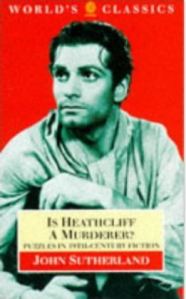
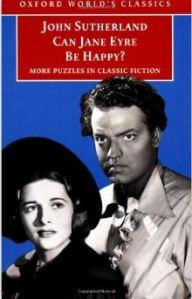
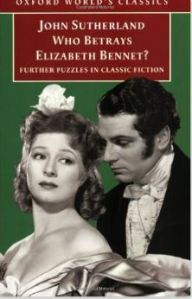
This blog post returns to the subject of essays, literary essays in particular, in the shape of John Sutherland’s collection of pieces delving behind the scenes of some well-known nineteenth century novels. Not surprisingly, the book’s title Is Heathcliff a Murderer? (OUP, 1996) attracted me straightaway. I can’t remember how long Sutherland’s book has been on the TBR Pile, but I probably bought it in the year of publication. Sutherland later wrote follow-up collections of articles on literary puzzles called Can Jane Eyre be Happy? (1997) and Who Betrays Elizabeth Bennet? (1999) neither of which I have got around to buying, which given the parlous state of the unread pile is probably just as well.

Is Heathclif a Murderer?

Literary Puzzles…

I have dipped into Sutherland’s collection at various times over the years, but this time I set out to read all of the essays (thirty-four) in the book. The pieces vary in length from about three and a half pages up to eight pages, so I found them ideal for bus and Luas journeys. I began, as I did when I read the Somerset Maugham essays, with those discussing books that I have read. Obviously, the literary puzzle that Sutherland dissects has more resonance if you have read the original work. Even so, there were certainly things that I had never noticed before; such are the benefits of a very close textual reading. I have discovered that there is a definite plot spoil element to my mission. I won’t however reveal these to you, dear reader. Suffice to say that  I will know what plot features and anomalies to look out for in for instance, Jude the Obscure, The Master of Ballantrae and Phineas Finn when I finally get around to tackling them.

In his introduction, John Sutherland acknowledges that his solutions may not be the most plausible. He explains the rationale behind his exploration of these literary brainteasers, which he defends from any accusation of mere frivolity:

But I would argue that however far my solutions are fetched the problems which inspire them are not frivolous. It is worthwhile for readers to be curious where Sir Thomas Bertram’s wealth comes from, or to wonder why The Picture of Dorian Gray is so ‘queerly’ disturbing, or to inquire why George Eliot and Henry James consciously flawed the printed endings to their greatest novels. It is less crucial, but no less thought-provoking, that Henry Esmond –the highly literate creation of a highly literate author-should quote from a work forty years before it will be written. The questions which have provoked this book are, I maintain, good questions.

If you are the kind of reader that says, ‘But hang on a minute, didn’t that…’ or ‘That timing doesn’t make Can Jane Eyre be Happy?sense’ or who argues about what the author really meant in writing the closing paragraphs, then this is the book for you. Some of the puzzles can be shown to be errors as the result of hasty writing; perhaps due to mistakes in plotting; or inaccuracies arising from the pressure of producing a story in instalments. Others are more intriguing (and as Sutherland points out, not in any way frivolous), such as the question of whether Thomas Bertram’s wealth was acquired on the backs of slaves. Some questions are of identifying plot location, explaining seasonal oddities or tracing missing days. Other questions arise simply out of the passage of time, as the modern reader misses allusions that would have been familiar to a contemporary reader.

The solutions that Sutherland offers in his essays have either been sending me back to re-read or have inspired me with an urge to read the original. One of the books with a mystery is Vanity Fair, which has been on my shelves since the 1980s. It is part of my classics series with the green/gold binding (Book Club), so as they all look alike, I won’t scan in a picture. Not only have I never read Vanity Fair, I have never read anything else by Thackeray so this seems as good a moment as any to rectify that omission. Be prepared for updates on my experiences with the folks inhabiting Vanity Fair. For obvious reasons, I will not even tell you the title of Sutherland’s piece on the mystery in Vanity Fair. You will just have to read it yourself (after reading the book of course!)

Has anyone else read any of the books in this series? Do drop me a line…

Who Betrays Elizabeth Bennet?

Picture Credits: Book jackets taken from Amazon.


Cold War publishing: The Zhivago Affair

A recent library visit found me as usual scanning the ‘New Titles’ and ‘Just Returned’ shelves for any likely contenders for a bedside table slot. Sometimes I have a deal with myself that I won’t take yet another book home (to distract me from the TBR Pile) if I can get out of the building without anything on the two aforementioned shelves catching my eye. Well, dear reader, as is so often the case something did catch my eye, thus pushing another book back a notch in the reading order. I should really ban myself from libraries until I have nothing left to read on The Landing.

Anyway…

The Zhivago Affair by Peter Finn and Petra Couvée was the title that grabbed my attention and threatened the status of the bedside table pile. The subtitle: The Kremlin, the CIA and the Battle over a Forbidden Book at first made me assume that the book was fiction. It sounded like a literary caper that would be right up my street. As it happens, the book is a real life literary caper that indeed proved to be right up my street. One of those ‘the truth is stranger than fiction’ or you ‘couldn’t make it up’ reading experiences. It really was like reading a Cold War spy novel but with added poetical asides and royalty disagreements to add piquancy.

The Zhivago Affair

My library find…

Finn and Couvée’s book tells the story of the battle to get Doctor Zhivago published and in particular reveals the CIA involvement in publishing and distributing a Russian language edition in 1958. As might be supposed, the CIA involvement had as much, if not more to do with propaganda than literature. According to one of Pasternak’s sons, Yevgeni, the author wasn’t at all happy about his work being used for Cold War propaganda purposes. Over the course of several years of research, Finn and Couvée uncovered the complicated saga of Doctor Zhivago with the help of previously classified CIA files. I could not help feeling that releasing the files was in itself yet another propaganda act. This is the CIA saying, ‘look it’s not all guns, we’re really nice guys and we love culture, and books and stuff’. It’s hard to judge whether the people in the organisation actually cared about the book or Pasternak, or whether they just cynically used a golden opportunity to poke the USSR. In these days of Twitter, Facebook and Instagram, the idea of a novel being such a powerful propaganda tool may seem quaint but it truly was that important in the West’s campaign against Communist ideology.

As you might recall, I read Pasternak’s book last year, many years after I first saw the film version and fell in love with Omar Sharif and the wonderful Russian scenery (which of course wasn’t Russian at all). The first edition of Doctor Zhivago was published in 1957 in Italy, as Pasternak was unable to get his first and only novel published in his own country. Pasternak told Italian publishing agent Sergio D’Angelo that ‘In the USSR, the novel will not come out. It doesn’t conform to official cultural guidelines’. Literature was very important in Soviet Russia, however the chilling fact was that it had to be the correct sort, as was made clear by Stalin in a 1932 speech at a gathering of writers to launch the ‘new literature’,

The production of souls is more important than the production of tanks…Here someone said that a writer must not sit still, that a writer must know the life of a country. And that is correct. Man is remade by life itself. But you, too, will assist in remaking his souls. This is important, the production of souls. And that is why I raise my glass to you, writers, the engineers of the human soul.

Doctor Zhivago: First Edition

Italian First Edition

If Golslitizdat, the state literary publisher did not consider a writer’s work suitable (not sufficiently productive of souls), then it would not see the light of day. There may also be serious consequences for the unfortunate author, despite the apparent thaw since Stalin’s death. As Doctor Zhivago had no merit in the eyes of the state publisher, Pasternak’s manuscript was smuggled out of Russia by D’Angelo. He was acting on behalf of Giangiacomo Feltrinelli, a Milanese publisher (a member of the Italian Communist party). Pasternak handed the manuscript over knowing that he was potentially putting his life at risk, as well as those of his family. He rather theatrically said to D’Angelo, ‘You are hereby invited to my execution’ after handing over his work with the words ‘This is Doctor Zhivago. May it make its way around the world’. I wonder if he had rehearsed those lines?

Having read the book, I would now like to read a straightforward biography of Pasternak, as this book obviously focuses on the Zhivago story. From what I have gleaned from this book, Boris Pasternak’s character was contradictory and he was probably not the easiest person to live with (whether his second wife Zinaida or his lover Olga). He had an unshakeable belief in his own talents yet was also unassuming, modest and personally engaging. It is hard to get to grips with, and understand Pasternak’s character. He seems to have been selfish enough to pursue publication even knowing that it could rebound badly upon his family. In fact, his mistress Olga Ivinskaya was twice imprisoned for her part in the affair, the second time after his death in 1960. Yet, according to the evidence, Pasternak was courageous enough to support the family members of those writers sent to the Gulag when others kept a distance.

Reading The Zhivago Affair has given me more leads to follow, not only on discovering more about Pasternak and his family but also about other writers mentioned in the text such as Osip Mandelstam and Anna Akhmatova. One book that I did read a few years ago was a fictionalised account of Isaac Babel’s imprisonment in the Lubyanka, The Archivist by Travis Holland which I would highly recommend. It’s not a happy read as you might expect, but there is still a bit of hope for humanity and the written word in it. Which brings us back to Pasternak’s work making its way around the world despite the repressive regime under which he lived.

If anyone has got any related recommendations, I would love to hear them…

Picture credit for the Italian First Edition : Wikipedia, with thanks.

Reading Somerset Maugham on Emily Brontë

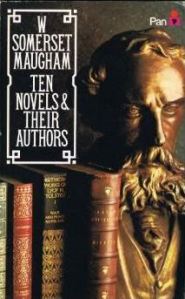
Ten NovelsI have been reading some of the literary criticism essays in Somerset Maugham’s book (mentioned in a recent post), beginning obviously enough with those about books that I have read. First, I turned to the essay on Emily Bronte and Wuthering Heights for the simple reason that I read Wuthering Heights so many years ago that it is probably due for a re-read. This essay seemed like a good way to begin to re-acquaint myself with both the book and the author. It also inspired me to dig out my copy of the Brontë family biography by Juliet Barker (1994).

Several writers have presented their views of the Brontë family since Somerset Maugham wrote his essay (1954), but Juliet Barker’s book, simply called The Brontës (1994) promises to be the definitive account. I somehow managed to miss a revised edition that came out in 2012. Perhaps I will give myself a very late Christmas present (I still have a voucher to spend) and upgrade my original copy. Meanwhile, it was interesting to see what Maugham made of Emily Brontë’s personality from the available sources. He did point out that to be able to talk about Emily; he needed to go back to her father’s origins and to approach Emily through her family, as she is difficult to know. Maugham’s portrayal of Patrick Brontë is much more negative than Barker’s image. She has painstakingly reconstructed hers from evidence culled from newspaper and church archives about Patrick’s political activities and presented a less one sided view.

It might seem obvious but the main fact to bear in mind when reading biographies about authors (or indeed any historical person) is that time and fresh documentary evidence often reveals a different picture. In some respects, that is not strictly true of Emily Brontë since she left very little personal testimony and apparently had no friends so there is a lack of social correspondence. Apart from her poetry, juvenilia and her only novel, evidence is indirect. However, over the years a much clearer picture of the whole family has emerged due in particular to Juliet Barker’s diligent archive research, which illuminates Emily’s character as far as it is possible to do so.

Here is a description of the fifteen-year-old Emily taken from Maugham’s essay, quoted here in full, as it seemed a shame to cut it short. Though he does not give the full reference, it was taken from the earliest biography of Emily by Mary Robinson, which was published by W.H. Allen in 1883 (I found this reference in Barker’s sources).

a tall, long-armed girl, full grown, elastic as to tread; with a slight figure that looked queenly in her best dresses, but loose and boyish when she slouched over the moors, whistling the dogs, and taking long strides over the rough earth. A tall, thin, loose-jointed girl – not ugly, but with irregular features and a pallid thick complexion. Her dark hair was naturally beautiful, and in later days looked well, loosely fastened with a tall comb at the back of her head; but in 1833 she wore it in an unbecoming tight curl and frizz. She had beautiful eyes of a hazel colour.

She was clearly an active girl, who loved the outdoors, perhaps one who would have been impatient with the restricted life of a well brought up lady. Physically she must have been what is often termed handsome, rather than conventionally pretty. Clearly, she ‘scrubbed up well’ as the saying goes. Emily was apparently painfully shy with anyone outside the family circle and Maugham quotes from Charlotte Brontë’s letters to show that the sisters at times had a difficult relationship. After learning from Juliet Barker that few writers have quoted from Charlotte’s original letters, using instead unreliable published ones, I am sceptical of Maugham’s conclusion, “One is inclined to think that Charlotte never knew her sister”.

It is illuminating to consider the different approaches to studying the Brontë family and Emily in particular. Due to the lack of straightforward biographical evidence, many writers have tried to find the real Emily through her writing. On the other hand, Juliet Barker considers it misguided to use literary criticism. As she says in her introduction, “Trawling through the Brontës fiction in search of some deeply hidden and autobiographical truth is a subjective and almost invariably pointless exercise”. She also rather scathingly refers to “theories of varying degrees of sanity” earlier in her introduction. I assume that she places in that category the theory, to which Maugham and other literary critics subscribe, that Emily Bronte was a lesbian. As far as I can recall, as it’s been twenty years since I read Barker’s biography, she doesn’t suggest this possibility from her study of contemporary sources.

One of the biggest myths that grew up around the Brontës was that they lived very harsh and isolated lives in a lonely moorland house. Maugham doesn’t perpetuate this idea, as after he visited Haworth, he described the house as situated at the top of a hill, “down which the village straggled”. However, he does mention that there was a graveyard on both sides of the parsonage, which some folks (but not perhaps curates) may have considered being a gloomy location. He also pointed out that the mood of the moorland varied with season and would not always have been wild and bleak. Indeed, he described his visit thus,

The countryside was bathed in a haze of silver-grey so that the distance, its outlines dim, was mysterious. The leafless trees had the elegance of trees in a wintry scene in a Japanese print, and the hawthorn hedges by the roadside glistened white with hoar frost. Emily’s poems and Wuthering Heights tell you how thrilling the spring was on the moor, and how rich in beauty and how sensuous in summer.

I didn’t find the location particularly bleak either when I was there a few years ago, and the house was solid and pleasant looking, though of course it would have been cold in winter without central heating. However, the Brontë sisters’ lives would have been no harsher than for any other country curate’s family in the nineteenth century. They could obviously afford a servant (Tabby Ackroyd) to help around the house. Emily helped with domestic chores, and I liked the image of her kneading bread with a book propped up in front of her as she worked. Industrious yet slightly impractical: (turning pages with a floury hand?)

The fact that Maugham included Wuthering Heights in his ten most important novels, despite asserting that it is very badly written, intrigued me. Maugham is critical of the construction of the novel (fitting two sets of events and characters into a unit) and the unrealistic dialogue that Emily gives Nellie Dean to say. However, his verdict is that, “It is a very bad novel. It is a very good one. It is ugly. It has beauty. It is a terrible, an agonizing, a powerful and a passionate book.” He discusses the unevenness of the novel and the reasons why Emily might have chosen to tell the story in the way she did, instead of perhaps choosing a first person narrative. He felt that she wanted to distance herself from events, in effect to in hide her from the passion. His reasons? Somerset Maugham’s theory located Emily as both Cathy and Heathcliff, “I think she found Heathcliff and Catherine Earnshaw in the depths of her own soul. I think she was herself Heathcliff, I think she was herself Catherine Earnshaw”.

Now I do really need to read it again…let me know what you think! Drop a line in the comment box.