Spoils from the Trinity College Book Sale

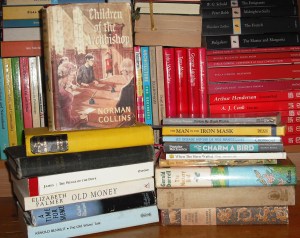
As regular readers probably realise, I  don’t need to be adding any more books to the huge TBR Pile that is the Landing Book Shelves but nevertheless I brought a few new additions home recently.  I hasten to add that the photographic evidence shown here is slightly misleading in that some of the books belong to one of the other book bugs in the household. Note that I’m attempting to fudge the numbers here.

Book Sale Purchases

Now where to put them…

I was particularly pleased to spot a Noel Streatfeild novel, When the Siren Wailed that I had not come across before. This was originally published in 1974 (William Collins) with the Collins Lions paperback edition I found dating from 1984. The book retains its Eason price sticker, originally costing £1.54. The blurb on the back from The Birmingham Post says, ‘Noel Streatfeild vividly recreates the atmosphere of blitz-torn London with all its friendliness, horror, confusion and tragedy. Her book cannot fail to impress young readers.’ The books tells the story of three children despatched with their school mates to safety as part of Operation Pied Piper.

Stories from the blitz interest me because my mum was evacuated from Birmingham during the war and she was lucky enough to make a lifelong friend as a result. I don’t think she ever had any exciting adventures as a result of being an evacuee though. I was struck by the fact that Laura the eldest sibling in the story,  was nine at the beginning of the war when the evacuation programme began. She was given the responsibility of looking after her two younger brothers Andy and Tim on a journey to an unknown destination with a train load of strangers. My mum was also nine years old at the outbreak of war but as an only child would have been sent away without the comfort of brothers or sisters. It’s hard to imagine now a circumstance where you would send a child away alone with a luggage label attached to a coat, a suitcase and a gas mask. Fortunately it all turned out well for my mother in her temporary home.

Closeup Books

Which one?

Now the only question remaining (apart from where to put the books when one bookshelf already covers the only landing window) is what to read next…I’ll keep you posted on that one.

I’d love to hear from anyone else who loves second hand book sale bargains too!

Boris Pasternak: Doctor Zhivago

As I mentioned previously I’m continuing with my Russian theme by reading Doctor Zhivago (Boris Pasternak) which I had for Christmas (it seems ages ago now!) In keeping with my usual mode of practice, the good doctor has had to give way to a couple of other reads, including Nancy Mitford, Andrés Neuman and Kader Abdolah but I do keep returning to him after straying.
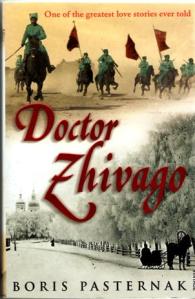
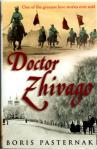
Doctor Zhivago

My Christmas Present…

Finally, I have reached the home straight in Doctor Zhivago, the penultimate chapter, at which point the revolution has the country in its tenacious grip. Life is ruled by committees and many, many regulations which it is not safe to ignore. Yuri Zhivago, now living once more in Moscow has seen his life change immeasurably by war and revolution. He has suffered hunger, violence and fear as well as experiencing great passion, as he became caught up in his nation’s struggle to throw off centuries of Tsarist rule. Given that Putin‘s Russia is so much in the news lately it has proved to be an appropriate time to read about the course of events that would eventually lead to the present political landscape.

As usual in my posts, I am trying to avoid plot spoilers but in this case, I think it is highly likely that many of you will have at least seen the film version (possibly more than once) so the broad outline of the plot will already be familiar. To many people I’m sure, Omar Sharif will always be Yuri and Julie Christie, Lara (Larissa) no matter how many times they may read the book. Apart from ‘Lara’s Theme’ and Sharif’s melting eyes my abiding memories of the film are the ambiguous personalities of Strelnikov (Lara’s husband Antipov) and Yevgraf (Yuri’s half brother) played by Tom Courtney and Alec Guinness respectively. And lots and lots of snow covering the Russian landscape against which Yuri’s wife Tonya (Geraldine Chaplin) appears luxuriously swathed in furs.

The strap line on the cover of my edition of the novel declares that Doctor Zhivago is ‘One of the greatest love stories ever told’ but there is much more to the book than that. The novel spans a period of intense upheaval in Russian history, as experienced by Yuri Zhivago, his family and friends. There is a huge cast of characters apart from those I’ve mentioned above, who participate in the momentous events described in the book. Yuri encounters people from different factions during the course of the book, some of whom he meets more than once during his various ordeals. Sometimes it seems to stretch credibility that so many coincidences of meeting seem to occur to Yuri, but overall I didn’t find that this detracted from the novel. Rather it created a sense of life not being lived in a neatly linear way; links between people who are not always apparent on the surface that affect our lives.
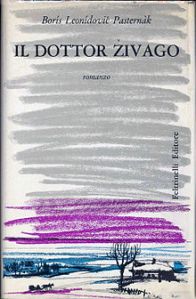
Doctor Zhivago: First Edition

Italian First Edition

The plot teems with life and death and it gives the reader a fascinating insight to the terrible realities of the struggle between the Whites and the Bolsheviks after the carnage of World War I. Pasternak was writing from a position of uncertain safety since he had fallen foul of Stalin’s regime to the extent that his book could not be published in his own country. The manuscript was eventually smuggled to Italy for publication. The translators of my edition, Max Hayward and Manya Harari (1958) pay tribute to Pasternak’s poetic prose style fearing that they haven’t done justice to his use of language.

Here is a passage from early on in the novel when Yuri’s wife Tonya has just given birth to their first child:

Raised higher, closer to the ceiling than is usual with ordinary mortals, Tonya lay exhausted in the cloud of her spent pain. To Yuri she seemed like a barque lying at rest in the middle of a harbour after putting in and being unloaded, a barque which plied between an unknown country and the continent of life across the waters of death with a cargo of new immigrant souls. One such soul had just landed, and the ship now lay at anchor, resting in the lightness of her empty flanks. The whole of her was resting, her strained masts and hull, and her memory washed clean of the image of the other shore, the crossing and the landing. 

I think the translators certainly did justice to one of the most moving passages on childbirth that I have ever read. Having said that, my grammar checker insists that the first sentence is a fragment and needs revising…proof if it is needed, that it’s not always wise to listen to machines…

I’ll be finishing Doctor Zhivago in a day or so (provided that I can pass the ‘Quick Pick’ shelf in the library without looking) and I will need to make a decision about the next Landing Book Shelves read.

More on that soon but meanwhile do drop me a line below or on Twitter if you have any challenging suggestions…

When Omar Met Julie: Doctor Zhivago on Film

I’m still reading Doctor Zhivago, having been side tracked by a couple of other books along the way. As I was getting further into the book, I realised that even though it is years since I last saw David Lean’s Doctor Zhivago, I still see Omar Sharif and Julie Christie in my mind’s eye as I read.

Doctor Zhivago

My Christmas Present…

That’s my excuse for this quick post featuring a lovely sequence of clips from the film. I hope you enjoy it; I’m just off to read a little more of ‘One of the greatest love stories ever told’.

I’ll post up more on Doctor Zhivago soon.

http://youtu.be/old4K4Tpo8c

Credit: Uploaded to YouTube on 17 Dec 2009 by IluvKenji (with thanks)

Musings on Tolstoy’s Women

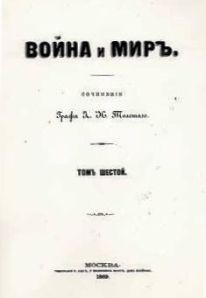
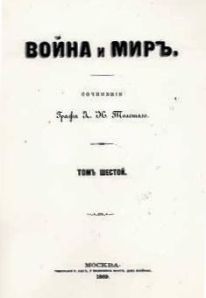
War and Peace, first edition

First edition, 1869

Now that I’ve finished my mammoth Tolstoy reading challenge, I’ve been trying to come up with an angle for a blog post on War and Peace without plot spoiling for any new readers. I was fortunate enough to begin Tolstoy’s opus with only a hazy idea of the plot and the knowledge that the background was Napoleon’s 1812 campaign. I studiously avoided discovering a synopsis of the novel, wishing to discover the intricacies for myself.

My search for a blog theme proved tricky, as I am sure you can imagine, working with such a long novel full of plot twists and turns. In the end, I have come down to the idea of looking at Tolstoy’s female characters, if I can do so without giving too much vital information away. The novel has a long cast list that includes several important female characters who are involved in the main threads of the drama. The women are members of the small group of families that the story follows during the years leading up to 1812 and the fall of Moscow. Here is a snap shot of some of Tolstoy’s women, as we meet them in Part I:

I think I will have to begin with Natasha (Natalie) Rostov as her part in the story is so crucial. The members of the Rostov family as a whole are very likeable but Natasha seems to be the bright, vivacious heart of the household. At the beginning of the novel, she is still a young girl who is not yet ‘out’ whose close companion is her cousin Sonja who lives as a sister with the family. The two girls are very close friends despite (or perhaps because of) their differing personalities. We first meet Natasha on her and her mother’s fête day, which was celebrated with a huge party attended by anyone and everyone. You get a glimpse of the daughter’s possible future in Tolstoy’s description of the elder Natasha as ‘evidently worn out with child-bearing – she was the mother of a dozen children. Her languid movements and slow speech due to her frail health gave her an air of dignity which inspired respect’.

All this is still a long way off for young Natasha who at this stage is still a child who ‘with her black eyes and wide mouth was not pretty but she was full of life’ and still enjoying childish games. Still apparently not much more than a child (and yet already with child) was Lisa Meinen, married to Prince Bolkonsky. Her first appearance is at a small party given by Anna Pavlovna who is one of the Empress Marie’s maids of honour. Lisa hardly seems to be a woman at all, but a child in grown-up costume. Everyone refers to her as the ‘little princess’ and ‘enjoyed seeing this lovely young creature so full of life and gaiety, soon to become a mother and bearing her burden so lightly’. The only person who seems not to be enamoured of the little princess is her husband, ‘the face of his pretty little wife was apparently the one that bored him most. With a grimace that distorted his handsome countenance he turned away from her’. I won’t say any more about their relationship in case I give too much away.

Prince Bolkonsky’s sister Marie is mentioned early on in the novel, during Anna Pavlovna’s reception as a possible bride for Prince Vasili’s son Anatole. He’s costing his father a fortune so a suitable heiress is required to plug the hole in the family finances. Princess Marie is devoted to her eccentric, tyrannical father and to her religious duties. Tolstoy mentions Marie’s ‘beautiful eyes’ several times but she is not beautiful or lively in the mould of Natasha or Lisa. She has a ‘heavy tread’ and a ‘thin, sickly face’ which appeared beautiful when her eyes shone with tears or emotion.

In complete contrast is Prince Vasili’s daughter Hélène who is very beautiful and fully aware of her charms, ‘she even appeared a little apologetic for her unquestionable, all too conquering beauty. She seemed to wish but to be able to tone down its effect’. Hélène is described by Tolstoy as being ‘statuesque’ which is a clear contrast to the delicate girl/woman figures of Natasha and Lisa. At this early stage of the story all we can glean about Prince Vasili’s daughter is that she has great beauty and a wonderful figure which she is not shy about displaying. She is a blank canvas compared to the other women, whose personalities we can glimpse soon after meeting them.  

I’ll leave my introductions to some of Tolstoy’s women at that, in the hope that if you have never tackled War and Peace, you do decide to at some point in the future.  As I mentioned before, I am continuing a Russian theme with Pasternak’s Doctor Zhivago which I will post about soon.   

How is your New Year reading going?


Doctor Zhivago: More Russian Literature

Doctor Zhivago

My Christmas Present…

This reading year is beginning briskly with Boris Pasternak’s Doctor Zhivago (Vintage Books) which is a new resident on the Landing Book Shelves. Pasternak’s epic novel was a Christmas present from He Who Put The Shelves Up to enable me to continue my Russian reading period after finishing War and Peace. I just managed to finish the latter on the cusp of the New Year and I can still feel a modest glow of success at that achievement. Now that I’ve finally read War and Peace I would like to go on to read more of Tolstoy’s work, so perhaps that might be a possibility for later this year.

I haven’t yet set any aims for this reading year but my broad plan will be to continue to tackle long neglected novels (and perhaps auto/biographies too). I was interested to come across a similar challenge on Twitter where writer Lynn Shepherd is inviting people to join her in reading Samuel Richardson’s Clarissa beginning tomorrow. A mammoth literary task if ever there was one (see @Lynn_Shepherd for more information and to join in).

I hope to tie up War and Peace with one more blog post (if I can manage to write something without plot spoiling) and I will give an update on the Doctor Zhivago progress as soon as possible. I’m toying with a couple more ideas for future reads as well, so watch this space!

Meanwhile why not drop me a line below to let everyone know about your 2014 reading challenges. Happy New Reading Year to one and all!

A Christmas Classic: A Christmas Carol

I hope you are all enjoying the Christmas break and managing to fit in a spot of reading in between dealing with the left-over turkey and stuffing. Here on The Landing we’ve been revisiting the old favourites, one of which is DickensA Christmas Carol (1843). I’ve been reading this aloud (but not, alas, in a very Dickensian manner) over the last couple of evenings. Last year we all went to see Clive  Francis performing his one man show of A Christmas Carol at the Mill Theatre in Dundrum, Dublin. While I can’t hope to emulate that fine version of the story, I have enjoyed our own reading of Scrooge’s Christmas journey towards a kinder, more generous life. And I still find Mr Fezziwig’s jolly party to be one of my most favourite episodes in Scrooge’s history.

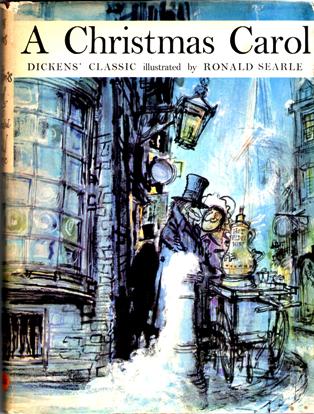
A Christmas Carol

Searle’s take on Dickens

Last Christmas I featured Dickens’ A Christmas Tree in my Advent series so it’s about time his most famous story got a look in here. This edition of A Christmas Carol contains illustrations by the wonderful Ronald Searle and was first published by Perpetua Books in 1960. I can’t remember when I acquired it, suffice to say it was several years ago when I was living in Birmingham. According to the title page, the book used to belong to a family from Moseley; now it seems to be quite settled on The Landing in Dublin.

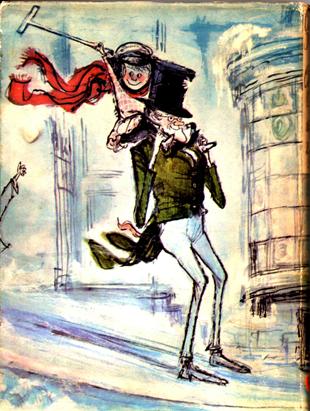
I would like to give you more of Searle’s illustrations, but I’ll have to content myself with scanning in the back cover for the present. You’d be hard pressed to find a better impression of Bob and Tiny Tim anywhere in print. And how else should the back cover be decorated except with a picture of Tiny Tim ‘who did NOT die’ and to whom Scrooge ‘became a second father’?

Tiny Tim and Bob Cratchit

A jolly way to end…

Wishing you all a very Happy Christmas from The Landing Book Shelves! 

More on the War and Peace Challenge

This short War and Peace post is a diversion from the actual text of the novel, being a clip from the 1956 film version of Tolstoy’s novel. I’ve never seen a screen version of War and Peace so recently I trawled  YouTube to investigate what adaptations had been made. Imagine the delight of a Audrey Hepburn fan on finding that the future the star of My Fair Lady (1964) once played the part of Natasha Rostov. I’m not sure that she was right for the role (possibly an unfair observation given that I’ve neither finished the book nor yet seen the film) but in the snatches that I’ve looked at she’s never less than as delightful as usual.

The clip below is taken from the scene depicting her first ball and her first dance with Prince Andrei Bolkonsky, which is the part I had got up to reading last night:

Having read that scene last night, I’d say that the filmed version doesn’t really capture Natasha’s experience of the ball or her emotions on dancing with Andrei; very Hollywood-ish. Neither am I convinced by Mel Ferrer as Andrei, though perhaps he was cast in the part as he was Hepburn’s husband at the time.

Meanwhile I am loving the novel, though I have broken it up with another couple of library reads. I’ll do a more detailed post next time.

Now all I want for Christmas is….

YouTube credits: uploaded on 17/5/12 (Movieclips)

War and Peace was directed by King Vidor and produced by Carlo Ponti

The First Bulletin on War and Peace

As I’m sure my readers will be pleased to know, my War and Peace challenge is making relatively good progress. Note that I’m hedging a bit here by using the word ‘relatively’ to describe my rate of reading. I have actually reached page eighty-five and I’m at the point where Count Bezuhov has suffered his sixth stroke and is not expected to live. Naturally enough the heirs presumptive are getting anxious as they can see a fortune slipping from their hands into those of Bezuhov’s illegitimate son Pierre.  I wonder what skullduggery may be afoot in the aftermath of the count’s death.

First Edition of War and Peace

First Edition, 1869

Already many aspects of human nature have popped up during the drama; I’ve met a diverse cast of characters in the action occurring between Moscow and St Petersburg. Not surprisingly I was rather taken with the younger players in the story, who were enjoying (and suffering) their first pangs of love. Natasha Rostov is delightful and I am almost apprehensive about what vicissitudes her life will throw at her, but I’m trying not to leap ahead and plot spoil for myself. I’ve never seen a film version of War and Peace and I’m studiously avoiding plot summaries that I’ve come across.

The thing that I find particularly fascinating is the sheer number of princes and princesses in the novel, to the extent that I’m tempted to try to find out just how many there were in Imperial Russia at that time. It also seems that having the title of prince or princess didn’t necessarily mean that you were wealthy. Having consulted Wikipedia, I’ve discovered that the titles of prince and princess belong to the titled nobility (which could be acquired) as opposed to the ancient hereditary nobility. Wikipedia goes on to point out that,

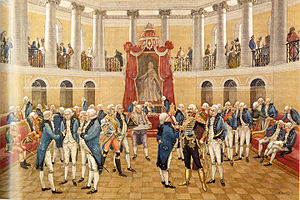
By 1805, the various ranks of the nobility had become confused, as is apparent in War and Peace. Here, we see counts who are wealthier and more important than princes. We see many noble families whose wealth has been dissipated, partly through lack of primogeniture and partly through extravagance and poor estate management. We see young noblemen serving in the Army, but we see none who acquire new landed estates that way’.  

A Noble Assembly

Nobles in the time of Catherine the Great

So presumably that accounts for poor old Princess Anna Drubetskoy desperately trying to obtain a placement and funding for her son Boris. This little bit is quite telling, ‘The mother smoothed her dyed silk gown, glanced at herself in the massive Venetian mirror on the wall and briskly mounted the carpeted staircase in her down-at-heel shoes’. A few lines above, her cloak is described as ‘threadbare’ which is noticed by a sharp-eyed servant.

I’m going to dive back into Imperial Russia now, having had a short break to finish a couple of library books, so I’ll hope to post up again soon with a further update.

Back soon….and if anyone else is tackling a hefty tome at the moment please let us know about it!

Picture Credits: Thanks to Wikipedia for the illustrations.

Tolstoy: The Next Landing TBR Pile Challenge

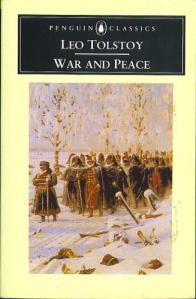
War and Peace

Cover shows detail from ‘The 1812 Retreat – The Battle of Borodino’ by Vereschagin

I promised you an announcement on the next stage of the Landing Book Shelves Reading Challenge and here it is at long last. As you will no doubt guess from the illustration, the challenge is the reading of War and Peace (Leo Tolstoy, 1828 -1910) a big hurdle if ever there was one. This worthy challenge has been put on the Landing Book Shelves agenda because it also happens to be my book group’s project at the moment, this killing the proverbial two birds. I’m not sure how long it will take me to read War and Peace (or how long it will take my fellow book clubbers for that matter) but I undertake to offer my blog readers reasonably regular progress updates. Weighing in at 1444 pages, this lengthy tome will be read in stages in between various other books.

It is just as well that the idea of reading War and Peace for book group came up as it is likely that it would have sat on the Landing Book Shelves almost indefinitely. I say ‘almost’ because I really and truly meant to get around to reading it sometime. I bought my copy in May 1992 with the intention of reading Tolstoy’s epic during my summer holidays. After all this time I can’t recall what I did read that summer, but it certainly wasn’t Tolstoy. So, it’s better late than never on the Russian classics front I suppose.

War and Peace was first published in 1869 (I’ll fill in the publication history in a future post) and the paperback edition that I have on The Landing was first published by Penguin Classics as a two-volume edition in 1957. The one volume edition came out in 1982; the translation is by Rosemary Edmonds from 1957 with revisions in 1973. I’m by no means an expert on the virtues of one translation over another so I will have to trust to the reliability of Penguin Classics in this instance. There are more recent translations available (for example from Penguin Classics and Vintage), but as this is the copy I have on The Landing, I’ll go with this one unless any reader out there tells me that I would be better served with a different translation.

I will be embarking for nineteenth century Russia just as soon as I’ve finished my library book and a couple of review books….I promise…

Finally there: The Frontenac Mystery by François Mauriac

The Frontenac Mystery

An evocative scene..

‘Before beginning a novel I re-create inside myself its places, its milieu, its colours and smells. I revive within myself the atmosphere of my childhood and youth – I am my characters and their world’ (François Mauriac).

This is the moment that you’ve all been waiting for (well I have at any rate) when finally I tackle the last novel in my Landing Eight sequence of books. After that I have another Reading Challenge lined up to tell you about, but more of that in due course. In the meantime I’ll put The Frontenac Mystery to bed and cross it off my TBR Pile with a sense of satisfaction. There have been many distractions along the way but I’ve finally completed reading the eight titles that I picked out last year. Still got lots yet to read though; but for now let’s move on with the book in hand…

I picked this book (one belonging to He Who Put the Shelves Up in fact) as part of my Landing Eight Challenge since I hadn’t read anything by François Mauriac (1885-1970) before and this seemed as good an opportunity as any to start. The edition of The Frontenac Mystery that we have at home is a Penguin Twentieth-Century Classics edition from 1986; the text was translated by Gerard Hopkins for the Eyre & Spottiswoode edition of 1951. Le Mystère Frontenac was originally published in 1933 by Bernard Grasset. For some background information on Mauriac here’s a link to his biography on the Nobel Prize page (he was given the Nobel Prize for Literature in 1952).

At the centre of the novel is the Frontenac family, a landed gentry family from the Bordeaux region (Mauriac’s birthplace); Blanche Frontenac has been widowed with five children to bring up and a family reputation and tradition to uphold. Her brother-in-law Xavier helps her as a fellow guardian and as a custodian of the family’s business and estate. As the novel opens, Blanche has been widowed for eight long years; she was a ‘tragic mother with the black eyes, and the sick, lined face, in whom the traces of a former beauty still warred with wrinkles and approaching age. Her greying, rather untidy hair gave her the neglected look of a woman who has nothing to look forward to’.

Blanche has become subsumed into the family into which she married and carries the pride and ‘mystery’ of the Frontenac name within her. Having said that, she resents Xavier for apparently being unable to see her as a person; he sees Blanche only as the mother of the next generation of Frontenacs and she believes that he doesn’t even really see her as a Frontenac anyway. Similarly, he also sees in the children the glory of the family and therefore ‘what gave them value in his eyes had nothing to do with individual qualities’. But it transpires that Xavier has a secret that would not reflect well upon the august name of Frontenac were it to become widely known.

The novel follows the lives of the family as the children grow up and assume their place within the mystique of the Frontenac name. The boys Jean-Louis (the eldest sibling), Jose and Yves are all very different characters and Mauriac explores their contrasting hopes and ambitions. The two sisters Danièle and Marie don’t receive so much attention, probably because the times and social position they were in would never have allowed them much choice. Tellingly, at one point in their childhood they are described by Mauriac thus, ‘ They were two little brood-mares in the making, and found an outlet for their maternal cravings in ministering to the children of various washerwomen and chars’.     

I’m not sure whether I really liked this novel as I didn’t feel much of a connection with or sympathy for many of the characters. They all seemed to be trapped in a web of their complex family history (and their pride in it)  that they all at times kicked against, yet ultimately submitted to maintaining. I did however, feel sorry for Xavier’s secret woman Josefa (who is not as much of a secret as he thinks) who lives patiently in the background since she isn’t deemed to be worthy of a life amongst the family Frontenac.  Xavier has conflicting emotions towards her, referring to as ‘shop-soiled’ but at the same time, ‘She was a kindly creature with a strong maternal instinct who did not laugh at him’.

Mauriac’s prose is beautiful and elegant but I think that the overall effect is cold and that the novel lacks that certain something that would draw me into the lives of the family. Perhaps it’s just that times have changed so much that it’s hard to imagine anyone devoting themselves so entirely to a collective without any consideration for the individual needs. The social segregation of Josefa from the family and her humble attitude towards them is hard to swallow. I would however, like to read something else by Mauriac (I will probably read this one again at some point) to delve a bit further into his world. It would perhaps help to read more on his life and the influences upon his work I think. Another project for the future.

And don’t forget that I promised an announcement on the next chapter of the Landing Book Shelves TBR Pile Reading Challenge! Tune in next time folks for an update…

If you’re also in Ireland, have a great Bank Holiday weekend.