W.B.Yeats

Having reached day thirteen of my #PoetryinJune Reading Challenge, we come to another literary festival marking the life of a famous poet. I have therefore decided to choose a poem by W.B. Yeats (1865-1939) in honour of Yeats Day today. This was originally the title poem from the Cuala Press volume (published in 1904) that I mentioned in my feature on Lily and Lolly Yeats. I have copied the text of this short poem from my Everyman’s Poetry edition which contains a selection of verse spanning Yeats’ career.

I first encountered Yeats’ work on my ‘O’ Level literature syllabus, which was more years ago than I care to remember. We also studied W.H. Auden and Wilfred Owen’s poetry, though sadly I don’t have a copy of the text-book. Since Auden has already had a spot in my #PoetryinJune series, I should certainly make room for Owen at some point this month. But in the meantime I hope you enjoy this evocative piece from W.B. As someone who tries to attract our stripey furry friends to the garden, I love the thought of the bees humming in the flowers in this scene. The contrast of the lime-tree flowers with paper flowers a few lines later seems to me to point up the beauties of the country.
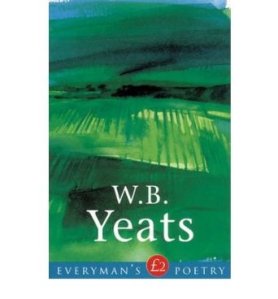
book cover of Yeats Selected Poems

Everyman paperback edition, 1997

In the Seven Woods

I have heard the pigeons of the Seven Woods,
Make their faint thunder, and the garden bees
Hum in the lime-tree flowers; and put away
The unavailing outcries and the old bitterness
That empty the heart. I have forgotten awhile
Tara uprooted, and new commonness
Upon the throne and crying about the streets
And hanging its paper flowers from post to post
Because it is alone of all things happy.
I am contented, for I know that Quiet
Wanders laughing and eating her wild heart
Among pigeons and bees, while that Great Archer,
Who but awaits His hour to shoot, still hangs
 A cloudy quiver over Pairc-na-lee.

There’s lots going on in Sligo today to honour its former resident and his creative siblings. The Yeats Society in Sligo was formed in 1958 ‘to promote appreciation of his poetry and other writings, and an awareness of the other members of this talented family‘. The society, based in the Yeats Memorial Building has been running both a summer and a winter school for several years as well as being involved in many other literary and cultural activities.

Click on the Press Release Link for more information about the Second Annual Yeats Day events in Sligo which runs from 8am until late.

Now, I must go and peruse the shelves for tomorrow’s #PoetryinJune verse…
Robert Louis Stevenson

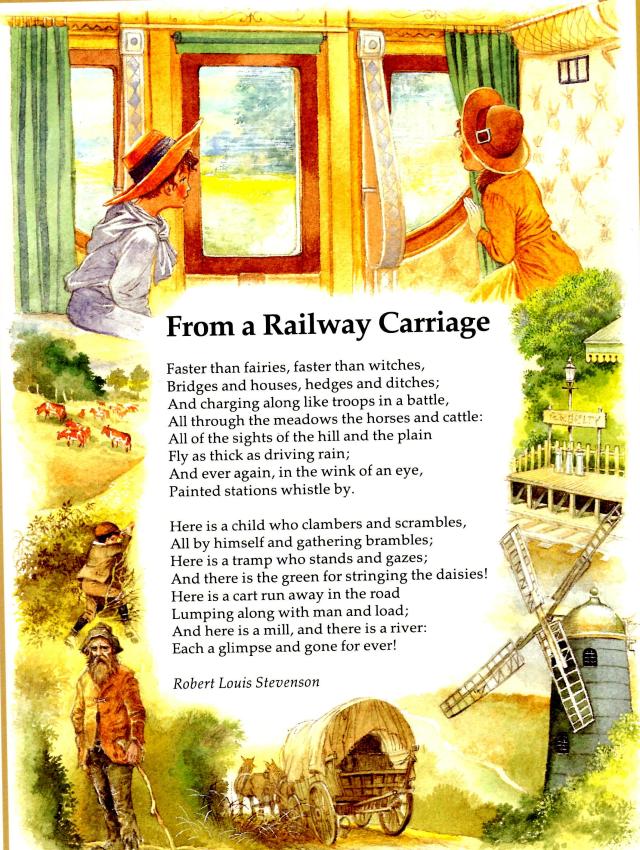
Yesterday I promised you one more poem about trains and here it is, right on time, from Robert Louis Stevenson’s (1850-1894) A Child’s Garden of Verses. This collection was originally published in 1885 under the title Penny Whistles. We have a nice Dover Publications edition (1992) with black and white illustrations but I have scanned the poem from an illustrated anthology, as the verse’s page has such an attractive border design.

The illustrations in A Children’s Book of Verse (Brimax Books 1978) are by Eric Kincaid and the poems selected by Marjorie Rogers.  This is a wonderful collection of poems, ‘Travel to the end of the rainbow, soar with eagles, fly to the moon, shiver with Old Jack Frost, delight in the animal kingdom, tremble in the underworld, dance with the fairies at the bottom of the garden or watch the seasons change’…you can also go on a train journey….

Text of Stevenson's Poem from a railway carriage

A wonderful train journey…

I like so many poems in A Child’s Garden of Verses that I opted for From a Railway Carriage since it had the dual effect of tying in with the previous train poems as well as meaning that I didn’t have to make a difficult choice. The collection encompasses many themes of childhood, such as playing games, going to bed, exploring and imaginary places. Poems such as My Bed is a Boat, The Land of Counterpane and My Shadow are timeless in their evocation of childish concerns.

And here’s a little extra one (simply because it amuses me):

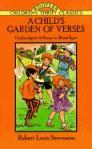
book cover of A Child's Garden of Verses

Childhood…

Auntie’s Skirts

Whenever Auntie moves around,
Her dresses make a curious sound;
They trail behind her up the floor,
And trundle after through the door.

(number xv in the Dover edition)

The verse conjures up a wonderful image; I hope that auntie never got her skirts caught up in the door…

I’ll leave you with a link to the Robert Louis Stevenson Website which is a comprehensive source of information on RLS and his work.

Look out for more #PoetryinJune verse tomorrow!

Letters and Trains: Auden

The Night Mail by W.H. Auden (1907- 1973) combines two of my favourites things, letters and train journeys. It was written to accompany a General Post Office (GPO) film made in 1936 about a London, Midland and Scottish Railway (LMS) mail train from London to Scotland. In the film, the music was composed by Benjamin Britten and The Night Mail was recited by John Grierson.

As the poem was written to tie in so closely with a train journey it has a great rhythm for reading aloud.  At this point in the poem, the Night Mail train has almost reached Glasgow, with postal workers beavering away on board all night. My dad used to be a postman (though he never worked on the night mail train) and I ordered the DVD of the film for him a couple of years ago (see a clip below) as a Father’s Day gift.

Of course, the fascinating thing about this poem is that it shows just how much people would have relied on the post for all sorts of things that we receive digitally these days. But where’s the romance in an email?

I’ve taken this poem from a collection that I picked up in a charity shop in Dublin a few years ago. It’s an interesting collection in that the editor Kaye Webb (1914- 1996) made her selection from around 1,000 recommendations from children so it is genuinely a children’s poetry book. I may return to it later in the month as it contains a few old favourites of mine.

The Night Mail (part III)

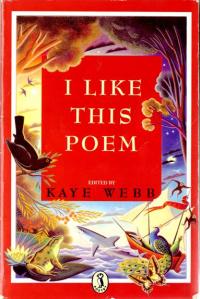
book cover of I Like this poem

Puffin Books, 1979

Letters of thanks, letters from banks,
Letters of joy from girl and boy
Receipted bills and invitations
To inspect new stock or visit relations,
And applications for situations
And timid lovers’ declarations
And gossip, gossip from all the nations,
News circumstantial, news financial,
Letters with holiday snaps to enlarge in,
Letters with faces scrawled in the margin,
Letters from uncles, cousins, and aunts,
Letters to Scotland from the South of France,
Letters of condolence to Highlands and Lowlands,
Notes from overseas to Hebrides –

Written on paper of every hue,
The pink, the violet, the white and the blue,
The chatty, the catty, the boring, adoring,
The cold and official and the heart outpouring,
Clever, stupid, short and long,
The typed and printed and the spelt all wrong,

And I love the last lines – they always make me a little teary –

And none will hear the postman’s knock
Without a quickening of the heart,
For who can bear to feel himself forgotten?

I thought I’d include a clip from the original GPO film that features the poem. This is the final section of the film:

Credits: clip taken from YouTube with thanks (uploaded June 2008 by Stephen Dowd)

Now, go on – write a letter to someone today!

Goblin Market

This will be the last fairy or other-worldly related poem for a while at least (honest). ‘Goblin Market’ does however, not only tie in with the themes of enchantment on recent days, but also because Christina Rossetti (1830-1894) inherited the mantle of Britain’s most famous female poet from Elizabeth Barrett Browning when she published this poem in 1862. I’ll talk more about Rossetti in a future post, but in the meantime here is a piece from her best known work.

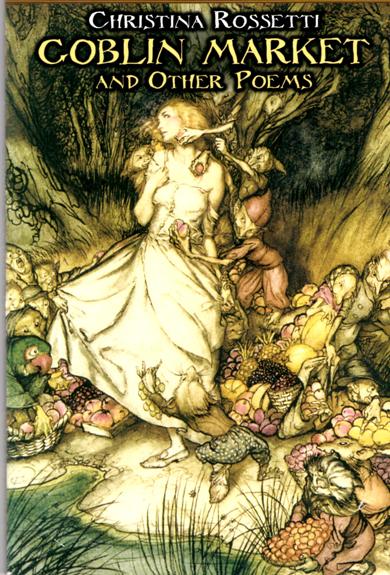
Dover Thrift Edition, 1994

Dover Thrift Edition, 1994

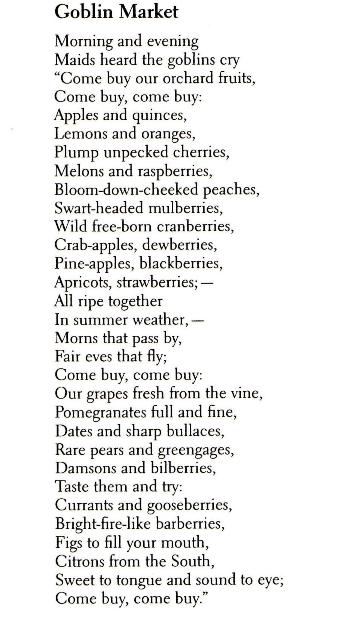
I have only included a small part of Rossetti’s  long poem and I decided to scan in the text from my daughter’s edition of Goblin Market as the type seems pretty clear. Let me know if it doesn’t seem to work with your browser. I mentioned the Dover editions previously and I am a big fan of this publisher’s reasonably priced classic re-prints.

rossetti

Of course, all of those luscious sounding fruits are only there to tempt the unwary, in this case two sisters named Laura and Lizzie who hear the call of the goblins touting their wares. Their cries of ‘come buy, come buy’ have an effect on one of the sisters but I won’t tell you which one just in case you don’t know the tale. Do read it if you get the chance.

That’s all from my Poetry in June sequence for today, I’ll leave you to the remainder of your weekend – but watch out for goblins selling unusually juicy produce if you are visiting any farmer’s markets today… 

Christopher Marlowe

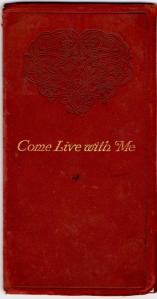
Today’s featured poem comes from Christopher (Kit) Marlowe (1564-1593) to coincide with Marlowe Day which is celebrated in Canterbury by the Marlowe Society every year. I have The Passionate Shepherd to his Love in more than one anthology, but my favourite example is the one illustrated here. There are just two further poems in this mini-collection which has no date, just the words:

Book jacket in red suede

An intriguing volume

London & Glasgow
Collins Clear-Type Press
on the title page. No editor or illustrator (line drawings and colour plates) is credited either so I have always been quite intrigued by it. The cover is red (though rather worn now) with a nice suede-like texture though I don’t know what material it is actually made from. It is another of my book sale acquisitions from several years ago and it has survived both house and country moves since taking up residence with me.

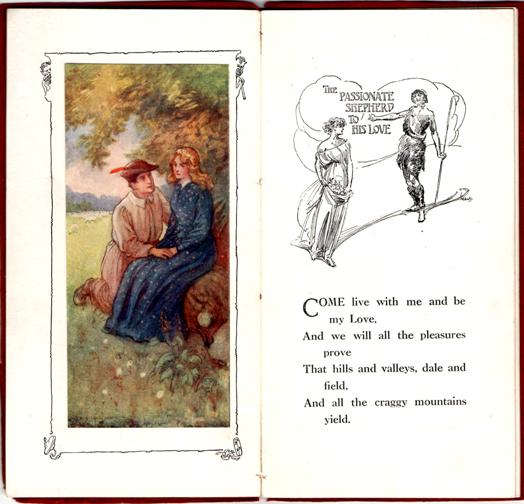
I have scanned part of the poem and its illustration to give you an idea of the style of the reproduction and I might include the remaining two poems (by different writers) later in the month. The Marlowe Society has plenty of information on Marlowe’s life and career and also discusses its position on the on going debate about the question of the authorship of Shakespeare’s plays. A few years ago I read Tamburlaine Must Die (2004) an excellent novella by Louise Welsh about the mysterious events surrounding Marlowe’s untimely death. Nobody will ever really know what happened but various writers have put forward their theories based upon what little evidence exists.

I know I’m beginning to sound like a school reading list in these posts, with suggestions for further reading but I find it difficult to resist the temptation to pass on ideas for a good read. Bearing that in mind, you could give The Reckoning: The Murder of Christopher Marlowe (1992) by Charles Nicholl a try.

First verse with illustration of two lovers

Beautifully illustrated

The final verse reads:

The Shepherd swains shall dance
        and sing
For thy delight each May-morn-
        ing:
If these delights thy mind may
      move,
Then live with me and be my
      Love.

 8th June is Marlowe Day – see you tomorrow for more Poetry in June.

A Sonnet: Elizabeth Barrett Browning

Sonnet (number XLIII) by Elizabeth Barrett Browning

How do I love thee? Let me count the ways.

book jacket of Poems by Heart

To love and remember

I love thee to the depth and breadth and height
My soul can reach, when feeling out of sight
For the ends of Being and Ideal Grace.
I love thee to the level of everyday’s
Most quiet need, by sun and candlelight.
I love thee freely, as men strive for Right;
I love thee purely, as they turn from Praise.
I love thee with a passion, put to use
In my old griefs, and with my childhood’s faith.
I love thee with the love I seemed to lose
With my lost saints, – I love thee with the breath,
Smiles, tears, of all my life! – and, if God choose,
I shall but love thee better after death.

I did mention yesterday that I was thinking of choosing one of Shakespeare’s sonnet’s before opting for some verses from a play, so today I have indeed given you a sonnet. This one by Elizabeth Barrett Browning (1806-1861) was originally written in 1845 and published in 1850 as part of a collection called Sonnets from the Portuguese. I have taken the sonnet from the small but beautifully chosen anthology published by Penguin Classics (2009) and selected by Laura Barber that is pictured above. I think I bought this originally as an ideal travelling companion as it is neat enough to fit in pocket or bag.

Elizabeth Barrett had been writing and translating poetry and essays for several years before she was introduced to her future husband Robert Browning in 1845, who later persuaded her to publish her love sonnets. My first awareness of Barrett Browning had been though the story of the couple’s love affair and elopement which was set against a background of parental disapproval and Barrett Browning’s invalid status. The film The Barretts of Wimpole Street (1934 version) made a great impression on me, as Charles Laughton was so terrifying as Mr Edward Barrett. All this for me, initially overshadowed her values and achievements. She wrote in support of the anti-slavery movement (her family money came from Jamaican plantations) and also of child labour reform legislation. By the time Robert Browning asked to be introduced to her, she was a very well-known and critically acclaimed writer.

If you want to know more about Elizabeth Barrett Browning’s life and work I can recommend a biography by Margaret Forster (1989) and also Lady’s Maid (1990) in which Forster went on to explore the life of Barrett Browning’s devoted maid Lily Wilson. For something more unusual, but well worth reading try Virginia Woolf’s Flush: a biography (1933) told from the point of view of  Barrett Browning’s pet dog which was given to Elizabeth by the writer Mary Russell Mitford. Finally, I have discovered that there is a Browning Society which promotes and discusses the work of both Elizabeth Barrett and Robert Browning.


MGM poster of Norma Shearer, Frederic March and Charles Laughton

Original film poster

More tomorrow!

(Film poster taken from Wikipedia)

More Fairies: Shakespeare

My choice of Shakespeare today is in honour of the Trinity Dublin Shakespeare Festival which is being held this week from 3-8 June. I have been to a couple of events so far and hope do more by the end of the week. My original plan for today was to select a sonnet, but I decided to pursue the theme of summer instead. Here, therefore is a short magical snatch from the action in

A Midsummer Night’s Dream:

Act II (Scene I)  – A wood near Athens     

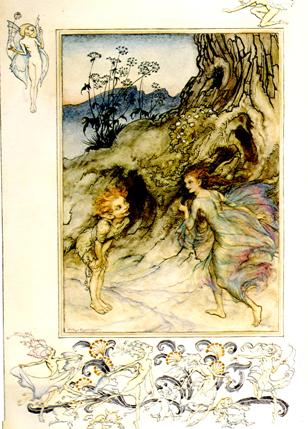
Puck and the fairy by a tree

Puck and the fairy


Enter from opposite sides, a fairy and Puck

PuckHow now, spirit, whither wander you?  

FairyOver hill, over dale
Thorough bush, thorough brier,
Over park, over pale,
Thorough flood, thorough fire,
I do wander everywhere,
 Swifter than the moony sphere;
And I serve the fairy queen,
To dew her orbs upon the green:
The cowslips tall her pensioners be;
In their gold coats spots you see,
Those be rubies, fairy favours,
In those freckles live their savours;
I must go seek some dew-drops here,
And hang a pearl in every cowslip’s ear.
Farewell, thou lob of spirits; I’ll be gone:
Our queen and all her elves come here anon.

I have had this illustrated edition for many years but sadly can’t remember where it came from, other than that I think it was probably from a book fair in the Birmingham area. That would put it around fifteen or more years ago, which is a scary thought.

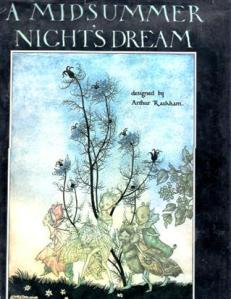
The illustrations are all by Arthur Rackham (1867-1939) and the text was written by calligrapher Graily Hewitt (1864-1952). The work was originally done in 1929 at the invitation of the Spencer Collection (New York Public Library)  This particular edition was published in 1977 by Weidenfeld and Nicolson Ltd and reproduced from the 1929 manuscript. I love Arthur Rackham’s work and maybe one day I might get to see his original drawings and watercolours. There is an Arthur Rackham Society if you want to discover more information about his work.

I hadn’t heard of Graily Hewitt before I owned this book but I have discovered that the Victoria and Albert Museum have holdings of his work. He was a very important figure in the world of calligraphy and typography and wrote The Pen and Type Design (1928) and Lettering (1930). The latter was last re-printed by Dover Publications in 1993 though it looks as if it is out of print now. This reminds me that Dover are a brilliant publisher for classic reprints and that perhaps I should do a post on their work sometime.

Apologies if the images don’t look as good as they might. I had problems scanning due to the size of the book.

Almost a week of poetry and poets so far….let me know your favourites so far!

Titania's fairies

Front of jacket


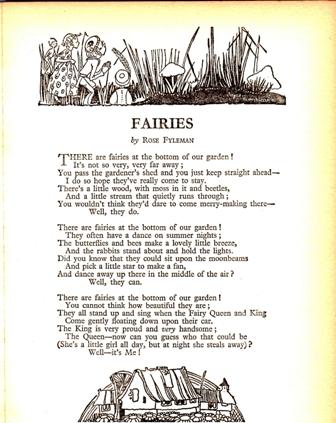
Rose Fyleman

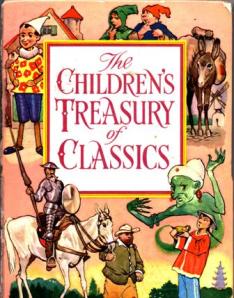
book cover with Aladdin, Pinoccio, Don Quixote

A childhood favourite

For the first of my ‘Poetry in June’ features I delved into the past –  to the Children’s Treasury of Classics that I mentioned in the last post . I have had the book (published by The Children’s Press) since I was a child, though I don’t remember if it was new when I had it. It is undated, though there is a pencilled price of 7/6 on the inside cover. The Treasury is now rather battered and the pages are yellowed.

I have picked out a poem by Rose Fyleman (1877-1957) which was originally published in Punch magazine in May 1917. Fyleman published many stories and verses for children over a very productive life. Her poems still appear in children’s collections today.

There is a nice continuity for me as this poem also happens to be one of our daughter’s favourite poems. And anyway, fairies in the garden seems to me to be a nice way to begin June. I have scanned in the page since I think the illustrations (by Joyce Plumstead 1907-1986) add to the piece, so I hope the text will be legible across different platforms and browsers. Drop a comment in the box if it doesn’t work for you.


text of Rose Fylman's poem Fairies

An old favourite…

I hope you enjoy the first day’s PoetryinJune choice. See you tomorrow!

Flaming June is Poetry Month #PoetryinJune

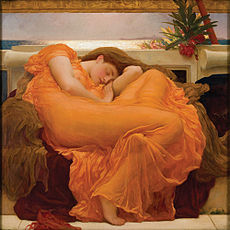
Woman in orange dress asleep on couch

Flaming June, Frederick Leighton, 1895

If you all cast your minds back to last December, you will recall that I set myself the daunting challenge of writing a seasonal posting every day during Advent. Somewhat to my surprise, I did indeed manage to do just that very thing. Ever since then I have in mind to attempt a similar challenge later in the year. Well, dear reader(s) that time has now arrived with the advent of spring (or what passes for spring in these parts at any rate).

To a great fanfare (well you’ll just have to imagine that bit) I am hereby announcing that the month of June will be Poetry Month (#PoetryinJune) on The Landing. I have been scouring the shelves here and blowing the dust off a few volumes that I have not looked at in a while. My intention is to put together a mixture of old and new(ish) poems, which will include a few childhood favourites too. My grand plan is to work out a complete list ready for June 1st but I may end up flying by the seat of my pants part of the way through the month.

I belatedly caught up with the poetry readings at the National Gallery of Ireland, which are run in association with Poetry Ireland. This has also helped to spur me into action and to include a sizeable chunk of poetry on the blog. Yesterday I was listening to Peter Sirr reading from both his own poems and his translations. One of the translations he read was Maison á Vendre (House for Sale) by André Frénaud both versions of which you can find on Sirr’s blog The Cat Flap.

I will have to apologise in advance if my choices for next month are not your choices but I will try to put together a reasonable mixture culled from our shelves. In fact, I have to come clean and admit that I never manage to read as much poetry as I would like. I am much more likely to pick up a novel or short story collection if I’m browsing and in need of something to read. Last year was supposed to be my year of reading more poetry so I picked up a couple of Faber volumes in a book sale to try and broaden my range but they are still languishing on the shelf.

Next month may then prove to be a voyage of discovery for me as there are clearly poetry books on our shelves that I have barely even opened. However, I will certainly feature a few poems from my childhood that have been read many times over and that are still enjoyed. This will, I hope even the balance a little and perhaps remind me of a time when I was more poetry minded than I am now. I used to have a Puffin collection of children’s poems and a Children’s Treasury containing stories and poetry. The latter still survives so I will choose a favourite memory from its rather battered pages for one of my blog entries.

At last Wednesday’s Poetry Ireland reading by Michael Krüger I jotted down his assertion that ‘a day without reading a poem is a lost day’. Let’s see what I can do about that during the course of next month.

Let me know about your favourites if you have time to drop me a line (use #Poetryinjune on Twitter).

(Picture Credit: Wikipedia – original painting in the Ponce Museum of Art, Puerto Rico)

Dolls on The Landing: Helen Clare

After writing a piece recently on Tara’s Palace for the Irish News Review I thought I would squeeze in a dolls’ house related post to further indulge my memories of childhood fantasies. Was I the only child who wished that some magic spell would turn me small enough to be able enter toy houses and shops? I doubt it very much. The dolls’ house stories by Helen Clare were entirely responsible for my particular fantasy. I so much wanted to be small enough to visit the doll’s bungalow that my dad had made for my birthday. Alas, it wasn’t to be!

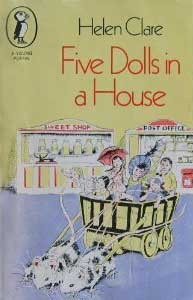
In Five Dolls in a House, (first published 1953) Elizabeth however, does exactly that. Magically she finds herself walking up the path to the front door and knocking. As she does so, she hears the voices of the dolls within:

And without thinking twice about it, Elizabeth walked into the house. She said nothing (she was too surprised) but followed the red-cheeked person into the house. 

Five Dolls in a House

Puffin edition, 1964, reprinted 1978.

If you have never met the dolls in Elizabeth’s dolls’ house then let me briefly introduce you:

Vanessa (she of the red cheeks) is rather bossily in charge of the household and is the daughter of a Duke (allegedly);

Jacqueline is the French paying guest who possesses lovely lace underwear;

Jane is a very sweet-tempered doll who always wears a long green nightdress:

Lupin by contrast is always clad solely in a blue woollen vest with a lot of dropped stitches;

Amanda is the lively, mischievous one who quarrels with Vanessa;

And last, but by no means least, is the monkey living on the roof who has been known to dress up as a duchess on occasion.

They all have lots of adventures with Elizabeth (in the guise of Mrs Small the landlady) including getting measles, acquiring two white mice to pull a trap and spring cleaning in their own inimitable style. I’m sure that Vanessa would have loved Tara’s Palace. She would have thought it ‘most genteel’, coming as she did from a castle (Cranberry Castle in fact).

I think all of the stories are now out of print, but they are well worth tracking down. My mum found the copy we have in Oxfam in Birmingham and we were lucky enough to spot even more adventures at last year’s Trinity College Book Sale.  All of the stories are complemented by Cecil Leslie’s delightful line drawings.

Do you have a favourite dolls’ house story? Let me know…