More catching up: Landing Eight Challenge

Murderers and Other Friends

Legal Memoirs…

In case you were all thinking that I had allowed my Landing Eight Challenge to fade quietly away, I will just slip in this quick post to let you know the next book to be read from the pile. After much deliberation I decided on the one remaining re-read in the pile (the other one having been Josephine Tey’s Daughter of Time).

I have opted to read John Mortimer’s Murderers and Other Friends (Orange Penguin edition) again. This title was grabbed for the Landing Eight pile because it has been several years since I originally read it. According to the note written in side the cover in my own fair hand, the book was a Christmas present in 1995. Try as I might though, I cannot recall from whom I received this volume of memoir (apologies to the unknown giver).

The trigger for picking up this book now and not saving the treat of a re-read for the end of my challenge, was that I happened to come accross a DVD of the first episode of Rumpole of the Bailey  while I was browsing in the library. Actually it would probably be incorect to call it a first episdoe since Rumpole first appeared  together with his wife Hilda (She Who Must Be Obeyed) in a BBC Play for Today in 1975. Rumpole became a series in 1978, produced by Thames Television. Mortimer’s memoirs of his work as a barrister were the inspiration behind Rumpole’s creation.

Now, I will re-aquaint myself with John Mortimer and report back in due course…

The Bones of a Good Story: Richard III

I was ridiculously excited to hear about the discovery of the mortal remains of Richard of York this week. Those of you who have been with me for a while will recall that one of my Landing Eight titles featured an examination of the alleged crimes of the Yorkist king. The Daughter of Time by Josephine Tey is one of my all time favourite books and was included on the blog as a re-read. As far as I know it is still in print, but if not, then this seems to be an ideal moment for a reprint of a title that is a great introduction to Richard III’s life and career.

I have found a couple of news snippets to illustrate the story of the research and discovery of the remains, including a fascinating piece about the facial reconstruction carried out:

http://www.bbc.co.uk/news/uk-england-leicestershire-21328380

As Phillipa Langley of the Richard III Society says, “It doesn’t look like the face of a tyrant. I’m sorry but it doesn’t. “He’s very handsome. It’s like you could just talk to him, have a conversation with him right now.”

The video below was taken from YouTube and produced by the University of Leicester:

After 500 years Richard III will once more formally be laid to rest. But what of his shady reputation? Perhaps it is time for another appraisal of his life and times; maybe he will yet be posthumously acquitted of his crimes. We will wait and see…

In the meantime, tomorrow  I welcome a visitor to The Landing, as debut author Sarah Moore Fitzgerald talks about the inspiration behind her time travelling YA novel Back to Blackbrick (published by Orion on the 7th February).

So enjoy catching with the news on Richard III and look out for another edition of #LandingAuthor here tomorrow…

John Buchan on film: those elusive thirty-nine celluloid steps

Orange Penguin cover of The Thirty-Nine Steps

Our edition of The Thirty-Nine Steps

As I mentioned previously, I watched one of the film versions of John Buchan’s classic adventure The Thirty-Nine Steps after reading it recently. The Hitchcock re-telling was one of my favourite screen versions, made in 1935 and starring Robert Donat (as Richard Hannay) and Madeleine Carroll (as Pamela). It was not until I read The Thirty-Nine Steps that I realised just how far were the screen versions from Buchan’s original story. I thought I knew the plot (more or less, a variation here and there perhaps) but now I concede that I knew absolutely nothing. Except that, thirty-nine steps (albeit with variant meanings) were involved and so was a large segment of rugged, almost deserted (except for the baddies) Scottish landscape.

For those of you who have never read The Thirty-Nine Steps, I will give a brief outline of the plot before
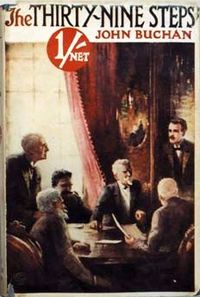
Cover of The Thirty-Nine Steps

A first edition of the novel

confusing you with the plot of the film: Hannay is a Scot, recently returned to the Old Country from South Africa who is heartily bored after three months. After an evening at dinner and a music hall show, he has determined to leave for the Cape if nothing interesting turns up within another day. Something certainly does turn up and Hannay finds himself fleeing across Scotland in several different disguises while in possession of a secret that could mean the difference between war and peace. Figuring out what or where the thirty-nine steps might be is a vital part of his un-looked for mission. As Buchan wrote the book in 1915, the plot’s threat, which involved the assassination of a European leader, was rather apposite. The Thirty-Nine Steps was Richard Hannay’s first adventure and it involves him in some tight moments and plenty of narrow escapes.

Moving on to the film version: I found to my surprise that whereas in Buchan’s original novel I found a distinct lack of women characters, two feisty ones pop up in the screen action. In the book, an occasional anonymous female supplies much-needed sustenance (fleeing dastardly spies is hungry work), but where, oh where is the glamorous Mata Hari type figure (Annabella Smith, played by Lucie Mannheim) that I saw in the film? In Buchan’s spy yarn, a mysterious American called Franklin P Scudder gives the vital information to Hannay. He does eventually wind up dead, but not as soon and arguably not as splendidly dramatically as Smith does.  In Buchan’s world, spying is obviously strictly a man’s game.
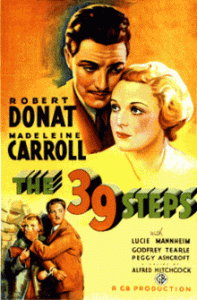
Film poster of Robert Donat and Madeleine Carroll

Film Poster

Hitchcock’s film further alters the female/male balance of the cast by adding the cool and elegant Pamela, to function as the ‘love interest’ part of the chase. I wonder what Buchan, who died in 1940 thought of the changes made to his story. He did not live to see the further screen adaptations, none of which was any more faithful than the 1935 film to the original tale. Carroll’s character is noticeably less exotic than the deceased Annabella Smith is but sparks soon fly between her and Hannay. Initially she disbelieves Hannay’s far fetched claims so betrays him to the police before finally realising that he was telling her the truth all along and so she helps him.

One side effect of playing with Google to research for blog pieces is that you find out other snippets of information. I found a site set up in tribute to Madeleine Carroll, who was apparently one of the few film actors to make a successful transition from silent movies to talkies. She was born in West Bromwich, England of an Irish father (Co Limerick) and a French mother and spent part of her early career with Barry Jackson’s Birmingham Repertory Theatre. A memorial was set up in her hometown in 2010 and an account of her life by Derek Chamberlain was published by Troubadour Publishing Ltd. If I manage to get a picture of her memorial next time I am in the area, I will post it up.

Follow the links given in the text for further information. Thanks to Wikipedia for the gorgeous The 39 Steps film poster and the shot of the first edition jacket.

If you are interested in further information about John Buchan’s life and work, I found a link to the John Buchan Society which has plenty of useful material.

Now, after John Buchan, which of the ‘Landing Eight’ shall I tackle next….Any thoughts?

A Centuries Old Mystery: Josephine Tey and Richard III

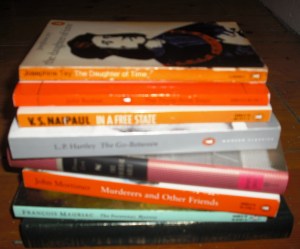
Cast your minds back to the post with the selection of the TBR Pile featured. I did say that I would be tackling them ‘in no particular order’ but the one I have been reading for the past few days was indeed at the top of the list. See photograph below for proof. The book in question is The Daughter of Time by Josephine Tey (real name Elizabeth Mackintosh) about Richard III and the Princes in the Tower mystery.

This was I think always going to be my first choice (it was the first one that I picked out as well as being the first listed). The reason being as I am sure you have guessed by now that this is a re-read of an old favourite of mine. The book was originally published in 1951 (the last book to be published in Tey’s lifetime as she died in 1952) and issued by Penguin Books in 1954. My edition is a 1969 reprint bought second-hand and it certainly shows: foxed is not the word for it I am afraid. The pages are heavily discoloured and threatening to fall out; both the front and back covers are damaged. Maybe one day I’ll treat myself to a new edition (I am not sure if the title is still in print) or a fine second-hand copy.

pile of classic novels

Working from the top down…

Two things make this book an old favourite: my affection for Josephine Tey’s crime novels and my long fascination with Richard III and the mystery of the princes in the tower. This fascination was in fact inspired by reading Tey’s book as I am sure was the case with many other readers. Indeed the Richard III Society credit her with helping to rehabilitate the king’s reputation and restore him to his rightful place in history. Shakespeare has much to answer for in his creation of the wicked hunchbacked uncle with a rather long crime sheet.

Tey’s novel features her regular detective character Inspector Alan Grant who is laid up in hospital after an accident and is terribly, mind numbingly, bored and frustrated. When his fascination with faces (from the bench or the cells?) causes him to become interested in the mystery surrounding Richard Plantagenet, the scene is set for a modern-day investigation into a historical crime. With the help of an amiable American student as his able-bodied research assistant, Grant delves into the murky doings of the fifteenth century. He is surprised by what he comes up with during his quest and is by no means impressed with your average historian’s powers of reasoning.

On the strength of reading this investigation into the Yorkist monarch several years ago, I did some further digging around and discovered more novels and academic studies on the subject. I then read as much as I could find on Richard and the Wars of the Roses and his eventual demise fighting at the Battle of Bosworth in 1485. I was keen enough on the topic to become a member of the Richard III Society though I eventually let my membership lapse. Having looked at the website recently I am tempted once more to become a Ricardian.

Meanwhile, back to the novel to follow-up a few leads! Are there any more Richard III enthusiasts out there? If so, let me know what you have been reading lately, I would love to know.

Just to finish with, here is a link to a fascinating site on Josephine Tey which is well worth a look if you are a fan of her writing.