The Past is Another Country: Culture Night

I am truly sorry about the miss-use of  that quotation in the title and have no excuse except that it just popped into my head and it seemed a shame to waste it. Just for the record, I have not yet actually begun to read The Go-Between and am still reading Bring up the Bodies. Anne Boleyn’s downfall is edging closer as I write so be prepared for copious amounts of bloodletting. And now on to a snapshot of our Culture Night’s activity…

As I said in my last piece, I was itching to get out and about to catch up with a few as yet unvisited cultural venues. At risk of sounding rather like a cultural box ticker, I did manage to cross three places off my list of ‘I must it do sometime’ activities. My brochure was a mass of ticks by Friday evening so I knew that there would be no hope of doing everything on my list. As it turned out, the first port of call for my fellow culture vulture and I was a late entrant to the event, not even mentioned in the brochure (though listed on the website) so that counts as a bonus point.
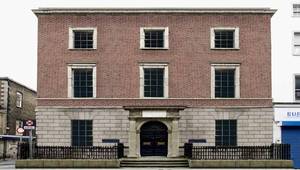
Assembly House

Dublin City Assembly House

Our bonus venue then, was the former City Assembly House in South William Street, which is due for a restoration programme by the Irish Georgian Society in partnership with Dublin City Council. I have long wanted to have a peek inside the elegant looking building but have never seen it open. Sadly, the interior fabric desperately needs attention from some dedicated craftspeople to restore its former glory. According to IGS’s literature, the group is looking to raise a staggering €2,000,000 to finance the restoration. When finished, the building will be the headquarters of the IGS and is also to be restored to its original function as a venue for exhibitions and other cultural events. The plan is to have the restoration completed in time for the building’s 250th anniversary.
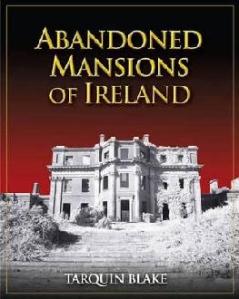
Abandoned Mansions

Tarquin Blake’s first volume

The building dates from 1765 and was the first purpose-built public exhibition gallery in Ireland. Wandering around the still gracious rooms, we could mentally step back in time and imagine how they must have looked. The double height octagonal exhibition room (once the city assembly’s meeting room) featured a collection of Tarquin Blake’s photographs of abandoned mansions of Ireland. He has recently brought out a second volume of images published by The Collins Press (see the illustration taken from the publisher’s site). It seemed strangely apposite to be viewing pictures of ruined buildings in this venue, which while not a ruin itself, clearly needs the planned intervention to prevent it becoming one. These images of ruined mansions and castles attest to a past that was indeed a very different place. Some of the mansions simply fell into disuse and became ruined while others were actively destroyed. Either way, looking at the pictures produces very mixed emotions. The owners of these houses lived very privileged and protected lives unlike the vast majority of people. Having said that, the house would have been a source of employment in the area and was a whole community in itself.
Abandoned Mansions II

More brilliant images…

I will follow the restoration process of the City Assembly House with interest and I hope one day to stroll around an exhibition in the finished rooms. If anyone is interested in the Irish Georgian Society’s activities, follow the link here and to check out Tarquin Blake’s gorgeous books click here.

And now, I’m off to read for a while…let me know what you’re reading at the moment!
Planning Culture Night: Landing field trip

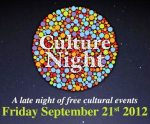
Culture Night is still a few more days away and already I am anticipating an evening of cultural entertainment. I do realise that the Landing Eight Reading Challenge should be my paramount concern, but Culture Night comes but once a year (just like Christmas only less expensive) and is not to be missed.

Culture Night 2012 Logo

It’s that time of year again..

I have been scanning the programme and trying to work out how many items I can feasibly fit into the evening (allowing time for refreshments of course). High on my list of priorities is a tour of the Freemason’s Hall, which is one of the decreasing numbers of yet unvisited places of interest in Dublin. I tried to get to see it last time it was opened to the public but the queues snaked down the road and round the corner. I am quite clearly not the only nosy (I mean cultured) person in Dublin.

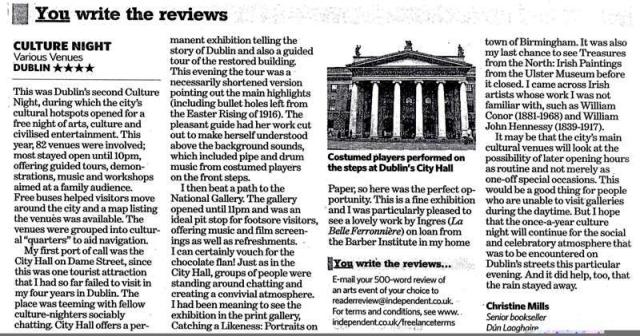
I was thinking of sticking to the South Georgian Quarter this time round, but who knows what might happen when I get the cultural bit between my teeth once again. It did occur to me while planning this year’s activities that I had written a short piece for the Reader Review column of the Independent newspaper (UK) in 2007 when Culture Night was still in its infancy. I managed to dig out a photocopy of the newspaper cutting to scan into the blog (my technological skills increase with every passing day). It is clear from looking back to 2007 how much the event has grown in five years, even spreading far beyond the confines of Dublin.

text of review

Review from the Independent (UK) (2007)

I wrote a piece this week for the Irish News Review about the up-coming 2012 event in which I mentioned that this year sees 134 venues participating in Dublin alone. It is a tribute to the hard work of all of the institutions, venues and organisers involved that this event has gone from strength to strength as it has. I will be out doing my bit to support the event on Friday evening (with a book in my bag of course!).

There will be a return to book talk for the next Landing post, but if you do get out and about for Culture Night, wherever you are, drop me a line and share your culture fix.

From Landing to Walls: Romans and Rows in Chester

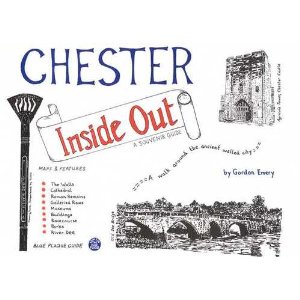
Black and white sketches of Chester

Chester Guide

The landing has been rather quiet of late as I have been away visiting my family in Birmingham for a few days. On my travels, I spent a day in Chester for the first time in many years. Though I did remember some of the city’s general features, my memory failed me on the detail. I definitely remembered the Chester Rows and I knew there were Roman remains somewhere in the city but the rest was rather hazy. Therefore, I was delighted to discover an informative souvenir-walking guide at the railway station.

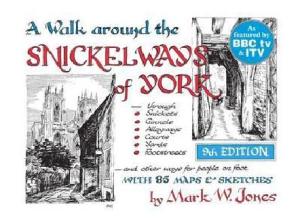
Chester Inside Out by Gordon Emery (1998) is as much of a pleasure to sit and read, as it is to use as a conventional guidebook.  The book abounds with maps, sketches, suggested walks (with detours) and snippets of Chester’s long history. The landscape orientation of the book’s page layout and its facsimile handwritten text owe a debt (acknowledged by the author) to Mark W Jones’ A Walk Around the Snickelways of York (1983, 2010).

Black and white sketches of York

Passages, walls and alleyways…

The latter title is now on its 10th edition so the formula obviously works. This type of guide has plenty to offer and can be enjoyed in different ways. I have been sitting reading my Chester guide and traversing the streets in my mind’s eye. Sadly, I have also been realising what we missed seeing on our short trip. An added bonus to walkers is the spiral binding on the book; a plastic rain cover would be perfect but you cannot have everything I suppose.

York and Chester have much in common, both being fine examples of walled cities with a history stretching back to the Roman occupation. What better way to get to know a city than to be able to walk around it atop a wall with wonderful views of the neighbourhood. In both York and Chester you really get a sense of how the cities have developed over the centuries, as the inhabitants gradually built beyond the old city walls.

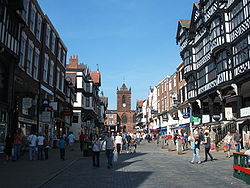
Where Chester is unique however is in its galleried streets of shops known as The Rows whose origins lie in the 14th century. The guide-book tells us that the first shops were probably built as a result of a disastrous fire in 1278. I could have spent hours just wandering up and down and window shopping (see picture below, courtesy of Wikipedia). Much more atmospheric than browsing in a glass and concrete shopping centre.

The Rows have certainly changed over the centuries:

If you could make your way along the creaky boards from one shop to another you would have to dodge displays of goods on the floor, walls, and hanging from the rafters; while stalls on the outside of the galleries dimmed the light.

A view of some of Chester’s Rows

The Chester guide is also handy if you want to go Blue Plaque spotting around the city as each one is marked on the walking route maps. At a reasonable £7.95 it was well worth the money and it will now nestle on a shelf next to my York Snickelways guide until called into service again. I wonder if anyone else has produced a similar style of city walking guide for other historic cities? I can feel a quest coming on (and a possible new collection).

If any readers have come across any such books I would love to hear (purely in the interests of research of course!)

Literary graveyard visiting in St Nahi’s Churchyard

Before I get stuck into my latest post I want to thank all of the people who have followed this blog so far. I am very grateful for the vote of confidence and I shall try to keep up my blogging efforts. Now, down to business….

This is an out-and–about post which ties in with the The Blurb page on the Cuala Press that I mentioned in the last post. I said in that piece that I had discovered to my surprise that the Yeats sisters Lollie (Elizabeth) and Lily (Susan) were buried in St Nahi’s Churchyard, Dundrum (part of Taney Parish). It has taken me some months but I finally got around to visiting the churchyard last Saturday afternoon.

For a short while, the sun shone so The Bookworm and I decided to look for the Yeats grave and generally explore the churchyard a little (possibly this is not everyone’s idea of summer holiday entertainment). After wrestling with the latch of a squeaky iron gate we let ourselves in and located a sign with the map of the burial plots.

Fortunately, an enterprising person has prepared a Podcast tour of the churchyard featuring notable names buried at St Nahi’s. While this was not on our agenda for the day, it did mean that the numbers allocated to the stops on the tour came in handy for our mini self-guided tour. We therefore found the grave (number 7) we were searching for easily enough, which looks towards the nearby Luas Green line (not that it was around at the time the sisters were buried I hasten to add).

I forgot to take photographs of the graveyard but I did find this video tour of the churchyard produced by Taney Parish on You Tube. The video has a bonus in that it shows the interior of the church (closed when we were there) with some shots of tapestries behind the altar that were made by Lily and Lollie Yeats. The video was made in 2009 and so is fairly recent and gives a useful overview of the history of the church and burial grounds, as well as highlighting the particular bit in which I was interested. Look out for the lovely stained glass (including some by Evie Hone) too.

I am still amazed that my technological skills have stretched as far as putting a copy of the video into my post so I might just quit while the going’s good and go and put the kettle on. Many thanks to Taney Parish for the fascinating tour of St Nahi’s Church and grounds. I would still like to find out exactly where Cuala Press was situated and whether the building still exists so I would love to hear from anyone who can point me in the right direction. I believe it was on Lower Churchtown Road but as I can’t be sure if the building still stands I’m a bit stuck at the moment.

Next time I post I will hope to have a positive report on the progress of the Landing Eight Reading Challenge to give you…..

March 2024 update:

Follow the link to The Yeats Sisters website celebrating the life and work of the sisters, with information about the first Yeats symposium in 2023 and advance notice of the second one due to be held in July 2024.