Mystery and Beatrix Potter

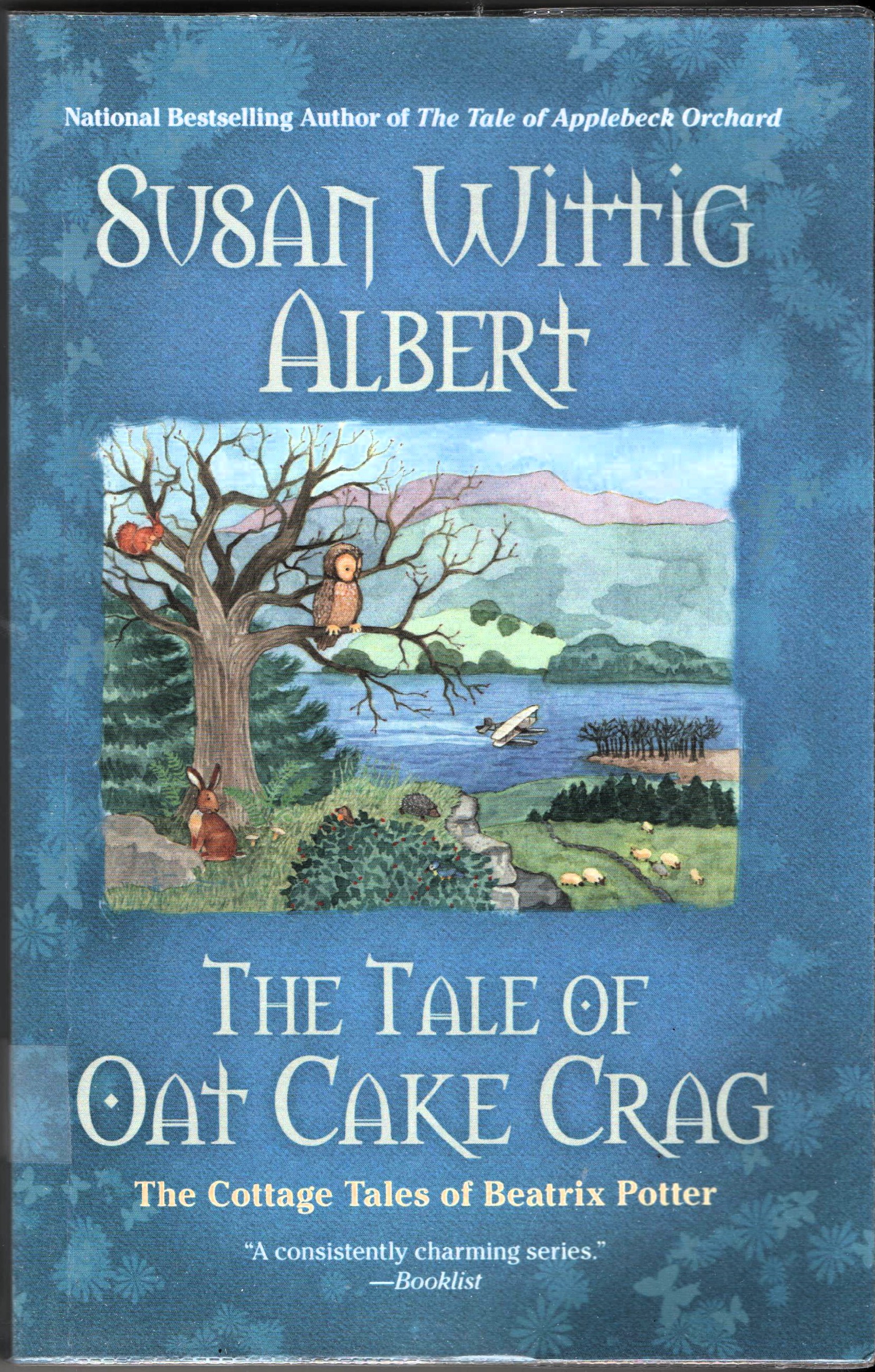
Front cover of The Tale of Oat Cake Crag by Susan Wittig Albert

The Tale of Oatcake Crag (2010) by American mystery writer Susan Wittig Albert is a curiosity that I came across in my ongoing search for detective stories featuring historical figures. Similarly to spotting the Groucho Marx crime series, I was so intrigued by the premiss of Beatrix Potter (1866-1943) as an amateur detective that I searched the online library catalogue to see what I could reserve. As before, I was forced to settle for a large print edition, as there is very little else of this series available nationally. So it is thanks to Cork City Libraries for the loan of this Chivers edition.

I was not sure what to expect from the novel, but I was not really surprised that this turned out to be a very gentle country tale indeed. No bodies in libraries, trains or anywhere else for that matter. It is one of a series, (The Cottage Tales of Beatrix Potter) imagining children’s writer Beatrix Potter as an amateur detective in her Lake District home and mixing real-life people with fictional characters. The eight-novel series began with The Tale of Hill Top Farm (2004), set around 1905 when the real Beatrix Potter’s fiancé Norman Warne has sadly died aged only thirty-seven. Potter subsequently bought Hill Top Farm in Near Sawrey with the proceeds from a legacy and the proceeds from her Peter Rabbit book, having become very attached to the Lake District over many years of visiting. She spent as much time as she could in this part of the country, when she was able to leave her parents for a while. Locations in the village feature in her books and illustrations.

Now, I have not read the earlier stories for comparison, but as I said, this one is very much in the cosy crime vein as there is indeed no murder (bloody or otherwise). The central mystery in the novel is the authorship of some poison pen letters, sent to the Vicar’s fiancée, Grace Lythecoe, apparently a respectable widow. Who would want to threaten the happiness of the seemingly well-liked couple? Grace asks her friend Beatrix to investigate the matter, which she does with the help of her present (unofficial) fiancé, William Heelis. The village animals also contribute to the investigations, which along with the dragon (yes, I did say dragon) requires a suspension of disbelief on the part of the reader.

The fictional poison pen letter affair is set against action inspired by real-life events; the literal ups and downs of the test flights of a hydroplane and the aggrieved local reaction to this. The test flights took place from 1911-12 and Wittig Albert has used details of the regular test flights over Lake Windermere as part of a sub-plot. The businessman backing the sea plane project has a fall and is seriously injured. An accident? Possibly suspicious, but again, no murder. Some details relating to the sea plane’s history in Windermere have been substantially altered but you will have to read the book to see what I mean (clue: the dragon is involved).
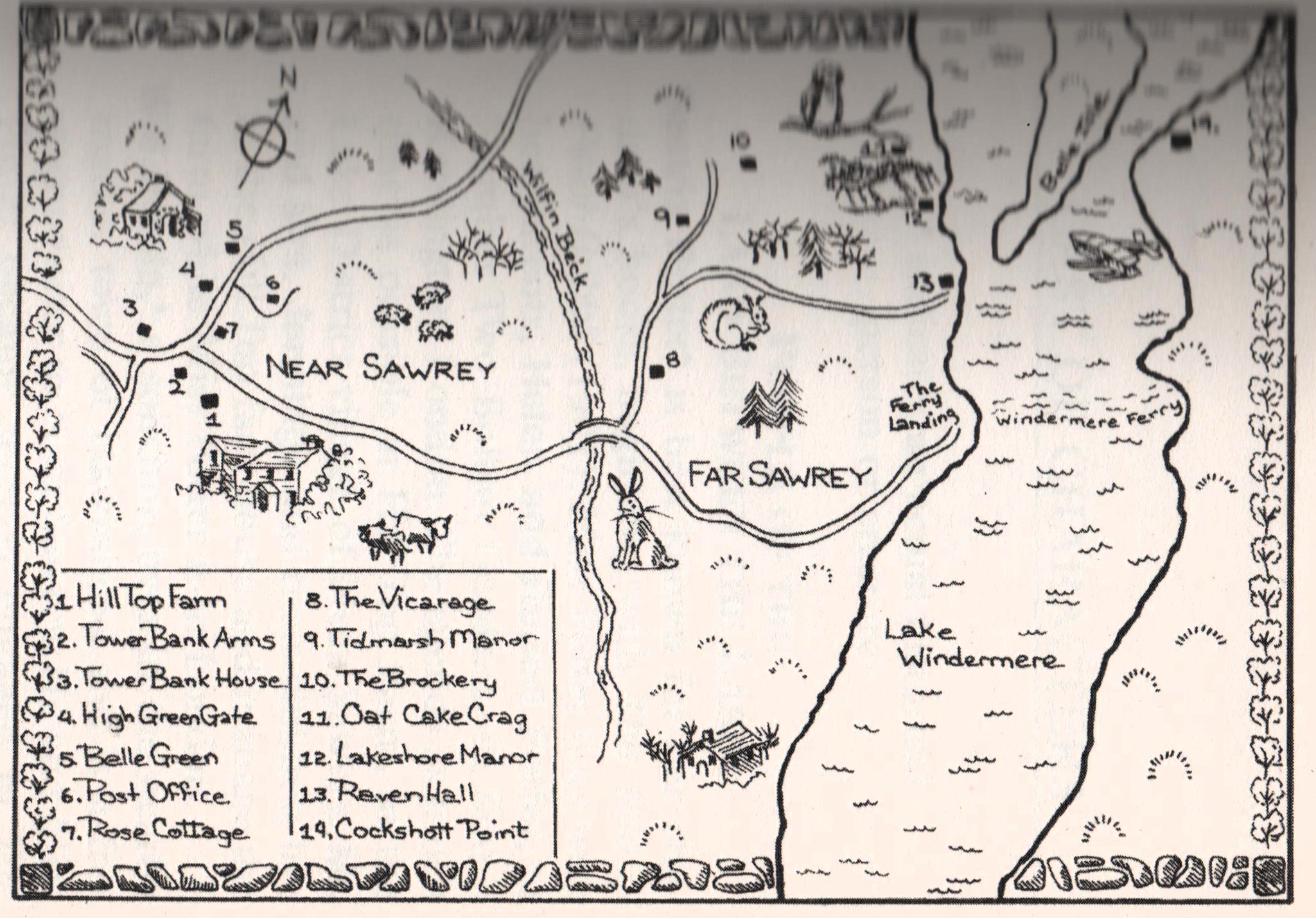
A map of Beatrix Potter's village
Map of the villages of Near & Far Sawrey, taken from the book.

We have gossip galore amongst the villagers of Near Sawrey, on the shores of Lake Windermere (though it has to be said that it is not merely the humans who gossip). However, with the chapters alternating between human and animal protagonists, it can really feel like reading a Peter Rabbit story for grownups. The author uses Potter’s affinity with animals to suggest that she can interpret what they are saying. Overall, this all has its charm but it does make me wonder who exactly is the intended audience for the series. Beatrix Potter solving the poison pen letters mystery is oddly convincing, as she does this by chatting to various people on her village rounds, in a perfectly natural way. She is very much a respected figure in her adopted home and her social class plays its part too. The overriding impression of reading this novel (if you discount the talking animals and a glowing green dragon) is of the dramas of village life as told in Miss Read’s tales of village goings-on in Fairacre and Thrush Green.

The descriptions of the area around Lake Windermere are beautifully done, as for example here, ‘I think it is fair to say that there is no place on this earth that gives the sun so much pleasure as this lovely green land, with its rambling rock walls, quiet lanes, tranquil waters, and long sweet silences.’ Lake District village life of the 1910s is well recreated, although with an awareness of the increased threat to the landscape from so-called progress. As Potter fans will know, she was instrumental in helping to preserve the landscape that she loved, via the National Trust, for future generations. At the end of the book, Wittig Albert includes some traditional recipes (though sadly without a conversion from cup measurements) as well as a glossary of local expressions, presumably aimed at her American audience.

I am not sure whether I would go out of my way to read another in the series, but this was an amusing and entertaining addition to my list of historical detectives. And all the better for not trying to shoehorn Potter’s fictional persona into a grittier or feistier role. I am still not convinced about the dragon though. Perhaps it deserves its own series.


Ireland Reads Day 2025

Ireland Reads logo

Today is Ireland Reads Day, hence the almost unprecedented phenomenon of three blog posts in one month. I have not marked this date in the reading calendar on The Landing blog in recent years, so I thought I would chip in with a bookish update this year to make up for that lack.

In the interests of sharing reading inspiration, I will give a quick rundown of what is currently awaiting/occupying my attention. Or should I say, what is immediately holding my attention, as to do any more would require extensive auditing of the Landing Book Shelves. The extensive TBR Pile is very extensive indeed. So much for the blog’s core aim of reading my way around the shelves. I am not sure that I have come very far in the twelve years that I have been book blogging! But, on with some book notes …

Having curtailed my book buying in favour of trying to read what I actually have on the shelves is good, but those library loans will tend to keep on creeping in. My library audio book of the moment is The Winter of our Discontent by John Steinbeck (narrated by Jeff Harding). Attentive readers of this blog will know that I usually listen to crime on my bus rides, so this is something of a departure (no pun intended) for me.  So far so good, though I have tended to doze off once or twice on the way home while listening. This is I am sure, no reflection on either Steinbeck or Harding, merely that after a day’s work a little bit of tension goes a long way towards keeping me awake. Though it is fair to point out that tension in the narrative is now growing as Ethan Hawley puts aside his previous scruples to improve his financial and social position.

I have several TBR library books at the moment, two of which are advance reading for a short Irish literature course that I am planning to take in April. In addition, and in no particular order are: The Death of Nature by Bill McKibben, The Millstone by Margaret Drabble, At Dusk by Hwang Sok-Yong and The Longest Afternoon: the 400 Men who Decided the Battle of Waterloo by Brendan Simms. As is often the case a moment of serendipity played a large part in the borrowing of these titles. I am a sucker for the trollies of the ‘Just Returned’ items. On the future ‘commute pile’ (I just invented that term) is One Big Damn Puzzler by John Harding (read by Peter Brooke), which is allegedly ‘painfully funny’, so that should surely keep me awake on the trip home. I will let you know.

At this stage of the year, I am still working my way through books I had for Christmas. One of these was Art History without Men by Katy Hessel, which I am dipping into in between novels. I have met some familiar artists, but also some new names to follow up on at my leisure. I may return to this one for a future blog post. Also on the Christmas pile is The Hidden Life of Trees: The Illustrated Edition by Peter Wohlleben. This I have yet to read, although I have browsed the photographs, which are absolutely fabulous.

Well, that is a quick snapshot of reading-in-progress chez The Landing, so I will go off into a quiet corner and carry on reading. I hope you have a pleasant Ireland Reads Day! Do let me know what you have been reading in the comment box below.

My Audio Crime Habit

I have previously written about my audio crime habit that livens up my rather tedious bus journeys into work. Well, I am here to tell you that both the audio and the crime bit are still going strong as part of my travel routine (that’s just as well as bus travel has been more than woeful in the last couple of weeks). Lately, I have been listening to a mixture of new-to-me authors as well as an old timer. And of course, I continue in my time-honoured habit of beginning any new series in the wrong place (in other words anywhere but at the beginning). My excuse is that I tend to pick up whatever catches my eye in the library, so that I often fail to get the titles in chronological order. Or at least, I don’t often have the patience to make a reservation from an author’s backlist so that I can ‘begin at the very beginning’ as Julie Andrews once so cheerfully sang.

I was particularly pleased finally to get around to Ray Celestin and his City Blues Quartet. Naturally, I inadvertently began at the end; but hey, at least I know who does and who does not end up dead by the final episode (never fear, I won’t plot spoil).  The last in the series is called Sunset Swing (2021) and is set in Los Angeles, Christmas 1967. The story features three recuring characters, retired private eye Ida Young; mafia fixer Dante Sanfelippo and the one and only Louis Armstrong. The city itself is a stunning character in its own right. Now I have to go back to the beginning at some point and see how it all began (Chicago, 1919 was the time and place) as I enjoyed this book so much. As always with an audio book, the narration is very important and can make or break an audio version of a novel; Christopher Ragland did a really good job.

Again, true to tradition I picked up Peter May’s The Lewis Man (2011) which is the second in the trilogy set on the Isle of Lewis (though I have spotted that a fourth book came out in 2024, so surely this is now actually a quartet whether originally intended or not). This is a murder mystery which begins with the discovery of a body in a bog where seasonal peat cutting is taking place. For me, the bog body was the hook, having long been fascinated by the discoveries explored in the National Museum of Ireland. Perhaps not surprisingly, in this story the body turns out to be much more modern than that; an Elvis tattoo was a dead giveaway on that score. Reading the (well, listening to) descriptions of the landscape of the Outer Hebridean islands made me really want to visit, despite, or perhaps because of the bleakness. At some point I will probably read the rest of the series, especially as I became quite invested into two of the main characters, Fin Macleod and Marsaili MacDonald.

Then for something completely different, I listened to Why Shoot a Butler? By Georgette Heyer (1933) a blast from my reading past as It has been quite a while since I last read any of GH’s novels, whether historical or detective. I started with her Regency romances as a teenager and then found my way to her contemporary crime novels later. In this novel the butler is the murder victim as opposed to the trope of ‘the butler did it.’ But of course, there had to be a motive for killing an apparently harmless servant. What is it? This is one of those Golden Age of crime plots where gifted amateur detective, barrister Frank Amberley runs rings around the rural police force. This probably isn’t my favourite GH crime novel, but still an entertaining listen with some very funny lines. If you have read her Regency novels you will be able to spot the character types that she has transposed to the contemporary setting.   

Sadly, not everything that I want to listen to is available in the Playaway MP3 unit format (see picture) which Is the audio version I favour for being out and about (or should I say, for being confined to public transport on wet mornings). Which, in a way is handy as I am likely to pick up something that I might not otherwise choose, if I find in a catalogue search that my first choice isn’t available in that edition. What I would love is if some of the British Library crime reprints were produced in the MP3 format. Now that woould make me a very happy bus traveller!

It is probably time to browse the library shelves again…

Jane Austen: Private Eye

Today’s blog topic is a hangover from last year, when I had the idea of delving into detective novels featuring real historical figures. I had a search around and came up with a few possibilities but only got as far as one blog post. Until now, that is. I have been having a further delve into this type of fan fiction and come up with a few more historical figures to think of as fearless detectives.

After previously riding along with Ron Goulart’s Groucho Marx on his cross-country crime solving, I have taken a trip back into Georgian England to encounter writer Jane Austen (1775-1817) in hitherto unsuspected detective mode. Austen has obviously struck a chord with some crime writers, as I have come across no less than four attempts to portray her as an amateur detective. In addition, I have discovered that she is apparently something of a time traveller too. There may be more crime, or indeed, time travelling Austen adventures out there that I have not yet discovered. Here are the crime novels that I have found so far:

An Austen crime series by Stephanie Barron, an American writer, originally from New York. The series began with Jane and the Unpleasantness at Scargave Manor (1996) and runs to ten books.

Miss Austen Investigates by London born and bred writer Jessica Bull (Michael Joseph, 2024). This is the first in a new series, the second novel being The Hapless Milliner.

Jane Austen Investigations: Death of a Lady by Laura Martin, Sapere Books, 2023. This is the first in a series of five novels by the Cambridgeshire based author.

Jane Austen Investigates: The Abbey Mystery by Julia Golding (for younger readers).

I have dipped into the Austen criminal world with the above-mentioned Stephanie Barron novel and the first of the Jessica Bull novels. Each author depicts Jane at a different stage in her life, Jessica Bull choosing to begin her series in 1795. Here is a youthful Jane, a writer but not yet a published author. She is engaged in a flirtation with Tom Lefroy and hoping that he will propose. As Austen aficionados will know, the desired proposal does not materialise due to family intervention. This Austen persona is lively and feisty, though an infuriatingly immature twenty-year-old. Given that she would be certainly be considered to be at a marriageable age in that era, the characterisation grates somewhat. Actually, the Austen characterisation reminds me of Georgette Heyer’s lively fresh-out-of-the-schoolroom misses who embark on risky escapades at the drop of a hat, but in this case with less charm.

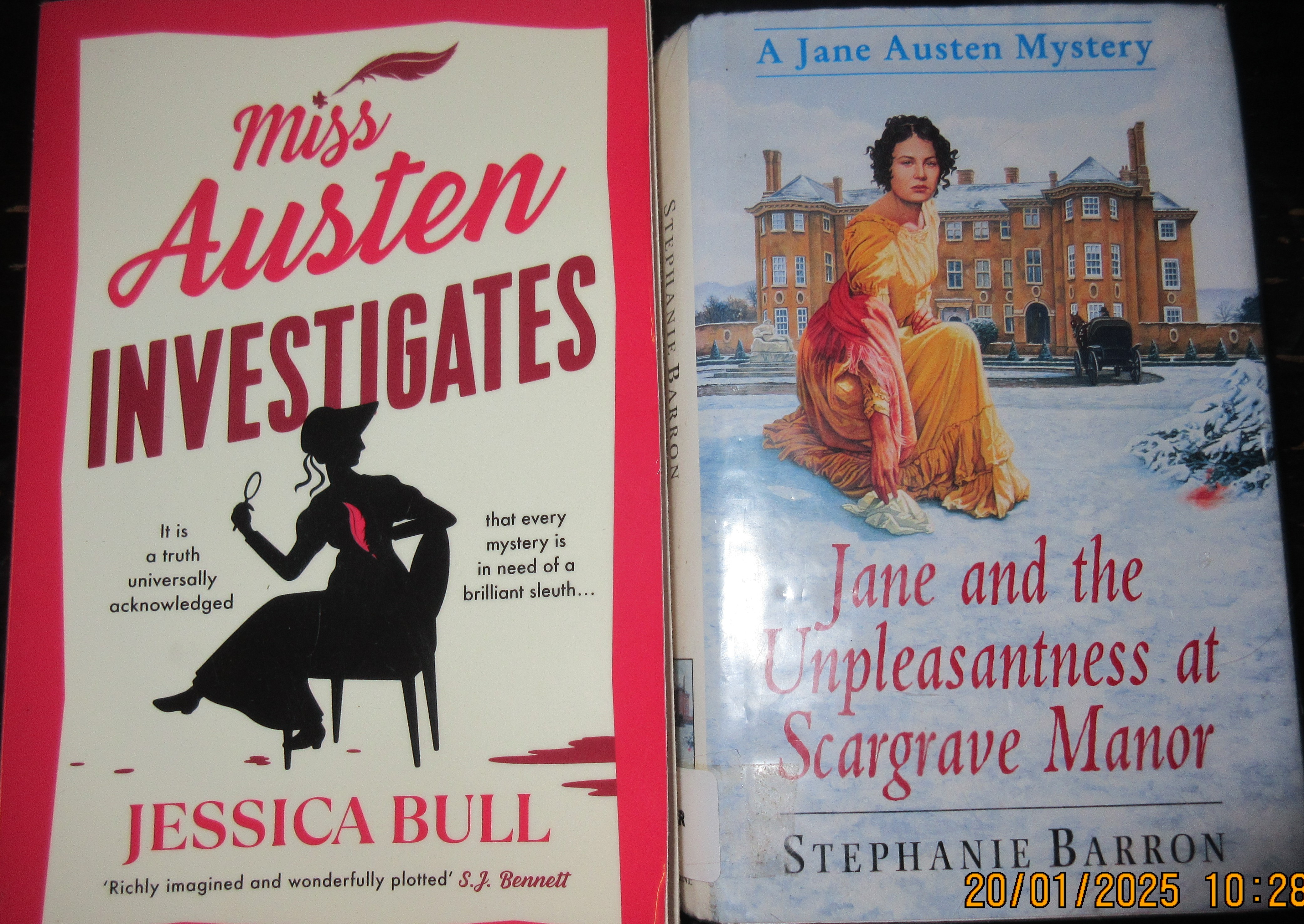
Two book covers featuring the Jane Austen as investigator stories mentioned in the text.

In contrast Barron chose to place her version of Jane Austen in a slightly later period of her life, 1802 to be precise. However, in common with Jessica Bull’s novel, Austen’s romantic life is not going well. She has just accepted and subsequently refused a proposal from wealthy landowner Harris Bigg-Wither on the basis that she did not love him. The story therefore sees Austen on a visit to a newly married friend, the Countess of Scargrave to escape the fallout and find some peace. Unfortunately, she ends up having to deal with the murder of her friend’s husband.

Stephanie Barron introduced her story using the well-worn device of the discovery of long-lost manuscripts and letters that just happened to be penned by you know who (a distant ancestress of some friends). These papers detailed Austen’s experiences with several detective cases and had been preserved for posterity and then forgotten. As we know, Cassandra destroyed much of her sister’s correspondence, so the conceit of the papers being found in an American descendant’s cellar neatly avoids having to explain why they were not destroyed. The book’s preamble has Barron being allowed to read the manuscripts fresh from the hands of conservators and against the background of anxious bidding from august literary institutions for the previously unknown Austen trove. It is a clunky beginning but the story is readable and the Austen persona more likeable than in my other sample of the genre.

Even after having now read a couple of books featuring a version of Austen as a detective, I am still baffled as to why anyone ever hit upon the idea. Perhaps it was simply the unlikeliness of the idea of a gently bred, clergyman’s daughter as a detective. Though come to think of it, that could almost be the fictional Miss Jane Marple, in more modern times. I have tried to work out why the idea of Jane Austen as an intrepid detective does not really work for me and I am still no nearer an answer. Perhaps it is because her real-life literary output, unlike say, Elizabeth MacKintosh (AKA Josephine Tey) has nothing to do with crime so that I am unable to take the idea seriously. Oddly enough, even though the Groucho book was playing the comedic persona to the hilt, the idea of him as a detective seemed plausible enough, as was the idea that he was aquainted with mobsters. Though according to a 2024 Guardian article it was Groucho’s brother Zeppo who was connected with various mobsters and the underworld.

That is only skimming the surface of the considerable amount of Jane Austen focussed crime novels. I may come back to this crowded field again at some point. And reconsider the appeal of Jane as detective perhaps.

Groucho Marx: Detective

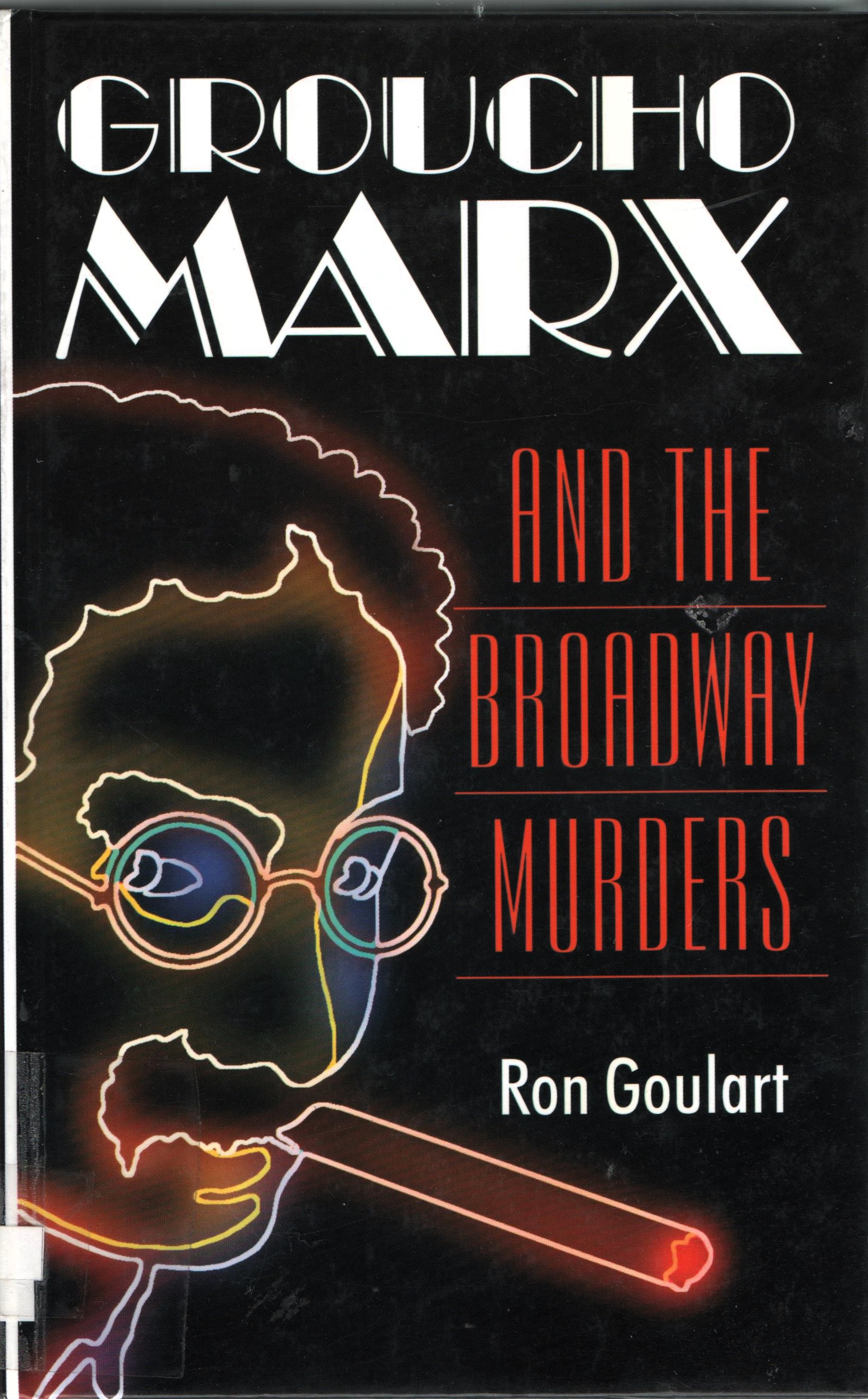
Front cover of Groucho Marx & the Broadway Murders.

Previously, dear readers, I left you to wonder who was going to be my first example of famous person as crime-solver in my new occasional blog series. I can now reveal that my eye has fallen on none other than erstwhile star of stage and film, Groucho Marx (1890-1977). The famed comedian has featured in a short series of crime novels by the American writer Ron Goulart (1933-2022). The idea of a writer using Marx as a crime buster sounded so bonkers that I just had to get hold of one or two of the novels to satisfy my curiosity. And, I have to say that the story that I did get hold of was an entertaining read and Groucho was a surprisingly plausible character. But that is skipping ahead.

In his sideline as a detective, true to literary tradition Marx has his own Dr Watson figure (who also functions as the ‘straight man’ that all comedy double acts need) in the person of crime reporter turned scriptwriter Frank Denby. Naturally there are wisecracks aplenty despite the grave task of solving murder cases:

‘We’re as good as the Thin Man, Philo Vance and Charlie Chan rolled into one,’ Groucho maintained. ‘Although why anyone would want a five-hundred-pound detective is beyond me.’

The series is a rarity in the Irish library system, but I did manage to order one of the titles, albeit in a large print version. I suppose sacrifice in the interests of research has to be made sometime. At least that meant that I didn’t need my glasses to read the book! Groucho Marx and the Broadway Murders (2001, 2002) is the fourth book in a series of six crime adventures staring Julius ‘Groucho’ Marx. At this point the Marx brothers have finished making the movie At the Circus (1939), which included the song ‘Lydia the Tattooed Lady’ performed by Groucho. He quips to Denby that the experience of hearing it might be ‘compared to Caruso in his prime.’

Original poster for the film At the Circus starring the Marx Brothers.

But to the crime details: A murdered mobster named Nick Sanantonio at first seems to have nothing to do with our intrepid duo, but his boss Vince Salermo sees things differently. He wants the guys to investigate, as he does not think that the murder was a gangland killing. This is an enticing assignment that they politely decline due to pressing engagements out of town. Both are due to head to New York, so this is true but also very convenient. Is this crime a red herring or will Sanantonio’s name crop up again?

The plot then sees Marx and Denby discovering the attempted murder of a Hollywood producer on the long-distance sleeper train from Los Angeles to Chicago. Could this be a nod to Agatha Christie’s Murder on the Orient Express? Especially as the passenger list contains more than a few members of the entertainment industry who could have a motive. The detectives are keen to investigate despite the victim and his associates not being similarly keen. Inevitably of course a murder does later occur in New York, rather dramatically during a Broadway show first night which Groucho is attending.

On first reading this novel, I did struggle to hear Groucho’s voice, as I remember it from those Saturday afternoon films on the BBC. That of course could be mere passage of time. But perhaps I am forgetting to allow for the fact that Groucho was the name of the stage persona of Julius Marx. So, the figure we are encountering in the books is really Goulart’s representation of the ‘real’ Groucho I suppose (similarly to Elizabeth MacKintosh’s Josephine Tey literary persona as interpreted by Nicola Upson). Or is that getting too confusing? Marx certainly did seem to be fond of those cigars offstage too (assuming that that is a genuine personality trait) judging from this novel. And the Groucho patter and one liners are very well done; I feel that this series must have been great fun for the author to write. But why I wonder, do authors pick unlikely characters to play detective? Is it the sheer unlikeliness that attracts perhaps? A literary challenge to make a credible detective character?

As I said above, this was an enjoyable book, though not particularly taut or thrilling, being played more for laughs. I liked the character of Groucho Marx, sometime detective, and his relationship with Denby and his cartoonist wife Jane. The historical detail is good too. I also learnt, somewhat to my surprise that Marx was a Gilbert and Sullivan fan, with a yen to play in The Mikado. As a humorous, easy read I would certainly choose another one in the series, if I could lay my hands on a library copy.

Now, I just need to come up with a fresh subject for my foray down this avenue of crime fiction. Until next time…

A criminal new blog theme?

I have been mulling over a theme for an new occasional series of Landing Tales blog posts. Perhaps not surprisingly, the germ of this new idea lies in my continued pre-occupation with reading detective novels.

Of late, my crime novel reading has branched out to include stories where the crime busting detective is a historical person. I have every now and then dipped into the series featuring Italian philosopher Giordano Bruno (1548-1600) by S J Parris. Lots of skulduggery, espionage and hair breadth escapes in Elizabethan England. What’s not to like? Though originally, I came at that series more from my interest in historical novels than crime. The author weaves what is known about Bruno’s life and fits into that his ficticious (or maybe not) assignments for spymaster Walsingham. However, what started me off recently thinking about featuring this sub-genre on the blog was my reading one of Nicola Upson’s detective stories featuring the Scottish writer Josephine Tey as her main character (Dear Little Corpses, 2022).

This is the second Upson novel that I have read, though inevitably not in series order. I have jumped from George V’s coronation in 1937 (London Rain, 2015) straight to the evacuation of children in World War II. I enjoyed the novels that I have read so far; as with the Bruno novels, the period detail is excellent. But I still feel a touch ambivalent about the idea of building a series around real people, albeit those dead and gone. What would they have thought about becoming a character in a novel? Maybe some people would secretly love to have their lives novelised after their death, particularly if they get to be crime solving heroes. Sadly, no royalty payments though. Would Bruno be chagrined that more 21st century readers probably know of him for the novels than for his own philosphical works? It is quite likely however, that Upson’s novels featuring Tey have brought the Scottish writer new readers, eager to find out about her work.

The twist with Nicola Upson’s crime novel characterisation, is that Josephine Tey was not in a sense a real person, but one of the literary personae of Inverness-based writer Elizabeth MacKintosh (1896-1952). Her other nom de plume was Gordon Daviot, used for her plays. Therefore, Nicola Upson’s novels could be said not really to feature a historic figure at all. This perhaps gives Upson writerly licence to take the known facts of MacKintosh’s London literary life (in which she was known as Josephine Tey) and to graft them onto her series character’s life. And of course, to invent a whole different career for her as an amateur detective in various mysteries. I was amused to find that Margery Allingham had a small part to play in Dear Little Corpses and I could not help wondering whether the two writers knew each other in real life. I do hope so as they seemed to get on very well in this novel. Maybe a literary sleuthing partnership in the making?

Once I started doing a bit of idle Googling and jotting down the names that I came across, I realised that crime stories starring real historical figures as the detective form quite a significant part of the crime novel scene. A deep rabbit hole awaited me. As a result of my online research, I came across a wide range of series and one-off outings featuring literary luminaries as well as other historical figures. These came from different walks of life and spanned several centuries. This produced quite a list to work through. But where to start with my reading? I decided first to see what the library catalogue had to offer to my latest crime fancy. I had come across some unlikely-seeming detective figures in my online trawling, so I decided to plump for one of the unlikeliest but the one that seemed to promise the most entertainment value. I do enjoy a touch of humour with my crime solving.

So, what amateur tec am I talking about? Well, you will just have to wait and see! I will let you know what I have been reading in a future blog post.

The Flowerpot Forager

As it is Easter weekend, I thought that I would put up a quick garden-related post inspired by a book that I ordered from my local library in January. I originally spotted it in a bookshop while over in the UK before Christmas but I ended up buying a copy as a gift rather than one for myself. The Flowerpot Forager by Stuart Ovenden (Hardie Grant Book, 2023) happily combines two of my favourite outdoor interests, foraging and container plant gardening. The book has a UK focus but the plants discussed are all native/naturalised in Ireland too. This may yet become a genuine Landing Book Shelf title as I will probably buy my own copy in due course to add to my gardening/foraging/nature collection.

I have been browsing through the book for a while, looking for ideas for new projects to undertake. The book is beautifully presented and illustrated, a tempting book for armchair gardening on a cold winter’s evening. But now, with the sap finally rising, I have decided to be systematic and compile a shortlist of ideas for a spot of flowerpot foraging this year. I am very taken by the idea of raising plants that wouldn’t be immediately obvious choices for containers. And, I’m with the author in that much as I enjoy a spot of foraging, sometimes it can be tricky to be sure that your identification is correct or you may not have a good patch of whatever you seek close to hand.

The book is therefore mainly focussed on raising your own crops of plants more usually found in the wild, though Ovenden does offer some general advice on foraging as well. He gives instructions for growing thirty plants from seed or cuttings, as well as examples of culinary uses for your crops. I have been busy with scraps of paper (no hi-tech here) marking a few plants that I want to try. I was able to rule out borage and watercress as I grew those for the first time in the last year or two as container plants.

In the end I came up with a list of eight gardening-foraging subjects for my future attention. I was pleased to see Ransoms mentioned as I bought a packet of seeds before Christmas. Rather disappointingly however, Ovenden says that if growing from seeds, you may have to wait a year or two to obtain a substantial crop. He recommends digging up some bulbs from the wild (with the appropriate permissions) or buying bulbs from a supplier. Well, as I like a gardening challenge, I suppose that I will stick with my seeds and see what happens. Patience will be the ingredient most required I feel.

Apart from Ransoms, I have a list of possibles comprising, Elder, Bramble, Chickweed, Dog Rose, Alexanders, Pink Clover and Meadowsweet to be going on with this year. I am not too sure about the idea of raising Stinging Nettle in a pot, although I have previously foraged for leaf tips and made soup (perhaps not surprisingly this was a pandemic pursuit along with banana bread making). And, I will need some persuading to cultivate dandelions in my patio pots as they are already prone to pop up elsewhere without much encouragement. One plant project that I have mentally put on a To Do List for now is that of growing Marsh Samphire from seed. I am intrigued by the possibility so that is something that I would like to try in the future.

A nice bonus in the book is a recipe or two for using each plant to get you started on using your foraged crops. I am very tempted by the recipe for Alexanders Seed & Orange Beignets, which look absolutely delicious. First, grow your plants (or forage your seeds), as Mrs Beeton might have said…

New Year TBR Pile: Status Update

This is the post where I talk about all those lovely books that I received for Christmas and that now adorn my never diminishing TBR Pile. I know that it is almost the end of January, but bear with me. I’m sure I’m not the only person always playing catch-up with the reading pile. Here’s a brief run-through of my latest acquisitions.

Two books in particular I had had my eye on for a while, so when I got word that a family member wanted gift ideas, well that was my opportunity. The two books in question were The Lost Rainforests of Britain by Guy Shrubsole (William Collins) and Where the Wildflowers Grow by Leif Bersweden (2022, 2023 Hodder). I have begun to read the former and I am already fascinated by the huge variety of lichens and mosses to be found around Britain. The only problem I am having is wrestling with the Latin names; as Shrubsole points out, very few lichens have common names unlike more well-known specimens in the wider plant world.

I also had a Christmas crime fix in my book stash (which was in addition to a couple of library crime books awaiting my attention) from He Who Put the Shelves Up. Now, these two sets of crime novels resemble two sets of twins. In each corner I have a Japanese classic crime novel and a British Golden Age crime novel. The similarity is quite uncanny really, or would be if my crime fiction tastes were not so well known to my nearest and dearest. The Japanese mystery is from an author new to me, Fūtarō Yamada (1927-2001). This is the intriguing sounding The Meiji Guillotine Murders (2012, translated 2023 Pushkin Vertigo), a historical crime story set in 1869, after a recent civil war. My second murder tale is Murder in Blue (Galileo 1937, 2021) by Clifford Witting (1907-68), another author new to me. This tells of a case of a murdered policeman, whose body lying alongside his bicycle is discovered by a local bookseller and writer out for an evening stroll. This reprint is of Witting’s first crime novel from an eventual sixteen. So far Galileo seems to have reprinted a couple of titles so maybe there will be more to come. The original books are apparently very collectable and rare now. I did find a first edition copy of Murder in Blue on ABE for, wait for it… £1,622.48 (plus postage and packing!) Thank goodness for good quality reprints is all I can say.

The stack of books that I had for Christmas
A stack of Christmas books

By way of a complete contrast to anything that has gone before, I received a copy of a collection of George Eliot’s essays (2023 Renard Press) from one of my sisters. The titular essay is, ‘Silly Novels by Lady Novelists’ in which Eliot lists the ‘qualities of silliness that predominates’ in the novels in question. As you will surely want to know, I will tell you that they are, ‘the frothy, the pious or the pedantic.’ This book contains a collection of four essays, all published in journals between 1854 and 1879. So I shall be dipping into Eliot in between crime novels I think.

Finally, my post-Christmas TBR pile includes a copy of Hilary Mantel’s A Memoir of my Former Self: A Life in Writing (2023 John Murray). This is a collection of Mantel’s writing collected and edited by Nicolas Pearson, Mantel’s longtime book editor. I have read several of Mantel’s novels including the Thomas Cromwell trilogy, but I haven’t read any of her articles or reviews.  I have dipped into this collection only a little so far, enjoying very much her essays on Anne Boleyn and Marie Antoinette. Mantel’s range is wide, so it looks to be an interesting anthology.

Now that is the Christmas present list wrapped up, but I did mention that I had a couple of library crime reads on the dreaded pile. The Japanese novel in my library pile is by Seishi Yokomizo (1902-1981), The Devil Comes and Plays his Flute (1979, translated 2023, Pushkin Vertigo). This features Yokomizo’s regular detective character, the rather eccentric but endearing Kosuke Kindaichi grappling with a very strange case indeed. I have read all of the Yokomizo titles reprinted by Pushkin Press and highly recommend them. The other library classic  is The White Priory Murders: A Mystery for Christmas by Carter Dickson (the pen name of John Dickson Carr), originally published in 1935 but reprinted in 2022 by the British Library. I did borrow this before the festive season, planning to read It over Christmas, but sadly that didn’t happen. I will squeeze it in while we are at least still in the wintery months!

My task now is to read all of those books, before the distraction of acquiring anything else to read. Why don’t you drop me a line and share your TBR Pile status?

One Pair of Hands by Monica Dickens

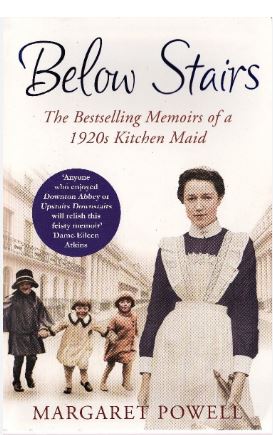
Today’s post sees me slipping back into library mode with One Pair of Hands, a book that I reserved after having heard about it from a borrower. As a domestic service memoir, it caught my attention since I had previously read Margaret Powell’s book, Below Stairs (1968) about her life as a housemaid in the 1920s, as well as Victory in the Kitchen by Annie Gray (telling the story of Georgina Landemare, who eventually became cook to Winston Churchill’s household). Of course, the book by Monica Dickens (1915-1992) really belongs in a different category to the other two, as her middle-class background meant that she had no need to earn a living (or at least, certainly not as a domestic servant)

This is the book jacket of One Pair of Hands, showing a picture of a smiling maid outside a large front door.

The tagline on this paperback edition (2011 reprint) gives a clue to the tone of the book, ‘From upstairs to downstairs in this charming 1930s memoir’. It was originally published in 1939 as the result of a couple of years that Monica Dickens spent working in a domestic service capacity.  Dickens wrote that she didn’t know what to do after her finishing school and debs presentation. She questioned that, ‘there must be something more to life than going out to parties that one doesn’t enjoy, with people one doesn’t even like?’ The upshot of her musing was that she decided to get a job. But as what, she wondered? She was interested in cooking, having attended a French cookery school in London and learnt some basic skills at another cookery school.

The attitude of her chosen domestic service agency towards relevant experience and references seemed to be rather casual. No LinkedIn for CV checking in those days. And as Monica Dickens said herself, she was not really qualified to do anything. Yet this did not seem to stop the agency sending her out to prospective employers. Neither did it prevent several families from taking her on. I was intrigued by the fact that there she was attempting to fulfil the same role that the Dickens family’s cook-general played. When Dickens went to register with an agency the interviewer, ‘hinted in a delicate way that she wondered why I was looking for this sort of job.’ She had to resort to inventing family troubles to be convincing, claiming that her mother was a widow.

As Dickens came from a comfortable middle-class background, so her time spent ‘in service’ could be seen as merely slumming, a way to pass her time. Having said that, she certainly seemed to work hard. After registering with the employment agency, she did a variety of jobs, both live-in and out. Over the course of time, Dickens undertook several roles involving cooking, cleaning, maid’s duties, waitressing at functions and childcare. Several of the homes in which she was employed were suburban houses, with small households, which to me, did not seem to have an obvious need for domestic help. These were of course live-out posts as the houses did not have the capacity for anything else. I wonder if the decision to have staff in a comparatively normal-sized property was from a sense that appearances had to be kept up regardless. It was either that or lose face by scrubbing your own kitchen floor and making your own morning tea I suppose. All jobs seemed to be paid in cash, which I assume was par for the course in that type of work. Having said that, on occasions Dickens ended up having to use her own money to replace breakages. It was fortunate for her that she wasn’t a genuine kitchen maid/cook or that could have been a real financial blow.

There was plenty of chaos during Dickens’ period of domestic service. Inexperience played a large part here. She was self-confessedly not very keen on or good at cleaning. Monica describes one employer, ‘keeping a sharp look-out for signs of dirt and neglect, and me trying to disguise my slovenliness with subterfuge.’ It sounds as though some of the kitchens under her management were in a dire state, though perhaps that was exaggerated for the book. I was wondering whether the names of any of her employers had been changed for publication. She does not indicate that however. Even if she had, I would to love to know if any of her erstwhile employers recognised themselves or their kitchens if they or their friends read the book.

The memoir is humorous (and indeed, charming) detailing Dickens’ various domestic adventures with recalcitrant boilers (‘no woman ought to have to look after a boiler. They’re simply not made that way – it’s like overarm bowling’); exasperating tradesmen, kitchen breakages and pernickety or unpleasant employers. To say nothing of her desperate attempts at effective time management in the kitchen. And crucially, she could walk out of an unsatisfactory job if needs be, knowing that she was not relying on it to put bread on the table, ‘As I felt sure of getting another job, I saw no reason why I shouldn’t decamp before I got into a complete rut.’ Monica was fortunate in occupying a completely different place in the domestic service hierarchy to Margaret Powell (1907-1984) or Georgina Landemare (1882-1978).

Monica Dickens’ experiences do highlight the sheer drudgery of domestic work in those days. This drudgery would also apply to any housewife who had to labour in her own home. Similarly, the memoir shows us the poor working and living conditions that domestic staff would have put up with, not having any choice in the matter. Nobody worried about the kind of mattress the servants slept on. Despite this, Dickens does not seriously critique the structure of domestic service and the vastly unequal relationship between employer and servant. As Margaret Powell, looking back on her service in the 1920s expressed it, ‘We always called them ‘Them’, ‘Them’ was the enemy, ‘Them’ overworked us, and ‘Them’ underpaid us, and to ‘Them’ servants were a race apart, a necessary evil.’

But it was all good material for Monica Dickens the budding writer, as One Pair of Hands was the first book in a long and successful writing career, both for adults and children.

Books on the Bus

Cover of Anthony Horow.itz novel The Word is Murder
Crime on the commute

I noted in the last blog post that I was listening to The Word is Murder by Anthony Horowitz (ably read by Rory Kinnear) on my commute. My daily dose of audio book listening has become a travel fixture since December, after I followed a colleague’s suggestion to give them a try. As I said before, I have been using the handy little mp3 editions from the library. The audio book listening has been a useful tool in adapting to an unaccustomed bus/train commute; one that started in the unforgiving winter months, which certainly didn’t add a cheer factor to the tedious bus wrangling. I may have mentioned once or twice here, my penchant for crime fiction, so I keep an eye out for new (or indeed, old) ideas that appear in audio format. It is entirely possible, that having discovered the joys of audio books, I will increase my intake of crime novels considerably. Would that be such a bad thing? Don’t answer that one.

Crime has certainly become the genre of choice for my travelling books over the last couple of months. I have however, tried a couple of other ideas. For instance, I have long taken an interest in Bertie Pollock’s daily trials in Alexander McCall Smith’s Scotland Street books, so I tried one out as a commuting book.  Alas, it was too easy going, calm and philosphical to suit my journey to work. Maybe it would have suited my homeward trip better? Perhaps I should try a touch of crime in the morning and catch up on Scotland Street on the homeward ride.  Having said that, the rush hour frustrations of the evening commute might be better suited to the distractions of a juicy crime novel… It’s a work in progress, as they say. I also ventured to listen to Helen MacDonald’s Vesper Flights a few weeks ago, but for me it didn’t work as a bus book. That is a book that I will return to in print form as I think it is really one to be savoured at leisure, making notes of anything I want to follow up on.

Cover of the Christopher Fowler Bryant & May story, The Burning Man.
London crime

Of course, maybe the detective audio fiction urge will prove to be just a winter thing. Fragrant spring mornings and sultry summer evenings may well encourage quite different listening habits. Let’s wait and see, shall we? For now, I am generally pursuing a criminal course each morning and evening, which has led to my introduction to some new crime writers. One of those is the above-mentioned Anthony Horowitz, who has long been a name that I passed while shelving adult fiction A-M. I always meant at some point to give his adult fiction a go but I never got around to him. I’m not that sure that he’d appreciate that my impetus for doing so was that I needed something lively to distract me from interminable road works.

I have also discovered Christopher Fowler’s detectives Arthur Bryant and John May from The Peculiar Crimes Unit in the adventure, The Burning Man (read by Tim Goodman). Not for the first time in lighting on a new discovery, I have begun well into the series so at some point I need to back track to the earlier books. I really enjoyed this story, both the main characters being agreeably quirky in the chalk and cheese vein. The wealth of historical detail about London’s layers of history is woven into the detective action in a way that brings London vividly to life, as Bryant is a veritable fount of information about the city he loves. I will certainly read more of this series (not necessarily in order of course!)

Now all I need is a steady supply of AAA batteries to fuel my travelling crime fest. And maybe I should treat myself to some decent headphones. Does anyone else relish a good audio book on the bus?