The First Bulletin on War and Peace

As I’m sure my readers will be pleased to know, my War and Peace challenge is making relatively good progress. Note that I’m hedging a bit here by using the word ‘relatively’ to describe my rate of reading. I have actually reached page eighty-five and I’m at the point where Count Bezuhov has suffered his sixth stroke and is not expected to live. Naturally enough the heirs presumptive are getting anxious as they can see a fortune slipping from their hands into those of Bezuhov’s illegitimate son Pierre.  I wonder what skullduggery may be afoot in the aftermath of the count’s death.

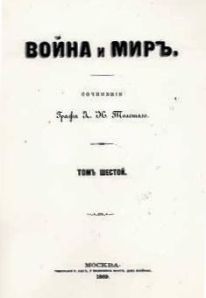
First Edition of War and Peace

First Edition, 1869

Already many aspects of human nature have popped up during the drama; I’ve met a diverse cast of characters in the action occurring between Moscow and St Petersburg. Not surprisingly I was rather taken with the younger players in the story, who were enjoying (and suffering) their first pangs of love. Natasha Rostov is delightful and I am almost apprehensive about what vicissitudes her life will throw at her, but I’m trying not to leap ahead and plot spoil for myself. I’ve never seen a film version of War and Peace and I’m studiously avoiding plot summaries that I’ve come across.

The thing that I find particularly fascinating is the sheer number of princes and princesses in the novel, to the extent that I’m tempted to try to find out just how many there were in Imperial Russia at that time. It also seems that having the title of prince or princess didn’t necessarily mean that you were wealthy. Having consulted Wikipedia, I’ve discovered that the titles of prince and princess belong to the titled nobility (which could be acquired) as opposed to the ancient hereditary nobility. Wikipedia goes on to point out that,

By 1805, the various ranks of the nobility had become confused, as is apparent in War and Peace. Here, we see counts who are wealthier and more important than princes. We see many noble families whose wealth has been dissipated, partly through lack of primogeniture and partly through extravagance and poor estate management. We see young noblemen serving in the Army, but we see none who acquire new landed estates that way’.  

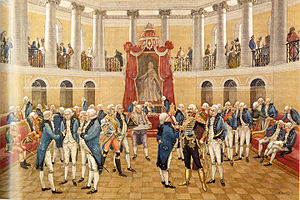
A Noble Assembly

Nobles in the time of Catherine the Great

So presumably that accounts for poor old Princess Anna Drubetskoy desperately trying to obtain a placement and funding for her son Boris. This little bit is quite telling, ‘The mother smoothed her dyed silk gown, glanced at herself in the massive Venetian mirror on the wall and briskly mounted the carpeted staircase in her down-at-heel shoes’. A few lines above, her cloak is described as ‘threadbare’ which is noticed by a sharp-eyed servant.

I’m going to dive back into Imperial Russia now, having had a short break to finish a couple of library books, so I’ll hope to post up again soon with a further update.

Back soon….and if anyone else is tackling a hefty tome at the moment please let us know about it!

Picture Credits: Thanks to Wikipedia for the illustrations.

Tolstoy: The Next Landing TBR Pile Challenge

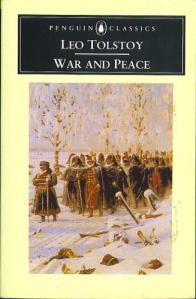
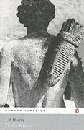
War and Peace

Cover shows detail from ‘The 1812 Retreat – The Battle of Borodino’ by Vereschagin

I promised you an announcement on the next stage of the Landing Book Shelves Reading Challenge and here it is at long last. As you will no doubt guess from the illustration, the challenge is the reading of War and Peace (Leo Tolstoy, 1828 -1910) a big hurdle if ever there was one. This worthy challenge has been put on the Landing Book Shelves agenda because it also happens to be my book group’s project at the moment, this killing the proverbial two birds. I’m not sure how long it will take me to read War and Peace (or how long it will take my fellow book clubbers for that matter) but I undertake to offer my blog readers reasonably regular progress updates. Weighing in at 1444 pages, this lengthy tome will be read in stages in between various other books.

It is just as well that the idea of reading War and Peace for book group came up as it is likely that it would have sat on the Landing Book Shelves almost indefinitely. I say ‘almost’ because I really and truly meant to get around to reading it sometime. I bought my copy in May 1992 with the intention of reading Tolstoy’s epic during my summer holidays. After all this time I can’t recall what I did read that summer, but it certainly wasn’t Tolstoy. So, it’s better late than never on the Russian classics front I suppose.

War and Peace was first published in 1869 (I’ll fill in the publication history in a future post) and the paperback edition that I have on The Landing was first published by Penguin Classics as a two-volume edition in 1957. The one volume edition came out in 1982; the translation is by Rosemary Edmonds from 1957 with revisions in 1973. I’m by no means an expert on the virtues of one translation over another so I will have to trust to the reliability of Penguin Classics in this instance. There are more recent translations available (for example from Penguin Classics and Vintage), but as this is the copy I have on The Landing, I’ll go with this one unless any reader out there tells me that I would be better served with a different translation.

I will be embarking for nineteenth century Russia just as soon as I’ve finished my library book and a couple of review books….I promise…

Finally there: The Frontenac Mystery by François Mauriac

The Frontenac Mystery

An evocative scene..

‘Before beginning a novel I re-create inside myself its places, its milieu, its colours and smells. I revive within myself the atmosphere of my childhood and youth – I am my characters and their world’ (François Mauriac).

This is the moment that you’ve all been waiting for (well I have at any rate) when finally I tackle the last novel in my Landing Eight sequence of books. After that I have another Reading Challenge lined up to tell you about, but more of that in due course. In the meantime I’ll put The Frontenac Mystery to bed and cross it off my TBR Pile with a sense of satisfaction. There have been many distractions along the way but I’ve finally completed reading the eight titles that I picked out last year. Still got lots yet to read though; but for now let’s move on with the book in hand…

I picked this book (one belonging to He Who Put the Shelves Up in fact) as part of my Landing Eight Challenge since I hadn’t read anything by François Mauriac (1885-1970) before and this seemed as good an opportunity as any to start. The edition of The Frontenac Mystery that we have at home is a Penguin Twentieth-Century Classics edition from 1986; the text was translated by Gerard Hopkins for the Eyre & Spottiswoode edition of 1951. Le Mystère Frontenac was originally published in 1933 by Bernard Grasset. For some background information on Mauriac here’s a link to his biography on the Nobel Prize page (he was given the Nobel Prize for Literature in 1952).

At the centre of the novel is the Frontenac family, a landed gentry family from the Bordeaux region (Mauriac’s birthplace); Blanche Frontenac has been widowed with five children to bring up and a family reputation and tradition to uphold. Her brother-in-law Xavier helps her as a fellow guardian and as a custodian of the family’s business and estate. As the novel opens, Blanche has been widowed for eight long years; she was a ‘tragic mother with the black eyes, and the sick, lined face, in whom the traces of a former beauty still warred with wrinkles and approaching age. Her greying, rather untidy hair gave her the neglected look of a woman who has nothing to look forward to’.

Blanche has become subsumed into the family into which she married and carries the pride and ‘mystery’ of the Frontenac name within her. Having said that, she resents Xavier for apparently being unable to see her as a person; he sees Blanche only as the mother of the next generation of Frontenacs and she believes that he doesn’t even really see her as a Frontenac anyway. Similarly, he also sees in the children the glory of the family and therefore ‘what gave them value in his eyes had nothing to do with individual qualities’. But it transpires that Xavier has a secret that would not reflect well upon the august name of Frontenac were it to become widely known.

The novel follows the lives of the family as the children grow up and assume their place within the mystique of the Frontenac name. The boys Jean-Louis (the eldest sibling), Jose and Yves are all very different characters and Mauriac explores their contrasting hopes and ambitions. The two sisters Danièle and Marie don’t receive so much attention, probably because the times and social position they were in would never have allowed them much choice. Tellingly, at one point in their childhood they are described by Mauriac thus, ‘ They were two little brood-mares in the making, and found an outlet for their maternal cravings in ministering to the children of various washerwomen and chars’.     

I’m not sure whether I really liked this novel as I didn’t feel much of a connection with or sympathy for many of the characters. They all seemed to be trapped in a web of their complex family history (and their pride in it)  that they all at times kicked against, yet ultimately submitted to maintaining. I did however, feel sorry for Xavier’s secret woman Josefa (who is not as much of a secret as he thinks) who lives patiently in the background since she isn’t deemed to be worthy of a life amongst the family Frontenac.  Xavier has conflicting emotions towards her, referring to as ‘shop-soiled’ but at the same time, ‘She was a kindly creature with a strong maternal instinct who did not laugh at him’.

Mauriac’s prose is beautiful and elegant but I think that the overall effect is cold and that the novel lacks that certain something that would draw me into the lives of the family. Perhaps it’s just that times have changed so much that it’s hard to imagine anyone devoting themselves so entirely to a collective without any consideration for the individual needs. The social segregation of Josefa from the family and her humble attitude towards them is hard to swallow. I would however, like to read something else by Mauriac (I will probably read this one again at some point) to delve a bit further into his world. It would perhaps help to read more on his life and the influences upon his work I think. Another project for the future.

And don’t forget that I promised an announcement on the next chapter of the Landing Book Shelves TBR Pile Reading Challenge! Tune in next time folks for an update…

If you’re also in Ireland, have a great Bank Holiday weekend.

Samarra or Isfahan?

I found this poem by Dutch poet PN Van Eyck (1887-1954) in a novel by Kader Abdolah called My Father’s Notebook (Canongate Books, 2006). I bought it in 2008 when I was working in Dún Laoghaire; you will be impressed to know that it didn’t stay on the TBR Pile for very long. It tells the story of Ishmael in exile in Europe who is trying to piece his father’s story together from notebooks written in a strange code. Poetry is a very important part of Abdolah’s book, but the following poem in particular caught my eye and I copied it into a notebook in case I ever lost track of the novel.

Van Eyck’s poem closely resembles a story that I remembered from many years ago that I never got around to tracking down. It has many variations and I think the version that I must have heard was the retelling of what is actually a very ancient story, by Somerset Maugham (1933) called Appointment in Samarra. The story that Maugham re-wrote and that Van Eyck turned into a poem is possibly a thousand years old. I’ve been delving into the history a little and it seems as though I wasn’t the only person to have this ghost of a story about Death and Samarra floating around in my head all this time.

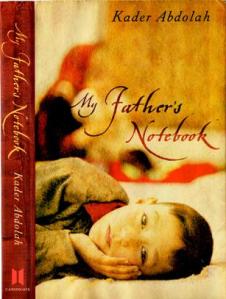
Death and the Gardener (translated from Dutch by David McKay)book jacket to My Father's Notebook by Kader Abdolah

A Persian Nobleman:
One morning, pale with fright, my gardener
Rushed in and cried, “I beg your pardon, Sir!

“Just now, down there where the roses bloom, I swear
I turned around and saw Death standing there.

“Though not another moment did I linger,
Before I fled he raised a threatening finger.

“Oh, Sir lend me your horse, and if I can,
By nightfall I shall ride to Isfahan!”

Later that day, long after he had gone,
I found death by the cedars on the lawn.

Breaking his silence in the fading light,
I asked, “Why give my gardener such a fright?”

Death smiled at me and said, “I meant no harm
This morning when I caused him such alarm.

“Imagine my surprise to see the man
I’m meant to meet tonight in Isfahan!”

You never know when and where you are going to find literary connections; with Van Eyck, I discovered a connection to one of my previous #PoetryinJune authors, WB Yeats. Apparently Van Eyck was very interested in the Irish Question and Irish Literature. He subscribed to the Cuala Press and corresponded with Lily Yeats and WB and Georgie Yeats during the 1920s and 30s. It’s an amazingly small literary world; either that or serendipity has been at work again.

That’s all for now on #PoetryinJune…but there’s plenty here to return to discuss another time. I spotted another of Kader Abdolah’s books in the library recently so I am sure he will feature as an extra to my Landing Reading Challenge at some point.

Meanwhile, if anyone else remembers Appointment in Samarra (or Isfahan) from childhood, I would love to hear about it, so drop me a line below.

NB – the ‘history’ link above seems to work better in Firefox than IE (haven’t tried Chrome but let me know)

New literary travel guide from Oxygen Books

St Petersburg Guide

Another delicious literary guide…

Quick Post: New literary travel guide from Oxygen Books

This is by way of a brief ‘thank you’ to Malcolm at Oxygen Books for my lovely copy of the latest in the City-Pick  series: St Petersburg (edited by Heather Reyes, Marina Samsonova and James Rann). I have had it tucked away for a wee while and have only now started dipping into it. I began with some pieces on the Marinsky Theatre, Anna Pavlova and extracts from Truman Capote’s visit to the city on a cultural exchange tour in 1957.  After reading about St Petersburg in the snow I am feeling quite Christmassy already.

My first City-Pick guide was the Dublin guide which I originally wrote about for Hackwriters and which has seen plenty of wear in the meantime. If you want to read this piece I have now tweaked it and re-posted. (here). Similarly you might like to take a look at Amsterdam (here) which I wrote about after a weekend trip in 2011. Now all I need is a holiday in Russia….

Update ( June 2013) – I have been sitting on the Istanbul guide for a while and have been inspired to take it out after seeing the Bollywood film Ek Tha Tiger (Salman Khan and Katrina Kaif) in which part of the action takes place in this lovely city. Whether the book contains any anecdotes about secret agents (of any stripe) remains to be seen though. Mind you the plot of the film began in Dublin, so if there’s ever a revised edition of the Dublin guide perhaps it might include reminiscences from the Bollywood film crew. Now there’s a thought…

cover of Istanbul guide with cresent and minarets

‘perfect gems of city writing’…

Auschwitz

Auschwitz: A footnote to the Periodic Table post:

Now that I have discovered the handy ‘aside’ post facility I can jot down snippets as I think of them…

I just wanted to add a link to a blog post by one of my colleagues at the Irish News Review Glenn Dowd, which ties in with one of my ‘Landing Eight’ authors, Primo Levi. Glenn describes a tour of Auschwitz, which was the concentration camp where Levi was incarcerated. Some of the stories in Levi’s Periodic Table (mentioned in 31 August’s entry) describes his experiences there. I can highly recommend If this is a man/The Truce if you want to know more.

That’s all for now…

Landing Eight Progress: L.P.Hartley

The Go-Between

The winged messenger

Turning my attention back to the Reading Challenge that was whole purpose of this blog, I have been scanning the remaining Landing Eight titles to decide what will come next. My choice will be to read L.P. Hartley’s The Go-Between (Penguin) as a complete contrast to The Periodic Table. In common with many people I suspect, I have known the famous first line to this novel for years without ever having read the book. Well, now is the time to put that lack of experience finally to rights. That is, after I have finished a couple of other books that are floating around, procrastination being my modus operandi (she confesses sadly).

The Locust and the Bird

The Locust and the Bird – trade paperback edition

At present, I am reading My Mother’s Story: The Locust and the Bird by Hanan Al-Shaykh, a completely engrossing Lebanese memoir. The book is a trade paperback title that I grabbed from a bargain section some while ago because the lovely title (and the stylish woman on the jacket) appealed to me. A quick mention also for the memoir, The Storyteller’s Daughter by journalist Saira Shah; in which Shah tells of her attempts to come to terms with, and understand her Afghan heritage. She has had some truly close shaves during several years of conflict in Afghanistan, which are un-nerving even to read.

A wonderful thread running through the book is that of the stories passed down the generations of the family. At one point Shah quotes her father comparing stories to dried onions. He told her that stories are ‘like dried experience. They aren’t the original experience but they are more than nothing at all’. The stories have a purpose in helping to explain and deal with life’s experiences as they come along. I have written a little about the importance of stories and storytellers in a previous post (April) so this aspect of the book was of particular interest to me.

Now, your starter for ten: tell me about your favourite storyteller…

Other News:

As I am sure many people know, the nice folks running the Grafton Media Blog Awards Ireland have recently announced the shortlists. This blog has been shortlisted in the ‘Best Newcomer’ category, which is very exciting for me. A big ‘Thank You’ is due to the organisers (Amanda Webb, Lorna Sixsmith and Beatrice Whelan) for selecting the Landing Bookshelves for inclusion on the list. I put my head in the sand after the nomination went in and tried not to think too optimistically about the awards, so it was particularly cheering to find that I had got this far. I will be firmly crossing fingers (and maybe toes too) ahead of the Finalists announcement (29th September). However, the crossing fingers part may make typing tricky so perhaps I will simply try to visualise crossed fingers and see how that works. Actually, page turning would be awkward as well and I definitely do not need any obstacles on the reading front either.

So, it’s back to The Go-Between for me…

Blog Wards Logo

It’s awards time…

The Best Science Book of All Time*: The Periodic Table

As I explained in a previous post, the latest book that I have been tackling here on the ‘Landing Eight’ Reading Challenge is Primo Levi’s The Periodic Table (or Il Sistema Periodico in the original Italian, 1975). I have previously read If This is a Man and The Truce (published in one volume) which I would list as a ‘must read’ even though strictly speaking I dislike the idea of telling folks what they should read. I find it hard to resist doing it occasionally though. To read of Levi’s experiences is the nearest that most of us will, fortunately, ever get to such inhumanity. Reading of them, bearing witness to such actions, is therefore the very least we can do.

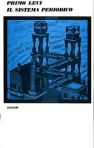
Italian first edition of Il Sistema Periodico

First edition with Escher etching

The Periodic Table has long been on the back burner (as opposed to the Bunsen burner), probably because the scientific term of the title put me off a little. I was anticipating the prose to be inevitably laden with chemical names and processes and consequently rather hard going. After having finally read the book I can testify to the fact that my brain has been absorbing the names of elements and compounds that it has not had much reason to consider in years (apart from the basics such as oxygen and carbon that is).

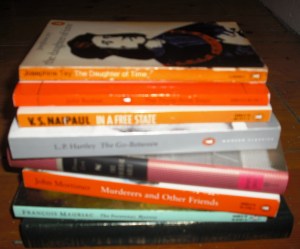
stack of classics

It’s the fifth one down

As it happens, I found the chemistry experiments fascinating (especially when things failed to turn out as hoped) despite it being a very long time since I last studied science.  I admit that I would have had trouble recalling many of the elements on the Periodic Table off the top of my head (of course, chemists have added new discoveries to the table over the years). Since reading the book, I have been trying earnestly to recall the chemical symbols I used to know.

Having my chemical memories jogged a little has brought back images from the school year that saw our form ensconced in Lab 12 with Dr F as our form mistress. Looking back, I question the wisdom of the school using a science lab as a form  room, but I suppose anything really dangerous was locked safely away. I actually used to enjoy chemistry though I have a vague memory that my experiments generally failed to turn out as expected. There was a definite excitement in the processes of measuring and heating. Fortunately nothing actually exploded.

Then, I did go on to study bakery and confectionery, which is where you mix one ingredient with another to produce a chemical reaction.

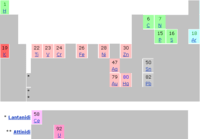
diagram of The Periodic Table of Elements

The Periodic Table showing elements used by Levi

We all do chemistry every day, but just tend not to realise it as such. Now, I think that before I go in search of my old school lab coat, perhaps I had better do just a little more reading. If anyone has a favourite scientific read I would love to hear about it, so drop me a line in the comment box.

*As voted for in 2006 by a Royal Institution survey – link to a Guardian article here.

(Thanks as always to the nice people at Wikipedia for the additional illustrations of The Periodic Table diagram and the cover of the original Italian edition of Primo Levi’s book)

An Enlightening Journey with Andrés Neuman

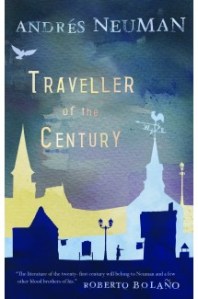
After my Q and A with Argentinian/Spanish writer Andrés Neuman here is my piece on his novel Traveller of the Century. At a hefty 584 densely packed pages it is a book that cries out for the luxury of a few hours solid reading time. As I found that to be impossible, I have followed the characters in fits and starts. Thankfully, the engrossing themes and threads of the novel guided me through the drama. When I first got my hands on Neuman’s first novel in translation and read Roberto Bolaño’s effusive praise in the introduction, I felt somewhat ambivalent about tackling the book. I am not much given to hyperbole so I find it rather hard to swallow in others. Bolaño claims that ‘the literature of the twenty-first century will belong to Neuman and a few other blood brothers of his’; (very gender specific; no blood sisters then?). Therefore, it was with some scepticism and a certain amount of trepidation that I began to read the novel. After I had finished reading, I felt that there had been so much going on in the novel that I would pull out a few themes and images that particularly struck me, to highlight here.

Cover of Traveller of the Century with silhouette of town

Traveller of the Century

Traveller of the century is set in nineteenth century Germany, after the European upheaval of the Napoleonic Wars. When the story opens, Hans, a translator and compulsive traveller is in a coach creaking its way through a bleak winter landscape.  Late at night, he plans to break his journey to Dessau in the town of Wandernburg and finds lodging in a rather shabby looking inn. As the story unfolds Hans, who never stays anywhere for very long, finds himself unable to leave. This is in part because of the strange qualities of the town and in part due to his increasing entanglement with the lives of the people he meets in Wandernburg.

A silken thread running through Traveller is the seeming ability of the geography of the town to shift around, almost as if the town itself does not want people to leave. In trying to find places that, he had found the previous day, ‘Hans had the strange feeling that the city’s layout somehow shifted while everyone was asleep’. He finds the market square to be the only location easy to pinpoint. This sense you get of the changing aspect of the town is unsettling and suggests unseen and unknown forces below the surface. Is it coincidence that Hans only gets to grips with the town’s geography when he is about to leave? Does he imagine this is happening; or is the town really playing with his perceptions?

Hans befriends a poor old organ grinder who usually plays in the town’s market square. As they become friendly, the organ grinder invites Hans to his home that turns out to be a cave just outside the town, where he lives with only his dog Franz for company. Hans starts to spend evenings at the cave talking to the organ grinder and two local workers Reichardt and Lamberg. There is much animated debate, discussion and cheap wine drinking carried on late into the night. One of the topics that the men discuss is the town itself; as a place to leave or to remain in. The organ grinder (who goes by no other name) is devoted to his town and sees beauty in the changing seasons of his home. The imagery of the men passionately talking and arguing into the early hours is very vivid and is a piquant contrast to Han’s elegant evenings with the town’s bourgeoisie.

Hans meets Sophie Gottlieb, a merchant’s daughter who is engaged to a local wealthy landowner, Rudi Wilderhaus. The philosophical discussions at the cave are mirrored by the Friday night Salons held at the Gottlieb house where the more socially elevated group debates the poetry, philosophy, history and literature of Germany and her neighbours. Hans is often in conflict with the hitherto leading light of the group, Professor Meitter though he finds a kindred spirit in Álvaro a Spanish merchant settled in Wandernburg. The Enlightenment is gradually gaining ground in this corner of Germany, even though the town seems otherwise rather set in its ways.

At the heart of Traveller of the Century is the illicit love affair between Sophie and Hans. Their relationship plays out against the background of often-intense discussions between the members of the two overlapping groups of debaters. Hans and later, Álvaro are equally at home in the two very different settings and Sophie is charmed by the organ grinder and his cave when Hans takes her to visit there. Apart from these encounters and the love affair between Álvaro and Sophie’s maid Elsa, the townsfolk stay in their allotted rigid social places. Enlightenment is also reaching Wandernburg’s women, as Sophie declares that ‘I for one don’t intend to spend my days with flour up to my elbows’. In tandem with discussing poetry and politics with Sophie, Hans is teaching the innkeepers daughter Lisa to read.

Translation is perhaps not surprisingly another recurring theme in Neuman’s book (see the Q&A for Neuman’s thoughts on translation of his own work). There is much discussion of language and nationality in the Friday salon and translation is also the means by which Hans earns his living. Translation becomes the means to enable Sophie and Hans’ affair to continue, as they begin to work together on Hans’ commissions. They in effect translate each other while they discuss the literature they are working on. The process of selecting the right words to use and then reading aloud their differing versions functions as a delicious foreplay, heightening their desire for one another.

There is a darker thread running through the drama, in the figure of the cloaked rapist who haunts the darker side streets of the city. I do not want to spoil the plot by mentioning the identity of the attacker. Suffice to say that the shadowy figure seems to be the antithesis of progress and enlightenment in Wandernburg. The police attempt to track the culprit by employing the appropriate rational means and careful reasoning. However, at one point Hans runs afoul of the local police and discovers that the law is not by any means as rational as it could be.

I hope I have succeeded in doing justice to a fascinating novel, that I am certain to read again. And was Bolaño right in his estimation of Traveller of the Century? Read it and judge for yourself!

Andrés Neuman: Q and A session

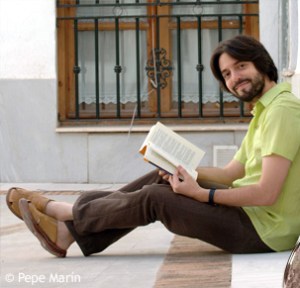
profile view of Andres Neuman

Andrés Neuman

As promised, here are the results of my LandingAuthor interview with author of Traveller of the Century Andrés Neuman:

CM: You have been featured on the list of Granta‘s Best Young Spanish language novelists and on the Bogotá 39 list. Do you feel that these lists achieve the result of bringing writers to the attention of a wider public and if so, has it benefited you in that way? 

AN: Well, there are so many lists around, that sometimes I think that the most effective one would be a list of never-listed authors. More seriously (or not), to be honest I don’t know the practical results of those two lists. Nevertheless, each one of them had a very interesting nuance in terms of literary theory. Granta’s one represented, if I’m not wrong, the very first time that such an influential Anglophone publication was fully dedicated to non-English language authors. Which was quite a hopeful sign I guess. Regarding Bogotá 39 list, when it came out I realized that at least half of the writers included on it hadn’t lived in their born countries for a long time, so that they already had a kind of mixed national identity; and two of them (Daniel Alarcón and Junot Díaz) didn’t even write in Spanish language, so they were twice peripheral. I feel quite close to these alternative ways of looking at the Latin American tradition, since I was born in an Argentine home but I grew up in Spain.


CM: Following on from the Bogotá 39 list, with which the Hay Festival was involved, I would like to ask you about participation in literary festivals. Do you enjoy doing festivals and meeting readers and fellow writers or do you perhaps feel obliged to make appearances? 

AN: Maybe both. On one hand, anything which implies leaving home painfully stops or at least delays the book you were working on. On the other hand, thanks to the festivals and book fairs you get to know two essential, yet often invisible for you, parts of your vocation: readers and colleagues. Most of the time you work alone, so when a reader appears you feel genuinely amazed: so they really existed! And they even had the patience of reading one of your books! When that happens, I’d like to apologize or returning them their money. In the end, I tend to think that travelling is literary healthy. Travels remind you that the world was much more complex than you thought. And that’s what literature is about, isn’t it?


 CM: You have written a book based upon your travels around South America, your own back yard as it were, but do you have an urge to explore any other places with a view to writing and if so, where would you like to go?

AN: That book (Cómo viajar sin ver. Latinoamérica en tránsito/ How to travel without seeing. Latin America in transit) actually tells a trip across the whole Latin America, which is an immense planet itself. It’s an amazing experience to feel a foreign person twenty times, without changing of language. That’s a little miracle that Spanish language allows us. Where else I’d like to go to and write about? I’d prefer not to plan it: I enjoy much more when a place takes me by surprise. Precisely that surprise is what stimulates the muscle of attention.


 CM: After having lived in both Spain and Argentina do you feel that you have a leaning towards the literature of one country more than the other?

AN: That’s a puzzling conflict which I have never got to solve. I have the inclination to look at Europe from a Latin American perspective, whereas when I’m in Argentina I often put myself in a Spaniard point of view. In fact, Argentine people usually ask me about Spain, and vice versa. So I’ve ended up assuming that’s my natural place: a sort of border between both countries or continents. I have a double citizenship and a double foreignness as well.


 CM: As a book hoarder myself, I was much struck by your account of your parents’ house clearance in which the books were piled up to be measured by the dealer. How attached are you to your books now? Do you keep everything you buy or have a purge every now and then?

AN: When my family left Argentina and we had to sell quickly almost everything we had (even the toys of my whole childhood, which was a painful thing to do at that time), I learned that collecting things is much less important than remembering them deeply –and telling them under the form of stories. I’m not too fond of collecting things now. I really don’t mind to drop or give any kind of stuff. But I must confess that I hate to lose (an even to lend, what a sin!) the books I have already read. I usually underline and take notes on them, so perhaps the only things I’d save from a sinking would be my read books -and my laptop. Will e-books eventually change our fetishistic attitude towards printed objects? Who knows. Maybe. I’ve got a kindle and I love it. Though I wouldn’t trust monster enterprises like Google, Amazon, Apple or Microsoft as the exclusive guardians of our memories.


 CM: I am interested in how it feels to have your work translated. No matter how good the translator, it must be somewhat dislocating to see your words rendered by him/her into another language. Can you talk about that a little?

AN: You’re right. Dislocating. And revealing too. I do feel that foreign languages teach you a lot about your mother tongue. Maybe that’s poetry about: looking at your mother tongue as it was a foreign one. That’s why I enjoy so much the whole translation process, both as a translator or as the translated one. Translators need to suspect of every single word, just as poets do. So, when your book is translated, you learn unforeseen meanings on it. As if the author wasn’t you. And actually you’re not. What translators do is not only transferring your own words into a different language. But radically transforming their connotations and nuances, often for good. Good translators (just like good mistakes!) are able to enhance the original intention. That’s why I don’t expect my translators to respect me too much: I rather to be shamelessly invaded by them.
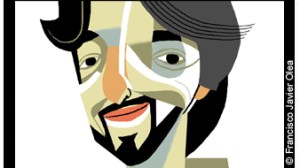
 

cartoon drawing of Andres Neuman

Andrés Neuman

CM: I was looking at your blog and Facebook pages and I was wondering whether you have willingly embraced the social media platforms that so many writers use to promote their work, or whether you have to be dragged kicking and screaming to the computer to engage with your virtual friends?

 AN:Interestingly, my personal blog and Facebook page are two very different, if not opposite, cases. The blog Microrréplicas  is entirely written and updated by me. I consider it just another part of my literary work, indeed not below the books. Whereas the FB profile was actually opened, and is still ruled, by a nice group of readers. They are the only ones who decide what to put on it, and when and how. I think that’s fair. Personal contact with readers can be really great, and sometimes deeply moving. But I guess that keep always interacting online can also be tricky for a writer, since a good book needs quite a lot of solitude and time to be written. And its feed-back is much more a long-term one. So maybe the most respectful thing that writers can do for those wonderful virtual friends is, precisely, to dedicate most of their time to work hard on their books. Which will be hopefully read, discussed, loved or hated on social networks.


CM: And finally….. I have based my blog content on tackling the unread books lurking on my bookshelves. Do you have a ‘TBR Pile’ and if so, what is on it?

AN: Oh, that’s my favourite wet dream: to read everything I haven’t read yet. I have no just one, but several ‘to be read’ piles everywhere at home. The most interesting pile is, of course, the bathroom one: the only place in which nothing can seriously interrupt our reading. What’s on that pile right now? Let’s see: a biography of Chéjov written by my beloved Natalia Ginzburg, the first volume of Philip K. Dick complete short stories, Houellebecq’s new novel, Pierre Michon’s penultimate, an anthology of Chilean poet Nicanor Parra, several young Argentine novelists, a very good half-read book of stories by James Lasdun, a collection of fragments by wonderful Spaniard philosopher María Zambrano, last Julian Barnes’ book, a manual of compared mythology (what the hell is doing that here?), a travel book about Italy by Stendhal, a political essay by Cameroon activist Achile Mbembe titled Necropolitics, an anthology of contemporary Welsh poets (recently found in Cardiff), a couple of comics, some old and crumpled and dirty newspapers… If I resurrected, I’d dedicate that extra life exclusively to pending books. I promise. Well, I don’t. Will there be a bathroom after death?

Many thanks to Andrés Neuman for taking the time to answer my questions. I’ll be posting up a blog post about Traveller of the Century shortly.

Picture credits: All of the illustrations used here were taken from Andrés Neuman’s official website with thanks.