Edith Nesbit’s (1858-1924) stories were a big part of my childhood; I loved The Phoenix and the Carpet and the fantasy of being able to fly away to strange lands with a magical creature. The adventures of the Bastable family came a close second. I didn’t realise that Edith Nesbit wrote verse until I did a little digging around after reading Man of Parts (David Lodge) which tells of H.G.Well’s relationship with Edith Nesbit and her involvement with the Fabian Society.
I found a couple of Nesbit’s poems in The Oxford Book of Twentieth Century Verse, which I have used in an earlier post. I chose to post an extract of the following verse because it struck a chord with me. We spend a lifetime accumulating knowledge and skills which we hope to pass on to the next generation, but as the woman in Nesbit’s poem says, not everything can be written down and saved. I love the plea in the last line; I think I’d like to know something too.
The Things that Matter
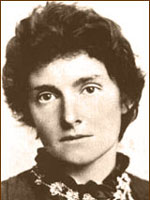
Edith Nesbit
Now that I’ve nearly done my days,
And grown too stiff to sweep or sew,
I sit and think, till I’m amaze,
About what lots of things I know:
Things as I’ve found out one by one-
And when I’m fast down in the clay,
My knowing things and how they’re done
Will all be lost and thrown away.
There’s things, I know, as won’t be lost,
Things as folks write and talk about:
The way to keep your roots from frost,
And how to get your ink spots out.
What medicine’s good for sores and sprains,
What way to salt your butter down,
What charms will cure your different pains,
And what will bright your faded gown.
But more important things than these,
They can’t be written in a book:
How fast to boil your greens and peas,
And how good bacon ought to look;
The feel of real good wearing stuff,
The kind of apple as will keep,
The look of bread that’s rose enough,
And how to get a child asleep.
…
Forgetting seems such silly waste!
I know so many little things,
And now the Angels will make haste
To dust it all away with wings!
O God, you made me like to know,
You kept the things straight in my head,
Please God, if you can make it so,
Let me know something when I’m dead.
Poem originally published in the Rainbow and the Rose (Longman, 1905)
I discovered the Edith Nesbit Society, devoted to discussing and promoting Edith Nesbit’s life and work while trawling the internet. It has occurred to me that it would be useful to compile a directory of all of the literary societies that I come across in the course of my blogging. I think it would fit in alongside the Bibliography pages. It’s probably a long-term project, but these last few #PoetryinJune posts have made me realise just how many literary societies are active, so I would like to support them in a small way.
That’s all for today’s #PoetryinJune – check out the link above for more information on Edith Nesbit.
Picture Credit: Wikipedia – with thanks
 Tales From the Landing Book Shelves
You must be logged in to post a comment.