Ireland Reads Day 2025

Ireland Reads logo

Today is Ireland Reads Day, hence the almost unprecedented phenomenon of three blog posts in one month. I have not marked this date in the reading calendar on The Landing blog in recent years, so I thought I would chip in with a bookish update this year to make up for that lack.

In the interests of sharing reading inspiration, I will give a quick rundown of what is currently awaiting/occupying my attention. Or should I say, what is immediately holding my attention, as to do any more would require extensive auditing of the Landing Book Shelves. The extensive TBR Pile is very extensive indeed. So much for the blog’s core aim of reading my way around the shelves. I am not sure that I have come very far in the twelve years that I have been book blogging! But, on with some book notes …

Having curtailed my book buying in favour of trying to read what I actually have on the shelves is good, but those library loans will tend to keep on creeping in. My library audio book of the moment is The Winter of our Discontent by John Steinbeck (narrated by Jeff Harding). Attentive readers of this blog will know that I usually listen to crime on my bus rides, so this is something of a departure (no pun intended) for me.  So far so good, though I have tended to doze off once or twice on the way home while listening. This is I am sure, no reflection on either Steinbeck or Harding, merely that after a day’s work a little bit of tension goes a long way towards keeping me awake. Though it is fair to point out that tension in the narrative is now growing as Ethan Hawley puts aside his previous scruples to improve his financial and social position.

I have several TBR library books at the moment, two of which are advance reading for a short Irish literature course that I am planning to take in April. In addition, and in no particular order are: The Death of Nature by Bill McKibben, The Millstone by Margaret Drabble, At Dusk by Hwang Sok-Yong and The Longest Afternoon: the 400 Men who Decided the Battle of Waterloo by Brendan Simms. As is often the case a moment of serendipity played a large part in the borrowing of these titles. I am a sucker for the trollies of the ‘Just Returned’ items. On the future ‘commute pile’ (I just invented that term) is One Big Damn Puzzler by John Harding (read by Peter Brooke), which is allegedly ‘painfully funny’, so that should surely keep me awake on the trip home. I will let you know.

At this stage of the year, I am still working my way through books I had for Christmas. One of these was Art History without Men by Katy Hessel, which I am dipping into in between novels. I have met some familiar artists, but also some new names to follow up on at my leisure. I may return to this one for a future blog post. Also on the Christmas pile is The Hidden Life of Trees: The Illustrated Edition by Peter Wohlleben. This I have yet to read, although I have browsed the photographs, which are absolutely fabulous.

Well, that is a quick snapshot of reading-in-progress chez The Landing, so I will go off into a quiet corner and carry on reading. I hope you have a pleasant Ireland Reads Day! Do let me know what you have been reading in the comment box below.
Ireland Reads Day: Squeezing in a read (or two)

Today’s Landing Tales post is written in support of the Irish Government initiative, #Ireland Reads Day, which is supported by public libraries. So, I want to talk a little about my memories of my early reading life (once upon a time in Birmingham) going back to where it all started, with a quick delve into the Landing Book Shelves. I hope to give you a little insight into what started me off on a lifetime love of books and reading. And of course, today I will certainly be squeezing in a read. Though in fairness, it’s more a case of trying to stop me squeezing in a loooong read…

My relationship with books goes back a long way. Like many people, I can trace that love back to all those old familiar nursery rhymes and songs, many of which will never be forgotten. Then it’s a short step onto children’s poems such as those of AA Milne, whose ‘The King’s Breakfast’ was one of my early favourites. Nowadays, just like the poor old king, ‘I do like a little bit of butter to my bread’ in the mornings! Although, I am also of the view that ‘marmalade is tasty, if it’s very thickly spread’, so I’m at one with the Dairymaid on that issue.

Now, as Paddington Bear afficionados know well, he is also a confirmed marmalade fan, usually keeping a spare marmalade sandwich under his hat for emergencies. Apparently, it’s a well-known fact that bears who come from Darkest Peru like marmalade,

“Where was it you said you’d come from? Peru?”
“That’s right,” said Paddington. “Darkest Peru.”
“Humph!” Mrs. Bird looked thoughtful for a moment. “Then I expect you like marmalade. I’d better get some more from the grocer.”
“There you are! What did I tell you?” cried Judy, as the door shut behind Mrs. Bird. “She does like you.”
“Fancy her knowing I like marmalade,” said Paddington.

If I were to attempt to compile a top ten childhood favourites list, then Paddington may well be at the top. Not least because, as an adult of (ahem, mature) years I can still sit down and chuckle over one of his adventures, which really do stand the test of time. Take a bow, Michael Bond.

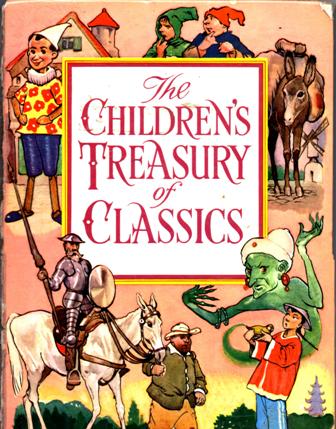
I think that I have probably mentioned on here before, The Treasury of Children’s Classics collection that I had as a child, which still survives, albeit in a very battered state, with the cover selotaped together. It contains a mixture of extracts from classic tales and several poems. It was my first introduction to the brothers Grimm, Hans Christian Anderson, Dickens, Shakespeare (via Lamb’s Tales) the Arabian Nights and Susan Coolidge, to name but a few.

book cover with Aladdin, Pinoccio, Don Quixote
A childhood favourite

But it was the verses that initially drew me into the book, when I was too young to appreciate extracts from Robinson Crusoe and the like. I enjoyed the humorous poems best, such as John Drinkwater’s ‘Washing’, which I am sure struck a chord with many a child. Here’s an extract:

What is all this washing about,
Every day, week in, week out?
From getting up till going to bed,
I’m tired of hearing the same thing said.
Whether I’m dirty or whether I’m not,
Whether the water is cold or hot,
Whether I like or whether I don’t,
Whether I will or whether I won’t.-
“Have you washed your hands, and washed your face?”
I seem to live in the washing place.

Of course, this poem seems particularly innocent and old-fashioned in our Covid era of required hand washing, when handwashing doesn’t just relate to a grubby child in from playing in the garden, who can’t see why a bit of dirt would hurt a jam sandwich.  Or in Paddington’s case it would be sticky paws from eating directly from the marmalade jar.

The themes of washing and general cleanliness link to my final choice for this post (though believe me, I could go on but I have to stop somewhere), which is The Family from One End Street written and illustrated by Eve Garnett (1937).  The family is the Ruggles family, father Joe is a dustman and his wife Rosie takes in laundry:

Mrs Ruggles was a Washerwoman and her husband was a Dustman. “Very suitable too,” she would say, though whether this referred to Mr Ruggles himself, or the fact that they both, so to speak, cleaned up after other people, it was hard to decide.

Mrs Ruggles has a sign outside their little terraced house proclaiming, ‘The Ideal Laundry. Careful Hand Work’ and the house is often full of clothes, steam and folded laundry. Joe and Rosie have seven children, the youngest still a baby so life is busy and full of activity and comic adventures. If you know Alan Ahlberg’s picture book Peepo!, then you would recognise these books as sharing the same working class world of the 1930s and 40s. Clothes drying by the fire, kids playing in the yard and the mother in her pinny doing the chores. Though in Mrs Ruggles’ case, working as we would now term it ‘from home’ as well as doing the family tasks. These stories could be sentimental, dealing as they do with a poor family whose children seem to be constantly taking boots to be repaired, yet who have a happy life. Yet, they aren’t at all saccharine sweet, merely very funny and thoughtful. And Eve Garnett’s black and white sketches speak volumes.

I’ll wrap it up for now, but I’d love to hear about your favourite childhood reads or what you’re reading for #IrelandReads, so drop me a line below if you’d like to do so. Now, I will just go and #SqueezeInARead!