Mystery and Beatrix Potter

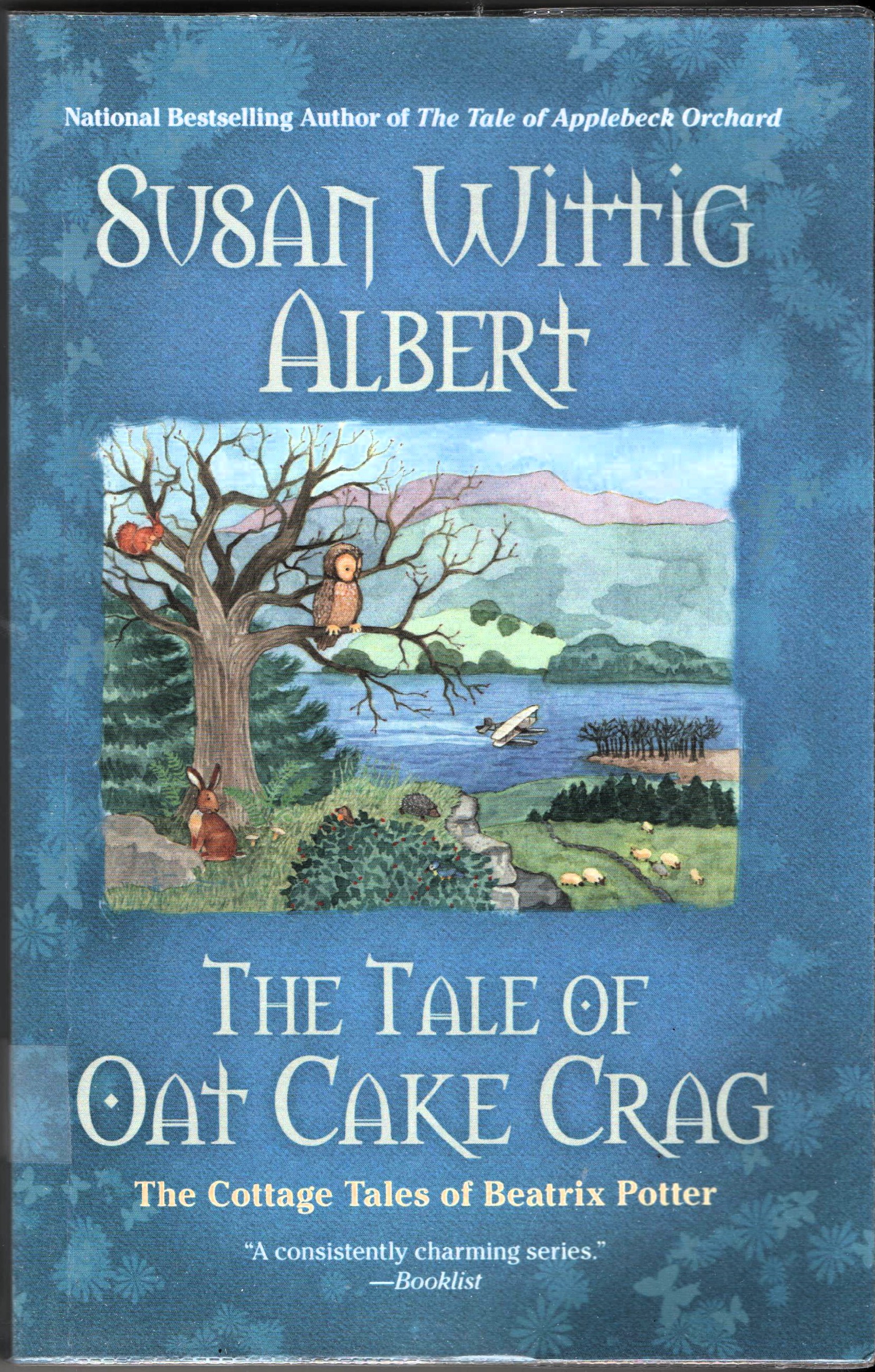
Front cover of The Tale of Oat Cake Crag by Susan Wittig Albert

The Tale of Oatcake Crag (2010) by American mystery writer Susan Wittig Albert is a curiosity that I came across in my ongoing search for detective stories featuring historical figures. Similarly to spotting the Groucho Marx crime series, I was so intrigued by the premiss of Beatrix Potter (1866-1943) as an amateur detective that I searched the online library catalogue to see what I could reserve. As before, I was forced to settle for a large print edition, as there is very little else of this series available nationally. So it is thanks to Cork City Libraries for the loan of this Chivers edition.

I was not sure what to expect from the novel, but I was not really surprised that this turned out to be a very gentle country tale indeed. No bodies in libraries, trains or anywhere else for that matter. It is one of a series, (The Cottage Tales of Beatrix Potter) imagining children’s writer Beatrix Potter as an amateur detective in her Lake District home and mixing real-life people with fictional characters. The eight-novel series began with The Tale of Hill Top Farm (2004), set around 1905 when the real Beatrix Potter’s fiancé Norman Warne has sadly died aged only thirty-seven. Potter subsequently bought Hill Top Farm in Near Sawrey with the proceeds from a legacy and the proceeds from her Peter Rabbit book, having become very attached to the Lake District over many years of visiting. She spent as much time as she could in this part of the country, when she was able to leave her parents for a while. Locations in the village feature in her books and illustrations.

Now, I have not read the earlier stories for comparison, but as I said, this one is very much in the cosy crime vein as there is indeed no murder (bloody or otherwise). The central mystery in the novel is the authorship of some poison pen letters, sent to the Vicar’s fiancée, Grace Lythecoe, apparently a respectable widow. Who would want to threaten the happiness of the seemingly well-liked couple? Grace asks her friend Beatrix to investigate the matter, which she does with the help of her present (unofficial) fiancé, William Heelis. The village animals also contribute to the investigations, which along with the dragon (yes, I did say dragon) requires a suspension of disbelief on the part of the reader.

The fictional poison pen letter affair is set against action inspired by real-life events; the literal ups and downs of the test flights of a hydroplane and the aggrieved local reaction to this. The test flights took place from 1911-12 and Wittig Albert has used details of the regular test flights over Lake Windermere as part of a sub-plot. The businessman backing the sea plane project has a fall and is seriously injured. An accident? Possibly suspicious, but again, no murder. Some details relating to the sea plane’s history in Windermere have been substantially altered but you will have to read the book to see what I mean (clue: the dragon is involved).
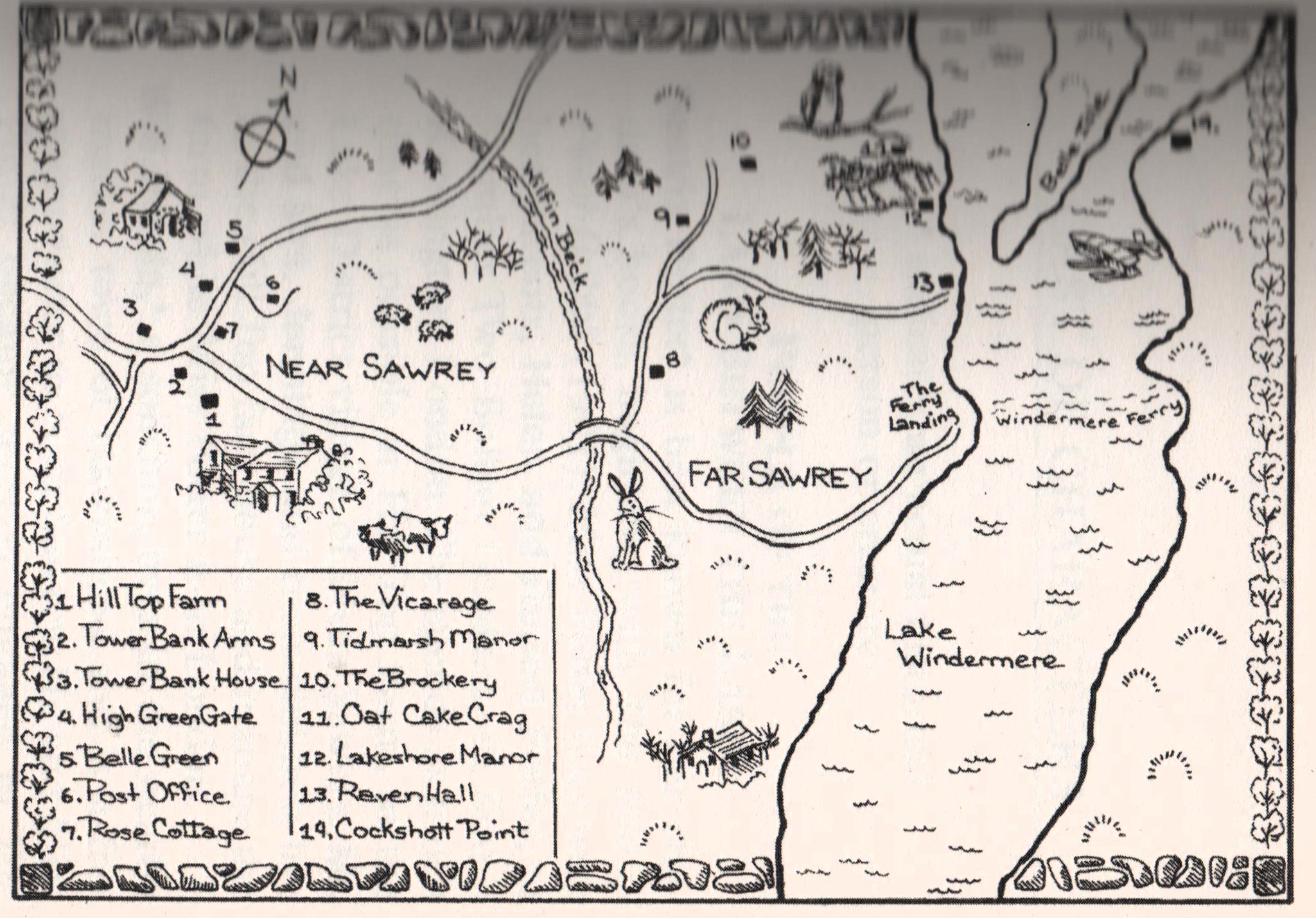
A map of Beatrix Potter's village
Map of the villages of Near & Far Sawrey, taken from the book.

We have gossip galore amongst the villagers of Near Sawrey, on the shores of Lake Windermere (though it has to be said that it is not merely the humans who gossip). However, with the chapters alternating between human and animal protagonists, it can really feel like reading a Peter Rabbit story for grownups. The author uses Potter’s affinity with animals to suggest that she can interpret what they are saying. Overall, this all has its charm but it does make me wonder who exactly is the intended audience for the series. Beatrix Potter solving the poison pen letters mystery is oddly convincing, as she does this by chatting to various people on her village rounds, in a perfectly natural way. She is very much a respected figure in her adopted home and her social class plays its part too. The overriding impression of reading this novel (if you discount the talking animals and a glowing green dragon) is of the dramas of village life as told in Miss Read’s tales of village goings-on in Fairacre and Thrush Green.

The descriptions of the area around Lake Windermere are beautifully done, as for example here, ‘I think it is fair to say that there is no place on this earth that gives the sun so much pleasure as this lovely green land, with its rambling rock walls, quiet lanes, tranquil waters, and long sweet silences.’ Lake District village life of the 1910s is well recreated, although with an awareness of the increased threat to the landscape from so-called progress. As Potter fans will know, she was instrumental in helping to preserve the landscape that she loved, via the National Trust, for future generations. At the end of the book, Wittig Albert includes some traditional recipes (though sadly without a conversion from cup measurements) as well as a glossary of local expressions, presumably aimed at her American audience.

I am not sure whether I would go out of my way to read another in the series, but this was an amusing and entertaining addition to my list of historical detectives. And all the better for not trying to shoehorn Potter’s fictional persona into a grittier or feistier role. I am still not convinced about the dragon though. Perhaps it deserves its own series.

Springtime for Miss Read (and Mrs Griffin)

Cover of Mrs Griffin Sends her Love

A Country collection…

This latest post is going to be a spring-themed blog post, to continue the recent seasonal bent on The Landing’s sister blog, Curiously Creatively. It is also another of those literary digressions where I sideline my TBR Pile in favour of a library discovery (or in this case a re-discovery of sorts). For anyone who came across the Miss Read (real name, Dora Saint) ‘Thrush Green’ or ‘Fairacre’ books many years ago, to discover a relatively new publication is a great find. As is my wont, I was browsing in the local library despite the presence of plenty of unread volumes on my shelves. Having spotted Mrs Griffin Sends her Love in my favourite section for serendipitous discoveries (AKA the ‘Just Returned’ shelf), I threw caution and the TBR pile to the winds. I may have also picked up a couple more books in addition, but let us not go into that little matter now.

Mrs Griffin Sends her Love is a collection of short pieces and articles compiled by Dora Saint’s daughter Jill and her former editor Jenny Dereham, to mark what would have been Mrs Saint’s 100th birthday in 2013. Some of the pieces were originally published elsewhere, some only discovered after Dora Saint’s death. They are a mixture of essays, humorous articles and extracts from longer works. The anthology includes articles on education (originally for the Times Educational Supplement), as well as pieces taken from Tales from a Village School and Time Remembered. Included also is part of a projected book on ‘The Village Year’ and some diary extracts from 1963, begun while Dora and her husband were housebound due to the heavy snow that winter. Just for the record, it has to be said that Mrs Griffin does not get a very big part, given that she provides the collection’s title

My favourite pieces are the ones about village school life: particularly the extracts from Time Remembered and a set of articles gathered under the heading ‘The Joys and Perils of Teaching’. As you might imagine it is the telling of the perils that is the most entertaining to read. In one article entitled ‘Scriptural Matters’ one youngster observes ‘Why didn’t God make us knowing everything? It would have saved a lot of trouble’. Saint describes her own early years as a pupil at a village school after her family moved from London to the Kent countryside. She reminds us how boring school life could be, and how the smallest things could be a fascinating distraction to pupils: ‘Small pieces of pink blotting paper, torn from the precious three-by-four allowed, were surprisingly nice to eat, and occasionally an obliging fly would settle on the arid desk top and create a diversion’.

Dora Saint had a real love of the natural beauties surrounding her on her walk to school as a youngster new to the countryside. The descriptions of the flowers and fauna are a joy to read and it is clear that Saint loved the country sights from a very young age. She recalls her very first experience of arriving in Kent, ’I discovered dog violets and harebells in the North Downs countryside, as well as old friends like buttercups and daisies’. However, Saint was not enamoured of all aspects of country life. She disliked seeing, ‘poor dead rooks hanging upside down from sticks among the crops, their black satin wings opening and shutting macabrely in the wind.’ I can’t say that I blame her, it must have been an unnerving sight for a young child.

Cover of The Year at Thrush Green

Two more Miss Read books …

Having picked up this library book inspired me to have a root around on The Landing shelves and see what Miss Read books I could come up with to re-read. Miss Read is one of the authors that I discovered many years ago, courtesy of my mum’s reading tastes and I borrowed several from our local library as a teenager. We have a couple of Miss Read titles here on The Landing, so I have just been dipping into The Year at Thrush Green, looking at the seasonal changes that she describes. Taking the February entry, here is her observation of signs that spring is beginning in Thrush Green,

Soon yellow primroses would star the woods, and the daffodils would blow their trumpets in the gardens of Thrush Green. Yellow, gold and green, spring’s particular colours, would bring hope again after the bleak black and white of winter.

Miss Read also has an eye to the spring garden, as she describes the vicar wandering in his garden one bright March morning, seeking respite from a particularly trying parishioner. Blackbirds and thrushes are busy looking for food, while daffodils and narcissi promise better things to come and ‘polyanthus plants turned their velvety faces to the morning sunshine, bright yellow, orange, red and a deep mauvish-blue’. Add an almond tree scattering blossom and you have a very inviting seasonal snapshot.

Her evocation of the colours and imagery of spring scenery is delightful. By the merry month of May, ‘the roses were showing plump buds’, wisteria ‘drooped massive tassels against the Cotswold stone’ and along the lanes was ‘cow parsley frothing each side as far as the eye could see’. I particularly like the wisteria analogy as it is one of my favourite climbing plants and there are some lovely examples to enjoy around my part of Dublin.

I think that I will now head into June (in a literary sense if not in reality) and see what is growing in the hedgerows and gardens. I might even catch up with a few Thrush Green inhabitants at the same time. There sure to be a bit of gossip circulating…

Drop a line in the comment box if you are a Miss Read fan!

TBR Pile Update: It’s growing larger, not smaller

TBR Pile Bedside Table

Not getting any smaller…

I am yet again becoming worried about the size of my TBR Pile, as I seem to be adding to it faster than I am reading it. The interesting aspect of this TBR growth is that new piles have begun to accrete in different places. To be strictly accurate, the growth in the bedside table pile is not a new phenomenon, but the strangely solid, immovable quality is a new feature. In the past, bedside table books tended to come and go, so the whole pile had a fluid feel to it. However, for the best part of this year, the books on the pile have been behaving like a sticky post or a pined tweet, and staying firmly put. That is not a good sign. Now, I will admit that books have remained on my bookshelves unread for about twenty years, but a bedside reading table isn’t supposed to work like that. I am not sure why, but it just isn’t. This is not a restful state of affairs I can assure you.

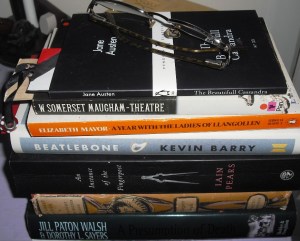
Strangely enough, a couple of books on the Bedside TBR pile have no right to be where they are, as I have actually read them. Why I have not re-homed them by now, I have absolutely no idea. Well, except for the small matter of running short of shelf space in the fiction section (AKA the bedroom bookshelves). An Instance of the Fingerpost (Iain Pears) and a Presumption of Death (Dorothy Sayers and Jill Paton Walsh) will definitely be heading for a charity shop soon. I brought them back this summer from another TBR Pile at my mum’s house. The Iain Pears novel had languished unread for years and I am glad that finally I managed to read it, as it was both gripping and atmospheric. As you might recall, I am fond of historical skulduggery and this was an excellent example of 17th century political and religious machinations.

My guiltiest TBR confession is that Kevin Barry’s Beatlebone has been awaiting reading since I received it as a ‘Secret Santa’ gift last year. I did begin to read it a few months ago but I put it aside after becoming distracted by something else. I think I made it to page twenty-two before Mary Queen of Scots came between us. My only excuse is that I must have still been in a historical frame of mind at the time. I think this was after Arbella Stuart and Elizabeth I, but before An Instance of the Fingerpost. As it happens, I still haven’t finished My Heart is My Own (John Guy), having paused for breath round about the time of the Earl of Bothwell’s marriage to the queen. If anyone had poor judgment in husbands, it was Mary Stuart, though to be fair the first one (the French Dauphin) was not her decision.

The Other TBR Pile…

TBR Pile Desk

Even more reading here!

The recently instituted Desk TBR Pile is largely composed of library books and new additions (OK, I know there aren’t supposed to be any new additions, but it just sort of happens to me). I am looking forward to reading Chris Cleave’s Everyone Brave is Forgiven, passed on to me by a friend. I started reading it on the Luas on the way home and was immediately taken with the story, though I decided it could wait its turn while I finished something else. The library book of the moment is a collection of pieces, Mrs Griffin Sends her Love by Miss Read (Dora Saint) that I spotted recently and picked up in a fit of nostalgia. My mum first introduced me to Miss Read’s chronicles of the fictional English villages of Fairacre and Thrush Green, when I was a teenager, so I was pleased to discover this collection. Dora Saint’s daughter Jill has written the foreword to the book, published in 2013 to mark her mother’s centenary year. The onset of winter is an apt time to be reading these short pieces, as it reminds me how hard life would have been in rural England (and Ireland) a comparatively few years ago. Thank heavens for indoor plumbing!

I probably should return to one of my TBR Piles now… How is yours getting on these days?