Midsummer on the Landing Book Shelves

This post returns us to the original idea behind the blog, reading or re-reading some of the books on the (admittedly former) Landing Book Shelves. I was prompted into this after we went to see this summer’s Shakespearian production from the Balally Players. This year it was A Midsummer Night’s Dream, an obvious choice for this season. It was just a pity that the weather refused to play along with the idea, as were almost rained off at one point in the performance. All credit to the company for carrying on regardless (and the audience sticking it out!) A cup of coffee and a slice of lemon drizzle cake at the interval helped us to cope with the resulting dampness.

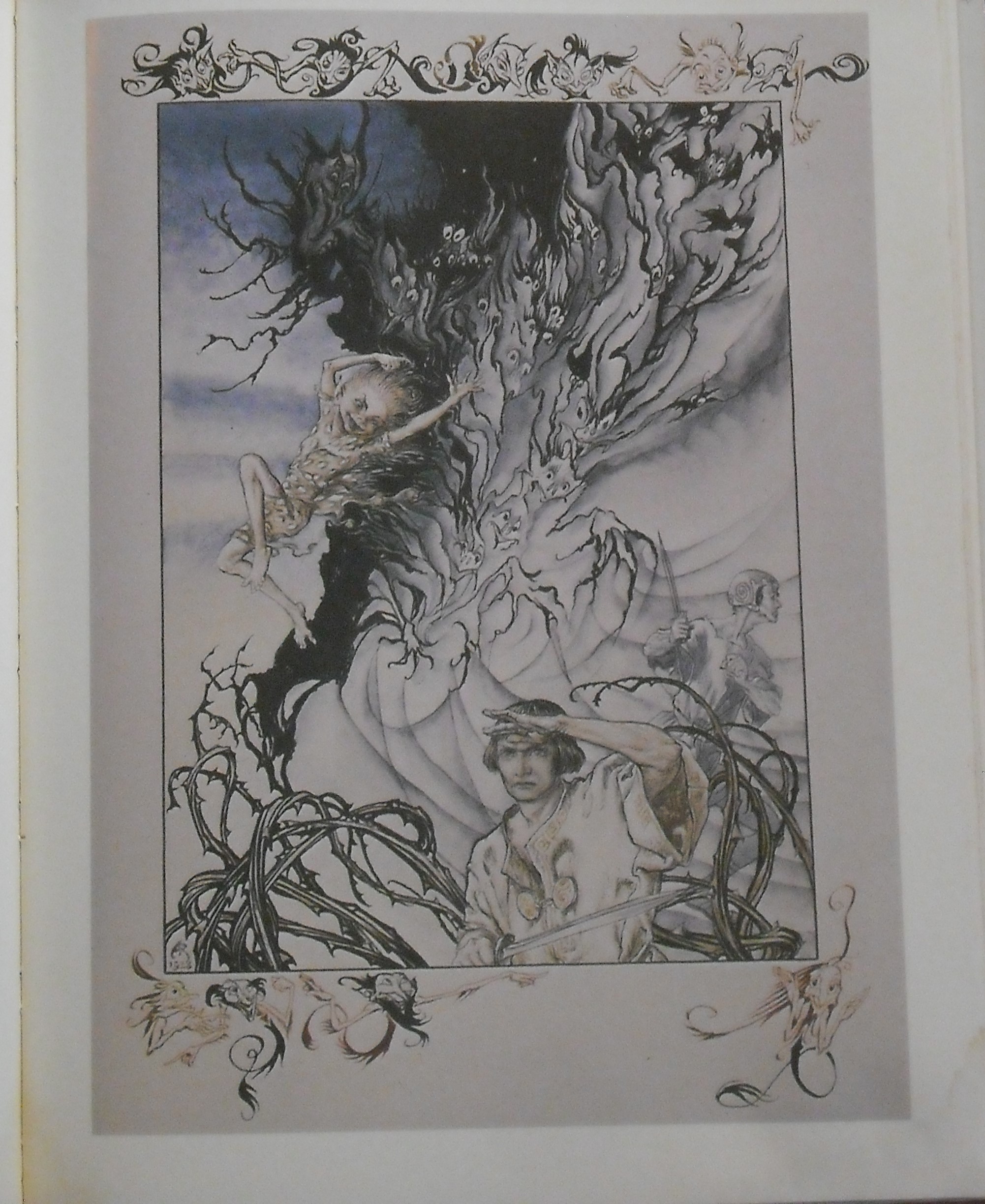
Anyway, the upshot is that afterwards, I had a ferret around on the bookshelves, braving the inevitable dust, to retrieve a copy of the very play. I have had this edition for many years and at this stage its origins are lost in the mists of time. As you can see from my photos, it is an edition beautifully illustrated by Arthur Rackham (1867-1939). Sadly, the jacket is not in the best condition at all. It wasn’t perfect when I acquired it, but several house moves over the years probably have not helped. However, the book itself is still in very good condition and is a lovely book to handle and to read. Suffice to say that although this is a first edition, I doubt if it will make my fortune.

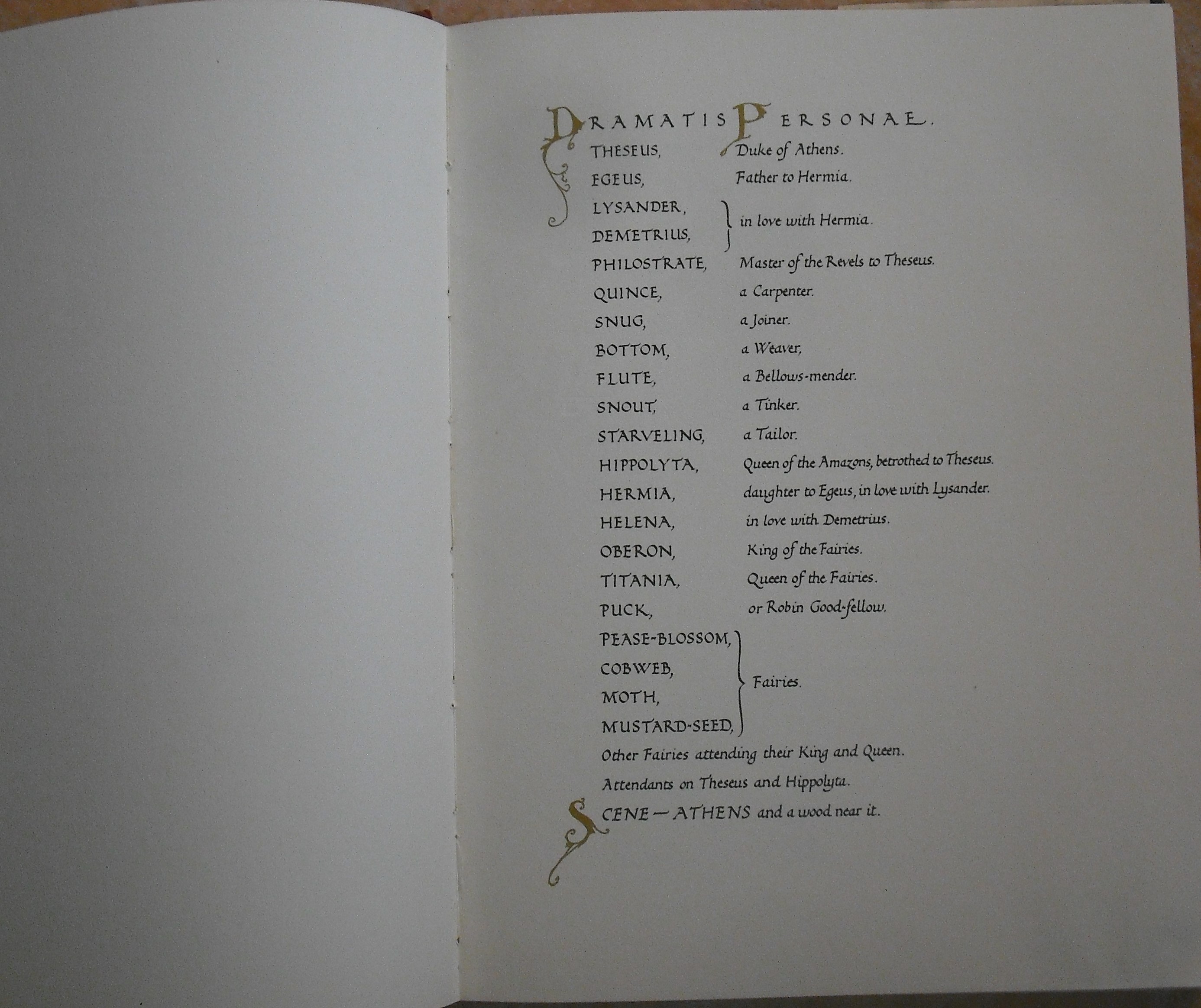
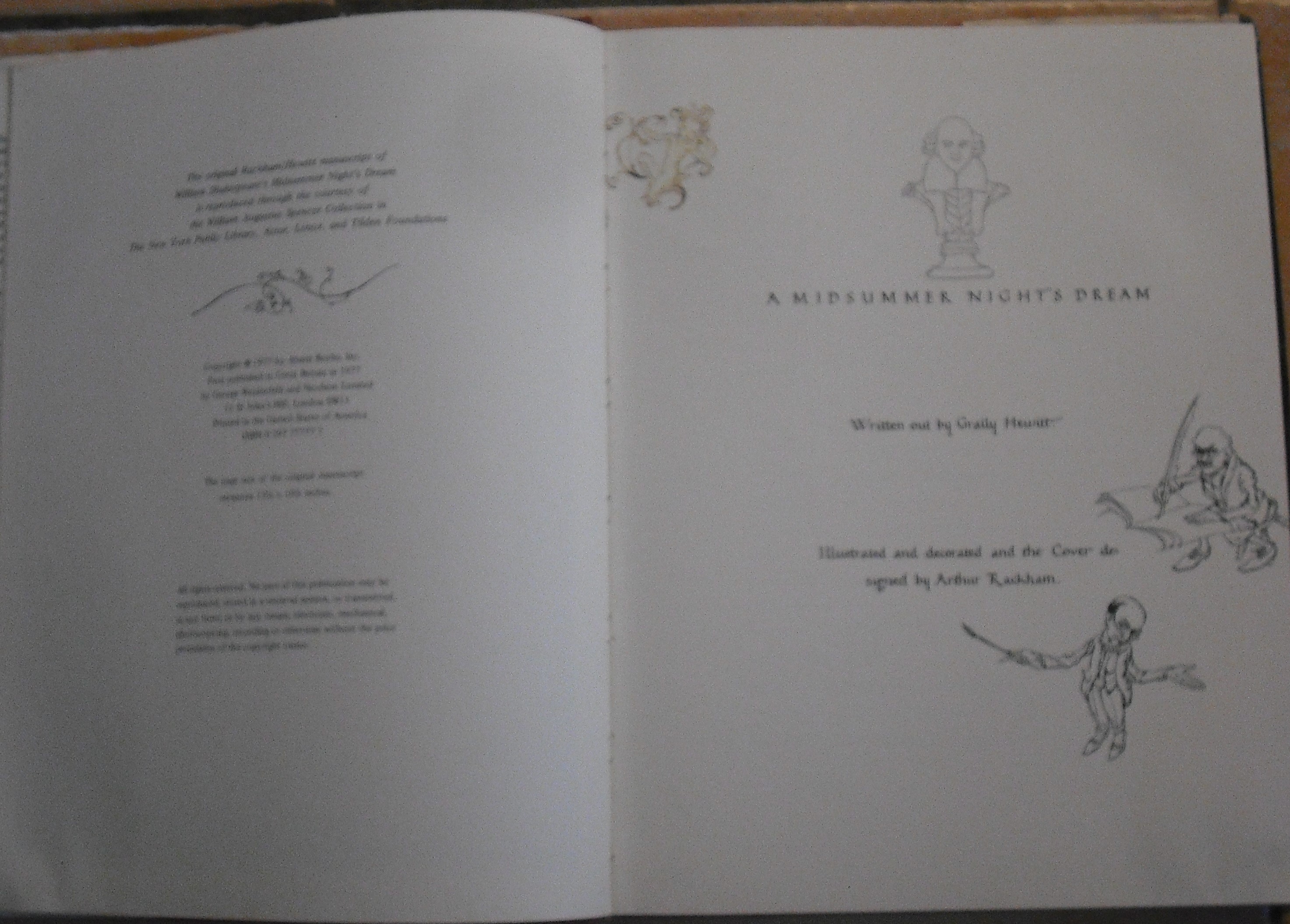
This edition was published from a book commissioned from Rackham by the New York Public Library’s William Augustus Spencer Collection in 1929. Calligrapher and novelist Graily Hewitt (1864-1952) produced the text, while Rackham designed the cover, page decorations and colour plates. The work was released for publication by the Spencer Collection in 1977, published in the US by Abaris Books and in the UK by Weidenfeld and Nicolson. If you want to know more about the gorgeous items in the Spencer collection, the NYPL blog has lots of information.
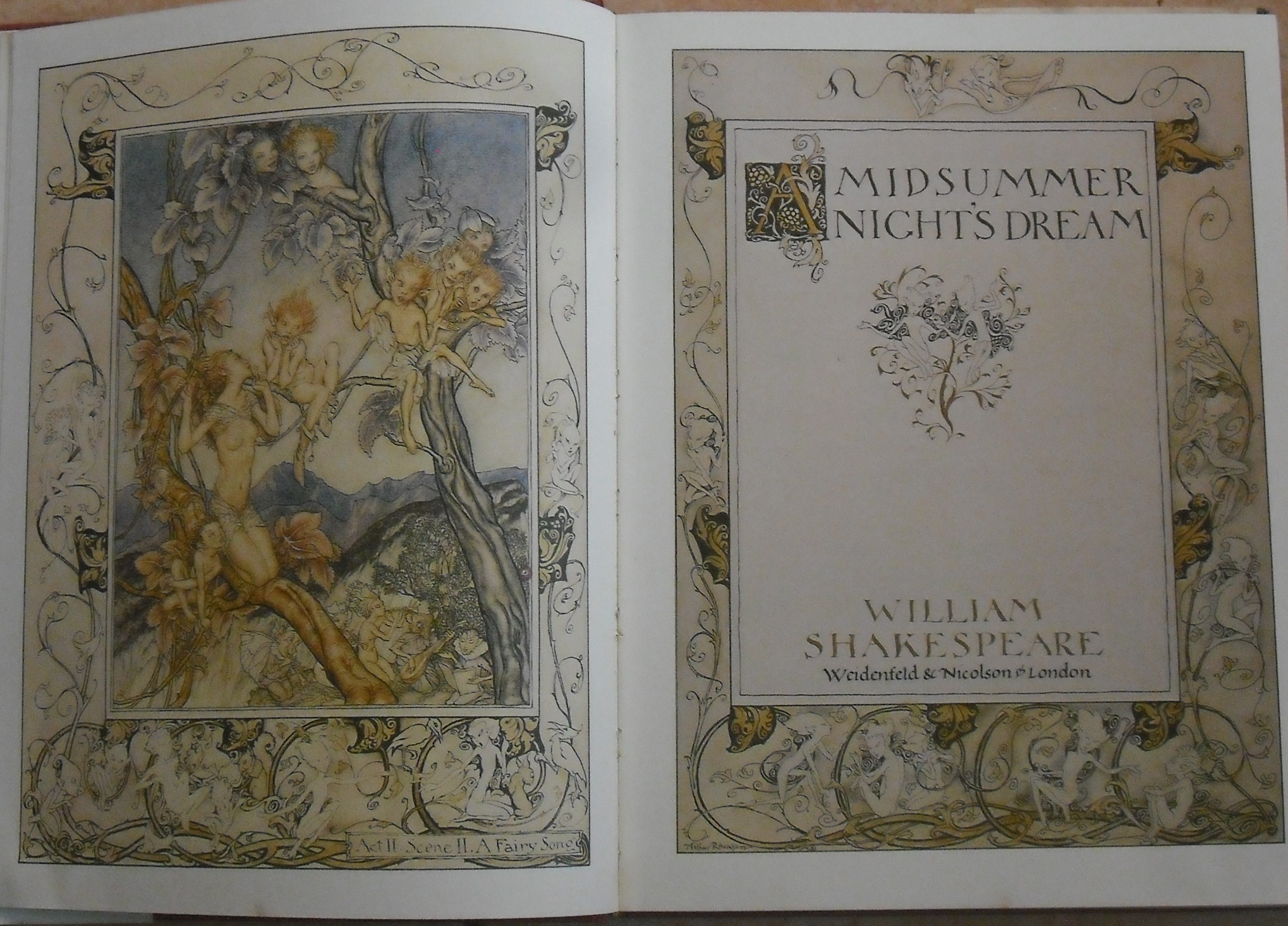
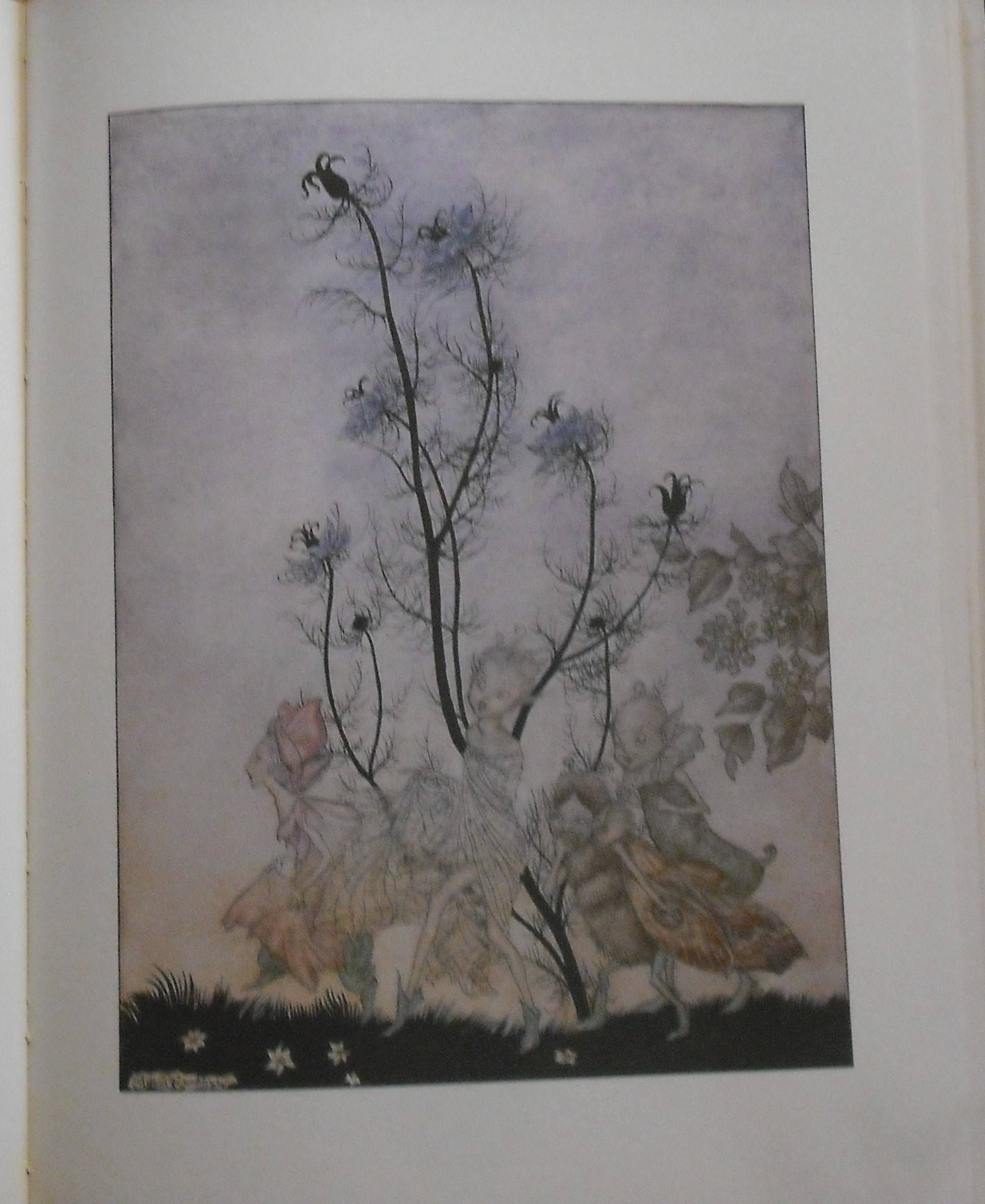
This is rather a large book to read curled up on the sofa, so resting it on a table is the best approach. The calligraphy is so beautiful to read that it adds much to the experience of reading Shakespeare’s words. Of course, re-reading while the production was still fresh in my mind was an added bonus. I am just going to indulge myself by quoting a few lines from Puck (or Robin Good-fellow) at the end of the play, to close this post.

And I will just mention that I have not forgotten my new crime theme for the blog. More of this goodly matter anon.

If we shadows have offended,
Think but this, and all is mended, –
That you have but slumbered here,
While these visions did appear.

So, good night unto you all.
Give me your hands, if we be friends,
And Robin shall restore amends. [Exit]
More Fairies: Shakespeare

My choice of Shakespeare today is in honour of the Trinity Dublin Shakespeare Festival which is being held this week from 3-8 June. I have been to a couple of events so far and hope do more by the end of the week. My original plan for today was to select a sonnet, but I decided to pursue the theme of summer instead. Here, therefore is a short magical snatch from the action in

A Midsummer Night’s Dream:

Act II (Scene I)  – A wood near Athens     

Puck and the fairy by a tree

Puck and the fairy


Enter from opposite sides, a fairy and Puck

PuckHow now, spirit, whither wander you?  

FairyOver hill, over dale
Thorough bush, thorough brier,
Over park, over pale,
Thorough flood, thorough fire,
I do wander everywhere,
 Swifter than the moony sphere;
And I serve the fairy queen,
To dew her orbs upon the green:
The cowslips tall her pensioners be;
In their gold coats spots you see,
Those be rubies, fairy favours,
In those freckles live their savours;
I must go seek some dew-drops here,
And hang a pearl in every cowslip’s ear.
Farewell, thou lob of spirits; I’ll be gone:
Our queen and all her elves come here anon.

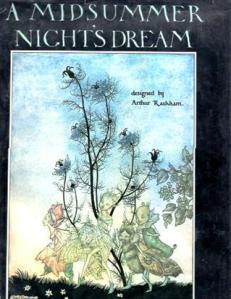
I have had this illustrated edition for many years but sadly can’t remember where it came from, other than that I think it was probably from a book fair in the Birmingham area. That would put it around fifteen or more years ago, which is a scary thought.

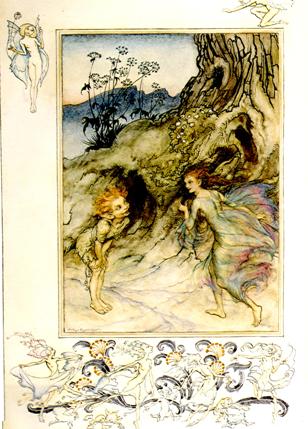
The illustrations are all by Arthur Rackham (1867-1939) and the text was written by calligrapher Graily Hewitt (1864-1952). The work was originally done in 1929 at the invitation of the Spencer Collection (New York Public Library)  This particular edition was published in 1977 by Weidenfeld and Nicolson Ltd and reproduced from the 1929 manuscript. I love Arthur Rackham’s work and maybe one day I might get to see his original drawings and watercolours. There is an Arthur Rackham Society if you want to discover more information about his work.

I hadn’t heard of Graily Hewitt before I owned this book but I have discovered that the Victoria and Albert Museum have holdings of his work. He was a very important figure in the world of calligraphy and typography and wrote The Pen and Type Design (1928) and Lettering (1930). The latter was last re-printed by Dover Publications in 1993 though it looks as if it is out of print now. This reminds me that Dover are a brilliant publisher for classic reprints and that perhaps I should do a post on their work sometime.

Apologies if the images don’t look as good as they might. I had problems scanning due to the size of the book.

Almost a week of poetry and poets so far….let me know your favourites so far!

Titania's fairies

Front of jacket


Some Literary Facts in Honour of World Book Night

I’ve borrowed this from the brilliant blog Interesting Literature’ as it will serve as a reminder to me that I really must get around to reading The Swerve. It has sat patiently on my bed-side table (does this now make it part of the TBR Pile?) since its purchase a few months ago.

Anyway, here’s wishing you all a happy World Book Day (Night)…

InterestingLiterature's avatarInteresting Literature

Today, 23 April, is World Book Night (sometimes known, confusingly, as World Book Day). It is also the birthday (according to convention; nobody knows for sure) of William Shakespeare, and also the date on which he died, in 1616. On different calendars, Miguel de Cervantes (author of Don Quixote) and William Wordsworth also died on this day, in 1616 and 1850 respectively. In honour of this literary event, we thought we’d compile 23 literary facts about the world of books, poetry, plays, novels, and other bookish delights for you to revel in and share today. We hope you enjoy them!

World1

The first detective novel in English is often said to be The Moonstone by Wilkie Collins (1868). However, The Notting Hill Mystery (which, sadly, doesn’t feature Hugh Grant in Victorian gaiters going around on a killing spree) got there first, in 1862-3. The author of this – the bona fide

View original post 955 more words

A Centuries Old Mystery: Josephine Tey and Richard III

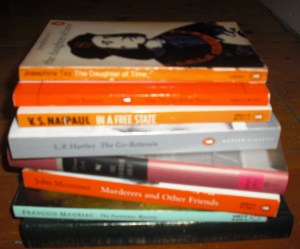
Cast your minds back to the post with the selection of the TBR Pile featured. I did say that I would be tackling them ‘in no particular order’ but the one I have been reading for the past few days was indeed at the top of the list. See photograph below for proof. The book in question is The Daughter of Time by Josephine Tey (real name Elizabeth Mackintosh) about Richard III and the Princes in the Tower mystery.

This was I think always going to be my first choice (it was the first one that I picked out as well as being the first listed). The reason being as I am sure you have guessed by now that this is a re-read of an old favourite of mine. The book was originally published in 1951 (the last book to be published in Tey’s lifetime as she died in 1952) and issued by Penguin Books in 1954. My edition is a 1969 reprint bought second-hand and it certainly shows: foxed is not the word for it I am afraid. The pages are heavily discoloured and threatening to fall out; both the front and back covers are damaged. Maybe one day I’ll treat myself to a new edition (I am not sure if the title is still in print) or a fine second-hand copy.

pile of classic novels

Working from the top down…

Two things make this book an old favourite: my affection for Josephine Tey’s crime novels and my long fascination with Richard III and the mystery of the princes in the tower. This fascination was in fact inspired by reading Tey’s book as I am sure was the case with many other readers. Indeed the Richard III Society credit her with helping to rehabilitate the king’s reputation and restore him to his rightful place in history. Shakespeare has much to answer for in his creation of the wicked hunchbacked uncle with a rather long crime sheet.

Tey’s novel features her regular detective character Inspector Alan Grant who is laid up in hospital after an accident and is terribly, mind numbingly, bored and frustrated. When his fascination with faces (from the bench or the cells?) causes him to become interested in the mystery surrounding Richard Plantagenet, the scene is set for a modern-day investigation into a historical crime. With the help of an amiable American student as his able-bodied research assistant, Grant delves into the murky doings of the fifteenth century. He is surprised by what he comes up with during his quest and is by no means impressed with your average historian’s powers of reasoning.

On the strength of reading this investigation into the Yorkist monarch several years ago, I did some further digging around and discovered more novels and academic studies on the subject. I then read as much as I could find on Richard and the Wars of the Roses and his eventual demise fighting at the Battle of Bosworth in 1485. I was keen enough on the topic to become a member of the Richard III Society though I eventually let my membership lapse. Having looked at the website recently I am tempted once more to become a Ricardian.

Meanwhile, back to the novel to follow-up a few leads! Are there any more Richard III enthusiasts out there? If so, let me know what you have been reading lately, I would love to know.

Just to finish with, here is a link to a fascinating site on Josephine Tey which is well worth a look if you are a fan of her writing.