From Landing to Garden: Sunflowers and The Pip Book:

close-up of a sunflower

Home grown sunflower

As a heavy rain shower has just stopped play (or rather work) in the garden I now sit diligently in front of my computer waiting for inspiration to strike. At the same time, I am endeavouring to keep one eye on the kitchen window to see what the weather is up to now. If however the sunshine does break through again, I will have to dash back to the lawn mower leaving you to carry on regardless. In the meantime a smidgen of writerly inspiration has struck The Landing regions so I will devote this post to a garden theme.

This flurry of garden activity has reminded me of the garden diary that I have been keeping intermittently for around twenty years. The diary now in fact has spawned a sequel co-written by The Bookworm. However, I doubt whether our efforts at a garden diary will ever be published and attain legendary status among future generations of gardeners. Nevertheless it will serve a purpose as a piece of family history as will the pictorial evidence (shown here) that we did once manage to grow a substantial sized sunflower. I am sure that Gertrude Jekyll and Vita Sackville-West would not be overly impressed but it was a first for us.

My (or rather our diary) contains notes of what has been planted when and where and is copiously illustrated with pictures from seed packets. Also it tends to note the rather frequent occurrence of cases of seed non-germination and slug depredations in the flower and vegetable borders. When I first started the diary I lived in a small flat so the entries were all about houseplants. Looking back through the pages I realise just how many plants I used to have. I wonder how there was room for anything else in such a domestic jungle. At the beginning of 1993 the grand plant total was thirty-two plus a variety of herbs.

Cover of The Pip Book with an avocado plant.

Mine didn’t look like that…

You might be surprised to hear that my library of gardening books is not (and never has been) very extensive. The sum total is four volumes, including one very small paperback book called The Pip Book by Keith Mossman which tells you about growing plants from almost any variety of fruit you can think of trying. I first came across this book when I was working in a bookshop in Birmingham several years ago and ordered a copy. According to a diary entry for 27th May 1994 I had recently bought this and another (un-named) gardening book. It is a great book full of helpful advice and I have tried growing several varieties of seeds and stones as a result. I have to confess though, that despite Keith Mossman’s book I have never yet had great success with avocados.

The illustration below is of a more recent edition from 2011 and I assume the book has been revised but even if it has not it would be well worth buying if you enjoy a growing challenge.
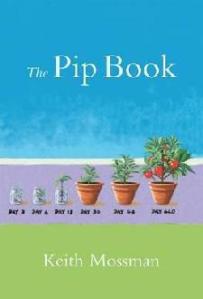
cover of the Pip Book with plants in pots

More Gardening Inspiration..

Now I really must show willing and get back to the lawn mowing (though that topic isn’t covered in The Pip Book) before it rains…

ps: Feel free to boast about any gardening successes in the comment box below:
John Buchan on film: those elusive thirty-nine celluloid steps

Orange Penguin cover of The Thirty-Nine Steps

Our edition of The Thirty-Nine Steps

As I mentioned previously, I watched one of the film versions of John Buchan’s classic adventure The Thirty-Nine Steps after reading it recently. The Hitchcock re-telling was one of my favourite screen versions, made in 1935 and starring Robert Donat (as Richard Hannay) and Madeleine Carroll (as Pamela). It was not until I read The Thirty-Nine Steps that I realised just how far were the screen versions from Buchan’s original story. I thought I knew the plot (more or less, a variation here and there perhaps) but now I concede that I knew absolutely nothing. Except that, thirty-nine steps (albeit with variant meanings) were involved and so was a large segment of rugged, almost deserted (except for the baddies) Scottish landscape.

For those of you who have never read The Thirty-Nine Steps, I will give a brief outline of the plot before

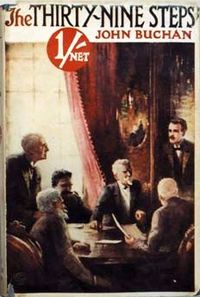
Cover of The Thirty-Nine Steps

A first edition of the novel

confusing you with the plot of the film: Hannay is a Scot, recently returned to the Old Country from South Africa who is heartily bored after three months. After an evening at dinner and a music hall show, he has determined to leave for the Cape if nothing interesting turns up within another day. Something certainly does turn up and Hannay finds himself fleeing across Scotland in several different disguises while in possession of a secret that could mean the difference between war and peace. Figuring out what or where the thirty-nine steps might be is a vital part of his un-looked for mission. As Buchan wrote the book in 1915, the plot’s threat, which involved the assassination of a European leader, was rather apposite. The Thirty-Nine Steps was Richard Hannay’s first adventure and it involves him in some tight moments and plenty of narrow escapes.

Moving on to the film version: I found to my surprise that whereas in Buchan’s original novel I found a distinct lack of women characters, two feisty ones pop up in the screen action. In the book, an occasional anonymous female supplies much-needed sustenance (fleeing dastardly spies is hungry work), but where, oh where is the glamorous Mata Hari type figure (Annabella Smith, played by Lucie Mannheim) that I saw in the film? In Buchan’s spy yarn, a mysterious American called Franklin P Scudder gives the vital information to Hannay. He does eventually wind up dead, but not as soon and arguably not as splendidly dramatically as Smith does.  In Buchan’s world, spying is obviously strictly a man’s game.

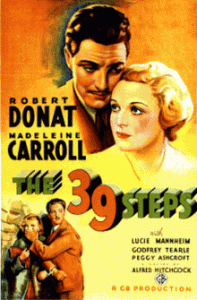
Film poster of Robert Donat and Madeleine Carroll

Film Poster

Hitchcock’s film further alters the female/male balance of the cast by adding the cool and elegant Pamela, to function as the ‘love interest’ part of the chase. I wonder what Buchan, who died in 1940 thought of the changes made to his story. He did not live to see the further screen adaptations, none of which was any more faithful than the 1935 film to the original tale. Carroll’s character is noticeably less exotic than the deceased Annabella Smith is but sparks soon fly between her and Hannay. Initially she disbelieves Hannay’s far fetched claims so betrays him to the police before finally realising that he was telling her the truth all along and so she helps him.

One side effect of playing with Google to research for blog pieces is that you find out other snippets of information. I found a site set up in tribute to Madeleine Carroll, who was apparently one of the few film actors to make a successful transition from silent movies to talkies. She was born in West Bromwich, England of an Irish father (Co Limerick) and a French mother and spent part of her early career with Barry Jackson’s Birmingham Repertory Theatre. A memorial was set up in her hometown in 2010 and an account of her life by Derek Chamberlain was published by Troubadour Publishing Ltd. If I manage to get a picture of her memorial next time I am in the area, I will post it up.

Follow the links given in the text for further information. Thanks to Wikipedia for the gorgeous The 39 Steps film poster and the shot of the first edition jacket.

If you are interested in further information about John Buchan’s life and work, I found a link to the John Buchan Society which has plenty of useful material.

Now, after John Buchan, which of the ‘Landing Eight’ shall I tackle next….Any thoughts?

Literary graveyard visiting in St Nahi’s Churchyard

Before I get stuck into my latest post I want to thank all of the people who have followed this blog so far. I am very grateful for the vote of confidence and I shall try to keep up my blogging efforts. Now, down to business….

This is an out-and–about post which ties in with the The Blurb page on the Cuala Press that I mentioned in the last post. I said in that piece that I had discovered to my surprise that the Yeats sisters Lollie (Elizabeth) and Lily (Susan) were buried in St Nahi’s Churchyard, Dundrum (part of Taney Parish). It has taken me some months but I finally got around to visiting the churchyard last Saturday afternoon.

For a short while, the sun shone so The Bookworm and I decided to look for the Yeats grave and generally explore the churchyard a little (possibly this is not everyone’s idea of summer holiday entertainment). After wrestling with the latch of a squeaky iron gate we let ourselves in and located a sign with the map of the burial plots.

Fortunately, an enterprising person has prepared a Podcast tour of the churchyard featuring notable names buried at St Nahi’s. While this was not on our agenda for the day, it did mean that the numbers allocated to the stops on the tour came in handy for our mini self-guided tour. We therefore found the grave (number 7) we were searching for easily enough, which looks towards the nearby Luas Green line (not that it was around at the time the sisters were buried I hasten to add).

I forgot to take photographs of the graveyard but I did find this video tour of the churchyard produced by Taney Parish on You Tube. The video has a bonus in that it shows the interior of the church (closed when we were there) with some shots of tapestries behind the altar that were made by Lily and Lollie Yeats. The video was made in 2009 and so is fairly recent and gives a useful overview of the history of the church and burial grounds, as well as highlighting the particular bit in which I was interested. Look out for the lovely stained glass (including some by Evie Hone) too.

I am still amazed that my technological skills have stretched as far as putting a copy of the video into my post so I might just quit while the going’s good and go and put the kettle on. Many thanks to Taney Parish for the fascinating tour of St Nahi’s Church and grounds. I would still like to find out exactly where Cuala Press was situated and whether the building still exists so I would love to hear from anyone who can point me in the right direction. I believe it was on Lower Churchtown Road but as I can’t be sure if the building still stands I’m a bit stuck at the moment.

Next time I post I will hope to have a positive report on the progress of the Landing Eight Reading Challenge to give you…..

March 2024 update:

Follow the link to The Yeats Sisters website celebrating the life and work of the sisters, with information about the first Yeats symposium in 2023 and advance notice of the second one due to be held in July 2024.

John Buchan and the Arts and Events File

Since my last post I have been busy getting stuck into The Thirty-Nine Steps by John Buchan so I will shortly be well on the way to ticking off another title from the ‘Landing Eight’ selected recently. More on this in the next post. I have recently watched one of the film versions of the book (Robert Donat as Richard Hannay) thanks to one of those free DVDs you sometimes get with the Sunday papers. The comparison of page to screen was interesting.


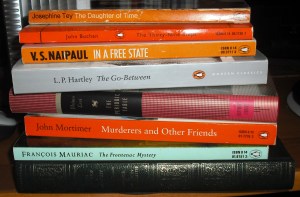
A pile of classic novels

Progress…

Other News: I have also been busy trying to add new chapters to my site to incorporate more cultural bits and bobs than I can include on the main blog stream. In my Arts and Events File I have added a few pieces that were previously published elsewhere and that I have tweaked and edited slightly before posting up here.

This bit will be a random collection of arts related topics – anything that grabs my attention really. Another section called The Blurb features small publishers, one current (Red Fox Press) and one the iconic Cuala Press run by the Yeats sisters in Churchtown, Dublin. There will also be other literary related articles, such as one on Marsh’s Library, Dublin.

I have included links on these pages so anyone interested in following up any of the information can easily do so. I test the links as I go along but would appreciate feedback if any of them fail to connect.

cover of Mandy Moore's Yarn Bombing

Yarn Bombing by Mandy Moore

Another of my arts pages highlights the fantastic ‘knitted graffiti’  (or yarn bombing) trend, which is something that I came across at an exhibition in the Royal Artis Zoo in Amsterdam last year. I just wish my own knitting was up to the challenge!

Last, but by no mean least I have posted up a page about a famous American Civil War quilt and Jane Stickle who created it so beautifully. This was inspired by a visit last year to the Knitting and Stitching Show at the Royal Dublin Showground (RDS).

I hope these pieces in the Arts and Events File and The Blurb pique your interest in the topics; if anyone has any ideas for future posts I would love to hear them.

Thanks for reading!