Musings on Tolstoy’s Women

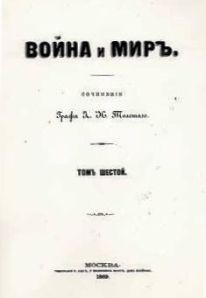
War and Peace, first edition

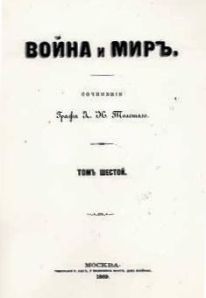
First edition, 1869

Now that I’ve finished my mammoth Tolstoy reading challenge, I’ve been trying to come up with an angle for a blog post on War and Peace without plot spoiling for any new readers. I was fortunate enough to begin Tolstoy’s opus with only a hazy idea of the plot and the knowledge that the background was Napoleon’s 1812 campaign. I studiously avoided discovering a synopsis of the novel, wishing to discover the intricacies for myself.

My search for a blog theme proved tricky, as I am sure you can imagine, working with such a long novel full of plot twists and turns. In the end, I have come down to the idea of looking at Tolstoy’s female characters, if I can do so without giving too much vital information away. The novel has a long cast list that includes several important female characters who are involved in the main threads of the drama. The women are members of the small group of families that the story follows during the years leading up to 1812 and the fall of Moscow. Here is a snap shot of some of Tolstoy’s women, as we meet them in Part I:

I think I will have to begin with Natasha (Natalie) Rostov as her part in the story is so crucial. The members of the Rostov family as a whole are very likeable but Natasha seems to be the bright, vivacious heart of the household. At the beginning of the novel, she is still a young girl who is not yet ‘out’ whose close companion is her cousin Sonja who lives as a sister with the family. The two girls are very close friends despite (or perhaps because of) their differing personalities. We first meet Natasha on her and her mother’s fête day, which was celebrated with a huge party attended by anyone and everyone. You get a glimpse of the daughter’s possible future in Tolstoy’s description of the elder Natasha as ‘evidently worn out with child-bearing – she was the mother of a dozen children. Her languid movements and slow speech due to her frail health gave her an air of dignity which inspired respect’.

All this is still a long way off for young Natasha who at this stage is still a child who ‘with her black eyes and wide mouth was not pretty but she was full of life’ and still enjoying childish games. Still apparently not much more than a child (and yet already with child) was Lisa Meinen, married to Prince Bolkonsky. Her first appearance is at a small party given by Anna Pavlovna who is one of the Empress Marie’s maids of honour. Lisa hardly seems to be a woman at all, but a child in grown-up costume. Everyone refers to her as the ‘little princess’ and ‘enjoyed seeing this lovely young creature so full of life and gaiety, soon to become a mother and bearing her burden so lightly’. The only person who seems not to be enamoured of the little princess is her husband, ‘the face of his pretty little wife was apparently the one that bored him most. With a grimace that distorted his handsome countenance he turned away from her’. I won’t say any more about their relationship in case I give too much away.

Prince Bolkonsky’s sister Marie is mentioned early on in the novel, during Anna Pavlovna’s reception as a possible bride for Prince Vasili’s son Anatole. He’s costing his father a fortune so a suitable heiress is required to plug the hole in the family finances. Princess Marie is devoted to her eccentric, tyrannical father and to her religious duties. Tolstoy mentions Marie’s ‘beautiful eyes’ several times but she is not beautiful or lively in the mould of Natasha or Lisa. She has a ‘heavy tread’ and a ‘thin, sickly face’ which appeared beautiful when her eyes shone with tears or emotion.

In complete contrast is Prince Vasili’s daughter Hélène who is very beautiful and fully aware of her charms, ‘she even appeared a little apologetic for her unquestionable, all too conquering beauty. She seemed to wish but to be able to tone down its effect’. Hélène is described by Tolstoy as being ‘statuesque’ which is a clear contrast to the delicate girl/woman figures of Natasha and Lisa. At this early stage of the story all we can glean about Prince Vasili’s daughter is that she has great beauty and a wonderful figure which she is not shy about displaying. She is a blank canvas compared to the other women, whose personalities we can glimpse soon after meeting them.  

I’ll leave my introductions to some of Tolstoy’s women at that, in the hope that if you have never tackled War and Peace, you do decide to at some point in the future.  As I mentioned before, I am continuing a Russian theme with Pasternak’s Doctor Zhivago which I will post about soon.   

How is your New Year reading going?
   

Doctor Zhivago: More Russian Literature

Doctor Zhivago

My Christmas Present…

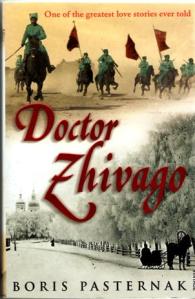
This reading year is beginning briskly with Boris Pasternak’s Doctor Zhivago (Vintage Books) which is a new resident on the Landing Book Shelves. Pasternak’s epic novel was a Christmas present from He Who Put The Shelves Up to enable me to continue my Russian reading period after finishing War and Peace. I just managed to finish the latter on the cusp of the New Year and I can still feel a modest glow of success at that achievement. Now that I’ve finally read War and Peace I would like to go on to read more of Tolstoy’s work, so perhaps that might be a possibility for later this year.

I haven’t yet set any aims for this reading year but my broad plan will be to continue to tackle long neglected novels (and perhaps auto/biographies too). I was interested to come across a similar challenge on Twitter where writer Lynn Shepherd is inviting people to join her in reading Samuel Richardson’s Clarissa beginning tomorrow. A mammoth literary task if ever there was one (see @Lynn_Shepherd for more information and to join in).

I hope to tie up War and Peace with one more blog post (if I can manage to write something without plot spoiling) and I will give an update on the Doctor Zhivago progress as soon as possible. I’m toying with a couple more ideas for future reads as well, so watch this space!

Meanwhile why not drop me a line below to let everyone know about your 2014 reading challenges. Happy New Reading Year to one and all!

A Christmas Classic: A Christmas Carol

I hope you are all enjoying the Christmas break and managing to fit in a spot of reading in between dealing with the left-over turkey and stuffing. Here on The Landing we’ve been revisiting the old favourites, one of which is DickensA Christmas Carol (1843). I’ve been reading this aloud (but not, alas, in a very Dickensian manner) over the last couple of evenings. Last year we all went to see Clive  Francis performing his one man show of A Christmas Carol at the Mill Theatre in Dundrum, Dublin. While I can’t hope to emulate that fine version of the story, I have enjoyed our own reading of Scrooge’s Christmas journey towards a kinder, more generous life. And I still find Mr Fezziwig’s jolly party to be one of my most favourite episodes in Scrooge’s history.

A Christmas Carol

Searle’s take on Dickens

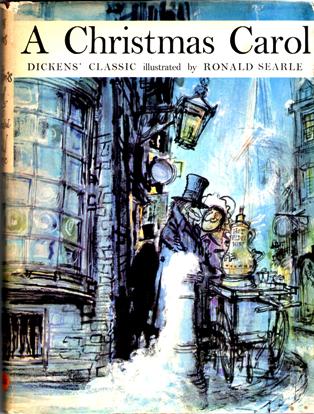
Last Christmas I featured Dickens’ A Christmas Tree in my Advent series so it’s about time his most famous story got a look in here. This edition of A Christmas Carol contains illustrations by the wonderful Ronald Searle and was first published by Perpetua Books in 1960. I can’t remember when I acquired it, suffice to say it was several years ago when I was living in Birmingham. According to the title page, the book used to belong to a family from Moseley; now it seems to be quite settled on The Landing in Dublin.

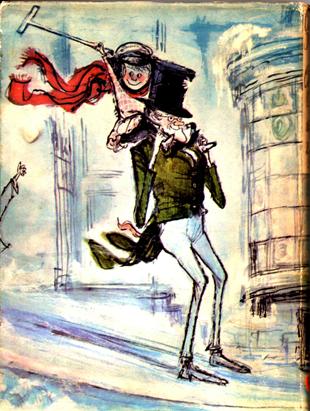
I would like to give you more of Searle’s illustrations, but I’ll have to content myself with scanning in the back cover for the present. You’d be hard pressed to find a better impression of Bob and Tiny Tim anywhere in print. And how else should the back cover be decorated except with a picture of Tiny Tim ‘who did NOT die’ and to whom Scrooge ‘became a second father’?

Tiny Tim and Bob Cratchit

A jolly way to end…

Wishing you all a very Happy Christmas from The Landing Book Shelves! 

Christmas Decorations on The Landing

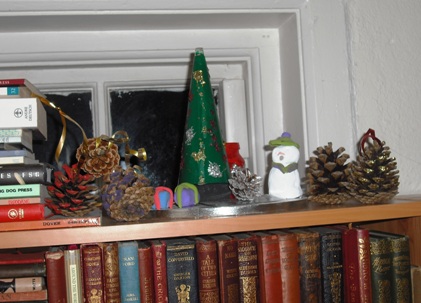
This is just a quick post to give you some idea of what The Landing Book Shelves look like at Christmas. This is also just in case some of you doubt that the Landing Shelves really do exist (and not merely in some parallel universe or in my over heated imagination).

Now, as we haven’t finished putting decorations up yet (and having a wet Christmas tree doesn’t help too much in this endeavour) this may not be the final decorative result. Anyway I like to think that the bookshelves won’t be left out of the Christmas spirit; perhaps a bit of tinsel and a sprig or two of holly would be nice. If it stops raining for long enough I will traipse though the mud to the holly hedge at the end of the garden and bring a few sprigs back to adorn the books.

The Landing at Christmas

Christmas Scene

I hope to squeeze in one or two more posts before the end of December but if you want to have a bit of extra Christmassy literary inspiration do look back over some of last year’s Advent Calendar posts. Here’s one of my favourite Advent blog posts to nudge you towards Christmas Eve: Please Put a Penny

Now, where have those fairy lights gone?

Lewis Chessmen and Noggin the Nog

Last Saturday afternoon The Bookworm and I went along to one of the National Gallery of Ireland’s regular showings of made for television art documentaries. This week’s film was on the Lewis Chessmen and their strange history. We have (or should I say He Who Put The Shelves Up has) a replica set of the Lewis Chessmen and even though I’ve never mastered the game I’m very fond of the little men (fiendish to dust though they are).

The Lewis Chessmen

Incredible Carving

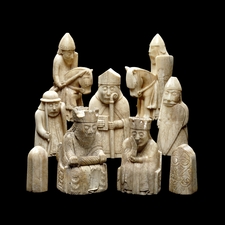
The history of the chessmen is shrouded in mystery as they were discovered sometime prior to April 1831 (when they were exhibited in Edinburgh) having been at some point buried in sand on the Isle of Lewis in the Outer Hebrides. It is now thought likely that the figures which were carved from walrus ivory, were made in Norway between 1150-1200 AD. But how they came to be where they were found and who owned them is still, and will probably remain unknowable. The most likely theory is that they were being taken by a merchant to be sold. Even the details of the actual discovery of the carvings seems vague and uncertain.

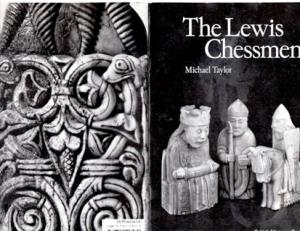
The hoard found consisted of seventy-eight chess pieces plus fourteen counters and a belt buckle. The chess pieces are all exists  from four chess sets but the remaining pieces have never been discovered. The known pieces are all in public hands, with sixty-seven in the British Museum and eleven in the Museum of Scotland and they do also apparently go on tour. The cover shown here is from a British Museum booklet that we have on our bookshelves. I scanned the back too because it gives a good idea of the tremendous detail in the carving. In the documentary, a craftsman explained how difficult and with what skill the ivory figures were carved.

Lewis Chessmen Book

The Story of the Chess Set

But where does Noggin the Nog come into it I hear you ask? The answer is that the creator of the BBC Children’s Television series Peter Firmin was inspired by his visits to see the Lewis Chessmen to tell ‘their’ story. The result was a delightful saga of Noggin the Nog and his kingdom. As a child I loved this series so much that it is an indelible paart of my childhood memories. For anyone out there who has never heard of Noggin, or indeed of Nogbad the Bad, if you have trawl though YouTube you will find plenty of excerpts. The series was made by Peter Firmin and Oliver Postgate and was first broadcast in 1959, originally in black and white.

Every episode began something like this (I think it was Oliver Postage’s voice):

Listen to me and I will tell you the story of Noggin the Nog, as it was told in the days of old”, or “In the lands of the North, where the Black Rocks stand guard against the cold sea, in the dark night that is very long the Men of the Northlands sit by their great log fires and they tell a tale … and those tales they tell are the stories of a kind and wise king and his people; they are the Sagas of Noggin the Nog. Welcome to Northlands, a tribute to Noggin, King of the Nogs and the People of the Northlands.

I am now feeling very nostalgic for old television programmes. I also have a renewed interest in one day going to see the original chessmen in either location. There have been calls for all of the pieces to be relocated to Scotland but there’s probably not much likelihood of that happening in the near future. However, the history society in Uig, Isle of Lewis has said that it doesn’t support calls to remove the men from London and is happy for them to remain where they are. Now, if anyone ever proves where the chess pieces were actually made then no doubt there will be another claim put foward for return to rival that of Lewis.

Credits: Lewis Chessmen image taken from British Museum pages.

Noggin the Nog quotation taken from Wikipedia. 

First Day of Advent

This time last year I was just embarking on my Advent Calendar challenge for the Landing Book Shelves but this year’s December won’t be as bustling. I hope to do some seasonal posts but I’m continuing with the challenge of reading War and Peace too; my aim is to finish the book by Christmas.

As this is the first day of Advent the ritual of putting up the Advent Calendar has taken place in our house (the calendar having first been retrieved from the mysterious depths of the loft by He Who Put The Shelves Up). There is usually more than this one calendar in the house thanks to various friends and relations but they are mere bit part players. The perpetual Advent Calendar is the star of the show.

Advent Calendar

Advent Calendar

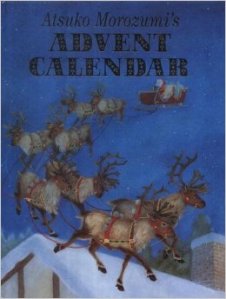
The calendar is a hard backed book that opens out into a 3 D scene of a living room with a fireplace, down the chimney of which Father Christmas will pop on Christmas Eve. The calendar is by writer and illustrator Atsuko Morozumi and published in 2006 by Mathew Price Ltd. I can’t remember when we first had the calendar but it has certainly been doing its duty for the last few years. A few creases have appeared but it is wearing well.

It’s hard to believe that Christmas is coming closer again, I really must get geared up for making mince pies and other seasonal goodies. The first door on the Advent Calendar is always a wake-up call to get planning and list-making. I’ve also had my first Christmas card.

Advent Calendar Interior

Interior of the Advent scene

If you have a favourite Advent Calendar at home do drop me a line in the comment box. By the way, does anyone else remember the Blue Peter team making an Advent decoration with wire coat hangers and tinsel?

More on the War and Peace Challenge

This short War and Peace post is a diversion from the actual text of the novel, being a clip from the 1956 film version of Tolstoy’s novel. I’ve never seen a screen version of War and Peace so recently I trawled  YouTube to investigate what adaptations had been made. Imagine the delight of a Audrey Hepburn fan on finding that the future the star of My Fair Lady (1964) once played the part of Natasha Rostov. I’m not sure that she was right for the role (possibly an unfair observation given that I’ve neither finished the book nor yet seen the film) but in the snatches that I’ve looked at she’s never less than as delightful as usual.

The clip below is taken from the scene depicting her first ball and her first dance with Prince Andrei Bolkonsky, which is the part I had got up to reading last night:

Having read that scene last night, I’d say that the filmed version doesn’t really capture Natasha’s experience of the ball or her emotions on dancing with Andrei; very Hollywood-ish. Neither am I convinced by Mel Ferrer as Andrei, though perhaps he was cast in the part as he was Hepburn’s husband at the time.

Meanwhile I am loving the novel, though I have broken it up with another couple of library reads. I’ll do a more detailed post next time.

Now all I want for Christmas is….

YouTube credits: uploaded on 17/5/12 (Movieclips)

War and Peace was directed by King Vidor and produced by Carlo Ponti

Another Bit of Memoir: The Perils of Travel

Now that Christmas is nudging a little closer, my thoughts have been turning to sorting out the logistics of popping over to see my parents. This also inevitably brings to mind the various travel related mishaps that I’ve had over the years (late trains, snow, rough seas, flight delays etc.).

I wrote the following piece about one of the times things went awry, for a school newsletter a few years ago and have just been fiddling with it a bit more. It’s another of my attempts (along with The Cake Lady) to experiment with memoir writing.

Stranded in Wales: Our Holyhead Experience

Welsh Flag

Motto: “Cymru am byth”
“Wales for ever

A few years ago, I often travelled from Dublin to Birmingham using the Dún Laoghaire /Holyhead ferry route. After one particular visit to Birmingham, the return trip didn’t go according to plan. My daughter and I had planned to be back in Dublin in time for her dad’s birthday and we duly arrived in Holyhead to catch the last Stena ferry to Dún Laoghaire. But the departure area was strangely, evenly ominously quiet. Did I have the sailing time wrong? I was dismayed to discover that Stena had cancelled the evening sailing; our ferry had been sailing through rough seas on the way over to Wales and had been involved in a slight collision in. While no serious damage had occurred, repairs and safety checks meant that we were not going anywhere in a hurry. There would be no ferry until about 9am the next day; an Irish Ferries boat would then (apparently) be sailing the stranded passengers into Dublin Port instead of Dún Laoghaire. So much for my best efforts at forward birthday planning.

So I found myself in the somewhat daunting position of being stranded in a town I hardly knew with nowhere to stay. Oh, and not forgetting the small (very tired) child in tow. I was at least equipped with the necessary cash for emergencies (whether being prepared for emergencies is a legacy of being in the Brownies or from reading Paddington, I’m not sure but nevertheless, generally I am prepared). After patiently explaining our predicament to my tearful four-year old and then phoning home to break the news of the interesting situation, I set about trying to figure out where we could stay. After ruling out a night on hard moulded plastic seats, I thought that our best option might be to head back to Brum and start afresh next morning. The thought of a proper bed to sleep in was strangely tempting. Unfortunately, a quick glance at the train timetable ruled that idea out of court.

Fortune seemed to be smiling on me when I spotted a pile of glossy leaflets advertising a new bed and breakfast place in town. It looked decent and reasonably priced. The only thing that now remained was to find the address given in as short a time as possible. My daughter was still upset at not being able to get home for daddy’s birthday. I tried to persuade her that being stuck on the wrong side of the Irish Sea from the birthday cake and (her own bed) was a great adventure. At that point, she just wouldn’t buy it and I had no more treats in my armoury to placate her. Call it being prepared for emergencies, but only up to a point (this situation wasn’t covered in the Brownie Handbook). Fortunately, sharing the stimulating experience of being stranded in Holyhead was her elephant (Ella).

We found the address of the B&B without too much difficulty, but there our luck petered out. The sign read, ‘Full up, no vacancies‘. Well it was half term so I suppose this was hardly surprising. I decided that it made sense to ask anyway, since we needed help. The owner would probably be able to point us in the direction of another bed (or so I hoped). The proprietor confirmed that he didn’t have any vacancies, but then asked me to wait and said that he would see what he could do. We promptly crossed our fingers and toes (even Ella the elephant did). His side of the overheard phone conversation involved the explanation that he had a stranded mammy and child. It turned out that he had been speaking to his mother who just happened to run a small guesthouse nearby. To my great relief we were sorted. Then instead of just giving me the address and directions, our newfound friend (I regret that I failed to keep a note of his name) offered to drive us to his mother’s house. I wondered fleetingly whether I was being very irresponsible in getting into a car with a total stranger. But there are times when you have to trust your gut and this was one of those occasions.

I was actually grateful to have had the lift over to the house, as we were both rather tired and dispirited. We then realised that we needed to find somewhere handy to eat as the premises didn’t offer evening meals. It turned out that our most likely option was a local fish and chip shop that boasted a couple of tables for dining in. The only question remaining was whether it would be open on a Sunday night or not. To my amazement, our new landlady’s son then very kindly offered a lift to the chip shop. He even said he would wait to be sure the shop was open before leaving us; this was certainly well above the call of guesthouse duty. I did however feel that I should draw the line at phoning him for the offered lift back. 

My daughter was finally reconciled to our Holyhead adventure by the experience of eating piping hot fish and chips hours past her normal bedtime. Thankfully, I found the way back to the B&B after only one wrong turning. I even managed to find an Aldi (or was it Lidl?) to buy orange juice. Cue a brief moment of self-congratulation upon my innate sense of direction. We were certainly glad to see our beds that night; it had been a very long day and we were still not sure whether we would get home on Irish Ferries’ morning sailing. Meanwhile things had turned out much better than I expected, thanks to the kindness of strangers.

Although we were yet to leave Holyhead to brave the stormy seas on our homeward trek…       

I hope you liked the piece and would appreciate any constructive comments! I’ll be back with a Tolstoy update soon..


The First Bulletin on War and Peace

As I’m sure my readers will be pleased to know, my War and Peace challenge is making relatively good progress. Note that I’m hedging a bit here by using the word ‘relatively’ to describe my rate of reading. I have actually reached page eighty-five and I’m at the point where Count Bezuhov has suffered his sixth stroke and is not expected to live. Naturally enough the heirs presumptive are getting anxious as they can see a fortune slipping from their hands into those of Bezuhov’s illegitimate son Pierre.  I wonder what skullduggery may be afoot in the aftermath of the count’s death.

First Edition of War and Peace

First Edition, 1869

Already many aspects of human nature have popped up during the drama; I’ve met a diverse cast of characters in the action occurring between Moscow and St Petersburg. Not surprisingly I was rather taken with the younger players in the story, who were enjoying (and suffering) their first pangs of love. Natasha Rostov is delightful and I am almost apprehensive about what vicissitudes her life will throw at her, but I’m trying not to leap ahead and plot spoil for myself. I’ve never seen a film version of War and Peace and I’m studiously avoiding plot summaries that I’ve come across.

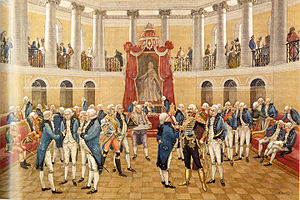
The thing that I find particularly fascinating is the sheer number of princes and princesses in the novel, to the extent that I’m tempted to try to find out just how many there were in Imperial Russia at that time. It also seems that having the title of prince or princess didn’t necessarily mean that you were wealthy. Having consulted Wikipedia, I’ve discovered that the titles of prince and princess belong to the titled nobility (which could be acquired) as opposed to the ancient hereditary nobility. Wikipedia goes on to point out that,

By 1805, the various ranks of the nobility had become confused, as is apparent in War and Peace. Here, we see counts who are wealthier and more important than princes. We see many noble families whose wealth has been dissipated, partly through lack of primogeniture and partly through extravagance and poor estate management. We see young noblemen serving in the Army, but we see none who acquire new landed estates that way’.  

A Noble Assembly

Nobles in the time of Catherine the Great

So presumably that accounts for poor old Princess Anna Drubetskoy desperately trying to obtain a placement and funding for her son Boris. This little bit is quite telling, ‘The mother smoothed her dyed silk gown, glanced at herself in the massive Venetian mirror on the wall and briskly mounted the carpeted staircase in her down-at-heel shoes’. A few lines above, her cloak is described as ‘threadbare’ which is noticed by a sharp-eyed servant.

I’m going to dive back into Imperial Russia now, having had a short break to finish a couple of library books, so I’ll hope to post up again soon with a further update.

Back soon….and if anyone else is tackling a hefty tome at the moment please let us know about it!

Picture Credits: Thanks to Wikipedia for the illustrations.

A Witchy Halloween Poem

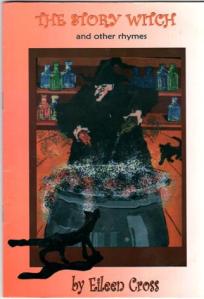
This is my small contribution to the Halloween festival, in the form of a poem taken from a poetry book called The Story Witch and Other Rhymes that my sister gave to our daughter a few years ago. I like all of the poems in the collection as they are funny, imaginative and not at all tedious to read aloud over… and… over… and… over again. This one is short enough to reproduce in its entirety.

Witches and Wizards

The Story Witch

A Seething Cauldron

Witches and Wizards are born not made.
Their parents are witches and wizards too.
A different blood runs through their veins
And they will go to the greatest pains
To emphasise this point to you:
Witches and wizards are born not made!

So look very hard for your family tree –
You may find it somewhere on your shelf,
And examine it very carefully.
You may be a wizard or witch yourself.

The Story Witch and Other Rhymes written by Eileen Cross and illustrated by Helen Ricketts (2005). Printed by Anthony Phillips & Davis Print & Design.

Eileen Cross, a literacy volunteer was inspired to write this collection by the children at Quinton Church Primary School in Birmingham. A percentage of the proceeds from the sale of the first edition were donated to Acorns Children’s Hospice Trust. I’m not sure if it is still available to buy new but I did notice that a second-hand copy was advertised recently via Amazon.

Witch Family Tree

Where do you fit in?

Happy Halloween folks! And don’t forget to check your family tree for pointy-hat wearing ancestors…