Studying the Shelves: Books Galore on the TBR Pile

I have arrived at a point where I have become extremely sidetracked into reading books other than those on The Landing, so I thought I’d do a quick tour of the shelves to remind myself what I am supposed to be reading. Not that it will do much immediate good as I have just begun Jane Harris’s Gillespie and I and I am completely hooked. I have started, so I’ll finish…

book shelves

Where do I Start?

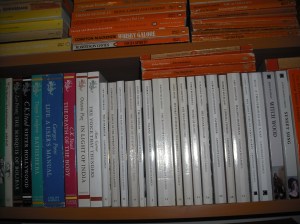
Taken at random, these are a couple of the shelves that this Reading Challenge is all about:

section of book shelves

A Few Orange Penguins

I have been going around snapping bits of the shelves in an effort to record the shelves for posterity (and inspiration). Let’s hope it works!

shelves of classics

Tantalising Glimpse

Jane Robinson’s Bluestockings: Heroines of Education

This post came about because I have been reading a couple of biographies at the same time: one about the Crimean heroine Mary Seacole (Jane Robinson) and the biography of Louisa May Alcott (Martha Saxton) that I mentioned a while back. While thinking about the role of women in the nineteenth century as a result of this reading, I remembered that I had another book by Jane Robinson tucked away. This one is a fascinating account of the long struggle for the right of women to be educated. Robinson is an engaging writer on various aspects of women’s history and I thoroughly recommend her work. I read Bluestockings over a year ago and wrote a couple of short posts on the topic for a student site. I’ve dug them from the archives:

Bluestockings: the story of female undergraduates


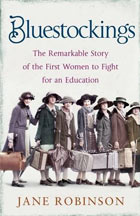
cover of Bluestockings

Bluestockings

I’ve recently been reading an excellent book about the early years of women’s university education in England, Bluestockings: The Remarkable Story of the First Women to fight for an Education by Jane Robinson. It is still shocking to realise that women were at one time not considered to be capable of serious study. And worse than that, the (male) medical profession of the Victorian era thought that women would lose the use of their wombs (atrophy would set in apparently) through the effect of all of that dreadfully tiring brain activity. It would be just too much for the poor things. Early women students also really had to fight hard to be taken seriously and accepted as equals by male academics who didn’t think that women could produce work of a comparable standard. Though to be fair, some women also held similar views, believing that women’s place was in the home and that women had more to lose than to gain by trying to attain an education and a degree. Apparently no man wanted a clever wife, so an educated woman risked throwing away her chances of marriage and children. And of course this was at a time when many professions were still closed to women.  

Robinson’s book deals with the struggle that females had to get into universities (and on equal terms) in England, but at one time the picture in Ireland wasn’t much better either. Apparently Trinity College Dublin fought hard against the monstrous regiment of women undergraduates and only finally gave in and admitted them in 1904. Even then however there were many restrictions governing their conduct and access to various parts of the university which lasted well into the twentieth century.  A Danger to the Men? A History of Women in Trinity College Dublin 1904-2004, edited by Susan Parkes gives a fascinating picture of women’s life in the realms of higher education here in Ireland. It makes you fully appreciate how far women have come when you read of the determination that the early female students needed to prove that they really could stay the course (sorry about the pun). And naturally they still needed to be full of the womanly virtues at the end of it all.

Maybe every college and university should have one day in the academic year where the previous cohorts of women students are honoured for the courageous trailblazers that they were (with or without blue stockings). What do you think?   


 More Shades of Blue

In this follow up to my first blog I want to mention a few of the heroines (and heroes) of the fight for women’s education on both sides of the Irish Sea. It’s such a big subject with many people playing a part that it’s difficult to pick out names, but here goes. In Ireland one woman at the forefront of the struggle was Anne Jellicoe who was to become founder of Alexandra College, Dublin. She was a pioneer of women’s education, who along with Ada Corlett began the Dublin branch of SPEW, the Society for Promoting the Employment of Women in 1861. The society, which was renamed the Queen’s Institute gave classes to women to help them get jobs in offices or as sewing machinists. The emphasis was on helping to equip women who had to earn a living to find ‘respectable’ employment. Later on, there was more focus on girls’ higher education as the college forged strong links with Trinity College. I did mention heroes at the beginning, and so an honourable mention goes to one man who was involved in women’s education in both England (Queen’s College London) and in Ireland. Anglican Archbishop of Dublin Dr Chenevix-Trench was a prime mover in the establishment of Alexandra College (1866), enlisting Anne Jellicoe to help develop the college.  In 1879 the Royal University of Ireland was created, which awarded degrees to women right from the start (Trinity didn’t crumble until 1904) thanks to robust representation by a committee set up by Isabella Tod. She had previously successfully campaigned to have the new Intermediate Exams opened up to girls in 1874, which paved the way for university education. The fight to open Trinity College to women was a long one, assisted by the first women graduates from the RUI such as Alice Oldham and Mary Hayden. For anyone who wants to know more about women’s education, the two books I have mentioned provide a wealth of information and some fascinating personal accounts.

Originally I posted the previous articles up on Campus Dig (a student web site) on  8/1/2011 and 18/1/2011.

An Enlightening Journey with Andrés Neuman

After my Q and A with Argentinian/Spanish writer Andrés Neuman here is my piece on his novel Traveller of the Century. At a hefty 584 densely packed pages it is a book that cries out for the luxury of a few hours solid reading time. As I found that to be impossible, I have followed the characters in fits and starts. Thankfully, the engrossing themes and threads of the novel guided me through the drama. When I first got my hands on Neuman’s first novel in translation and read Roberto Bolaño’s effusive praise in the introduction, I felt somewhat ambivalent about tackling the book. I am not much given to hyperbole so I find it rather hard to swallow in others. Bolaño claims that ‘the literature of the twenty-first century will belong to Neuman and a few other blood brothers of his’; (very gender specific; no blood sisters then?). Therefore, it was with some scepticism and a certain amount of trepidation that I began to read the novel. After I had finished reading, I felt that there had been so much going on in the novel that I would pull out a few themes and images that particularly struck me, to highlight here.

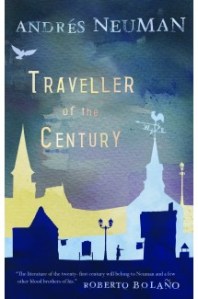
Cover of Traveller of the Century with silhouette of town

Traveller of the Century

Traveller of the century is set in nineteenth century Germany, after the European upheaval of the Napoleonic Wars. When the story opens, Hans, a translator and compulsive traveller is in a coach creaking its way through a bleak winter landscape.  Late at night, he plans to break his journey to Dessau in the town of Wandernburg and finds lodging in a rather shabby looking inn. As the story unfolds Hans, who never stays anywhere for very long, finds himself unable to leave. This is in part because of the strange qualities of the town and in part due to his increasing entanglement with the lives of the people he meets in Wandernburg.

A silken thread running through Traveller is the seeming ability of the geography of the town to shift around, almost as if the town itself does not want people to leave. In trying to find places that, he had found the previous day, ‘Hans had the strange feeling that the city’s layout somehow shifted while everyone was asleep’. He finds the market square to be the only location easy to pinpoint. This sense you get of the changing aspect of the town is unsettling and suggests unseen and unknown forces below the surface. Is it coincidence that Hans only gets to grips with the town’s geography when he is about to leave? Does he imagine this is happening; or is the town really playing with his perceptions?

Hans befriends a poor old organ grinder who usually plays in the town’s market square. As they become friendly, the organ grinder invites Hans to his home that turns out to be a cave just outside the town, where he lives with only his dog Franz for company. Hans starts to spend evenings at the cave talking to the organ grinder and two local workers Reichardt and Lamberg. There is much animated debate, discussion and cheap wine drinking carried on late into the night. One of the topics that the men discuss is the town itself; as a place to leave or to remain in. The organ grinder (who goes by no other name) is devoted to his town and sees beauty in the changing seasons of his home. The imagery of the men passionately talking and arguing into the early hours is very vivid and is a piquant contrast to Han’s elegant evenings with the town’s bourgeoisie.

Hans meets Sophie Gottlieb, a merchant’s daughter who is engaged to a local wealthy landowner, Rudi Wilderhaus. The philosophical discussions at the cave are mirrored by the Friday night Salons held at the Gottlieb house where the more socially elevated group debates the poetry, philosophy, history and literature of Germany and her neighbours. Hans is often in conflict with the hitherto leading light of the group, Professor Meitter though he finds a kindred spirit in Álvaro a Spanish merchant settled in Wandernburg. The Enlightenment is gradually gaining ground in this corner of Germany, even though the town seems otherwise rather set in its ways.

At the heart of Traveller of the Century is the illicit love affair between Sophie and Hans. Their relationship plays out against the background of often-intense discussions between the members of the two overlapping groups of debaters. Hans and later, Álvaro are equally at home in the two very different settings and Sophie is charmed by the organ grinder and his cave when Hans takes her to visit there. Apart from these encounters and the love affair between Álvaro and Sophie’s maid Elsa, the townsfolk stay in their allotted rigid social places. Enlightenment is also reaching Wandernburg’s women, as Sophie declares that ‘I for one don’t intend to spend my days with flour up to my elbows’. In tandem with discussing poetry and politics with Sophie, Hans is teaching the innkeepers daughter Lisa to read.

Translation is perhaps not surprisingly another recurring theme in Neuman’s book (see the Q&A for Neuman’s thoughts on translation of his own work). There is much discussion of language and nationality in the Friday salon and translation is also the means by which Hans earns his living. Translation becomes the means to enable Sophie and Hans’ affair to continue, as they begin to work together on Hans’ commissions. They in effect translate each other while they discuss the literature they are working on. The process of selecting the right words to use and then reading aloud their differing versions functions as a delicious foreplay, heightening their desire for one another.

There is a darker thread running through the drama, in the figure of the cloaked rapist who haunts the darker side streets of the city. I do not want to spoil the plot by mentioning the identity of the attacker. Suffice to say that the shadowy figure seems to be the antithesis of progress and enlightenment in Wandernburg. The police attempt to track the culprit by employing the appropriate rational means and careful reasoning. However, at one point Hans runs afoul of the local police and discovers that the law is not by any means as rational as it could be.

I hope I have succeeded in doing justice to a fascinating novel, that I am certain to read again. And was Bolaño right in his estimation of Traveller of the Century? Read it and judge for yourself!

Andrés Neuman: Q and A session

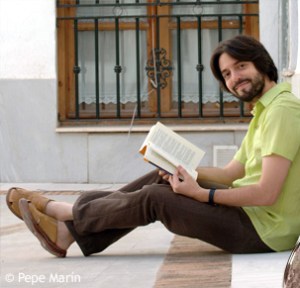
profile view of Andres Neuman

Andrés Neuman

As promised, here are the results of my LandingAuthor interview with author of Traveller of the Century Andrés Neuman:

CM: You have been featured on the list of Granta‘s Best Young Spanish language novelists and on the Bogotá 39 list. Do you feel that these lists achieve the result of bringing writers to the attention of a wider public and if so, has it benefited you in that way? 

AN: Well, there are so many lists around, that sometimes I think that the most effective one would be a list of never-listed authors. More seriously (or not), to be honest I don’t know the practical results of those two lists. Nevertheless, each one of them had a very interesting nuance in terms of literary theory. Granta’s one represented, if I’m not wrong, the very first time that such an influential Anglophone publication was fully dedicated to non-English language authors. Which was quite a hopeful sign I guess. Regarding Bogotá 39 list, when it came out I realized that at least half of the writers included on it hadn’t lived in their born countries for a long time, so that they already had a kind of mixed national identity; and two of them (Daniel Alarcón and Junot Díaz) didn’t even write in Spanish language, so they were twice peripheral. I feel quite close to these alternative ways of looking at the Latin American tradition, since I was born in an Argentine home but I grew up in Spain.


CM: Following on from the Bogotá 39 list, with which the Hay Festival was involved, I would like to ask you about participation in literary festivals. Do you enjoy doing festivals and meeting readers and fellow writers or do you perhaps feel obliged to make appearances? 

AN: Maybe both. On one hand, anything which implies leaving home painfully stops or at least delays the book you were working on. On the other hand, thanks to the festivals and book fairs you get to know two essential, yet often invisible for you, parts of your vocation: readers and colleagues. Most of the time you work alone, so when a reader appears you feel genuinely amazed: so they really existed! And they even had the patience of reading one of your books! When that happens, I’d like to apologize or returning them their money. In the end, I tend to think that travelling is literary healthy. Travels remind you that the world was much more complex than you thought. And that’s what literature is about, isn’t it?


 CM: You have written a book based upon your travels around South America, your own back yard as it were, but do you have an urge to explore any other places with a view to writing and if so, where would you like to go?

AN: That book (Cómo viajar sin ver. Latinoamérica en tránsito/ How to travel without seeing. Latin America in transit) actually tells a trip across the whole Latin America, which is an immense planet itself. It’s an amazing experience to feel a foreign person twenty times, without changing of language. That’s a little miracle that Spanish language allows us. Where else I’d like to go to and write about? I’d prefer not to plan it: I enjoy much more when a place takes me by surprise. Precisely that surprise is what stimulates the muscle of attention.


 CM: After having lived in both Spain and Argentina do you feel that you have a leaning towards the literature of one country more than the other?

AN: That’s a puzzling conflict which I have never got to solve. I have the inclination to look at Europe from a Latin American perspective, whereas when I’m in Argentina I often put myself in a Spaniard point of view. In fact, Argentine people usually ask me about Spain, and vice versa. So I’ve ended up assuming that’s my natural place: a sort of border between both countries or continents. I have a double citizenship and a double foreignness as well.


 CM: As a book hoarder myself, I was much struck by your account of your parents’ house clearance in which the books were piled up to be measured by the dealer. How attached are you to your books now? Do you keep everything you buy or have a purge every now and then?

AN: When my family left Argentina and we had to sell quickly almost everything we had (even the toys of my whole childhood, which was a painful thing to do at that time), I learned that collecting things is much less important than remembering them deeply –and telling them under the form of stories. I’m not too fond of collecting things now. I really don’t mind to drop or give any kind of stuff. But I must confess that I hate to lose (an even to lend, what a sin!) the books I have already read. I usually underline and take notes on them, so perhaps the only things I’d save from a sinking would be my read books -and my laptop. Will e-books eventually change our fetishistic attitude towards printed objects? Who knows. Maybe. I’ve got a kindle and I love it. Though I wouldn’t trust monster enterprises like Google, Amazon, Apple or Microsoft as the exclusive guardians of our memories.


 CM: I am interested in how it feels to have your work translated. No matter how good the translator, it must be somewhat dislocating to see your words rendered by him/her into another language. Can you talk about that a little?

AN: You’re right. Dislocating. And revealing too. I do feel that foreign languages teach you a lot about your mother tongue. Maybe that’s poetry about: looking at your mother tongue as it was a foreign one. That’s why I enjoy so much the whole translation process, both as a translator or as the translated one. Translators need to suspect of every single word, just as poets do. So, when your book is translated, you learn unforeseen meanings on it. As if the author wasn’t you. And actually you’re not. What translators do is not only transferring your own words into a different language. But radically transforming their connotations and nuances, often for good. Good translators (just like good mistakes!) are able to enhance the original intention. That’s why I don’t expect my translators to respect me too much: I rather to be shamelessly invaded by them.
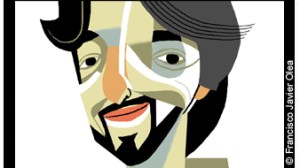
 

cartoon drawing of Andres Neuman

Andrés Neuman

CM: I was looking at your blog and Facebook pages and I was wondering whether you have willingly embraced the social media platforms that so many writers use to promote their work, or whether you have to be dragged kicking and screaming to the computer to engage with your virtual friends?

 AN:Interestingly, my personal blog and Facebook page are two very different, if not opposite, cases. The blog Microrréplicas  is entirely written and updated by me. I consider it just another part of my literary work, indeed not below the books. Whereas the FB profile was actually opened, and is still ruled, by a nice group of readers. They are the only ones who decide what to put on it, and when and how. I think that’s fair. Personal contact with readers can be really great, and sometimes deeply moving. But I guess that keep always interacting online can also be tricky for a writer, since a good book needs quite a lot of solitude and time to be written. And its feed-back is much more a long-term one. So maybe the most respectful thing that writers can do for those wonderful virtual friends is, precisely, to dedicate most of their time to work hard on their books. Which will be hopefully read, discussed, loved or hated on social networks.


CM: And finally….. I have based my blog content on tackling the unread books lurking on my bookshelves. Do you have a ‘TBR Pile’ and if so, what is on it?

AN: Oh, that’s my favourite wet dream: to read everything I haven’t read yet. I have no just one, but several ‘to be read’ piles everywhere at home. The most interesting pile is, of course, the bathroom one: the only place in which nothing can seriously interrupt our reading. What’s on that pile right now? Let’s see: a biography of Chéjov written by my beloved Natalia Ginzburg, the first volume of Philip K. Dick complete short stories, Houellebecq’s new novel, Pierre Michon’s penultimate, an anthology of Chilean poet Nicanor Parra, several young Argentine novelists, a very good half-read book of stories by James Lasdun, a collection of fragments by wonderful Spaniard philosopher María Zambrano, last Julian Barnes’ book, a manual of compared mythology (what the hell is doing that here?), a travel book about Italy by Stendhal, a political essay by Cameroon activist Achile Mbembe titled Necropolitics, an anthology of contemporary Welsh poets (recently found in Cardiff), a couple of comics, some old and crumpled and dirty newspapers… If I resurrected, I’d dedicate that extra life exclusively to pending books. I promise. Well, I don’t. Will there be a bathroom after death?

Many thanks to Andrés Neuman for taking the time to answer my questions. I’ll be posting up a blog post about Traveller of the Century shortly.

Picture credits: All of the illustrations used here were taken from Andrés Neuman’s official website with thanks.


Andrés Neuman: Traveller of the Century

Cover of Traveller of the Century with silhouette of town

Traveller of the Century

By no stretch of the imagination can I claim that Traveller of the Century has been lurking unread on the (admittedly over populated) landing bookshelves, therefore I will not attempt to justify reading what is patently a NEW book. My only defence is that the nice people at Pushkin Press offered me a copy and it seemed impolite to refuse the kind offer. (How does that sound?). In fairness, I do not think I ever claimed that I was never going to read a new book while perusing the backlog (and indeed have already allowed exceptions for library loans).

Next week I will be posting up a Q and A session with Andrés Neuman, the South American author of Traveller of the Century (recently published in translation by Pushkin Press). The publishers are arranging a series of email interviews between Neuman and literary bloggers.

My slot is to be next Wednesday 25th April so I shall be posting up the eight questions that I submitted to the author and his responses to them. I will also put together a piece about the novel for visitors to The Landing to read. It is the first time that I have ever had the opportunity to ask questions of a writer, so I was apprehensive about having a go.

portrait of Andres Neuman

Andres Neuman

Pop back on Wednesday to see the results. Meanwhile, it is back to reading Traveller of the Century and making notes..

Stories and Storytellers: the importance of stories

While tidying up some old files I came across a piece I had written for a guest blog spot (see note below) on the topic of stories. As it seemed to fit with the theme of my own blog, I offer a tweaked version here:

I have been thinking recently about stories, storytellers and the importance of stories to both children and adults alike. At present, these musings are rather random but I would like to turn them into something more substantial. I give you here some of my tangled thoughts in the hope that it might make them somewhat clearer to me….

Of interest to me is what makes a good story; which stories can be said to have stood the test of time and why this should be so. In addition, books that once fell out of fashion and that have since been rediscovered and reprinted. For example, Persephone Books now have a long list of fascinating reprints of once forgotten twentieth novels by women writers (I loved Miss Pettigrew Lives for a Day by Winifred Watson).

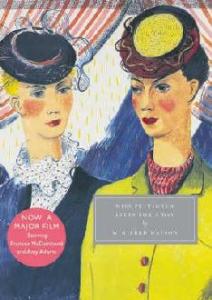
Book cover of Miss Pettigrew Lives for a Day featuring two fashionable ladies

Miss Pettigrew Lives for a Day

Moreover, what about children’s stories? Before Christmas, I was pulling together ideas for an article on Christmas gifts. Having recently been to an entertaining reading by Frank Cottrell Boyce in the company of a very critical nine year old, I added his latest book Cosmic to my list. At the event, Boyce talked to his young audience about how stories are told, retold and then retold some more. Each time storytellers add new elements. He regaled the children with variations on the theme of finding treasure and the (often-fatal!) consequences. It is a simple enough plot, yet there is enormous potential for exploring a range of actions and emotions. Great comic material too as Boyce proves in his novel Millionaires. There is a good chance that at least some kids reading it will have caught the lifelong story bug

I was initially thinking about the written as opposed to the spoken story but many authors also can spin a good yarn if doing a live session. And in Ireland, where there is a fine tradition of oral story telling I have been to many sessions that can be enjoyed by all ages. Think of in particular, Niall de Burca, Eddie Lenihan and Jack Lynch who can hold audiences in the palms of their hands with their wonderful (and often very tall) tales.

Children’s writers do a fantastic job of creating an imaginary world but story telling can be just as important to adults too. One book in particular that started me thinking about the vital effect a storyteller can have is Tahar Ben Jelloun’s This Blinding Absence of Light. In this novel, based on real events Selim, enduring the horror of imprisonment in Tazmamart, a secret prison in Morocco, becomes a storyteller to his fellow prisoners. He has no books, nor paper and pen so he draws upon his memories to retell old tales and even movie plots to them.

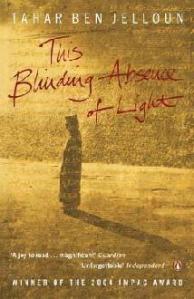
Cover of This Blinding Absence of Light with a figure in desert landscape.

This Blinding Absence of Light

Telling stories is a means of assisting him (and them) to survive, to keep his brain working and to keep up morale amongst the prisoners. They are all in tiny individual cells and it is a way of communicating through the walls, darkness and fears that surround them. The book is a moving testimony to the power of the storyteller. Those are of course extreme circumstances. Even so, people have often used stories in extremis, to come to terms with, and to make sense of events beyond control. Sometimes even to find humour in an otherwise difficult situation.

Well, those are some of my musings….now I am off to curl up with a box of chocolates and a good story.

This piece dates from 2nd January 2011 and this is an edited version of a blog entry for Hand and Star (now apparently defunct but formerly edited by Tom Chivers)  

As a postscript to this piece, there is a connection with my previous piece on Georgette Heyer in that one of her novels Friday’s Child became a symbol of survival for a group of Romanian women political prisoners. One of the women told and retold the story from memory and later, after spending twelve years in prison was able to write and thank the author (in 1963)  from the safety of the United States.

Never underestimate the power of a good story or a great storyteller – if you have any particularly favourite stories that you would like to share, just drop a line in the comment box. I’d love to hear about them!


Georgette Heyer: Doyenne of Regency Romance

portrait of Georgette Heyer in evening dress

Georgette Heyer

For Christmas, I bought my mum the hard back copy of Jennifer Kloester’s Georgette Heyer: Biography of a Bestseller, about one of my all time favourite writers. My cunning plan was (obviously) to read it myself too, but as this has proved tricky due to the two of us not living in the same country, I have had to resort to borrowing a copy from the library. I am now on my third renewal and not quite finished reading it yet as various other books have intervened. I may actually buy myself a copy since it is an excellent addition to my stash of literary biographies. I could see Georgette nestling in nicely next to Daphne; though I am not sure what she would have made of Dolly Wilde.

I have thoroughly enjoyed my journey through Georgette Heyer’s extensive output and I feel inspired to do much re-reading. However, I will have to make do with the sole Heyer title residing on the landing bookshelves. This is an Orange Penguin edition of The Devil’s Cub (1954, first published in 1932). The original price of this volume was 2/6 though I see from the inside cover that I paid £1.50 for it in 2001. It is still in good condition so it was money well spent despite the inflationary price.

The Devil’s Cub is a title that I have read and then re-read many times. It is possibly my favourite Heyer, though in truth it would be tricky to decide which of her forty-six titles is my favourite. I think I have read most of her books, barring only a couple of her contemporary novels that Heyer suppressed and that I have not yet managed to locate. I have a feeling that either I’ll need to be very lucky or very wealthy to get hold of them.

I wrote the short piece below about The Devil’s Cub a couple of years ago (I think) when I was inspired by reading a piece by journalist Rachel Cooke. Many people still tend to dismiss Georgette Heyer as just another romantic novelist without bothering to find out anything about her work. Some people even speak of her in the same breath as Barbara Cartland which is mystifying to a Heyer fan like me. Heyer’s heroines had much more character and courage than any of Cartland’s creations. And of course, a Heyer heroine had a sense of humour!

Orange Penguin book jacket

Orange Penguin Edition


The Devil’s Cub Georgette Heyer

‘If you know, you know. If you don’t, you should stop being so stuck up, and read her, pronto’. This was journalist Rachel Cooke outing herself as a Heyer fan. It is, apparently not the done thing to admit a liking for Heyer’s books. I am however, willing to stand up and be counted as a fan alongside Cooke.

I first read The Devil’s Cub as a teenager and in retrospect, I can see that the ‘dark and extremely handsome’ hero appealed. However, in the end it was the wit, madcap adventures and sheer escapist fun that had me hooked on Heyer. The giggle out loud lines had as much (if not more) staying power than the romance. A lesson for life really. From Heyer I gained a lifelong love of comic fiction.

I also admired her heroines. Never passive, they were intelligent, capable, and calm in a crisis and certainly did not faint at the sight of blood. In this novel, a case of mistaken identity results in Mary Challoner being abducted by Lord Vidal for strictly dishonourable purposes. In the ensuing action, Miss Challoner shoots Vidal to thwart his intentions and then calmly dresses his wound. Next morning she makes him eat a nourishing gruel for breakfast.

‘I observe that the sight of blood don’t turn you queasy.’

‘I am not such a fool, sir’ Miss Challoner began to roll up his sleeve. ‘I fear the lace is ruined my lord. Am I hurting you?’

‘Not at all,’ said Vidal politely.

Heyer’s female protagonists were the equal of any man and commanded respect. Woe betides the man who underestimated them. It was about woman, not girl power and it was not necessarily the best-looking woman who won the beau. Of course, the novel ends happily but I think the great thing is that the story ends with a riotously comic scene and not a clichéd clinch. I would ove to be able to write comedy as well as Georgette Heyer could. It is a great gift. In addition, her elegant and precise use of language is something to which I have always aspired. Her grasp of historical details and Regency slang were second to none. She always made it look so easy.

Are there any more fans out there? Shout out if you’re a Heyer lover….

UPDATE – I’ve just discovered that the paperback edition of Jennifer Koestler’s book (published by Cornerstone) is due to be released on 20 June 2013. I may just treat myself!

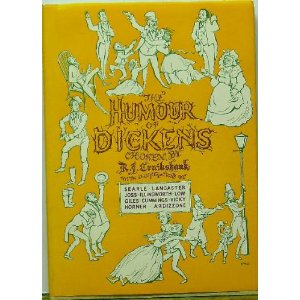
The Humour of Dickens

Book cover of The Humour of Dickens featuring several characters

A little light Dickens…

My Reading Challenge has just taken a useful turn, as the members of my book club (all four of us!) have decided to read Charles Dickens this month as a contribution towards the centenary year. This means that I can read a book for my book challenge and tackle the latest book group choice at the same time. I am rather pleased about it, though unfortunately I cannot claim credit for the book club’s good idea.

I ran through a mental list of the Dickens titles that I have not yet read (the dreaded TBR Pile) and I thought of choosing Hard Times. My rationale was that Dickens based the story upon his experiences of Preston (re-naming it Coketown), and as I have lived in that very city it seemed a good reason to choose the book. Although, as I retain a great fondness for the Lancashire city, this may not prove to be wise move on my part. I have metaphorically crossed swords before now with authors who portray my favourite places in a bad light. I wouldn’t want to fall out with Dickens at his time of life.

Finally, I have settled on a compilation volume that I have had on the shelf for some time, The Humour of Dickens edited by R.J. Cruikshank. I have read this volume before, so is not strictly a TBR Pile candidate, but it is reading for sheer pleasure. It deserves a re-read especially in view of the brilliant illustrations it contains which add to the enjoyment enormously. The Humour of Dickens was published in 1952 (my copy has an inscription saying ‘Xmas 1953, from Mairi’) by the News Chronicle, London. The original price of the volume was a princely three shillings and sixpence. I did a quick out of print book search and discovered that copies of the Dickens anthology can now fetch up to around thirty pounds depending on the condition. You can also pay as little as sixty three pence plus postage, which would be more like my price. I can only hazard a guess that I probably paid a pound or so for my copy several years ago in (I think) Birmingham.

The collection has excerpts from fifteen of Dickens’ novels including Oliver Twist, Our Mutual Friend, Hard Times and The Pickwick Papers. I mentioned the illustrations above; there are twenty of these by well-known contemporary (and by now highly collectible) illustrators. One of my all time favourites is Edward Ardizzone (remember the Tim stories?) whose frontispiece drawing of ‘Dinner at the Veneerings’ endows the dinner party guests with more charm than they probably deserve. Other great cartoon artists represented in the collection regularly featured in the newspapers of the time: Arthur Horner (1916-97) of the News Chronicle, David Low (1891-1963) of the Daily Herald and Carl Giles (1916-95) of the Daily Express to name but three. All are different in style but equally vivid in their interpretation of Dickens’ characters.    

I shall be in the right mindset to tackle Dickens since I am reading David Lodge’s novel about HG Wells, A Man of Parts at present. After rubbing shoulders with HG and his literary circle including Henry James and Edith Nesbit, I shall slide back into communing with Dickens quite smoothly I think. Apart from seasonal re-reading of A Christmas Carol it must be a long time since I have read any of Dickens novels. I was all prepared to take the plunge again after our book group had an outing last year to hear Claire Tomalin speaking about her Dickens biography at TCD. That plan fell by the wayside (until now), along with the intention of reading said biography. Dickens is still on my ‘to read’ list as I have previously very much enjoyed Claire Tomalin’s literary biographies.

In the meantime, Reading Challenge satisfied, I will be content with Charles Dickens’ funny bits…. 


All should have bonnets: a letter from Louisa M Alcott

After the dedication of my #LetterMo writing challenge efforts have faded gently away, I have decided to return to the compendium of historic letters that I mentioned in one of my earlier entries. Having struggled to post at least one item of correspondence every day for a month, I can truly say that I stand (pen poised) in awe of the sheer effort involved in letter writing pre-Microsoft Word technology. After all, even keeping up with just a few relatives in the last century would have been a Herculean task. But thank goodness that so many people did just that, providing a mine of information and insight that would otherwise have been lost to later generations.

One of the epistles in The World’s Great Letters is one from Louisa M Alcott to her sister Anna and while it could not be claimed to hold huge historical importance, it does give you a glimpse into the life of a would-be writer who was struggling to support her family. Alcott was also mired in domestic chores as well as suffering the frustration of waiting for editors to reply to her story submissions.

Alcott’s letter, written around 1861 describes the trials and tribulations of fashioning a decent bonnet (a social necessity) with only one dollar to spend; the contents of Alcott’s ribbon box supplemented the lack of cash. She makes the whole enterprise into an entertaining anecdote for Anna Alcott, but she clearly would have loved to be able to go out and buy a smart piece of headgear. She describes her attempts to trim the one-dollar bonnet thus:

I extracted the remains of the old white ribbon (used up, as I thought, two years ago), and the bits of black lace that have adorned a long line of departed hats. Of the lace I made a dish, on which I thriftily served up bows of ribbon, like meat on toast.  Inside put the lace bow, which adorns my form anywhere when needed. A white flower A.H. gave me sat airily on the brim, – fearfully unbecoming, but pretty in itself, and in keeping. Strings are yet to be evolved from chaos. I feel that they await me somewhere in the dim future.


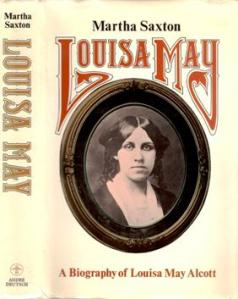
book cover with portrait of L.M. Alcott

Louisa May

All this occurred before Alcott struck gold with the phenomenally successful Little Women, which was published in 1867. At that time, she was still a ‘young woman with one dollar, no bonnet, half a gown and a discontented mind’ as she described herself. In one of those moments of literary serendipity, I spotted Louisa May (Martha Saxton, 1978) while rummaging in the Trinity Booksale on Saturday. I was meaning to re-read Little Women after seeing the sell out production last month at Dublin’s The Gate Theatre.  As Little Women and its sequels reside on the landing I can justify doing just that, but I will have to make (yet another) exception for reading the Louisa May Alcott biography. But, one of the joys of reading is that you never know what is going to be around the next corner of the bookshelf!

What have you discovered this week? And how is your Reading Challenge going? Drop a line in the comment box…

When Julian met Aphra: Behn vs Barnes

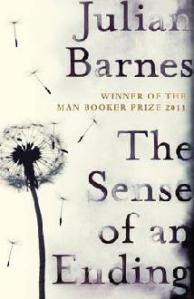
I have been reading Julian Barnes’ The Sense of an Ending recently after a customer in the bookshop where I work told me that I really must read it. As it has been quite some time since I last read any of Barnes’ work I decided to rectify this omission, in between bouts of pursuing both my letter writing and my Reading Challenge. I suppose it makes a good contrast to zip between Aphra Behn and Julian Barnes. Potentially confusing too, exchanging one cast list for another and jumping back and forth through the centuries.

Book cover with flower head on grey background

The Interloper…

Julian Barnes’ book has to take priority (temporarily) over the Landing Reading Challenge. Sadly, it is a library loan that is so much in demand that it is un-renewable. I could of course be a bad citizen and library user and take it back late but I always worry that I might be blacklisted and not allowed to have any more books out. The quick-witted amongst you might point out that this can only be a good thing, as I would have no excuse not to read my way around the entire house let alone the landing.

This thought does indeed make me wonder whether I should forswear the library and get truly stuck in to my TBR Pile. However, if I did that then would I also have to promise not to buy any new books? I could foresee that vow being very difficult to keep up due to working daily with new books. I also have a distressing weakness for bargain sections, charity shops and remainder outlets. All of this purchasing potential makes it highly likely that my landing bookshelves reading project could take rather a long time to complete.

 My train of thought has now brought me to an ethical problem (of sorts). In my meanderings around various sources of new books I will most likely come across books that should be housed on the landing after purchase i.e. classics, poetry etc. Now, this will of course mean that the original constituent parts of the landing bookshelves will most likely continue to grow over time. But do those books form part of my Reading Challenge despite not being present when the challenge began? Indeed I discovered a copy of Gwen Raverat’s Period Piece lurking in the wrong bookcase entirely (and it is a book I have not yet got around to reading) so I should re-house it on the landing. Because if I don’t, then I shouldn’t read it should I? No wonder my TBR Pile just keeps on growing.

Now, back to tackling Aphra Behn and seventeenth century English (but not until after I have finished Julian Barnes)…

UPDATE (June 2013)

I have come across a notification about the Aphra Behn Society’s Biennial Conference which will be held in October of this year. The topic will be Women, Reputation, and Identity in the Long Eighteenth Century and the conference will be held at The University of Tulsa, Tulsa, OK.