Aphra Behn: A Restoration Woman

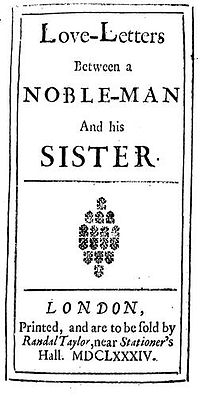
Title page of Love Letters between a nobleman & his sister

Title Page

In the last Reading Challenge blog post, I talked about reading some letters from The World’s Great Letters but I am bound to report that in the event I became slightly sidetracked by something else. I was hunting around for examples of epistolary novels for a bookseller’s blog piece for Writing.ie and came across Aphra Behn’s Love Letters between a Nobleman and his Sister. This three-part roman à clef (originally published 1684-7) was based on a sexual and political scandal of the time. The author is believed to have been the first woman to earn her living by her pen.

I was given this edition several years ago, March 1996 to be precise, but I have never got around to reading it before now. At that time, I was working in a bookshop in Birmingham and one of our customers ordered the Penguin Classics edition of the book from us. He then began to read the book and then (apparently) decided that he did not have enough time remaining in which to tackle the book and so passed it to me ‘to read at your leisure….or not, if you don’t want to’. By my reckoning, that was all of fifteen years ago and I have only just finished the introduction. Janet Todd’s scholarly introduction explains the background to the novel and gives some information on Aphra Behn’s fascinating life and career. 

The details of much of Aphra Behn’s early life remain vague and any chronology available seems to be approximate as far as I can tell. It is almost certain that she was born in 1640 near Canterbury and that her parents were Bartholomew Johnson and Elizabeth Denham. She apparently married a merchant of Dutch extraction named Behn in 1664 but the marriage did not last long. Opinion has been divided on whether they divorced or Behn was widowed.

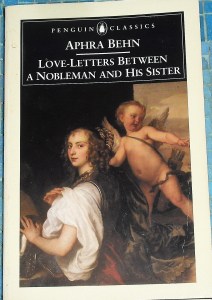
A year prior to the (probable) marriage Aphra Behn was probably in Surinam and then in 1667 she was to be found in Antwerp acting as a spy for Charles II’s government. The royal master was not good at paying his bills so Behn ended up in debtor’s prison for short while afterwards. If experience is needed to make a writer then Aphra Behn was hardly short of that valuable commodity.Cover of Love Letters between a Nobleman & his Sister
Behn’s first play, in 1670 was The Forced Marriage, which ran for six nights at Lincoln’s Inn Fields performed by the ‘Duke’s Company’. I was interested to discover that the payment system was such that the income from the third night belonged to the author, so in this case Behn received two nights worth of fees. I suppose it was tough luck if your play was booed off stage in a hail of rotten tomatoes on the second night.

I was enchanted with the information that Nell Gwyn, Charles II’s ‘Little Nell’ returned to the stage to play the part of a whore named Angelica Bianca in The Rover, which was probably Behn’s most successful play. Did the two women know each other well I wonder? They were both survivors in a tough male world so they may have had much in common. A plot for a novel perhaps?

I am honestly not sure if I will ever actually get through the novel, but I will make the attempt. If I achieve the first part at least, after all this time I will be pleased with myself. But I do also have a couple of library loans looking reproachfully at me…I will see how I get on.  

Meanwhile, at least I have begun to nibble away at the dreaded TBR Pile…more updates soon!

Historic Letters and #LetterMo

Cloth boundcover of The World's Great Letters

In my first Landing Reading Challenge post, I mentioned a collection of historic letters on the landing bookshelves. As February is the month of a brilliant letter writing challenge (Month of Letters set up by Mary Robinette Kowal), I decided to start my own particular reading challenge with a browse through the volume of historic letters. I cannot remember exactly when I bought this book but at a guess, I would estimate about fifteen years ago. The book was published in 1950 and at some point, an unknown hand had written the date 29/4/71 on the flyleaf. I am not sure that it really counts as being on a TBR Pile however, since it is the sort of book that you browse through rather than read cover to cover.

I must digress slightly at this point to admit that though I have signed up to the letter writing challenge I did sign up a few days late. In my defence though, I have actually been diligently writing and posting cards since 1st February but without any coherent plan in mind. I think I may continue to do it that way. I will decide in the morning to whom the day’s offering will be sent. In this case, the lucky recipient will be (almost) as much a surprise to me as it will be to them. So, two challenges in one for me this February.

A Month of Letters Partcipants' badge

Letter Writing Month Badge

In the meantime, back to The World’s Greatest Letters, which covers a fair slice of history beginning as it does with Cicero and ending with a letter written by an Air Raid Patrol (ARP) Warden in World War II. The nice thing about this collection of letters is that apart from a chronological list, it also has a classification of letters by subject. This means that you may go straight for the ‘Letters of Controversy, Hatred and Enmity’ should you so desire. If that seems to be too strong meat for your stomach, you might try ‘Letters in a Light Vein’ or ‘Letters about Nature’. Perhaps as 14th February is not too far off I should consult the more romantically inclined letter writers for Valentine’s Day inspiration.

I will let you know next time how I get on with reading the bygone love letters; it is time to write the next instalment of #LetterMo. I really must pop out and buy some more stamps. Juggling between a letter writing and a reading challenge will be a challenge in itself, but it is nice when they can overlap like this. I am going to enjoy both writing letters and reading some historical letters.

Twitter: @LetterMonth (#LetterMo)

An Introdution to the TBR Pile

two shelves of books

A small slice of a Reading Challenge

Consider this to be the Introduction to my Landing Tales Reading Challenge, albeit a brief one (partly because it is getting late and I am tired after tinkering overlong with WordPress widgets). Over in the Prologue you will find a bit of background explaining the reason behind the Landing Bookshelves name and what I’m planning (nay, optimistically hoping) to do with the challenge in due course. Basically this whole blog will be an elaborate mechanism for tackling my ever-growing TBR Pile, by beginning with the landing book shelves. As I mentioned in The Prologue I will leaven the Reading Challenge reports with other arts and culture related posts from my various activities.

The whole Landing Reading Challenge hinges on the literary contents of my (or more properly, our) landing book shelves of which there are three in number. As I said in the Prologue, the book cases contain mainly classics, poetry, literary fiction and children’s titles, but there is also a selection of old reference and non fiction volumes. I plan to read my way through as many of the unread books as possible and maybe even re-read some old favourites as I go along. This is going to be a Reading Challenge without too many rules however, for various reasons. One of the reasons is that I have to admit that the reference volumes are the sticking point to my grand plan. Another reason is that the contents of the shelves may not necesarily be static as the books get re-arranged from time to time (I find that re-arranging livens up the tedium of dusting).

The largest of the reference volumes in the book cases is a copy of the Western Union Telegraph Code (International Cable Directory Company, 1917) and I really can’t see me getting very far with that. At a pinch I might get part of the way through a Dictionary of Banking  (Waverley Book Company, 1911) but a much more realistic reading proposition is A Second Treasury of the World’s Great Letters (Heinemann, 1950). I love reading old letters and I have previously skimmed through this collection. I think I might have to allow a certain amount of dipping into volumes in cases such as these where it is more pleasurable to browse than doggedly to read through from beginning to end.Title page of The World's Great Letters

So it only remains for me to decide how and where to start the TBR Pile. It might be simplest to employ the equivalent of sticking a pin into a map; I  could just close my eyes and grab whatever comes to hand. This will be either the shortest or the longest Reading Challenge I have ever done depending on my literary stamina.

Either way I will choose a book, get challenged,  and feature the results in the next post.

Watch this space….

P.S – Fill me in on any of your challenges (reading or otherwise) – I’d love to hear from you.  And let me know about your TBR Pile too…