Old Possum: TS Eliot

Now, you may have thought ‘Ah ha, this is going to be a poem about a cat’. And you would indeed be right but it is also a poem that continues the train theme that I began yesterday. There are many magnificent cats (I might mention Cat Morgan, I might mention Mr Mistoffelees) in T.S. Eliot’s poems but only one ‘Railway Cat’ and that is the incomparable ‘Skimbleshanks: The Railway Cat’ Here’s the first part of Eliot’s poem:

text of T.S. Eliot's poem SkimbleshanksOld Possum’s Book of Practical Cats was first published by Faber in 1939 and re-published with additional poems in 1954.  Apparently T.S.Eliot first wrote the cat poems during the 1930s and included them in letters to his God children under the name ‘Old Possum’. Lucky kids! An illustrated edition of the Practical Cats (drawings by Nicholas Bentley) was first published in 1940 and re-titled in 1974 as ‘The Illustrated Old Possum’. More recently Axel Scheffler has illustrated Old Possum (2009) but I have a great fondness for Bentley’s cats in preference.

In this poem, there is again a great rhythm for reading aloud as the sense of the train journey up to Scotland is evoked. Mind you, I think T.S. Eliot was taking a few liberties with the night mail service, since I seem to recall from the GPO film that it carried no passengers. I believe there used to be a sleeper train travelling up and down but whether that carried mail or not, I doubt if it had as dedicated an employee as Skimbleshanks: The Railway Cat.

Book jacket of Old Possum's Practical Cats The first Old Possum cat that I recall was ‘Macavity: The Mystery Cat’ which I remember my mum reciting to us when we were young. I’ve had a couple of copies of Old Possum’s over the years and this present book  replaces one that mysteriously went astray during a house move (a case of the ‘hidden paw’ perhaps?).

I’m thinking of squeezing in one more train poem tomorrow on #PoetryinJune before moving onto a new topic so look out for that tomorrow. Meanwhile, any comments about your favourite poems on trains, cats or anything else would be very welcome!

Now, back to T.S. Eliot (AKA Old Possum…)
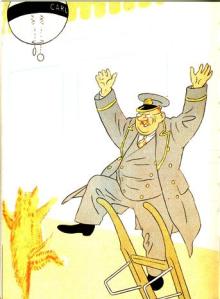
Skimbleshanks and the stationmaster

Skimble and the stationmaster
 

More Fairies: Shakespeare

My choice of Shakespeare today is in honour of the Trinity Dublin Shakespeare Festival which is being held this week from 3-8 June. I have been to a couple of events so far and hope do more by the end of the week. My original plan for today was to select a sonnet, but I decided to pursue the theme of summer instead. Here, therefore is a short magical snatch from the action in

A Midsummer Night’s Dream:

Act II (Scene I)  – A wood near Athens     

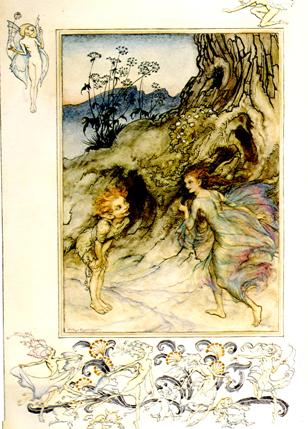
Puck and the fairy by a tree

Puck and the fairy


Enter from opposite sides, a fairy and Puck

PuckHow now, spirit, whither wander you?  

FairyOver hill, over dale
Thorough bush, thorough brier,
Over park, over pale,
Thorough flood, thorough fire,
I do wander everywhere,
 Swifter than the moony sphere;
And I serve the fairy queen,
To dew her orbs upon the green:
The cowslips tall her pensioners be;
In their gold coats spots you see,
Those be rubies, fairy favours,
In those freckles live their savours;
I must go seek some dew-drops here,
And hang a pearl in every cowslip’s ear.
Farewell, thou lob of spirits; I’ll be gone:
Our queen and all her elves come here anon.

I have had this illustrated edition for many years but sadly can’t remember where it came from, other than that I think it was probably from a book fair in the Birmingham area. That would put it around fifteen or more years ago, which is a scary thought.

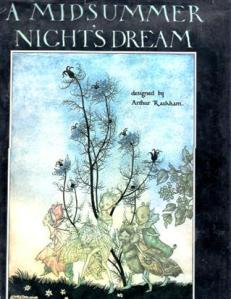
The illustrations are all by Arthur Rackham (1867-1939) and the text was written by calligrapher Graily Hewitt (1864-1952). The work was originally done in 1929 at the invitation of the Spencer Collection (New York Public Library)  This particular edition was published in 1977 by Weidenfeld and Nicolson Ltd and reproduced from the 1929 manuscript. I love Arthur Rackham’s work and maybe one day I might get to see his original drawings and watercolours. There is an Arthur Rackham Society if you want to discover more information about his work.

I hadn’t heard of Graily Hewitt before I owned this book but I have discovered that the Victoria and Albert Museum have holdings of his work. He was a very important figure in the world of calligraphy and typography and wrote The Pen and Type Design (1928) and Lettering (1930). The latter was last re-printed by Dover Publications in 1993 though it looks as if it is out of print now. This reminds me that Dover are a brilliant publisher for classic reprints and that perhaps I should do a post on their work sometime.

Apologies if the images don’t look as good as they might. I had problems scanning due to the size of the book.

Almost a week of poetry and poets so far….let me know your favourites so far!

Titania's fairies

Front of jacket


Belloc’s Beasts: Cautionary Verse

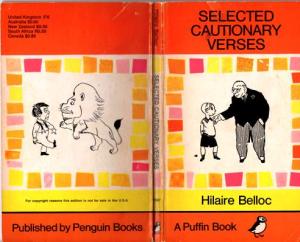
orange and yellow book jacket and poem characters

A couple of likely lads…

I know that this will be two children’s poems in a row, but I suppose that the excitement of having some sustained sunshine has addled my brain a little. In fact I’m beginning to suspect that this #PoetryinJune challenge may end up featuring rather a lot of light-hearted or comic verse. As summer is finally on the horizon, there may be just cause to steer clear of sad or tragic poetry (though that doesn’t mean I will eschew sadness completely).

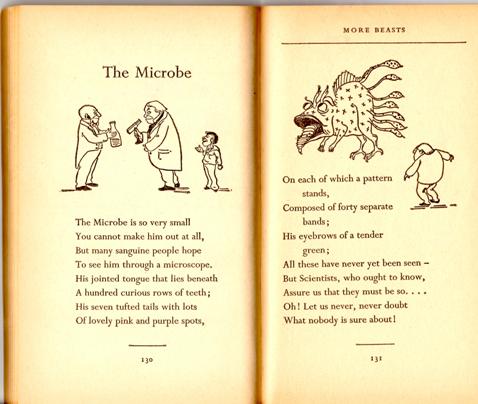
Having decided on comic verse, you can’t do much better than to choose one of Hilaire Belloc’s wonderful Cautionary Verses. The problem then, was which Cautionary Verse to choose for my featured poem. After much deliberation I decided on the following. This was solely on the basis that suffering from a sore throat as I was, I rather liked the thought of it being as the result of purple and pink microbes.

The edition I have here is a selected edition (mine is a 1968 reprint) taken from the illustrated album edition published in 1940 by Gerald Duckworth & Co. I dare not even consider how much you would pay for a first edition (381 illustrations and cloth gilt cover) these days. The illustrations of Belloc’s verses are by Nicholas Bentley and B.TB. (Basil Temple Blackwood).

text and illustration of poem The Microbe

A jolly purple microbe…

The above poem comes from More Beasts for Worse Children which was first published in 1910 as a separate book and later included, along with Cautionary Tales for Children (1907) in the album I mentioned. The drawings for ‘The Microbe’ are from B.T.B.

Now, I will see if I can become a little more serious for tomorrow….  

Gerbil Juggling with Brian Patten

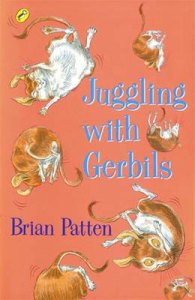
This is a really silly verse to celebrate the June Bank Holiday (well, it’s a holiday if you happen to be in Ireland anyway). Juggling with Gerbils is the title poem of a Brian Patten collection published by Puffin Books in 2000. Illustrations (and not only of gerbils) are by Chris Riddell. Even though I have been a gerbil owner myself I still find this poem funny. And before you ask, I have never tried it myself. Honest. Patten’s collection found its way onto The Landing a few years ago via a library sale in Dundrum, Dublin and has been read many times over. I somehow doubt if we’ll ever grow too old for gerbil juggling!

Juggling with Gerbils

book jacket with seven gerbils

Do not try this at home…


Don’t juggle with a gerbil
No matter what the thrill
For gerbils when they’re juggled
Can end up feeling ill.
It makes them all bad tempered
And then they’d like to kill
Those gerbil-juggling jugglers
Juggling gerbils till they’re ill.

(Do not try this at home)

Brian Patten  was born in Liverpool in 1946 and formed the Liverpool Poets with Roger McGough and Adrian Henri in the 1960s, bringing out The Mersey Sound in 1967. His first solo collection was also published in that year, Little Johnny’s Confessions and has written extensively both for adults and children since then.

For more information here is a link to Brian Patten’s website. Now where’s that gerbil gone…

Wendy Cope

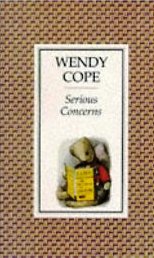
New Season by Wendy Cope (born 1945) is taken from Serious Concerns (Faber 1992) which was her second collection of verse, the first being Making Cocoa for Kingsley Amis (Faber 1986). I was given Serious Concerns by a customer when I worked in Birmingham in the late 90s and I went on to buy the first collection on the strength of reading it. Attentive readers will recall that I included one of Wendy Cope’s seasonal verses as an Advent post last year. If I was to try to sum up Cope’s work, I couldn’t do better than Dr Rowan Williams who said “Wendy Cope is without doubt the wittiest of contemporary English poets, and says a lot of extremely serious things”.

It was very difficult to make a selection from Serious Concerns, but finally I plumped for this one because it serves to remind me of life’s endless possibilities. It is something that we all probably need reminding of from time to time; I know I do. It is slightly late in the season to use this one, as the chestnuts are already in leaf, but I hope you will overlook that minor technicality.

New Season

book jacket with teddy bear

I also love the jacket..

No coats today. Buds bulge on chestnut trees,
and on the doorstep of a big, old house
a young man stands and plays his flute.

I watch the silver notes fly up
and circle in blue sky above the traffic,
travelling where they will.

And suddenly this paving-stone
midway between my front door and the bus stop
is a starting-point.

From here I can go anywhere I choose.

Of course I also just wanted an excuse to feature the Posy Simmonds drawing of the very studious bear on the front cover. I think that you will find almost as many illustrators as poets mentioned on The Landing this month. But then that can’t be a bad thing, can it?

If you liked this poem here is more information on her work from the Poetry Archive web site.

Rose Fyleman

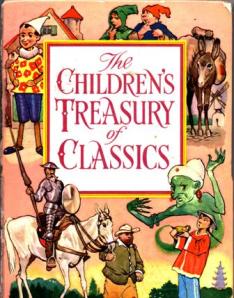
book cover with Aladdin, Pinoccio, Don Quixote

A childhood favourite

For the first of my ‘Poetry in June’ features I delved into the past –  to the Children’s Treasury of Classics that I mentioned in the last post . I have had the book (published by The Children’s Press) since I was a child, though I don’t remember if it was new when I had it. It is undated, though there is a pencilled price of 7/6 on the inside cover. The Treasury is now rather battered and the pages are yellowed.

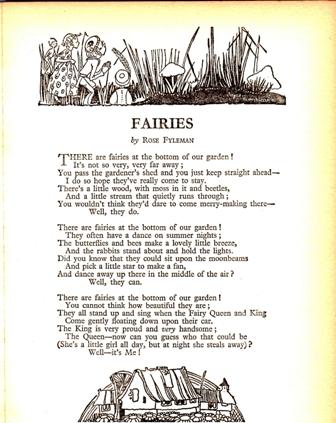
I have picked out a poem by Rose Fyleman (1877-1957) which was originally published in Punch magazine in May 1917. Fyleman published many stories and verses for children over a very productive life. Her poems still appear in children’s collections today.

There is a nice continuity for me as this poem also happens to be one of our daughter’s favourite poems. And anyway, fairies in the garden seems to me to be a nice way to begin June. I have scanned in the page since I think the illustrations (by Joyce Plumstead 1907-1986) add to the piece, so I hope the text will be legible across different platforms and browsers. Drop a comment in the box if it doesn’t work for you.


text of Rose Fylman's poem Fairies

An old favourite…

I hope you enjoy the first day’s PoetryinJune choice. See you tomorrow!

Dolls on The Landing: Helen Clare

After writing a piece recently on Tara’s Palace for the Irish News Review I thought I would squeeze in a dolls’ house related post to further indulge my memories of childhood fantasies. Was I the only child who wished that some magic spell would turn me small enough to be able enter toy houses and shops? I doubt it very much. The dolls’ house stories by Helen Clare were entirely responsible for my particular fantasy. I so much wanted to be small enough to visit the doll’s bungalow that my dad had made for my birthday. Alas, it wasn’t to be!

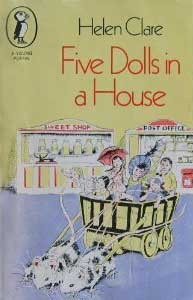
In Five Dolls in a House, (first published 1953) Elizabeth however, does exactly that. Magically she finds herself walking up the path to the front door and knocking. As she does so, she hears the voices of the dolls within:

And without thinking twice about it, Elizabeth walked into the house. She said nothing (she was too surprised) but followed the red-cheeked person into the house. 

Five Dolls in a House

Puffin edition, 1964, reprinted 1978.

If you have never met the dolls in Elizabeth’s dolls’ house then let me briefly introduce you:

Vanessa (she of the red cheeks) is rather bossily in charge of the household and is the daughter of a Duke (allegedly);

Jacqueline is the French paying guest who possesses lovely lace underwear;

Jane is a very sweet-tempered doll who always wears a long green nightdress:

Lupin by contrast is always clad solely in a blue woollen vest with a lot of dropped stitches;

Amanda is the lively, mischievous one who quarrels with Vanessa;

And last, but by no means least, is the monkey living on the roof who has been known to dress up as a duchess on occasion.

They all have lots of adventures with Elizabeth (in the guise of Mrs Small the landlady) including getting measles, acquiring two white mice to pull a trap and spring cleaning in their own inimitable style. I’m sure that Vanessa would have loved Tara’s Palace. She would have thought it ‘most genteel’, coming as she did from a castle (Cranberry Castle in fact).

I think all of the stories are now out of print, but they are well worth tracking down. My mum found the copy we have in Oxfam in Birmingham and we were lucky enough to spot even more adventures at last year’s Trinity College Book Sale.  All of the stories are complemented by Cecil Leslie’s delightful line drawings.

Do you have a favourite dolls’ house story? Let me know…

Mortimer and Rumpole Illustrated

Murderers and Other Friends

Legal Memoirs…

Lately I have been re-reading John Mortimer’s volume of memoirs, Murderers and Other Friends in between reading a couple of library books which I needed to tackle before they were due back. Still on the library pile is Jeet Thayil’s Narcopolis which I have fortunately been able to renew while I finish Lindsey Davis’ Roman crime novel Saturnalia.

I have long been a fan of Davis’ private eye, Marcus Didius Falco who gets embroiled in the seamy underbelly of Roman society with the able assistance of his formidable patrician wife Helena Justina. As I think I have mentioned, I have been having a crime binge lately (apart from reading Mortimer’s memoirs) thanks to my local library.

I hope to discuss the topic of crime novels in a future post, but for the moment I shall return to Mortimer and his well-known creation Horace Rumpole of the Bailey. While doing a Google search on John Mortimer (1923-2009) I came across this short video of an exhibition of caricaturist Tony Healey’s original watercolour Rumpole paintings. If you have not read any Rumpole stories or watched the television versions starring Leo McKern (1920-2002), then these glimpses of the irascible old barrister might inspire you to explore further. The exhibition also includes several lively portraits of John Mortimer.

The exhibition and the video were the work of a London gallery called Illustrationcupboard which specialises in featuring the work of contemporary book illustrators. This definitely sounds like a place to see when I next visit London. Check out the gallery’s website for some fabulous artists such as Jane Hissey, Edward Ardizzone, Brian Wildsmith and Lauren Child.

On  a separate note, I have recently set up a new chapter on the Landing entitled Booksellers Beyond which is aimed at showcasing the talents of various former booksellers who have gone on to explore other creative avenues. My first guest artist is an old friend with whom I used to work in Birmingham, Valleri Jillard who has forged a new career as a mixed media artist. Take a peek at some examples of her work over in Booksellers Beyond by following the links. I hope to add more to this section soon so keep checking back.

But now, back to Mortimer and Rumpole…

Video credit: Illustrationcupboard, uploaded to YouTube 12 March 2012 (exhibition 20 February – 10 March) – with thanks.

One Year on the Landing: A Literary Milestone

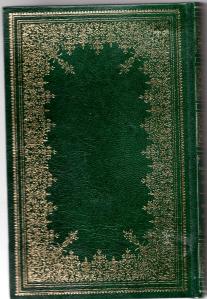
Green bound classic

A rather smart binding…

I am pleased to say that today is the First Anniversary of The Landing Book Shelves Reading Challenge. There was a time when I thought that I would fall by the wayside, but I am pleased that I managed to stick with it this far. I have enjoyed having a go at blogging and I have taught myself a few WordPress skills in the process. Having the blog has also ‘landed’ me with a marvellous excuse for reading more books! Of course when I have finally finished my Landing Eight bit of the Reading Challenge then I will simply have to begin all over again with another random pile culled from the shelves.

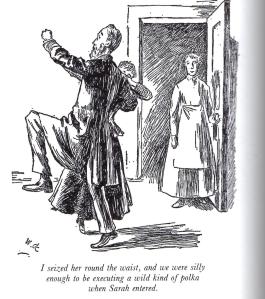
By way of an anniversary (or perhaps it should be birthday?) gesture I have chosen to post up a  rather jolly picture from The Diary of  a Nobody, depicting Mr and Mrs Poooter taking a few frivolous turns around the room. The occasion for celebration was their invitation to a party at the Mansion House. The illustrations, drawn by Weedon Grossmith are so good that it would be difficult to pick a favourite, but this one fits my purpose today just nicely.

The drawing captures the exuberance of the moment as the couple whirl around the room in anticipation of the social event of the year. Not surprisingly, the maid picks that moment to enter the room. Sarah witnesses her otherwise respectable employers dancing in the parlour:

I cannot tell what induced me to do it, but I seized her round the waist, and we were silly enough to be executing a wild kind of polka when Sarah entered, grinning, and said: “There is a man, mum, at the door who wants to know if you want any good coals”. Most annoyed at this.

Mr and Mrs Pooter dancing

A merry dance…

It is not clear whether Mr Pooter is annoyed at the interruption of his impromptu dance session or at being caught doing something silly by the maid. The episode describing the actual Mansion House dinner and ball is very entertaining as Mr Pooter is rather shocked to find that some of the tradespeople he deals with have also been invited. I do urge anyone who has not yet encountered the Pooters and their friends to get hold of a copy forthwith and make their acquaintance.

Meanwhile I will be busy with Mary Robinette Kowal’s February letter writing challenge Month of Letters (hashtag #lettermo) and embarking upon a web design course. I also hope to have a bash at reading another book from the Landing Eight challenge.

Until soon (I hope!)…

Post-Challenge Bonus Book: Andersen

I hope you all had a lovely Christmas (with plenty of new books to read) and that you are enjoying the peaceful hiatus between one set of festivities and the next. You may have even begun to ponder the dreaded New Year’s Resolution question.

But as Christmas is not yet over (there are Twelve days of Christmas after all) I am taking the opportunity to squeeze in one more tinselly title before normal service is resumed on the Landing Book Shelves. As I think I have mentioned during the course of the Advent Calendar Challenge, I try to add a Christmas book to our shelves every year.

The Fir Tree

The Fir Tree

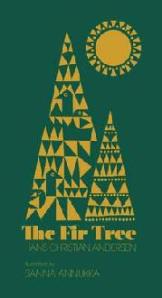
This year’s choice fell upon The Fir Tree by Hans Christian Andersen in a new edition illustrated by Finnish designer Sanna Annukka (Hutchinson, 2012). Annukka’s beautiful geometric style illustrations give the book a contemporary feel without detracting from the magic of this classic fable. The volume is produced as a cloth bound hard backed book with Annuka’s designs decorating the end papers.

Perhaps this is an apt choice for post-Christmas /pre-New Year since I am sure we could all learn a lesson from the little fir tree who realised too late that he should have been living in the present and making the most of what he had:

“It’s over, it’s over!” said the poor tree. “If only I had enjoyed it while I could. It’s over, it’s over!”

Hmm, I can feel a New Year’s Resolution coming on….

By the way, if anyone is interested in Sanna Annukka’s work the link to her website is here with some fabulous designs. I may well return to Hans Christian Andersen at a future date as there are many lovely editions of his stories available. In the meantime…

Enjoy the rest of the festive season, folks!