Landing Eight Progress: L.P.Hartley

The Go-Between

The winged messenger

Turning my attention back to the Reading Challenge that was whole purpose of this blog, I have been scanning the remaining Landing Eight titles to decide what will come next. My choice will be to read L.P. Hartley’s The Go-Between (Penguin) as a complete contrast to The Periodic Table. In common with many people I suspect, I have known the famous first line to this novel for years without ever having read the book. Well, now is the time to put that lack of experience finally to rights. That is, after I have finished a couple of other books that are floating around, procrastination being my modus operandi (she confesses sadly).

The Locust and the Bird

The Locust and the Bird – trade paperback edition

At present, I am reading My Mother’s Story: The Locust and the Bird by Hanan Al-Shaykh, a completely engrossing Lebanese memoir. The book is a trade paperback title that I grabbed from a bargain section some while ago because the lovely title (and the stylish woman on the jacket) appealed to me. A quick mention also for the memoir, The Storyteller’s Daughter by journalist Saira Shah; in which Shah tells of her attempts to come to terms with, and understand her Afghan heritage. She has had some truly close shaves during several years of conflict in Afghanistan, which are un-nerving even to read.

A wonderful thread running through the book is that of the stories passed down the generations of the family. At one point Shah quotes her father comparing stories to dried onions. He told her that stories are ‘like dried experience. They aren’t the original experience but they are more than nothing at all’. The stories have a purpose in helping to explain and deal with life’s experiences as they come along. I have written a little about the importance of stories and storytellers in a previous post (April) so this aspect of the book was of particular interest to me.

Now, your starter for ten: tell me about your favourite storyteller…

Other News:

As I am sure many people know, the nice folks running the Grafton Media Blog Awards Ireland have recently announced the shortlists. This blog has been shortlisted in the ‘Best Newcomer’ category, which is very exciting for me. A big ‘Thank You’ is due to the organisers (Amanda Webb, Lorna Sixsmith and Beatrice Whelan) for selecting the Landing Bookshelves for inclusion on the list. I put my head in the sand after the nomination went in and tried not to think too optimistically about the awards, so it was particularly cheering to find that I had got this far. I will be firmly crossing fingers (and maybe toes too) ahead of the Finalists announcement (29th September). However, the crossing fingers part may make typing tricky so perhaps I will simply try to visualise crossed fingers and see how that works. Actually, page turning would be awkward as well and I definitely do not need any obstacles on the reading front either.

So, it’s back to The Go-Between for me…

Blog Wards Logo

It’s awards time…

The Best Science Book of All Time*: The Periodic Table

As I explained in a previous post, the latest book that I have been tackling here on the ‘Landing Eight’ Reading Challenge is Primo Levi’s The Periodic Table (or Il Sistema Periodico in the original Italian, 1975). I have previously read If This is a Man and The Truce (published in one volume) which I would list as a ‘must read’ even though strictly speaking I dislike the idea of telling folks what they should read. I find it hard to resist doing it occasionally though. To read of Levi’s experiences is the nearest that most of us will, fortunately, ever get to such inhumanity. Reading of them, bearing witness to such actions, is therefore the very least we can do.

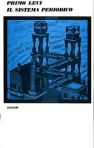
Italian first edition of Il Sistema Periodico

First edition with Escher etching

The Periodic Table has long been on the back burner (as opposed to the Bunsen burner), probably because the scientific term of the title put me off a little. I was anticipating the prose to be inevitably laden with chemical names and processes and consequently rather hard going. After having finally read the book I can testify to the fact that my brain has been absorbing the names of elements and compounds that it has not had much reason to consider in years (apart from the basics such as oxygen and carbon that is).

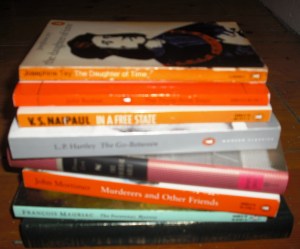
stack of classics

It’s the fifth one down

As it happens, I found the chemistry experiments fascinating (especially when things failed to turn out as hoped) despite it being a very long time since I last studied science.  I admit that I would have had trouble recalling many of the elements on the Periodic Table off the top of my head (of course, chemists have added new discoveries to the table over the years). Since reading the book, I have been trying earnestly to recall the chemical symbols I used to know.

Having my chemical memories jogged a little has brought back images from the school year that saw our form ensconced in Lab 12 with Dr F as our form mistress. Looking back, I question the wisdom of the school using a science lab as a form  room, but I suppose anything really dangerous was locked safely away. I actually used to enjoy chemistry though I have a vague memory that my experiments generally failed to turn out as expected. There was a definite excitement in the processes of measuring and heating. Fortunately nothing actually exploded.

Then, I did go on to study bakery and confectionery, which is where you mix one ingredient with another to produce a chemical reaction.

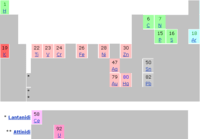
diagram of The Periodic Table of Elements

The Periodic Table showing elements used by Levi

We all do chemistry every day, but just tend not to realise it as such. Now, I think that before I go in search of my old school lab coat, perhaps I had better do just a little more reading. If anyone has a favourite scientific read I would love to hear about it, so drop me a line in the comment box.

*As voted for in 2006 by a Royal Institution survey – link to a Guardian article here.

(Thanks as always to the nice people at Wikipedia for the additional illustrations of The Periodic Table diagram and the cover of the original Italian edition of Primo Levi’s book)

John Buchan on film: those elusive thirty-nine celluloid steps

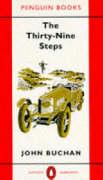
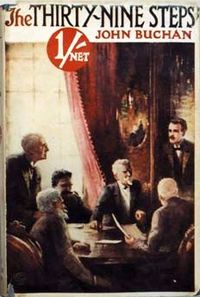
Orange Penguin cover of The Thirty-Nine Steps

Our edition of The Thirty-Nine Steps

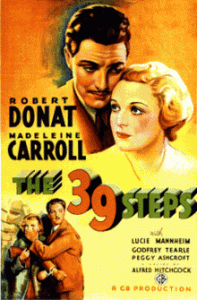
As I mentioned previously, I watched one of the film versions of John Buchan’s classic adventure The Thirty-Nine Steps after reading it recently. The Hitchcock re-telling was one of my favourite screen versions, made in 1935 and starring Robert Donat (as Richard Hannay) and Madeleine Carroll (as Pamela). It was not until I read The Thirty-Nine Steps that I realised just how far were the screen versions from Buchan’s original story. I thought I knew the plot (more or less, a variation here and there perhaps) but now I concede that I knew absolutely nothing. Except that, thirty-nine steps (albeit with variant meanings) were involved and so was a large segment of rugged, almost deserted (except for the baddies) Scottish landscape.

For those of you who have never read The Thirty-Nine Steps, I will give a brief outline of the plot before

Cover of The Thirty-Nine Steps

A first edition of the novel

confusing you with the plot of the film: Hannay is a Scot, recently returned to the Old Country from South Africa who is heartily bored after three months. After an evening at dinner and a music hall show, he has determined to leave for the Cape if nothing interesting turns up within another day. Something certainly does turn up and Hannay finds himself fleeing across Scotland in several different disguises while in possession of a secret that could mean the difference between war and peace. Figuring out what or where the thirty-nine steps might be is a vital part of his un-looked for mission. As Buchan wrote the book in 1915, the plot’s threat, which involved the assassination of a European leader, was rather apposite. The Thirty-Nine Steps was Richard Hannay’s first adventure and it involves him in some tight moments and plenty of narrow escapes.

Moving on to the film version: I found to my surprise that whereas in Buchan’s original novel I found a distinct lack of women characters, two feisty ones pop up in the screen action. In the book, an occasional anonymous female supplies much-needed sustenance (fleeing dastardly spies is hungry work), but where, oh where is the glamorous Mata Hari type figure (Annabella Smith, played by Lucie Mannheim) that I saw in the film? In Buchan’s spy yarn, a mysterious American called Franklin P Scudder gives the vital information to Hannay. He does eventually wind up dead, but not as soon and arguably not as splendidly dramatically as Smith does.  In Buchan’s world, spying is obviously strictly a man’s game.

Film poster of Robert Donat and Madeleine Carroll

Film Poster

Hitchcock’s film further alters the female/male balance of the cast by adding the cool and elegant Pamela, to function as the ‘love interest’ part of the chase. I wonder what Buchan, who died in 1940 thought of the changes made to his story. He did not live to see the further screen adaptations, none of which was any more faithful than the 1935 film to the original tale. Carroll’s character is noticeably less exotic than the deceased Annabella Smith is but sparks soon fly between her and Hannay. Initially she disbelieves Hannay’s far fetched claims so betrays him to the police before finally realising that he was telling her the truth all along and so she helps him.

One side effect of playing with Google to research for blog pieces is that you find out other snippets of information. I found a site set up in tribute to Madeleine Carroll, who was apparently one of the few film actors to make a successful transition from silent movies to talkies. She was born in West Bromwich, England of an Irish father (Co Limerick) and a French mother and spent part of her early career with Barry Jackson’s Birmingham Repertory Theatre. A memorial was set up in her hometown in 2010 and an account of her life by Derek Chamberlain was published by Troubadour Publishing Ltd. If I manage to get a picture of her memorial next time I am in the area, I will post it up.

Follow the links given in the text for further information. Thanks to Wikipedia for the gorgeous The 39 Steps film poster and the shot of the first edition jacket.

If you are interested in further information about John Buchan’s life and work, I found a link to the John Buchan Society which has plenty of useful material.

Now, after John Buchan, which of the ‘Landing Eight’ shall I tackle next….Any thoughts?

John Buchan and the Arts and Events File

Since my last post I have been busy getting stuck into The Thirty-Nine Steps by John Buchan so I will shortly be well on the way to ticking off another title from the ‘Landing Eight’ selected recently. More on this in the next post. I have recently watched one of the film versions of the book (Robert Donat as Richard Hannay) thanks to one of those free DVDs you sometimes get with the Sunday papers. The comparison of page to screen was interesting.


A pile of classic novels

Progress…

Other News: I have also been busy trying to add new chapters to my site to incorporate more cultural bits and bobs than I can include on the main blog stream. In my Arts and Events File I have added a few pieces that were previously published elsewhere and that I have tweaked and edited slightly before posting up here.

This bit will be a random collection of arts related topics – anything that grabs my attention really. Another section called The Blurb features small publishers, one current (Red Fox Press) and one the iconic Cuala Press run by the Yeats sisters in Churchtown, Dublin. There will also be other literary related articles, such as one on Marsh’s Library, Dublin.

I have included links on these pages so anyone interested in following up any of the information can easily do so. I test the links as I go along but would appreciate feedback if any of them fail to connect.

cover of Mandy Moore's Yarn Bombing

Yarn Bombing by Mandy Moore

Another of my arts pages highlights the fantastic ‘knitted graffiti’  (or yarn bombing) trend, which is something that I came across at an exhibition in the Royal Artis Zoo in Amsterdam last year. I just wish my own knitting was up to the challenge!

Last, but by no mean least I have posted up a page about a famous American Civil War quilt and Jane Stickle who created it so beautifully. This was inspired by a visit last year to the Knitting and Stitching Show at the Royal Dublin Showground (RDS).

I hope these pieces in the Arts and Events File and The Blurb pique your interest in the topics; if anyone has any ideas for future posts I would love to hear them.

Thanks for reading!

Honno Press: Welsh Women’s Press (Gwasg Menywod Cymru)

Honno Press logo

Honno Press

This post is another one of those detours from the Landing Bookshelves that keep happening despite my best intentions. My only excuse is that if you discover a new (to you) author or publisher, you have a bounden duty to pass it on to anyone who may be interested. Well, as excuses go…

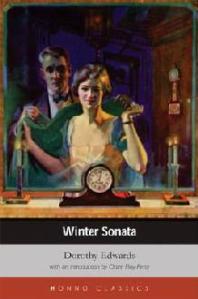
I came across Honno Press for the first time while book reviewing for www.belletrista.com   The novel in question, Winter Sonata (Dorothy Edwards, originally published in 1928) was part of the Honno Classics imprint. As I rather shamefacedly confessed at the time, I mistook this Dorothy Edwards for a children’s writer of the same name and when I realised my error did a bit of research into the other Dorothy Edwards at the same time as researching Honno Press.

Dorothy Edwards (1903-1934) was a very talented Welsh writer who published a collection of short stories called Rhapsody the year before her first novel in 1928. Winter Sonata contains a useful essay by Clare Flay about Dorothy Edwards and I also found a link to a copy of the original press account of her death by suicide. A sad loss to women’s literature indeed. After reading her novel (see review here) I will try to get hold of her short stories.

Honno (Welsh feminine form of ‘that’) Press was set up in 1986 with the twin aims of giving a wider platform to Welsh women writers and for increasing the opportunities in the publishing industry for the women of Wales. The company was set up as a co-operative with around 400 shares sold to members of the public in the first six months of trading.

The press, based in Aberystwyth, still operates within its original remit of only publishing work by women from Wales. Prospective writers either have to be Welsh or living in Wales or have significant Welsh connections. Apart from its shareholders’ continuing support, the press has received financial support from The Welsh Books Council and the European Union for its worthy endeavours to promote Welsh women’s literature. The publisher’s list boasts an impressive 450 authors whose work covers fiction (contemporary and classic), poetry, memoir and non-fiction as well as children’s and teen fiction.

cover of Winter Sonata

Winter Sonata

The catalogue has a strong Welsh language list as well, including books by well-known teen author Malorie Blackman translated into Welsh by Gwenllian Dafydd. Browsing through the Classics list has given me plenty of authors that I had not previously come across. As with the Persephone Books reprints (of which more another time perhaps) books that have slipped out of the reading public’s consciousness are given the chance to live again. Honno Classics provides a great opportunity to explore some rediscovered gems. I was particularly interested in the memoirs and some fiction reprints from the 1930s.

Over the years of Honno’s existence, many books have been prizewinners or have been included on awards shortlists. During the early years, Carol Anne Courtney won the 1989 ‘Wales Book of the Year’ for Morphine and Dolly Mixtures. More recently, Kitty Sewell’s thriller Ice Trap was shortlisted for the CWA New Blood Dagger in 2006. Coming right up to date Lorraine Jenkin’s comic novel Cold Enough to Freeze Cows won one of the top three prizes in the finals of the ‘Peoples Book Prize’ 2011.

To further the aims of the press in encouraging fresh new talent, Honno runs a programme of regular writing workshops (the next one is in January 2012) and hold ‘meet the editor’ sessions for prospective writers. Editors actively seek new writers for Honno Press with regular calls for submission for work they wish to include in the Honno short story collections. I am certainly planning to treat myself to couple of new books now that I have discovered this publisher; there might yet be a rival to my Persephone collection.

For further information on publications and workshops check out the website www.honno.co.uk

If anyone else has got any Honno Press favourites I would love to hear about them. Until next time…

A Centuries Old Mystery: Josephine Tey and Richard III

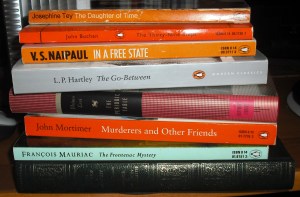
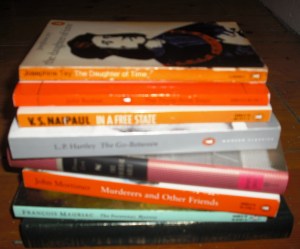
Cast your minds back to the post with the selection of the TBR Pile featured. I did say that I would be tackling them ‘in no particular order’ but the one I have been reading for the past few days was indeed at the top of the list. See photograph below for proof. The book in question is The Daughter of Time by Josephine Tey (real name Elizabeth Mackintosh) about Richard III and the Princes in the Tower mystery.

This was I think always going to be my first choice (it was the first one that I picked out as well as being the first listed). The reason being as I am sure you have guessed by now that this is a re-read of an old favourite of mine. The book was originally published in 1951 (the last book to be published in Tey’s lifetime as she died in 1952) and issued by Penguin Books in 1954. My edition is a 1969 reprint bought second-hand and it certainly shows: foxed is not the word for it I am afraid. The pages are heavily discoloured and threatening to fall out; both the front and back covers are damaged. Maybe one day I’ll treat myself to a new edition (I am not sure if the title is still in print) or a fine second-hand copy.

pile of classic novels

Working from the top down…

Two things make this book an old favourite: my affection for Josephine Tey’s crime novels and my long fascination with Richard III and the mystery of the princes in the tower. This fascination was in fact inspired by reading Tey’s book as I am sure was the case with many other readers. Indeed the Richard III Society credit her with helping to rehabilitate the king’s reputation and restore him to his rightful place in history. Shakespeare has much to answer for in his creation of the wicked hunchbacked uncle with a rather long crime sheet.

Tey’s novel features her regular detective character Inspector Alan Grant who is laid up in hospital after an accident and is terribly, mind numbingly, bored and frustrated. When his fascination with faces (from the bench or the cells?) causes him to become interested in the mystery surrounding Richard Plantagenet, the scene is set for a modern-day investigation into a historical crime. With the help of an amiable American student as his able-bodied research assistant, Grant delves into the murky doings of the fifteenth century. He is surprised by what he comes up with during his quest and is by no means impressed with your average historian’s powers of reasoning.

On the strength of reading this investigation into the Yorkist monarch several years ago, I did some further digging around and discovered more novels and academic studies on the subject. I then read as much as I could find on Richard and the Wars of the Roses and his eventual demise fighting at the Battle of Bosworth in 1485. I was keen enough on the topic to become a member of the Richard III Society though I eventually let my membership lapse. Having looked at the website recently I am tempted once more to become a Ricardian.

Meanwhile, back to the novel to follow-up a few leads! Are there any more Richard III enthusiasts out there? If so, let me know what you have been reading lately, I would love to know.

Just to finish with, here is a link to a fascinating site on Josephine Tey which is well worth a look if you are a fan of her writing.

A Glimpse of the TBR Pile: A Reading Challenge

shelves of classics

Tantalising Glimpse

A friend has given me a suggestion for a way of tackling my TBR Pile Reading Challenge, so I am basing this piece on that feedback (thanks Teri!). Never let it be said that I fail to listen to sensible advice (especially when I asked for it in the first place).

Various tantalising glimpses have been given of my Landing Bookshelves, but I have not actually written down any of the titles that I may tackle during my trek around the TBR Pile. This post is an attempt to remedy the lack thereof. It will probably be a random list as I am about to leave my computer and browse the shelves for ideas. The plan is to simply jot down any title from the TBR Pile that takes my fancy and present the list to you, dear reader, as an indication of my future (good) intentions.

Before I set off for uncharted (and possibly shockingly dusty) territories, I will just draw to your attention that I have set up a Bibliography page on the site, where I plan to list all of the books mentioned (however briefly) in the Reading Challenge blog posts. Some titles may be out of print, but I will try to remember to give details of dates, publishers etc in case anyone wants to follow up on anything. I hope to update the page regularly and even to maintain strict alphabetical order (that might be a challenge in itself).

(Noises off...)

Now, that was quick; I am back already from the cobwebby wastes of the upper storey with my list of books; in no particular order I hasten to add.

On the menu: The Landing Eight

A pile of classic novels

Progress…


The Daughter of Time Josephine Tey (Orange Penguin)

The Frontenac Mystery François Mauriac  (Penguin Modern Classics)

The Go-Between L P Hartley (Penguin Classics)

In a Free State V S Naipaul (Orange Penguin)

The Periodic Table Primo Levi (Everyman)

The Diary of a Nobody George & Weedon Grossmith (Guild Publishing)

Murderers and Other Friends John Mortimer (Orange Penguin)

The Thirty-Nine Steps John Buchan (Orange Penguin)

Some of the above will be re-reads but most of them are genuinely from the TBR Pile that constitutes much of the Landing Bookshelves, but I will leave it until a future date to disclose which are which, thus creating a modicum of suspense. I will not promise to read them in any particular order, but rather as the fancy takes me. I have also spotted a more few books that I would like to write about, but I will tuck them in here and there as a surprise literary morsel in between courses.

Feel free to suggest any preferences as to reading order. In the meantime, I will be busy cleaning my bookshelves; I may be some time.

Until we meet again behind the TBR Pile…

A Tale of Four Sisters: revisiting Little Women

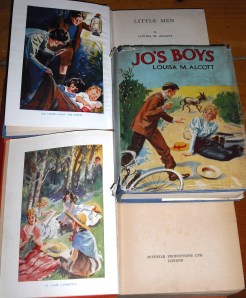
colour illustrations of the March sisters

The March family

A few posts ago, I mentioned that I had bought a biography of Louisa May Alcott at the Trinity College Book Sale. This book by Martha Saxton conveniently ties in with my Landing Project since Alcott’s best-known novel Little Women and its sequels are residents on the landing. Little Women was written in 1868 and Good Wives, the second volume in 1869. Both stories were published together in 1880 as Little Women. Alcott continued the saga in Little Men (1871) and Jo’s Boys (1886). Sadly, none of my volumes dates from that early on so they have no financial value. I think I bought all of them in second bookshops several years ago to replace my original childhood copies. They are from a series called Juvenile Library and all have a colour plate in the front depicting the characters. Only Jo’s Boys still retains its illustrated dust jacket. As you can (just) see from the photograph the girls are depicted as rather more glamorous than is consistent with the novels.

In common with so many other teenagers, I read and loved Little Women and I am sure that I was not the only one to identify with and be inspired by, the lively, tomboyish character of Jo March. In sharp contrast, Meg was too good and youngest sister Amy was too fine and fussy. Poor saintly Beth died after illness and decline, which would not have inspired anyone a great deal. I also remember being deeply disappointed that Jo eventually married Professor Bhaer instead of Laurie, the wealthy boy next door. I wanted fun, romance and frivolity but got practicality and companionship instead.

It is strange to pick up an old childhood favourite to re-read and then perhaps to revise long held memories of a cherished book. I started to read the opening chapters of Little Women, revisiting the March sisters as they prepare for their Christmas festivities. After such a lengthy passage of years, I now find myself not particularly in sympathy with the constant striving for goodness and selflessness on the part of the girls. While I can appreciate the solid work ethic and the ability of making the best of what they had, so much virtuousness is hard to take. The emphasis on womanly attributes and virtues is of course strange from a twenty first century perspective. During the progress of the novel, poor Jo is urged to put away her boyish ways and become a woman; an angel of the home. This is in contrast to the eldest sister Meg who is already well on the way to conventional, domestic womanhood.

Until I picked up Martha Saxton’s biography, I had not read anything about Alcott’s life. I had always assumed that her own family inspired the March family portrayed in her work. Which indeed it did, but there was much more to the story than a straightforward re-working of her family life. The March sisters were fictional versions of Louisa and her sisters: Anna (Meg March), Louisa (Jo March), May (Amy March) and Elizabeth (Beth March). Similarly, Bronson and Abba Alcott inspired the characters of Mr and Mrs March; but Louisa’s relationship with her parents was much more problematic than her fictional counterpart’s was with her parents.

I would like to return to Louisa Alcott and her family in a future post, but meanwhile please let me know which was your favourite March sister and why…

Studying the Shelves: Books Galore on the TBR Pile

I have arrived at a point where I have become extremely sidetracked into reading books other than those on The Landing, so I thought I’d do a quick tour of the shelves to remind myself what I am supposed to be reading. Not that it will do much immediate good as I have just begun Jane Harris’s Gillespie and I and I am completely hooked. I have started, so I’ll finish…

book shelves

Where do I Start?

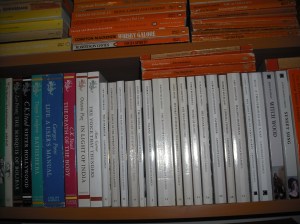
Taken at random, these are a couple of the shelves that this Reading Challenge is all about:

section of book shelves

A Few Orange Penguins

I have been going around snapping bits of the shelves in an effort to record the shelves for posterity (and inspiration). Let’s hope it works!

shelves of classics

Tantalising Glimpse

Stories and Storytellers: the importance of stories

While tidying up some old files I came across a piece I had written for a guest blog spot (see note below) on the topic of stories. As it seemed to fit with the theme of my own blog, I offer a tweaked version here:

I have been thinking recently about stories, storytellers and the importance of stories to both children and adults alike. At present, these musings are rather random but I would like to turn them into something more substantial. I give you here some of my tangled thoughts in the hope that it might make them somewhat clearer to me….

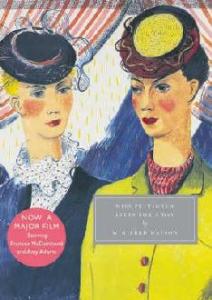
Of interest to me is what makes a good story; which stories can be said to have stood the test of time and why this should be so. In addition, books that once fell out of fashion and that have since been rediscovered and reprinted. For example, Persephone Books now have a long list of fascinating reprints of once forgotten twentieth novels by women writers (I loved Miss Pettigrew Lives for a Day by Winifred Watson).

Book cover of Miss Pettigrew Lives for a Day featuring two fashionable ladies

Miss Pettigrew Lives for a Day

Moreover, what about children’s stories? Before Christmas, I was pulling together ideas for an article on Christmas gifts. Having recently been to an entertaining reading by Frank Cottrell Boyce in the company of a very critical nine year old, I added his latest book Cosmic to my list. At the event, Boyce talked to his young audience about how stories are told, retold and then retold some more. Each time storytellers add new elements. He regaled the children with variations on the theme of finding treasure and the (often-fatal!) consequences. It is a simple enough plot, yet there is enormous potential for exploring a range of actions and emotions. Great comic material too as Boyce proves in his novel Millionaires. There is a good chance that at least some kids reading it will have caught the lifelong story bug

I was initially thinking about the written as opposed to the spoken story but many authors also can spin a good yarn if doing a live session. And in Ireland, where there is a fine tradition of oral story telling I have been to many sessions that can be enjoyed by all ages. Think of in particular, Niall de Burca, Eddie Lenihan and Jack Lynch who can hold audiences in the palms of their hands with their wonderful (and often very tall) tales.

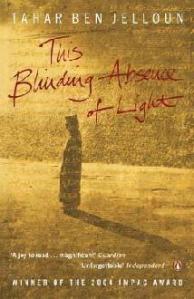
Children’s writers do a fantastic job of creating an imaginary world but story telling can be just as important to adults too. One book in particular that started me thinking about the vital effect a storyteller can have is Tahar Ben Jelloun’s This Blinding Absence of Light. In this novel, based on real events Selim, enduring the horror of imprisonment in Tazmamart, a secret prison in Morocco, becomes a storyteller to his fellow prisoners. He has no books, nor paper and pen so he draws upon his memories to retell old tales and even movie plots to them.

Cover of This Blinding Absence of Light with a figure in desert landscape.

This Blinding Absence of Light

Telling stories is a means of assisting him (and them) to survive, to keep his brain working and to keep up morale amongst the prisoners. They are all in tiny individual cells and it is a way of communicating through the walls, darkness and fears that surround them. The book is a moving testimony to the power of the storyteller. Those are of course extreme circumstances. Even so, people have often used stories in extremis, to come to terms with, and to make sense of events beyond control. Sometimes even to find humour in an otherwise difficult situation.

Well, those are some of my musings….now I am off to curl up with a box of chocolates and a good story.

This piece dates from 2nd January 2011 and this is an edited version of a blog entry for Hand and Star (now apparently defunct but formerly edited by Tom Chivers)  

As a postscript to this piece, there is a connection with my previous piece on Georgette Heyer in that one of her novels Friday’s Child became a symbol of survival for a group of Romanian women political prisoners. One of the women told and retold the story from memory and later, after spending twelve years in prison was able to write and thank the author (in 1963)  from the safety of the United States.

Never underestimate the power of a good story or a great storyteller – if you have any particularly favourite stories that you would like to share, just drop a line in the comment box. I’d love to hear about them!