Latest on the Landing : Mr Pooter

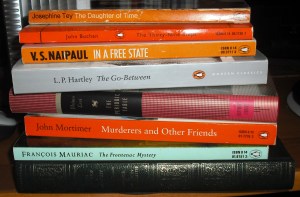
A pile of classic novels

Progress…

You may have noticed that things have been rather quiet of late on the Landing. Rest assured that I have not been entirely idle, merely adjusting to the demands of the New Year (it usually takes me until well into January to become accustomed to the year). After reading my way through a mini crime wave in library books, I have finally started reading the latest on the Landing Eight list. That’s probably as far as my New Year resolutions for my Reading Challenge will take me in the short term.

I have opted to read The Diary of  Nobody by George and Weedon Grossmith (Guild Publishing 1981) as my next book since I felt that this potentially dreary time of the year deserved a little light comedy. The edition that I have on the shelves dates back to the early 1980s when I was in the throes of a book club binge. By ‘book club’ I mean the kind where you promise to buy a book every month (possibly forever) after being lured in by a too good to be true special offer. Eventually I weaned myself off this habit after spending rather a lot of money. I did however end up with the guts of a decent classics collections so it was not all bad news by any means.

All in all then, I feel it is high time that I tackled this comedy classic (originally published in 1894) which has been languishing on our shelves for so long. Charles Pooter is a lower middle class clerk who lives with his beloved wife Carrie (Caroline)  in a respectable London suburb. Mr Pooter’s diary describes his day-to day life over a period of fifteen months, telling of his battles with recalcitrant tradespeople and forays into ‘Society’ as well as quiet evenings at home with his friends.

I will return to Mr and Mrs Charles Pooter anon. Meanwhile, I will leave you with the diarist’s own words to give you a little  taster, while I go off and finish the book:

Diary of a Nobody

First edition

Why should I not publish my diary?

I have often seen reminiscences of people

I have never even heard of, and I fail

to see-because I do not happen to be

a ‘Somebody’ – why my diary should

not be interesting. My only regret is

that I did not commence it when I was

a youth.

(The illustration of the first edition of The Diary of a Nobody was taken from Wikipedia) 

Letter Writing Challenge

Month of Letters (#LetterMo)

I know it might seem rather conceited to be re-blogging myself (albeit with a different hat), but I am keenly awaiting the start of February to get stuck into letter writing. This will be the second year that I have tackled Mary Robinette Kowal’s wonderful letter writing challenge. The re-blog is to help spread the letter writing bug as far and wide as possible!

Meanwhile I will be working on the next instalment of the Landing Reading Challenge…

Chris Mills's avatarIrish News Review

lwI know we are not yet clear of January but I am already looking ahead to February’s comparatively brief span. The reason for all of this eagerness is that the second month of the year has been designated as ‘letter-writing season’. If you are even the slightest bit intrigued by that idea, then read on:

Last year I participated in the ‘Month of Letters’ challenge set up by American writer Mary Robinette Kowal, although I discovered the challenge too late to be able to begin on time. I enjoyed making the effort to write more letters and postcards to family and friends than I usually manage. Most people I know still love to have something more cheering than a utility bill plopping onto their doormat in the morning. And in this year of ‘The Gathering’ it seems a good idea to get writing to all of those friends…

View original post 291 more words

Ghost Light: my treasure in the in-tray

Ghost Light

Molly Allgood…

As anyone who follows me on Twitter will be aware, this week I unearthed Joseph O’Connor’s Ghost Light (Harvill Secker 2010) from my in-tray where it has been languishing for the last few months. It is the trade paperback edition, purchased in a charity shop and put aside in favour of other things. As I am sure I have remarked before, there is a particular pleasure in coming across a book that you have completely forgotten ever buying. Finding it all over again is a treat in itself. O’Connor’s novel was chosen as the Dublin One City One Book title for 2011 but I never actually got around to reading it. (See this article in The Blurb pages for more on the annual event).

The novel brings to life the secret love affair between playwright John Millington Synge (1871-1909) and Abbey Theatre actress Mary (Molly) Allgood (1885-1952) from their meeting in 1905 until Synge’s death. Molly went on to become a well-known stage and film star (as Maire O’Neill) though Synge’s family and friends brushed aside her real-life role as Synge’s lover and muse. Her relationship with Synge had never been considered suitable owing to differences in their respective religious and social positions.

I am just over half way through Ghost Light now and enjoying it very much after taking a few pages to get into it. At first, I thought the novel was going to be too sad and dreary for what I wanted at the time. Certainly, persistence has paid dividends and, while the book has its sadness, there is plenty of humour too with some brilliant comic dialogue. Of course, Molly is a wonderful heroine, both in her fiery spirited youth and her resilient old age in a battered post-war London.

Portrait of Molly Allgood

Molly Allgood, by Yeats

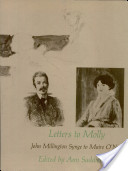
The more I progress with the novel, the more I want to know about Molly’s life and times. I found a lovely portrait, painted by John B Yeats on my internet trawl for more information. Molly made many films during her career, working up until the end of her life. She went on to marry twice (her first husband died and she was divorced from the second) and had two children. Apparently all of her letters to Synge were destroyed but an edition of his letters to Molly was published in 1971 by Harvard University Press (edited by Ann Saddlemyer). I think this is one volume I would like to add to my Landing Bookshelves letters collection. Perhaps a Christmas present to myself?

For more information take a look at Joseph O’Connor’s webpages: http://josephoconnorauthor.com/ and also an article he wrote for Prospect Magazine (from where the picture of Molly was taken): http://www.prospectmagazine.co.uk/magazine/the-playboy-and-his-muse/

Letters to Molly

Letters to Molly

All should have bonnets: a letter from Louisa M Alcott

After the dedication of my #LetterMo writing challenge efforts have faded gently away, I have decided to return to the compendium of historic letters that I mentioned in one of my earlier entries. Having struggled to post at least one item of correspondence every day for a month, I can truly say that I stand (pen poised) in awe of the sheer effort involved in letter writing pre-Microsoft Word technology. After all, even keeping up with just a few relatives in the last century would have been a Herculean task. But thank goodness that so many people did just that, providing a mine of information and insight that would otherwise have been lost to later generations.

One of the epistles in The World’s Great Letters is one from Louisa M Alcott to her sister Anna and while it could not be claimed to hold huge historical importance, it does give you a glimpse into the life of a would-be writer who was struggling to support her family. Alcott was also mired in domestic chores as well as suffering the frustration of waiting for editors to reply to her story submissions.

Alcott’s letter, written around 1861 describes the trials and tribulations of fashioning a decent bonnet (a social necessity) with only one dollar to spend; the contents of Alcott’s ribbon box supplemented the lack of cash. She makes the whole enterprise into an entertaining anecdote for Anna Alcott, but she clearly would have loved to be able to go out and buy a smart piece of headgear. She describes her attempts to trim the one-dollar bonnet thus:

I extracted the remains of the old white ribbon (used up, as I thought, two years ago), and the bits of black lace that have adorned a long line of departed hats. Of the lace I made a dish, on which I thriftily served up bows of ribbon, like meat on toast.  Inside put the lace bow, which adorns my form anywhere when needed. A white flower A.H. gave me sat airily on the brim, – fearfully unbecoming, but pretty in itself, and in keeping. Strings are yet to be evolved from chaos. I feel that they await me somewhere in the dim future.


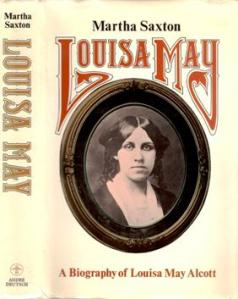
book cover with portrait of L.M. Alcott

Louisa May

All this occurred before Alcott struck gold with the phenomenally successful Little Women, which was published in 1867. At that time, she was still a ‘young woman with one dollar, no bonnet, half a gown and a discontented mind’ as she described herself. In one of those moments of literary serendipity, I spotted Louisa May (Martha Saxton, 1978) while rummaging in the Trinity Booksale on Saturday. I was meaning to re-read Little Women after seeing the sell out production last month at Dublin’s The Gate Theatre.  As Little Women and its sequels reside on the landing I can justify doing just that, but I will have to make (yet another) exception for reading the Louisa May Alcott biography. But, one of the joys of reading is that you never know what is going to be around the next corner of the bookshelf!

What have you discovered this week? And how is your Reading Challenge going? Drop a line in the comment box…

When Julian met Aphra: Behn vs Barnes

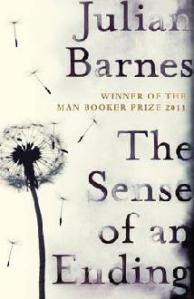
I have been reading Julian Barnes’ The Sense of an Ending recently after a customer in the bookshop where I work told me that I really must read it. As it has been quite some time since I last read any of Barnes’ work I decided to rectify this omission, in between bouts of pursuing both my letter writing and my Reading Challenge. I suppose it makes a good contrast to zip between Aphra Behn and Julian Barnes. Potentially confusing too, exchanging one cast list for another and jumping back and forth through the centuries.

Book cover with flower head on grey background

The Interloper…

Julian Barnes’ book has to take priority (temporarily) over the Landing Reading Challenge. Sadly, it is a library loan that is so much in demand that it is un-renewable. I could of course be a bad citizen and library user and take it back late but I always worry that I might be blacklisted and not allowed to have any more books out. The quick-witted amongst you might point out that this can only be a good thing, as I would have no excuse not to read my way around the entire house let alone the landing.

This thought does indeed make me wonder whether I should forswear the library and get truly stuck in to my TBR Pile. However, if I did that then would I also have to promise not to buy any new books? I could foresee that vow being very difficult to keep up due to working daily with new books. I also have a distressing weakness for bargain sections, charity shops and remainder outlets. All of this purchasing potential makes it highly likely that my landing bookshelves reading project could take rather a long time to complete.

 My train of thought has now brought me to an ethical problem (of sorts). In my meanderings around various sources of new books I will most likely come across books that should be housed on the landing after purchase i.e. classics, poetry etc. Now, this will of course mean that the original constituent parts of the landing bookshelves will most likely continue to grow over time. But do those books form part of my Reading Challenge despite not being present when the challenge began? Indeed I discovered a copy of Gwen Raverat’s Period Piece lurking in the wrong bookcase entirely (and it is a book I have not yet got around to reading) so I should re-house it on the landing. Because if I don’t, then I shouldn’t read it should I? No wonder my TBR Pile just keeps on growing.

Now, back to tackling Aphra Behn and seventeenth century English (but not until after I have finished Julian Barnes)…

UPDATE (June 2013)

I have come across a notification about the Aphra Behn Society’s Biennial Conference which will be held in October of this year. The topic will be Women, Reputation, and Identity in the Long Eighteenth Century and the conference will be held at The University of Tulsa, Tulsa, OK.


Aphra Behn: A Restoration Woman

Title page of Love Letters between a nobleman & his sister

Title Page

In the last Reading Challenge blog post, I talked about reading some letters from The World’s Great Letters but I am bound to report that in the event I became slightly sidetracked by something else. I was hunting around for examples of epistolary novels for a bookseller’s blog piece for Writing.ie and came across Aphra Behn’s Love Letters between a Nobleman and his Sister. This three-part roman à clef (originally published 1684-7) was based on a sexual and political scandal of the time. The author is believed to have been the first woman to earn her living by her pen.

I was given this edition several years ago, March 1996 to be precise, but I have never got around to reading it before now. At that time, I was working in a bookshop in Birmingham and one of our customers ordered the Penguin Classics edition of the book from us. He then began to read the book and then (apparently) decided that he did not have enough time remaining in which to tackle the book and so passed it to me ‘to read at your leisure….or not, if you don’t want to’. By my reckoning, that was all of fifteen years ago and I have only just finished the introduction. Janet Todd’s scholarly introduction explains the background to the novel and gives some information on Aphra Behn’s fascinating life and career. 

The details of much of Aphra Behn’s early life remain vague and any chronology available seems to be approximate as far as I can tell. It is almost certain that she was born in 1640 near Canterbury and that her parents were Bartholomew Johnson and Elizabeth Denham. She apparently married a merchant of Dutch extraction named Behn in 1664 but the marriage did not last long. Opinion has been divided on whether they divorced or Behn was widowed.

A year prior to the (probable) marriage Aphra Behn was probably in Surinam and then in 1667 she was to be found in Antwerp acting as a spy for Charles II’s government. The royal master was not good at paying his bills so Behn ended up in debtor’s prison for short while afterwards. If experience is needed to make a writer then Aphra Behn was hardly short of that valuable commodity.Cover of Love Letters between a Nobleman & his Sister

Behn’s first play, in 1670 was The Forced Marriage, which ran for six nights at Lincoln’s Inn Fields performed by the ‘Duke’s Company’. I was interested to discover that the payment system was such that the income from the third night belonged to the author, so in this case Behn received two nights worth of fees. I suppose it was tough luck if your play was booed off stage in a hail of rotten tomatoes on the second night.

I was enchanted with the information that Nell Gwyn, Charles II’s ‘Little Nell’ returned to the stage to play the part of a whore named Angelica Bianca in The Rover, which was probably Behn’s most successful play. Did the two women know each other well I wonder? They were both survivors in a tough male world so they may have had much in common. A plot for a novel perhaps?

I am honestly not sure if I will ever actually get through the novel, but I will make the attempt. If I achieve the first part at least, after all this time I will be pleased with myself. But I do also have a couple of library loans looking reproachfully at me…I will see how I get on.  

Meanwhile, at least I have begun to nibble away at the dreaded TBR Pile…more updates soon!

Historic Letters and #LetterMo

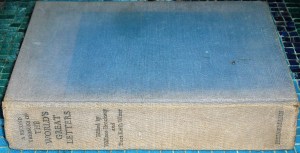
Cloth boundcover of The World's Great Letters

In my first Landing Reading Challenge post, I mentioned a collection of historic letters on the landing bookshelves. As February is the month of a brilliant letter writing challenge (Month of Letters set up by Mary Robinette Kowal), I decided to start my own particular reading challenge with a browse through the volume of historic letters. I cannot remember exactly when I bought this book but at a guess, I would estimate about fifteen years ago. The book was published in 1950 and at some point, an unknown hand had written the date 29/4/71 on the flyleaf. I am not sure that it really counts as being on a TBR Pile however, since it is the sort of book that you browse through rather than read cover to cover.

I must digress slightly at this point to admit that though I have signed up to the letter writing challenge I did sign up a few days late. In my defence though, I have actually been diligently writing and posting cards since 1st February but without any coherent plan in mind. I think I may continue to do it that way. I will decide in the morning to whom the day’s offering will be sent. In this case, the lucky recipient will be (almost) as much a surprise to me as it will be to them. So, two challenges in one for me this February.

A Month of Letters Partcipants' badge

Letter Writing Month Badge

In the meantime, back to The World’s Greatest Letters, which covers a fair slice of history beginning as it does with Cicero and ending with a letter written by an Air Raid Patrol (ARP) Warden in World War II. The nice thing about this collection of letters is that apart from a chronological list, it also has a classification of letters by subject. This means that you may go straight for the ‘Letters of Controversy, Hatred and Enmity’ should you so desire. If that seems to be too strong meat for your stomach, you might try ‘Letters in a Light Vein’ or ‘Letters about Nature’. Perhaps as 14th February is not too far off I should consult the more romantically inclined letter writers for Valentine’s Day inspiration.

I will let you know next time how I get on with reading the bygone love letters; it is time to write the next instalment of #LetterMo. I really must pop out and buy some more stamps. Juggling between a letter writing and a reading challenge will be a challenge in itself, but it is nice when they can overlap like this. I am going to enjoy both writing letters and reading some historical letters.

Twitter: @LetterMonth (#LetterMo)