Kipling

This week sees the last of our daughter’s primary school career so I am posting The Way Through the Woods by Rudyard Kipling (1865-1936by in honour. She recited this poem at a school poetry recitation competition and I can safely say that we all knew it by heart by the time the event came around. We have Kipling’s poem in Penguin’s Poems by Heart  (mentioned previously) which was a very apt title as it happened.

The Way Through the Woods

Woodland landscape

The Way Through the Woods

They shut the way through the woods
Seventy years ago.
Weather and rain have undone it again,
And now you would never know
There was once a road through the woods
Before they planted the trees.
It is underneath the coppice and heath
And the thin anenomes.
Only the keeper sees
That, where the ring-dove broods,
And the badgers roll at ease,
There was once a road through the woods.

Yet, if you enter the woods
Of a summer evening late,
When the night-air cools on the trout-ringed pools
Where the otter whistles his mate,
(They fear not men in the woods,
because they see so few.)
You will hear the beat of a horse’s feet,
And the swish of a skirt in the dew,
Steadily cantering through
The misty solitudes,
As though they perfectly knew
The old lost road through the woods…
But there is no road through the woods.

I may dig up even more nostalgic pieces for #PoetryinJune this week, so be warned…

Photo Credit: D.J.L. 2012

Elizabeth Jennings

I read The Young Ones (1964) by Elizabeth Jennings (1926-2001) again recently, and I thought that if I substituted ‘Luas’ or ‘Dart’ for ‘bus’ it easily be a scene in Dublin in 2013. Not that much has changed, it seems to me, except the hair styles of the young women. I often look at teenagers in Dundrum Shopping Centre and think that they look so much more self-assured than I did at their age. I can sympathise both with the satchel and the school coat; at one point I think I had a grey duffel coat which was hardly the height of teenage glamour. One of ‘The Young Ones’ I was not. Perhaps that’s true of most of us in each generation.

The Young Ones

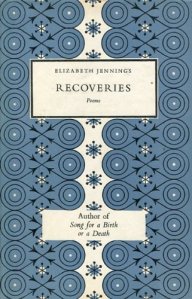
book jacket of Recoveries

A gorgeous edition of Recoveries

They slip on to the bus, hair piled up high.
New styles each month, it seems to me. I look,
Not wanting to be seen, casting my eye
Above the unread pages of a book.

They are fifteen or so. When I was thus,
I huddled in school coats, my satchel hung
Lop-sided on my shoulder. Without fuss
These enter adolescence; being young

Seems good to them, a state we cannot reach,
No talk of ‘awkward ages’ now. I see
How childish gazes staring out of each
Unfinished face prove me incredibly

Old -fashioned. Yet at least I have the chance
To size up several stages-young yet old,
 Doing the twist, mocking an ‘old time’ dance:
So many ways to be unsure or bold.

For Elizabeth Jennings poem, I have once more borrowed from The Oxford Book of English 20th Century Verse (with many thanks to the late Philip Larkin’s choices). However, as I have used the cover already and in any case it is rather a sombre jacket to depict the bright young things of the ‘Swinging Sixties’ I have snipped a picture of the edition that The Young Ones originally appeared in. The lovely looking cover of Recoveries (Deutsch, 1964) is tempting me to indulge in a purchase. I only know a handful of Elizabeth Jennings’ poems so this would be a nice addition to my TBR Pile.

Now I just need an excuse to treat myself….any suggestions will be gratefully received… 

Samarra or Isfahan?

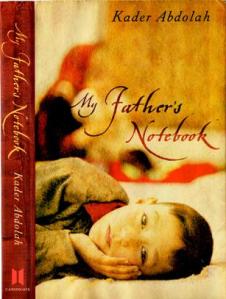
I found this poem by Dutch poet PN Van Eyck (1887-1954) in a novel by Kader Abdolah called My Father’s Notebook (Canongate Books, 2006). I bought it in 2008 when I was working in Dún Laoghaire; you will be impressed to know that it didn’t stay on the TBR Pile for very long. It tells the story of Ishmael in exile in Europe who is trying to piece his father’s story together from notebooks written in a strange code. Poetry is a very important part of Abdolah’s book, but the following poem in particular caught my eye and I copied it into a notebook in case I ever lost track of the novel.

Van Eyck’s poem closely resembles a story that I remembered from many years ago that I never got around to tracking down. It has many variations and I think the version that I must have heard was the retelling of what is actually a very ancient story, by Somerset Maugham (1933) called Appointment in Samarra. The story that Maugham re-wrote and that Van Eyck turned into a poem is possibly a thousand years old. I’ve been delving into the history a little and it seems as though I wasn’t the only person to have this ghost of a story about Death and Samarra floating around in my head all this time.

Death and the Gardener (translated from Dutch by David McKay)book jacket to My Father's Notebook by Kader Abdolah
A Persian Nobleman:
One morning, pale with fright, my gardener
Rushed in and cried, “I beg your pardon, Sir!

“Just now, down there where the roses bloom, I swear
I turned around and saw Death standing there.

“Though not another moment did I linger,
Before I fled he raised a threatening finger.

“Oh, Sir lend me your horse, and if I can,
By nightfall I shall ride to Isfahan!”

Later that day, long after he had gone,
I found death by the cedars on the lawn.

Breaking his silence in the fading light,
I asked, “Why give my gardener such a fright?”

Death smiled at me and said, “I meant no harm
This morning when I caused him such alarm.

“Imagine my surprise to see the man
I’m meant to meet tonight in Isfahan!”

You never know when and where you are going to find literary connections; with Van Eyck, I discovered a connection to one of my previous #PoetryinJune authors, WB Yeats. Apparently Van Eyck was very interested in the Irish Question and Irish Literature. He subscribed to the Cuala Press and corresponded with Lily Yeats and WB and Georgie Yeats during the 1920s and 30s. It’s an amazingly small literary world; either that or serendipity has been at work again.

That’s all for now on #PoetryinJune…but there’s plenty here to return to discuss another time. I spotted another of Kader Abdolah’s books in the library recently so I am sure he will feature as an extra to my Landing Reading Challenge at some point.

Meanwhile, if anyone else remembers Appointment in Samarra (or Isfahan) from childhood, I would love to hear about it, so drop me a line below.

NB – the ‘history’ link above seems to work better in Firefox than IE (haven’t tried Chrome but let me know)

Edith Nesbit

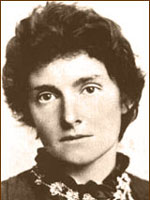
Edith Nesbit’s (1858-1924) stories were a big part of my childhood; I loved The Phoenix and the Carpet and the fantasy of being able to fly away to strange lands with a magical creature. The adventures of the Bastable family came a close second. I didn’t realise that Edith Nesbit wrote verse until I did a little digging around after reading Man of Parts (David Lodge) which tells of H.G.Well’s relationship with Edith Nesbit and her involvement with the Fabian Society.

I found a couple of Nesbit’s poems in The Oxford Book of Twentieth Century Verse, which I have used in an earlier post. I chose to post an extract of the following verse because it struck a chord with me. We spend a lifetime accumulating knowledge and skills which we hope to pass on to the next generation, but as the woman in Nesbit’s poem says, not everything can be written down and saved. I love the plea in the last line; I think I’d like to know something too.

The Things that Matter

Portrait of Edith Nesbit

Edith Nesbit

Now that I’ve nearly done my days,
 And grown too stiff to sweep or sew,
I sit and think, till I’m amaze,
About what lots of things I know:
 Things as I’ve found out one by one-
And when I’m fast down in the clay,
My knowing things and how they’re done
Will all be lost and thrown away.

There’s things, I know, as won’t be lost,
Things as folks write and talk about:
The way to keep your roots from frost,
And how to get your ink spots out.
What medicine’s good for sores and sprains,
What way to salt your butter down,
What charms will cure your different pains,
And what will bright your faded gown.

But more important things than these,
They can’t be written in a book:
How fast to boil your greens and peas,
And how good bacon ought to look;
The feel of real good wearing stuff,
The kind of apple as will keep,
The look of bread that’s rose enough,
And how to get a child asleep.

Forgetting seems such silly waste!
I know so many little things,
And now the Angels will make haste
To dust it all away with wings!
O God, you made me like to know,
You kept the things straight in my head,
Please God, if you can make it so,
Let me know something when I’m dead.

Poem originally published in the Rainbow and the Rose (Longman, 1905)

I discovered the Edith Nesbit Society, devoted to discussing and promoting Edith Nesbit’s life and work while trawling the internet. It has occurred  to me that it would be useful to compile a directory of all of the literary societies that I come across in the course of my blogging. I think it would fit in alongside the Bibliography pages. It’s probably a long-term project, but these last few #PoetryinJune posts have made me realise just how many literary societies are active, so I would like to support them in a small way.

That’s all for today’s #PoetryinJune – check out the link above for more information on Edith Nesbit.

Picture Credit: Wikipedia – with thanks

JRR Tolkien

My #PoetryinJune spot has been taken over by dwarves today who have been busily tidying Bilbo Baggins’ kitchen, much to the poor Hobbit’s consternation. Fortunately nothing was broken despite the sound of the following verses. This is J.R.R. Tolkien’s (1892-1973) second appearance on The Landing as I featured the beautiful Father Christmas Letters in my Advent Reading Challenge last December.

I’ve taken the following text from my old copy of The Hobbit (Harper Collins, 1993) which my daughter has been recently re-reading. Last summer holidays, she tackled the entire Lord of the Rings trilogy with He Who Put the Shelves and Up, but I have to admit that I have never got around to reading it myself. Another one on the groaning TBR Pile I’m afraid.

Chip the Glasses and Crack the Plates

Book jacket of The Hobbit

Smaug in his gold filled lair

Chip the glasses and crack the plates!
Blunt the knives and bend the forks!
That’s what Bilbo Baggins hates –
Smash the bottles and burn the corks.

Cut the cloth and tread on the fat!
Pour the milk on the pantry floor!
Leave the bones on the bedroom mat!
Splash the wine on every door!

Dump the crocks in a boiling bowl;
Pound them with a thumping pole;
And when you’ve finished, if any are whole,
Send them down the hall to roll.

That’s what Bilbo Baggins hates!
So, carefully! carefully with the plates!

I was delighted to come across a recording on YouTube of J.R.R. Tolkien himself singing about Bilbo Baggins’ crockery. It’s only a short recording (I don’t know the date of the piece) but do give it a listen. Versions of Tolkien’s poem have been set to music in the film versions of The Hobbit, including the most recent one.

Perhaps I should set myself a Tolkien Reading Challenge? Or maybe I’ll just incorporate The Lord of the Rings into my existing Landing Book Shelves Reading Challenge as I have quite a queue of books yet to read!

YouTube Credit: Uploaded to YouTube February 2013 by MightyCrow19 – With Thanks

Jenny Joseph

This morning, on my #PoetryinJune Reading Challenge, you have the delight of listening to Jenny Joseph (b 1932) reading her poem Warning in a clip that I discovered on YouTube. I’ve given the text below as well in case the piece is unfamiliar to you. This poem was published in 1961 and I came across it in the late 1990s when I was working in a Birmingham bookshop (as it happens Jenny Joseph was born in Birmingham).

In 1997, Warning was published as a stand alone piece with illustrations by Pythia Ashton-Jewell (Souvenir Press) and I remember selling many copies at the time. It was a fantastic idea to publish the poem as a gift book (see picture of front cover) and Ashton’s drawings are a brilliant complement to the text. The giving of the poem as a gift (along with a red hat) by one particular woman gave rise to the establishment of the Red Hat Society (1998) in the USA.

Sue Ellen Cooper gave a copy of the poem with a red hat on friend’s 55th birthday in 1996, and the rest, as they say is history. The society now has many chapters in the US and world-wide. I would love to know whether Jenny Joseph is an honorary member of the RHS. Not many people can claim to have written a poem that has resulted in a global women’s movement. It is appropriate to have picked Warning for my #Poetryinjune feature as the Red Hat Society’s World Wide Hoot 2013 was held on 15 June. If had realised sooner I would have posted Warning up on the day, but belated best wishes to all of the Red Hatters out there.

And here is the poem that started it all:

Warning

When I am an old woman I shall wear purple
With a red hat which doesn’t go, and doesn’t suit me,
And I shall spend my pension on brandy and summer gloves

Jacket of Warning by Jenny Joseph

Souvenir Press, 1997

And satin sandals, and say we’ve no money for butter.
I shall sit down on the pavement when I’m tired
And gobble up samples in shops and press alarm bell
And run my stick along the public railings
And make up for the sobriety of my youth.
I shall go out in my slippers in the rain
And pick the flowers in other people’s gardens
And learn to spit.

You can wear terrible shirts and grow more fat
And eat three pounds of sausages at a go
Or only bread and pickle for a week
And hoard pens and pencils and beermats and things in boxes.

But now we must have clothes that keep us dry
And pay our rent and not swear in the street
And set a good example for the children.
We will have friends to dinner and read the papers.

But maybe I ought to practise a little now?
So people who know me are not too shocked and surprised
When suddenly I am old and start to wear purple.

I hope that has given you a mid-week smile. More #PoetryinJune tomorrow! Are any Red Hatters out there? If so, give me a shout…

Credits:  details shown at end of video (recorded 2008) – with thanks.

Wilfred Owen

My choice of Wilfred Owen (1893-1918) today is another nod to the GCE ‘O’ Level syllabus of x number of years ago when I was at school in Birmingham and would have been knee-deep in exams at this time of year. If I tell you that I took mine in the year that Virginia Wade won the Women’s Singles title at Wimbledon….well I will leave you to work it out.

As I don’t have the original copy of the poetry book from school (we didn’t have to buy our own text books) then the next best thing is the Oxford Book of Twentieth Century English Verse (edited by Philip Larkin, 1973, 1985). This is stamped as once belonging to a college in Coventry but I promise that I came by it honestly, via a second-hand book shop.

Anthem for Doomed Youth

What passing-bells for those who die as cattle?

Jacket of OUP 20th Century Verse

Horror of War

Only the monstrous anger of the guns.
Only the stuttering rifles’ rapid rattle
 Can patter out their hasty orisons.
No mockeries now for them; no prayers nor bells,
Nor any voice of mourning save the choirs,-
The shrill, demented choirs of wailing shells;
And bugles calling for them from sad shires.

What candles may be held to speed them all?
Not in the hands of boys, but in their eyes
Shall shine the holy glimmers of good-byes.
 The pallor of girls’ brows shall be their pall;
Their flowers the tenderness of patient minds,
And each slow dusk a drawing-down of blinds.

I haven’t read Wilfred Owen for a while, though he was my favourite from the syllabus. The problem with studying anything for an exam is that you hack it to pieces until sick of it. I have found that for me, Owen’s poetry  has survived the school experience and that after a certain grace period, I could read it again. I also still read Owen because of my interest in reading about the First World War – in literary fiction, poetry, biography and history. He was the first World War I poet that I read and I could probably trace my interest in WWI all the way back to that stuffy classroom and Wilfred Owen. Perhaps I should do a First World War post in the near future?

That’s all for today’s edition of the poetry reading challenge, but drop me a line with your school literary loves (or hates)….

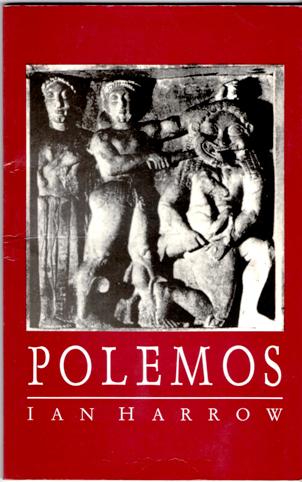
Ian Harrow

Gaugin to himself

Jacket of Polemos

Eperon Press, 1998

      (1897)

The girl sits on a stone to watch
Salt water brush her sturdy feet,
Cleansing thighs of dust from the road.
Her lips, with faint sea-fruit bouquet
Show, mocking and inflamed, the risk
Was yours. Swift as a day that life
When she asked you to let her go
And you felt the relief of one
Almost sacredly cast down…Here
Suddenly, your longing to be
Disappointed! What else schedules
Of days for, wandering unfree?
Mark with your secreta the sites
Of ghosts; take your place, a cornered
Wolf in a wreck of squealing cats.
More thrown back than resurrected.

My rationale for choosing today’s poem is that as I was typing up the post about Alan Murphy’s verse on Marc Chagall my thoughts strayed to my days studying art history at the University of Central Lancashire. Ian Harrow was one of my lecturers when I started the course in September 1998. It seems a frighteningly long time ago now. I remember choosing Chagall as an essay topic in one of the modules that Ian taught but I have so far stopped short of digging the paper out of my archive. Probably best to let sleeping essays lie.

I’ve had this collection for a while, though I bought it after I had graduated. I’ve chosen the poem on Gaugin, partly to continue the art related theme generally and partly because of the specific topic.

A few years ago He Who Put the Shelves Up bought me a study of Gaugin’s work in Tahiti, Gaugin’s Skirt by Stephen F Eisenman (Thames and Hudson, 1997).  Eisenman’s fascinating book looks at Gaugin’s relationship with Tahiti, depiction of women, colonialism and contemporary Tahitians. Having being prompted by my poetry musing to pick it up again I might add it to my ever growing summer holiday list.

Ian Harrow has  a new collection published this year called Words Take Me (Lapwing Press). I’ve read a couple of poems from this collection on Poetry PF so take a look at the link.

Apologies for the late posting today – I was busy doing a bit of blog maintenance behind the scenes. Now to get working on tomorrow’s choice….

James Joyce

Happy Bloomsday!

As promised my choice of James Joyce’s verse today will mark today’s event (though Bloomsday seems to have begun to stretch out over a few days as though it refuses to be confined by a mere twenty-four hours). I probably won’t actually be doing anything Bloomsday-ish though, as I will be at the Dalkey Book Festival for a couple of the Kids’ events. I just hope the weather is kind to us. But back to James Joyce…

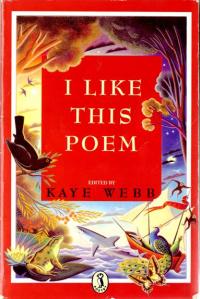
For this poem I am returning to one of the anthologies I have used before, selected by Kaye Webb from children’s suggestions of their favourite poems.

Chamber Music

book cover of I like this Poem by Kaye Webb

Another #Poetryinjune choice


Lean out of the window,
Golden hair,
I hear you singing
A merry air.

My book is closed;
I read no more,
Watching the fire dance
On the floor.

I have left my books:
I have left my room:
For I heard you singing
Through the gloom.

Singing and singing
A merry air.
Lean out of the window,
Golden hair.

I was surprised to see that this poem was from James Joyce; it doesn’t strike me as the sort of piece he would write. It has such a gentle, tender story book quality. But then I have to confess to not being a very experienced Joycean so perhaps my impression is wide of the mark. The poem was originally the title poem of a collection of love poems published in 1907 by Elkin Matthews.

Joyce later said to his wife, ‘ When I wrote [Chamber Music], I was a lonely boy, walking about by myself at night and thinking that one day a girl would love me.’  There is also a more earthy tale about a connection with chamber pots which may or may not have any basis in fact. Appropriately enough, considering the date today,  In Ulysses, Leopold Bloom reflects, ‘Chamber music. Could make a pun on that.’

The young reader who put forward this choice in the anthology said it was, ‘because it reminds me of the best fairy tales, such as Rapunzel singing from a turret window at dusk…It is reassuringly old-fashioned and chivalrous…quietly inspiring and my favourite poem’. (Charlotte Woodward in I like this poem). One of the aspects I love about this collection is reading the comments made by the children (I wonder where they all are now – do they still read poetry?) showing their engagement and enthusiasm with the written word.

I’ll leave you to enjoy the rest of your weekend, wherever you are. Regards to all James Joyce aficionados celebrating Bloomsday.

Alan Murphy on Marc Chagall

Catalogue for Marc Chagall exhibition

Spotlight on Chagall

The back story of today’s #PoetryinJune choice of Alan Murphy is that yesterday I heard from a friend about a major exhibition of Marc Chagall’s (1887-1985) work that has just moved to Tate Liverpool. The timing couldn’t be better as I usually go over to the UK on a summer visit. I realised with a vague sense of shock that it was as long ago as 1998 that I went to London to see ‘Chagall, Love and the Stage’ at the Royal Academy. It was a stunning experience so I am keen on fitting in a trip to Liverpool with our summer travel plans.

This then leads me to Alan Murphy, whom we first saw at one of the Mountains to Sea Festival events at the County Hall a couple of years ago. I bought his collection The Mona Lisa’s on our Fridge (2009) which the author kindly signed for my daughter. Apart from the title poem, the book also contains two other art related poems; one on Picasso and one on Chagall. I will just quote the first and last verses to give you an idea.

According to Marc Chagallbook cover of The Mona Lisa's on our Fridge

How does it rain if the rain runs upwards?
 -in the mind of Marc Chagall.
How can a bun turn into the sun?
 -by the power of Marc Chagall.
And when does a town recline on a cloud?
 -when its world is Marc Chagall’s.

So doff your hat but hold on to your head;
Just lose your logical limits instead,
And gamely greet green, orange and red
 -the music of Marc Chagall.

My 1998 exhibition guide says of Chagall’s Russian – Jewish background that ‘An intense belief in the supernatural and miracles was part of everyday life’ and this is expressed in his paintings. Alan Murphy’s poem beautifully translates Marc Chagall’s scenes into words and puts over the sheer delight and exuberance of the paintings where ‘gravity wanes and withers’ (2nd verse). If you had never seen a Chagall painting, this poem would be a great introduction as it conjures up the surreal world that you find in his art. Alan Murphy is an artist as well as a writer and I think that his engagement with art comes across in this poem in a way that children can appreciate. Adults (well me anyway) can enjoy the fun with art too; there’s a also great poem entitled Pablo Picasso in this collection which is fitting as he and Chagall were artistic rivals.

Alan Murphy is based in Co Waterford and has published a second volume of poetry for children Psychosilly in 2011.

I hope you’re having a good weekend so far. After today’s piece on Chagall, drop by tomorrow for a poem to commemorate Bloomsday.

Update August 2013:

I did actually get to see the Tate Liverpool exhibition this month and bought the catalogue which I have featured in a blog post on Chagall.