Belloc’s Beasts: Cautionary Verse

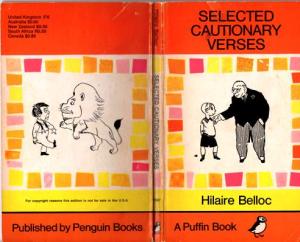
orange and yellow book jacket and poem characters

A couple of likely lads…

I know that this will be two children’s poems in a row, but I suppose that the excitement of having some sustained sunshine has addled my brain a little. In fact I’m beginning to suspect that this #PoetryinJune challenge may end up featuring rather a lot of light-hearted or comic verse. As summer is finally on the horizon, there may be just cause to steer clear of sad or tragic poetry (though that doesn’t mean I will eschew sadness completely).

Having decided on comic verse, you can’t do much better than to choose one of Hilaire Belloc’s wonderful Cautionary Verses. The problem then, was which Cautionary Verse to choose for my featured poem. After much deliberation I decided on the following. This was solely on the basis that suffering from a sore throat as I was, I rather liked the thought of it being as the result of purple and pink microbes.

The edition I have here is a selected edition (mine is a 1968 reprint) taken from the illustrated album edition published in 1940 by Gerald Duckworth & Co. I dare not even consider how much you would pay for a first edition (381 illustrations and cloth gilt cover) these days. The illustrations of Belloc’s verses are by Nicholas Bentley and B.TB. (Basil Temple Blackwood).
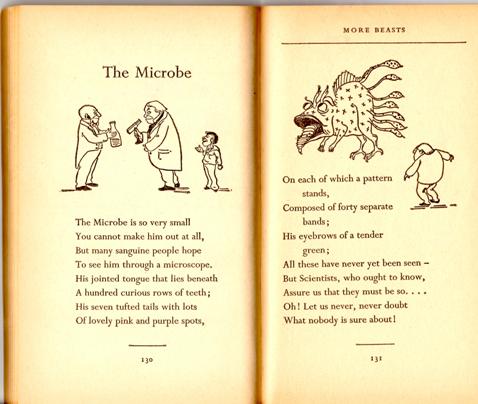
text and illustration of poem The Microbe

A jolly purple microbe…

The above poem comes from More Beasts for Worse Children which was first published in 1910 as a separate book and later included, along with Cautionary Tales for Children (1907) in the album I mentioned. The drawings for ‘The Microbe’ are from B.T.B.

Now, I will see if I can become a little more serious for tomorrow….  
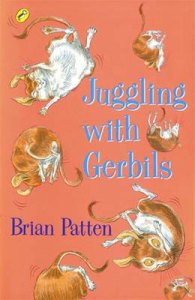
Gerbil Juggling with Brian Patten

This is a really silly verse to celebrate the June Bank Holiday (well, it’s a holiday if you happen to be in Ireland anyway). Juggling with Gerbils is the title poem of a Brian Patten collection published by Puffin Books in 2000. Illustrations (and not only of gerbils) are by Chris Riddell. Even though I have been a gerbil owner myself I still find this poem funny. And before you ask, I have never tried it myself. Honest. Patten’s collection found its way onto The Landing a few years ago via a library sale in Dundrum, Dublin and has been read many times over. I somehow doubt if we’ll ever grow too old for gerbil juggling!

Juggling with Gerbils

book jacket with seven gerbils

Do not try this at home…


Don’t juggle with a gerbil
No matter what the thrill
For gerbils when they’re juggled
Can end up feeling ill.
It makes them all bad tempered
And then they’d like to kill
Those gerbil-juggling jugglers
Juggling gerbils till they’re ill.

(Do not try this at home)

Brian Patten  was born in Liverpool in 1946 and formed the Liverpool Poets with Roger McGough and Adrian Henri in the 1960s, bringing out The Mersey Sound in 1967. His first solo collection was also published in that year, Little Johnny’s Confessions and has written extensively both for adults and children since then.

For more information here is a link to Brian Patten’s website. Now where’s that gerbil gone…

Wendy Cope

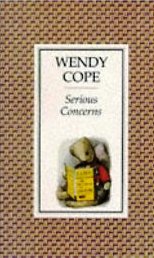
New Season by Wendy Cope (born 1945) is taken from Serious Concerns (Faber 1992) which was her second collection of verse, the first being Making Cocoa for Kingsley Amis (Faber 1986). I was given Serious Concerns by a customer when I worked in Birmingham in the late 90s and I went on to buy the first collection on the strength of reading it. Attentive readers will recall that I included one of Wendy Cope’s seasonal verses as an Advent post last year. If I was to try to sum up Cope’s work, I couldn’t do better than Dr Rowan Williams who said “Wendy Cope is without doubt the wittiest of contemporary English poets, and says a lot of extremely serious things”.

It was very difficult to make a selection from Serious Concerns, but finally I plumped for this one because it serves to remind me of life’s endless possibilities. It is something that we all probably need reminding of from time to time; I know I do. It is slightly late in the season to use this one, as the chestnuts are already in leaf, but I hope you will overlook that minor technicality.

New Season

book jacket with teddy bear

I also love the jacket..

No coats today. Buds bulge on chestnut trees,
and on the doorstep of a big, old house
a young man stands and plays his flute.

I watch the silver notes fly up
and circle in blue sky above the traffic,
travelling where they will.

And suddenly this paving-stone
midway between my front door and the bus stop
is a starting-point.

From here I can go anywhere I choose.

Of course I also just wanted an excuse to feature the Posy Simmonds drawing of the very studious bear on the front cover. I think that you will find almost as many illustrators as poets mentioned on The Landing this month. But then that can’t be a bad thing, can it?

If you liked this poem here is more information on her work from the Poetry Archive web site.

Rose Fyleman

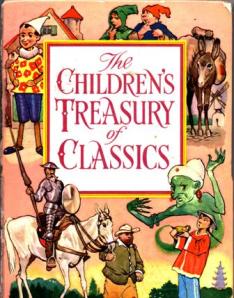
book cover with Aladdin, Pinoccio, Don Quixote

A childhood favourite

For the first of my ‘Poetry in June’ features I delved into the past –  to the Children’s Treasury of Classics that I mentioned in the last post . I have had the book (published by The Children’s Press) since I was a child, though I don’t remember if it was new when I had it. It is undated, though there is a pencilled price of 7/6 on the inside cover. The Treasury is now rather battered and the pages are yellowed.

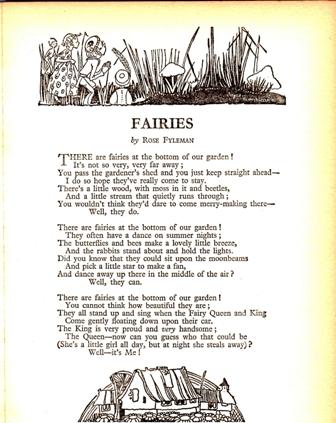
I have picked out a poem by Rose Fyleman (1877-1957) which was originally published in Punch magazine in May 1917. Fyleman published many stories and verses for children over a very productive life. Her poems still appear in children’s collections today.

There is a nice continuity for me as this poem also happens to be one of our daughter’s favourite poems. And anyway, fairies in the garden seems to me to be a nice way to begin June. I have scanned in the page since I think the illustrations (by Joyce Plumstead 1907-1986) add to the piece, so I hope the text will be legible across different platforms and browsers. Drop a comment in the box if it doesn’t work for you.


text of Rose Fylman's poem Fairies

An old favourite…

I hope you enjoy the first day’s PoetryinJune choice. See you tomorrow!

Flaming June is Poetry Month #PoetryinJune

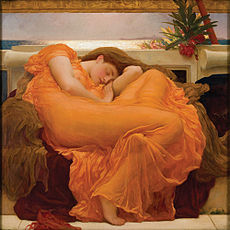
Woman in orange dress asleep on couch

Flaming June, Frederick Leighton, 1895

If you all cast your minds back to last December, you will recall that I set myself the daunting challenge of writing a seasonal posting every day during Advent. Somewhat to my surprise, I did indeed manage to do just that very thing. Ever since then I have in mind to attempt a similar challenge later in the year. Well, dear reader(s) that time has now arrived with the advent of spring (or what passes for spring in these parts at any rate).

To a great fanfare (well you’ll just have to imagine that bit) I am hereby announcing that the month of June will be Poetry Month (#PoetryinJune) on The Landing. I have been scouring the shelves here and blowing the dust off a few volumes that I have not looked at in a while. My intention is to put together a mixture of old and new(ish) poems, which will include a few childhood favourites too. My grand plan is to work out a complete list ready for June 1st but I may end up flying by the seat of my pants part of the way through the month.

I belatedly caught up with the poetry readings at the National Gallery of Ireland, which are run in association with Poetry Ireland. This has also helped to spur me into action and to include a sizeable chunk of poetry on the blog. Yesterday I was listening to Peter Sirr reading from both his own poems and his translations. One of the translations he read was Maison á Vendre (House for Sale) by André Frénaud both versions of which you can find on Sirr’s blog The Cat Flap.

I will have to apologise in advance if my choices for next month are not your choices but I will try to put together a reasonable mixture culled from our shelves. In fact, I have to come clean and admit that I never manage to read as much poetry as I would like. I am much more likely to pick up a novel or short story collection if I’m browsing and in need of something to read. Last year was supposed to be my year of reading more poetry so I picked up a couple of Faber volumes in a book sale to try and broaden my range but they are still languishing on the shelf.

Next month may then prove to be a voyage of discovery for me as there are clearly poetry books on our shelves that I have barely even opened. However, I will certainly feature a few poems from my childhood that have been read many times over and that are still enjoyed. This will, I hope even the balance a little and perhaps remind me of a time when I was more poetry minded than I am now. I used to have a Puffin collection of children’s poems and a Children’s Treasury containing stories and poetry. The latter still survives so I will choose a favourite memory from its rather battered pages for one of my blog entries.

At last Wednesday’s Poetry Ireland reading by Michael Krüger I jotted down his assertion that ‘a day without reading a poem is a lost day’. Let’s see what I can do about that during the course of next month.

Let me know about your favourites if you have time to drop me a line (use #Poetryinjune on Twitter).

(Picture Credit: Wikipedia – original painting in the Ponce Museum of Art, Puerto Rico)

Landing Advent Calendar Day Twenty Two

22nd December

‘Twas the Night Before Christmas (or: Account of a visit from St Nicholas) illustrated by Matt Tavares (Published by Walker Books, 2010).

'Twas the Night Before Christmas

‘Twas the Night…

This well-known poem first appeared on 23rd December 1823, published anonymously in an American magazine, the Troy Sentinel as ‘Account of a visit from St Nicholas’. Several years later in 1844, authorship of the poem was claimed by Clement C Moore. Opinion continues to be divided on who really wrote the verses.

In the introduction to this edition, Matt Tavares points out that editors have often made changes to the spelling and punctuation of the original text, even changing the names of the reindeer. For this edition, Tavares has returned to the original version. I have quoted two snatches of the verse here to whet your appetite:

‘Twas the night before Christmas,
When all thro’ the house,
Not a creature was stirring,
Not even a mouse;
The stocking were hung
By the chimney with care,
In hopes that St. Nicholas
Soon would be there;

The magical figure of St Nicholas fills the stockings and disappears into the night, in his sleigh pulled by Dasher, Dancer, Vixen, Comet, Cupid, Dunder and Blixen, “Now dash away! dash away! dash away all!”

He sprung to his sleigh, to his team gave a whistle,
And way they all flew, like the down of a thistle:
But I heard him exclaim,
Ere he drove out of sight –
Happy Christmas to all,
And to all a good night.

We will be reading this poem again at Christmas (I may even get a little further in trying to learn it off by heart) and appreciating the lovely illustrations in this edition.

I will also be searching out the Christmas stockings ready for our seasonal visitor. Not long to wait now…

Advent Reading Challenge: Nativity Play

21st December

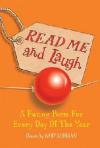
Read Me and Laugh

Funny poems galore


‘Just Doing my Job’ a poem by Clare Bevan (taken from Read me and Laugh, edited by Gaby Morgan, mentioned in a previous post). This poem was originally published in We Three Kings (ed. Brian Moses, Macmillan, 1998).

I love this poem, conjuring up as it does long forgotten memories of participating in the school Nativity Play. Not that I ever had a starring role, I hasten to add, my only ever role being as the inn keeper’s wife which only had one short line. Hardly a distinguished theatrical career.

The poem features several small boys in the role of ‘Herod’s Henchmen’, which no doubt required lots of parental assistance in the form of cardboard and tinfoil accessories. All of that charging around the school hall sounds great fun (not that fun was exactly the point of it all I suppose). But it probably burnt off excess end of term excitement in the process.

I have extracted three verses to give you a flavour of the activity:

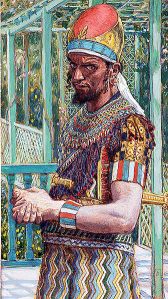
King Herod

King Herod by James Tissot


1, I’m one of Herod’s Henchmen.
    We don’t have much to say,
   We charge through the audience
    In a Henchman sort of way.

3, Our swords are made of cardboard
    So blood will not be spilled
    If we trip and stab a parent
    When the hall’s completely filled.

6, Yet when the play is over
    And Miss is out of breath
    We’ll charge like Henchmen through the hall
    And scare our Mums to death.

Of course, the sting behind the title of the poem is that a whole multitude of sins may be glossed over by employing the excuse of ‘just doing my job’. A lesson for children to learn while they enjoy reading the poem.

The striking painting of Herod the Great dates from 1886-1894 and is in the Brooklyn Museum (image courtesy of Wikipedia).

Advent Reading Challenge: Three Kings

16th December

Three Kings Came Riding by Henry Wadsworth Longfellow (1807-1882) another poem taken from The Book of Christmas

This is a long poem of fourteen verses telling the story of the journey of the Three Kings (Wise Men or Magi) to find the new saviour. I have known the poem since my own childhood and well remember the sense of romance about these mysterious figures making such a long journey. I also recall being absolutely baffled as to what frankincense and myrrh actually were.

I have just picked three verses to give a potted version of the story. The men set out following the star:

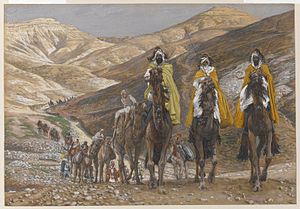
The Magi Journeying

The Magi Journeying (Les Rois Mages en Voyages)

1) Three Kings came riding from far away,

Melchior and Gaspar and Baltasar;

Three Wise Men out of the East were they,

And they travelled by night and they slept by day,

For their guide was a beautiful, wonderful star.

Along the way the travellers talk to people they meet of the child, and so Herod the Great hears.

He asks the Wise Men to bring him news from Bethlehem:

8) So they rode away; and the star stood still,

The only one in the grey of the morn;

Yes, it stopped it stood still of its own free will,

Right over Bethlehem on the hill,

The city of David where Christ was born.

The Three Kings found their way to the baby’s birth place and gave their gifts:

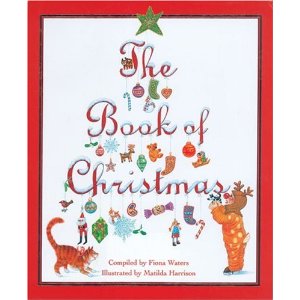
The Book of Christmas

The Book of Christmas

12) They laid their offerings at his feet;

The gold was their tribute to a King,

The frankincense, with its odour sweet,

Was for the Priest, the Paraclete,

The myrrh for the body’s burying.

After worshiping the new child, the Three Kings rode away and headed back to their homes in the East. They were wise enough not to return to King Herod, but travelled home a different way.

The painting here is by James Tissot which is in the Brooklyn Museum (image taken from Wikipedia).

Advent Reading Challenge: Baubles

15th December

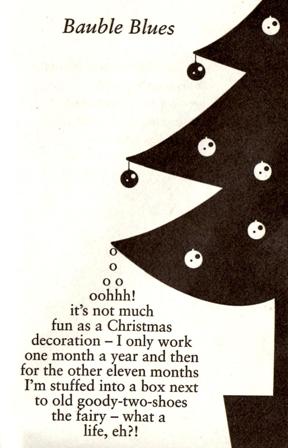
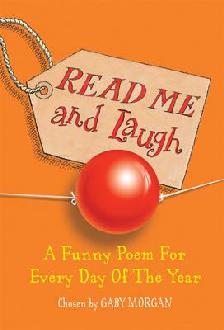
Bauble Blues by James Carter (taken from Read me and Laugh: A Funy Poem For Every Day Of The Year, chosen by Gaby Morgan),  Macmillan, 2005. This poem was originally published in Cars, Stars and Electric Guitars by James Carter, 2002.

This is another great collection of verse for children, and though you do not of course have to read the poems on their appointed day, the structure does encourage incorporating poetry into daily life. The verses vary in length and are from poets old and new covering a range of topics. I had a trawl through December and found this one and another which will appear on the blog next week.

As this is a concrete poem I have reproduced it in its entirety alongside the typed version:

oohhh! it’s not much fun as a Christmas decoration –

Bauble Blues concrete poem

Concrete thoughts…


I only work one month a year and then for the other

eleven months I’m stuffed into a box next to old goody-

two-shoes the fairy – what a life, eh?!

I had never thought of Christmas decorations having sad lives before reading this short poem, now I wonder whether I should simply keep them up all year round. It is also probably just as well that we have a star and not a fairy for the top of our tree.

Read Me and Laugh

Funny poems galore


Advent Reading Challenge: Partridges and Pears

13th December

Twelve Days of Christmas (Correspondence) by John Julius Norwich (illustrated by Quentin Blake) Atlantic Books 2010. First published by Doubleday in 1998.

These are not quite the Twelve days of Christmas that you might recall from long ago. We have here an old rhyme with a new twist from John Julius Norwich, which has been brilliantly interpreted by Quentin Blake’s drawings. There is indeed a partridge, pear tree, hens, geese, swans and so on but these days a girl (Emily) is not so impressed by such gifts from her swain (Edward). Emily’s mother and the neighbours are generally not too keen either (noise and mess being a prime consideration).

Here are a couple of extracts from Emily’s letters, written in response to an increasingly strange tally of Christmas gifts. It all begins promisingly enough:

25th December

My dearest darling – That partridge, in that

Twelve Days of Christmas

Another twelve days…


lovely little pear tree! What an enchanting,

romantic, poetic present! Bless you and thank you.

Your deeply loving Emily

But Emily’s mood gradually change as more and more birds appear

(the five gold rings offering only a brief hiatus from the feathery flow):

30th December

Dear Edward – Whatever  I expected to find

when I opened the front door this morning,

it certainly wasn’t six socking great geese laying

eggs all over the doorstep. Frankly, I rather hoped

you had stopped sending me birds – we have no

room for them and they have already ruined

the croquet lawn. I know you meant well, but –

Let’s call a halt, shall we?

Love, Emily              

As usual, I shall not a breathe a word about the ending. I shall merely suggest that Edward’s example in the are of gift purchasing is not one to be followed with impunity.