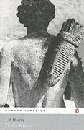
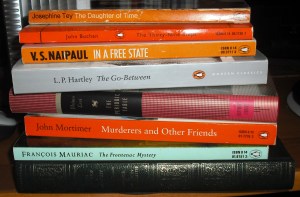
Arabella Stuart and Bess of Hardwick

I mentioned in the last post immersing myself in some dubious sixteenth century doings. Wreath for Arabella by Doris Leslie (Hutchinson 1948) was the book that started me off on my tour of historical skulduggery. This is one of the spoils from a previous Trinity Book Sale. I feel sure that I must have read Leslie’s books before, but perhaps it’s just that I remember my mum having them from the library (along with Miss Reed and Mazo de la Roche). Doris Leslie (1891-1982) was a British novelist and historical biographer who originally wanted to be an artist, then studied drama and finally discovered a talent for writing, publishing her first book in 1927. I didn’t know anything about her before lighting on a biographical note by the Southborough Society who have put up a blue plaque in Leslie’s honour. She does not seem to be particularly well known today. Although she was writing contemporaneously with Georgette Heyer whose books are still widely available, her books have since slipped through the publishing cracks.

Wreath for Arabella is a lively, well-written fictionalised account of the life of the ill-fated Arabella (Arbella) Stuart (1575-1615), a cousin of Queen Elizabeth I (1533-1603). Both women descended from Henry VII: Elizabeth was his granddaughter (Henry VIII’s daughter) and Arabella his great great granddaughter (her father Charles Stuart was descended from Henry VIII’s sister Margaret of Scotland). Elizabeth apparently favoured choosing Arabella as her successor to the throne, only to change her mind in later years. From her earliest years, Arabella was educated as befitted as princess, studying Hebrew, French, Greek and Latin. In the end, Elizabeth’s choice of successor settled upon another cousin, James Stuart, the son of Mary Queen of Scots, so the careful preparation was to no avail. England was not to have three women (four queens if you count Lady Jane Grey) in a row on the throne after all.

As you might imagine, being a potential heir to the throne was not a particularly safe place to be. In fact, Elizabeth had taken it amiss that Arabella’s parents had married in the first place, due to the likelihood of creating yet another claimant to the throne. Arabella’s grandmothers languished in the infamous Tower of London for a while. In such family circumstances, probably it would be wiser to keep your head down (lest you lose it) and to be of a very shy and retiring disposition. Unfortunately, according to Leslie’s novel, Arabella was anything but shy and retiring and consequently earned the queen’s displeasure on more than one occasion. Elizabeth once sent Arabella away from court for flirting with her current favourite, the young Earl of Essex. More seriously, Arabella was the focus of various Catholic plots to remove Elizabeth from the throne, though admittedly she was not directly involved. Whether that was loyalty or merely the lesson learned from her cousin Mary Queen of Scots’ bad judgment, it is hard to ascertain from the novel. Suffice to say that many political figures would have liked to use Arabella as a pawn in their schemes (see, I told you there was skulduggery afoot).

This slideshow requires JavaScript.

Stuart family history in general has always fascinated me, but as a bonus, Arabella’s story meshes with the most formidable woman of the era (apart from Elizabeth herself that is), her maternal grandmother, and known to history as Bess of Hardwick (1527-1608). From relatively modest origins, Elizabeth Hardwick rose to become the richest woman in England with a penchant for building beautiful houses such as Hardwick Hall. She came very close to being the grandmother of a queen, after engineering the marriage of Arabella’s parents and coming into conflict with her royal namesake. Unfortunately as I have said, Bess’s ambition didn’t allow her to achieve her final goal, but she still left her descendants very well placed in Tudor society. She even managed to survive the other Elizabeth by five years, and lived to see Arabella welcomed at the court of the new monarch James I (VI of Scotland) and his wife Anne of Denmark.

Bess would probably not have been a very comfortable relative to have around, but her drive and her energy were undeniable. Moreover, in an era when women’s role was to play a quiet domestic part, Bess had a public status not common at the time. Bess of Hardwick organised her own life very effectively, as well as those of her extended family, whether they liked it or not. The lady of Hardwick was the one moving the pieces across the chessboard and not the other way around. She married four times, each time carefully moving further up the social scale and acquiring more land and property. Her first marriage to Robert Barlow was very short and both bride and groom were only teenagers. After her husband’s death, Bess married a widower, Sir William Cavendish, with whom she had several children, six surviving into adulthood. After marrying and burying Sir William St Loe within a few short years, her crowning achievement was to become a countess upon her fourth marriage to another widower, George Talbot, Earl of Shrewsbury. She then very shrewdly married two of her children with two of the young Talbots to keep assets within the family. Oh, and in later years she had a very public marriage breakdown. Twentieth century celebs have nothing on Bess!

One of the short live series, Kate Hubbard’s A Material Girl from Short Books (belonging to He Who Put The Shelves Up) is a great introduction to this most fascinating of women. I first came across Bess of Hardwick many years ago via a BBC television programme but I can’t find any trace of it on the usually reliable YouTube. However, you can watch some more recent biographical clips if you want to look. Reading these two books has reminded me that I have yet to get around to visiting Hardwick Hall, so maybe I will manage to fit it in during my next trip over to see the family. I will also keep a look out for more of Doris Leslie’s historical novels (or perhaps not depending on the state of the TBR Pile!)

Meanwhile, I will continue with reading more of my Trinity Book Sale bargains…

Extra picture credits: the Doris Leslie plaque taken from the Southborough Society page (see above)
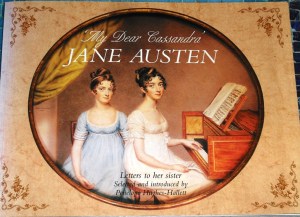
Jane Austen: Letters to Cassandra

While continuing to keep up with the A Month of Letters challenge (now successfully completed), I have been browsing the bookshelves to remind myself what letter collections I have tucked away. Possibly one of the most famous letter writers in literary history was Jane Austen, whose main correspondent was her elder sister Cassandra. Perhaps it is more correct to say that, Austen’s letters to her sister have survived, whereas others have been lost (Cassandra destroyed many letters before her own death in 1845). After Cassandra’s death, the surviving letters passed to her great niece Fanny Knight and in due course, Fanny’s son published these letters in 1884.Jane Austen Letters

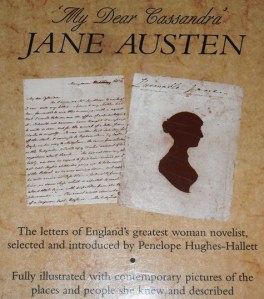
It is a sample of these letters that are published in My Dear Cassandra: Letters to her Sister (selected and introduced by Penelope Hughes-Hallett). The book is fully illustrated and features notes to contextualise the letters and excerpts from Austen’s fiction. It is a lovely book to own, though I have to confess that I do not remember when or from where I bought my copy. This collection was published as a hardback gift edition for Past Times in 1990 (paperback 1991) and it is clearly not intended to be a comprehensive, scholarly edition. However, as an introduction to Jane Austen, her letters and her world it is an excellent choice. As you start to read, you can see how Austen garnered the material for the novels yet to come. The reader can follow up references for further biographical reading, although this edition pre-dates Claire Tomalin and David Nokes’ biographies of Jane Austen (1997).

As you might suppose, this collection of letters has lain on The Landing TBR Pile for some years, so it is about time that I perused a few of the letters. I did not intend to read straight through, but of course, as the letters are presented chronologically, you read on to find out what happened next, as in any good novel. Not surprisingly, there are gaps in the story however, when they didn’t exchange the twice-weekly letters, due to being together. For instance, from 1801- 1805, there is more need of contextual prose in the absence of original letters, to keep the continuity of events flowing. The sisters corresponded when one or other was away on the extended family visits and duties that were common in that period. The one thing that is hard to appreciate is the frequency with which letters were delivered in the 1800s. We think that we are well connected now, but it is amazing to think that you could once have had an evening postal delivery. Back Cover Illustration

The problem with reading someone else’s letters is that you are peeking into to a different life and don’t know the dramatis personae. Add to that, a different century and an alien social milieu and even with the helpful notes (and they can inevitably only go so far) it can be difficult to put flesh on the incidents and people mentioned. Even so, what comes over is that Jane Austen was an observant student of human nature and enjoyed regaling her sister with various goings-on. She clearly had a great affection for family and friends but she enjoyed poking fun at various people.

Sometimes there seems to be a sharp contrast between her mocking of acquaintances, and her affectionate regard for her family. This letter from 1798, has an almost cruel throwaway comment about a neighbour, yet displays doting affection for her three-year-old nephew:

Mrs Hall, of Sherborne, was brought to bed yesterday of a dead child, some weeks before she expected, owing to a fright. I suppose she happened unawares to look at her husband.

We are very glad to hear such a good account of your patients, little and great. My dear itty Dordy’s remembrance of me is very pleasing to me – foolishly pleasing, because I know it will be over so soon. My attachment to him will be more durable. I shall think with tenderness and delight on his beautiful and smiling countenance and interesting manners till a few years have turned him into an ungovernable, ungracious fellow.

Her trademark humour is there in the line about the likelihood of the boy growing up much changed, but it is not as barbed as her comment about the bereaved Mrs Hall. I wonder what this woman was to Jane Austen that she felt the need to be so flippant. Maybe however, this was merely misfired humour in a family letter, which would never have seen the light of day if its author had not become famous. In a later letter, Jane Austen writes of how amusing Cassandra’s latest letter was, so I cannot help wishing that I could read it too. I assume that Cassandra’s letters were lost, but I have not researched this yet.

Inside TextTo finish, I will give you a snapshot of Austen’s experience at a dance in 1799, which conjures up vivid impressions of her fictional country balls:

I do not think I was very much in request. People were rather apt not to ask me till they could not help it; one’s consequence, you know, varies so much at times without any particular reason. There was one gentleman, an officer of the Cheshire, a very good-looking young man, who, I was told, wanted very much to be introduced to me; but as he did not want it quite enough to take much trouble in effecting it, we never could bring it about.

I wonder whether this young man regretted in later years, that he could not boast of having once danced with the famous author. How does that song go, ‘I’ve danced with a man, who’s danced with a girl, who’s danced with the Prince of Wales’ (Herbert Farjeon, 1927).

I definitely have more letters stashed away on The Landing, so perhaps I will have another delve later in the year. I don’t really need the excuse of A Month of Letters to read other people’s letters. Meanwhile, I will have a root around for the subject of my next blog post…


Yes, We Have No Oranges (Nor Bananas)…

Last year author Juliet Greenwood (We That Are left, Honno Press)) wrote a guest blog post on the topic of producing and preparing food for the Home Front during the First World War. In her novel, the main protagonist, Elin goes back to her mother’s old recipe book to help her produce nutritious recipes for wartime. Recipes from the period were reproduced at the end of the book, some of which you can find on Juliet’s guest post. I have gradually tried out Juliet’s recipes, most recently the seed cake, which I have blogged about over on Curiously Creatively this week. It was most delicious!

Few Eggs and No Oranges

Reprinted edition

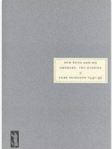
As Juliet pointed out at the time, rationing only came about towards the end of World War I, and lessons learned from this conflict influenced rationing decisions in the Second World War. I was reminded of this when I was browsing recently in Hodges Figgis and spotted a reprint of a Second World War diary. Few Oranges and No Eggs (Persephone, 1991, 2010) was the work of Birmingham born Vere Hodgson (1901-1979) who began work in London in 1935 and stayed there throughout the war. She worked for the Greater World Christian Spiritualist Association in a welfare role and helped to produce the association’s newspaper. The office was in a house (named The Sanctuary) in Lansdowne Road and Vere lived nearby in Ladbrooke Road, though she often spent the nights of The Blitz at The Sanctuary taking a turn on fire watch duty. Although the diary entries continue until VE Day, I have just quoted from the early part of the book to give you some idea of Vere’s life. The diary actually began life as letters sent around to family members and then posted out to a cousin in Rhodesia. Only one batch of letters ever got lost en route. Not bad for a war-time postal service!

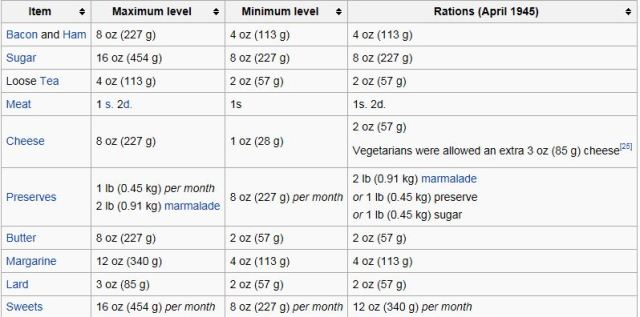
As the book’s title suggests, one of the major preoccupations of the author was obtaining food during the lean years of the war. On 9th July 1940, Vere Hodgson was recording that “We are to have six ounces of butter cum margarine, and two ounces of cooking fat” and on 16th July she was writing of the shortage of eggs in London, declaring, “I shall have to switch over to baked beans”.   Rationing restrictions changed over the years, but began in January 1940 with bacon, butter and sugar. Later, several other food products were added to the rationed list and supplies of fresh fruit and vegetables were limited, though not rationed. Tinned products were un-rationed but you needed points to buy the food. The chart I have included (taken from Wikipedia) will give some idea of the range of weekly rationing, from lowest to highest. Not on the chart are eggs (one per week) and milk (3 pints per week). There were increased milk rations for children, pregnant women and invalids and oranges, when available were usually only for children or pregnant women.

World War II Rations

Ration Chart

Vere’s observations marked the daily difficulties of obtaining scarce supplies and the alteration in the rations. Despite fruit not being rationed, imported fruits such as bananas and oranges were obviously hard to come by at all. Prices of homegrown produce varied a great deal as this entry from February 1941 shows, “Bought a pound of apples yesterday for one shilling…what a price. No oranges at all, at all. Very annoying.”  Later that month she notes that the cheese rationing will probably amount to a one inch cube per week. At that point, it was immaterial as none was available in her area anyway.

One of the effects of rationing and shortages appeared to be that people craved that which they would not ordinarily have eaten, such as in this case, onions. “Mr Booker was saying that though he hates onions, when once more we can get them he will sit down and really enjoy one. I think we shall go in for onion binges when the war is over”. (16th February 1941) I have a vision of Vere tucking into endless plates of fried onions after the war. In many entries such as this one, Vere displays that sense of humour and stoicism that enabled many people to carry on despite the shortages. I will just finish with this excerpt from 22nd February 1941, which details the proceeds of a shopping expedition:

Managed to get a few eating apples yesterday to my great joy. I treated myself – they are one shilling and one penny per pound. I carried them home as if they were the Crown Jewels. Also had some luck over cheese. Went for my bacon ration and while cutting it had a word with the man about the Cubic Inch of Cheese. He got rid of the other customers and then whispered, ‘Wait a mo’.’ I found half a pound of cheese being thrust into my bag with great secrecy and speed!

Then going to the Dairy for my butter ration I was given four eggs and a quarter of cheese! Had no compunction in taking it, for I went straight to my Mercury Cafe and gave it to them….they had said they did not think they could open the next day as they had no meat and only a morsel of cheese. I could not resist, when I got in, cutting off a hunk of my piece and eating it there and then. I always sympathised with Ben Gunn when he dreamed of toasted cheese on that desert island.

If you’ve never come across this diary, I recommend it for the day-to-day picture of war-time life. The experiences are particular to one educated, middle class woman but it does give you a vivid picture of what life must have like for Londoners and Brummies in all walks of life as they coped with the destruction and privation on the Home Front. This is one book that I am sure I will dip into again and again. Vere Hodgson’s voice is lively and compassionate; her conscientious recording of all that happens draws the reader into her world.

I have also written a piece for Headstuff if you would like to read it too: http://www.headstuff.org/2015/05/exploring-a-wartime-diarist-vere-hodgson/

Until next time!

Serendipity: Jane Austen, a family letter and Somerset Maugham

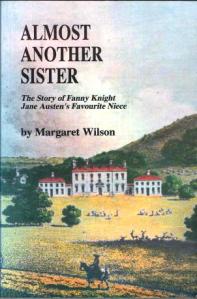
While I was over visiting my parents before Christmas, I had my usual riffle through their bookshelves in search of old friends. I came across a book that I had completely forgotten leaving behind. (Or did I lend it to someone?) The book in question was Almost Another Sister: The Story of Fanny Knight, Jane Austen’s Favourite Niece by Margaret Wilson (George Mann Books, 1998) which I see from my note on the flyleaf that I actually bought in the year of publication.

Fanny Knight book

The picture on the cover is Fanny’s childhood home, Godmersham Park

In the previous year were published biographies of Jane Austen by Claire Tomalin and David Nokes so I was well into Austen family history by the time I bought the Fanny Knight book. I can’t remember how I came to hear of it, but I must have ordered it especially as it wasn’t published by a mainstream publisher. The book represents the extensive research of archivist and former teacher Margaret Wilson, who embarked on a study of Fanny Knight while working at the Centre for Kentish Studies (formerly the Archives Office).

Frances (Fanny) Knight (1793-1882) was the daughter of Jane Austen’s elder brother Edward who had the good fortune to gain a benefactor in Thomas Knight, a wealthy cousin. He made Edward heir to his estates on condition that Edward took the family name. By the time that Edward took the name of Knight, his daughter Fanny was a young woman of nineteen. It must have been strange for her to change from Austen to Knight, given that she probably anticipated changing name yet again on marriage. In 1820, when she was twenty-seven, Fanny married Sir Edward Knatchbull a widower with five children. The couple went on to have a further nine children.

Margaret Wilson has delved into family archives, Fanny Knight’s diaries and surviving letters to paint what she calls a ‘cameo’ rather than a ‘full biography’. This is due to the patchy nature of the available sources, such as the brief diary entries and scraps enclosed which the author describes thus: ‘The overall effect is of a multitude of minutiae, like tiny fragments of a jigsaw picture which is too complex ever to complete in full yet offers tantalising glimpses of the finished scene’. Nevertheless, the book is a fascinating account of a life that bridged two centuries and saw many changes as the Regency period gave way to the Victorian age.

As Fanny grew up, she visited and corresponded with Jane and her sister Cassandra. There was a strong connection between the branches of the Austen family, Jane in Hampshire and Fanny’s family in Kent. Apparently, Fanny was particularly close to Aunt Jane, though sadly not many of their letters survive. A quote from one of Jane’s letters to Cassandra gives an idea of how fond Jane was of Fanny:

A young Fanny Knight

A Young Fanny Knight

I am greatly pleased with your account of Fanny; I found her in the summer just what you describe, almost another sister – and could not have supposed that a niece would ever have been so much to me. She is quite after one’s own heart; … I always think of her with pleasure.

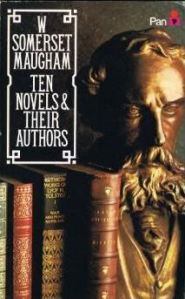
At this point you are probably wondering where Somerset Maugham fits into the picture. It is simple (and highly serendipitous). I was skimming through the bibliography of Fanny Knight when I came across mention of a collection of essays by Maugham, Ten Novels and their Authors. (1954, Pan Macmillan 1978). This sounded familiar so I had a root around on the shelves (in the living room, not in the landing ones this time) and lo and behold, I unearthed the very book. I had picked it up at a second-hand bookstall in Wexford a couple of years ago and never got around to reading it since.

Maugham has an essay on Jane Austen and Pride and Prejudice, which he feels to be her best book. His collection of essays has its origins in a challenge issued to him (by the editor of a journal called Redbook) to pick out the ten greatest novels in the world. Maugham comments ‘Of course my list was arbitrary. I could have made one of ten other novels, just as good in their different ways as those I chose, and give just as sound reasons for selecting them’. But he goes on to speculate that if a hundred readers produced a similar list, selecting perhaps two or three hundred novels, then ‘I think that in all the lists most of those I have chosen would find a place’. 

Fanny Knight in later life

Fanny Knight (Lady Knatchbull)

Margaret Wilson makes use of Maugham for his discussion of a particular letter that Fanny Knight wrote to one of her sisters many years after Jane Austen’s death. If you are a clued-up Austen fan, you will know to what letter I refer, as Margaret Wilson says that ‘Fanny has acquired a poor reputation’ because of the much-debated letter. In this much quoted letter, Fanny is clearly responding to a query or alluding to a previous conversation about her late aunt when, in 1869 she writes,

Yes my love it is very true that Aunt Jane from various circumstances was not so refined as she ought to have been from her talent, & if she had lived 50 years later she would have been in many respects more suitable to our more refined tastes. They were not rich, & the people around with whom they chiefly mixed, were not at all high bred, or in short anything more than mediocre & they of course though superior in mental powers & cultivation were on the same level so far as refinement goes – …

Both Maugham and Wilson quote the offending passages and Wilson also includes the remainder of the letter in an appendix. The discussions about what Fanny did or did not mean by her remarks are interesting. It was all new to me as I had never heard about these criticisms of Aunt Jane. Key to understanding the letter seems to be the changing social times and also Fanny’s social elevation as the result of her marriage. I was amused by Maugham’s reflection that, ‘It is regrettable, but it is a fact, that children do not look upon their parents, or their relations belonging to another generation, with the same degree of affection as their parents, or relations, look upon them. Parents and relations are very unwise to expect it’. In other words he is, perhaps wisely, not particularly surprised that Fanny should be rather mean about the aunt who cared for her so much.

Ten Novels

A bargain in 1978 at 90p!

I would love to have Jane Austen’s thoughts on the offending letter. I am sure that would be worth reading! Since that is an impossibility I will have to make do with reading more of Maugham’s literary criticism. I feel sure that he would be a good subject for a further blog post as he has plenty to say on the art of fiction. Perhaps my new TBR Challenge should explore all of the lit crit lurking around on The Landing!

Any thoughts?

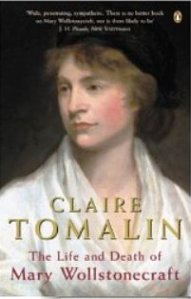
Mary Wollstonecraft by Claire Tomalin

Book jacket

Old Penguin edition, now re-jacketed

I have recently been re-reading a biography of Mary Wollstonecraft (1759 -1797) by Claire Tomalin that I bought some years ago. The Life and Death of Mary Wollstonecraft is one of several literary biographies by Tomalin that I have read and enjoyed. This biography was first published in 1974 and I came across the revised and expanded 1992 paperback edition when I was working in a Birmingham bookshop. Of Tomalin’s other books, I can also recommend The story of Nelly Ternan and Charles Dickens and Jane Austen: A Life; particularly Nelly’s story as there was a real prospect of her history being lost forever amongst the Dickens mythology. I still haven’t managed to get around to buying Claire Tomalin’s volume about the great man himself, despite having listened to her give an excellent talk about Dickens which fired my interest.

Moving away from the literary world to the stage was Mrs Jordan’s Profession, the history of actress Dorothy Jordan who became William, Duke of Clarence’s mistress. She bore him around ten children (I think) and they were a very happy family until the duke was forced to end his morganatic relationship and marry respectably. The future of the crown was at stake after the death of the Prince of Wales’ only daughter Charlotte in childbirth. Both this book and the biography of Nelly Ternan give you some idea of how precarious life on the stage was for women in the eighteenth and nineteenth centuries. Neither fish nor fowl, their place away from the theatrical world was ambiguous. Nelly Ternan and Dorothy Jordan had to live their lives around society’s expectations of ‘respectable’ women and both suffered because of these expectations.

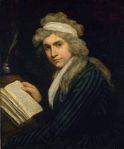
Mary Wollstonecraft portrait

A Studious pose by J. Opie.

Mary Wollstonecraft similarly lived an unconventional life, though in her case it was for the reasons of her political and philosophical views. As a young woman, she became involved in the Dissenting circles that had grown up in Newington Green, at that time still a village outside the bustle of London. Her introduction was through Dr Richard Price, the minister from the Dissenting Chapel who was well known to radical intellectuals, reformers and scientists of the day. He corresponded internationally, with Condorcet in France and with Franklin and Jefferson in America so he was very well informed. Taken together with his local political and reforming connections, he was an ideal person to begin the process of stimulating Wollstonecraft’s yet unfocused intellect and energies.

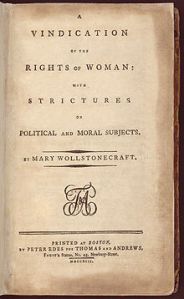
Mary Wollstonecraft was a fascinating and complicated woman, far ahead of and often out of step with the social attitudes of her time. However, I’m not sure whether we would have been bosom pals judging by Claire Tomalin’s observations on Mary’s ‘sense of grievance’ (which I feel is never an attractive character trait). But perhaps this sense of grievance was the necessary spur that drove her onwards and paved the way for Vindication of the Rights of Woman, published in 1792 as a response to Thomas Paine’s Rights of Man.

Vindication

American edition

Mary Wollstonecraft certainly had reasons to question the way things were done: her father had tended towards drinking and violence to the extent that Mary had needed at times to protect her mother. Education for Mary and her two sisters was barely adequate whereas their brother Ned attended school and went into law. Ned was also to inherit a considerable portion of his grandfather’s estate but the girls received nothing. I wonder if feminist history would have been vastly different if Mary had not experienced the unfairness of societies attitudes from such an early age? But perhaps her enquiring and lively mind would have taken her in much the same direction whatever her personal circumstances.

This was yet another diversion from reading more of the unread books on The Landing, and I am even contemplating another re-read of the books I’ve mentioned above. At this rate, the day that I can safely say that the day I have read everything tucked away on the book shelves is still a long way away!


How are your challenges going, fellow readers?

Picture credits: Wikipedia, with thanks


A Landing Bonus Book: The Herbalist by Niamh Boyce

He just appeared one morning and set up shop in the market square. It was drizzling. Everything was either a shade of brown or a shade of grey. He was the lightest thing there, the one they called the black doctor. He wore a pale suit, a straw hat and waved his arms like a conductor. The men spat about dark crafts and foreign notions, but the women loved him. Oh, the rubs, potions, tinctures and lotions he had. Unguents even.

As a break from my regular Landing Book Shelves task, I have been reading The Herbalist, the first novel from Niamh Boyce who was winner of the Hennessy XO New Irish Writer of the Year in 2012. The book was kindly offered by Penguin Ireland and has not tarried for too long on the TBR Pile due to The Herbalist’s very tempting prologue, from which I quoted above.

The Herbalist by Niamh Boyce

‘An elegant morality tale’ (Sunday Times)

Niamh Boyce based her title character on a real person called Don Rodrique de Vere who was practising as a herbalist in Athy in 1942. I won’t say any more for fear of giving away the germ of the novel’s plot, but if you do want to know more about the inspiration behind the character, click on Athy Eye on the Past blog or read Niamh Boyce’s interview with Sinead Gleeson in the Irish TimesThe Herbalist is set in a small midlands town in the late 1930s and is told through the voices of four women of differing ages and social positions. Emily, Carmel, Sarah and Aggie are all well drawn, strong characters.  Boyce adds to her strong cast with several minor characters such as Mai and Birdie; also with the beautiful Rose whose quieter voice interweaves throughout the narrative.

This was an era when people’s lives (and arguably women’s in particular) were structured and controlled to a great degree and it wasn’t done to stick out too far against the perceived norm. Into this repressed social mix comes a half –Indian herbalist who promises much to the enthralled women of the town. Most of the towns women seem to have dealings with the herbalist; an exotic stranger who upsets the balance of the town where everyone knows everyone else’s business (or thinks they do).

Impressionable teenager Emily develops an infatuation with the healer (known as The Don) and becomes the talk of the town as a result. He indulges her fantasy for his own reasons, promising Emily a new life far away from the town where her family is regarded as less than respectable and nobody thinks she will amount to much good. Emily’s voice comes clearly down the years and you can well imagine a lively Hollywood obsessed girl itching for more than her life seems to promise. The reader sees before she does, that Emily’s route out will be her exquisite skill with a needle and thread. But before that, she will have to stand up and attempt to put right an injustice with all of her reserves of courage. I’ll say no more lest I plot-spoil.

The novel has plenty of fascinating insights into life for people (and in particular the women) in small town Ireland of seventy years ago. Banned books, the need to be respectable, the pressure on married couples to conceive, shameful secrets lurking behind closed doors and young women disappearing into Magdalene Laundries (often as a result of rape) are all themes in the novel. The book carries all this lightly however and there isn’t a feeling of being overburdened as Boyce tucks her threads so neatly together. There are obviously plenty of darker shades in the story, but these are well handled and leavened with gritty humour.

I was intrigued to discover that the banning of books in fact led to a thriving black market in racy books such as Lady Chatterley’s Lover, Bird Alone and Tender is the Night. In the novel, both Birdie and Carmel have an under the counter trade in illegal books to bring in a few extra shillings. There is a funny scene where Carmel’s husband Dan discovers the stash and claims to be so shocked, yet he can’t put the book down and he avidly reads the awful material, ‘ He slammed it shut, glared at his wife. Opened it again…read a section, snapped it shut. Glared. Opened it…on he went, over and over again, with the same exaggerated expression of wide-eyed horror’.

The herbalist may have used his potions to charm the women of the town, but Sarah’s aunt Mai is also a skilled herbalist, using her ancient talents in her role as a midwife in her village. Mai’s kitchen in the throes of violet tincture production was beautifully described. Again with a touch of humour, as Mai and Sarah hide the poitín used in the process from the local school master’s sharp eyes. Boyce reminds us both how important a woman like Mai would have been in her community and how little money there was at the time to pay for the services of a midwife. Mai more often than not had to accept payment in kind, because as she pointed out to Sarah ‘you couldn’t shove a baby back in’.

I thoroughly enjoyed The Herbalist and look forward to reading more from Niamh Boyce in the future. In the meantime, I have one more Landing Eight title to report back on and then a new Landing Reading Challenge awaits me! All will be revealed shortly…

Back soon and don’t forget to drop a comment in the box if you’ve read anything good lately.

Ghost Light: my treasure in the in-tray

Ghost Light

Molly Allgood…

As anyone who follows me on Twitter will be aware, this week I unearthed Joseph O’Connor’s Ghost Light (Harvill Secker 2010) from my in-tray where it has been languishing for the last few months. It is the trade paperback edition, purchased in a charity shop and put aside in favour of other things. As I am sure I have remarked before, there is a particular pleasure in coming across a book that you have completely forgotten ever buying. Finding it all over again is a treat in itself. O’Connor’s novel was chosen as the Dublin One City One Book title for 2011 but I never actually got around to reading it. (See this article in The Blurb pages for more on the annual event).

The novel brings to life the secret love affair between playwright John Millington Synge (1871-1909) and Abbey Theatre actress Mary (Molly) Allgood (1885-1952) from their meeting in 1905 until Synge’s death. Molly went on to become a well-known stage and film star (as Maire O’Neill) though Synge’s family and friends brushed aside her real-life role as Synge’s lover and muse. Her relationship with Synge had never been considered suitable owing to differences in their respective religious and social positions.

I am just over half way through Ghost Light now and enjoying it very much after taking a few pages to get into it. At first, I thought the novel was going to be too sad and dreary for what I wanted at the time. Certainly, persistence has paid dividends and, while the book has its sadness, there is plenty of humour too with some brilliant comic dialogue. Of course, Molly is a wonderful heroine, both in her fiery spirited youth and her resilient old age in a battered post-war London.

Portrait of Molly Allgood

Molly Allgood, by Yeats

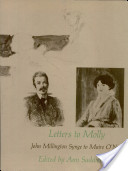
The more I progress with the novel, the more I want to know about Molly’s life and times. I found a lovely portrait, painted by John B Yeats on my internet trawl for more information. Molly made many films during her career, working up until the end of her life. She went on to marry twice (her first husband died and she was divorced from the second) and had two children. Apparently all of her letters to Synge were destroyed but an edition of his letters to Molly was published in 1971 by Harvard University Press (edited by Ann Saddlemyer). I think this is one volume I would like to add to my Landing Bookshelves letters collection. Perhaps a Christmas present to myself?

For more information take a look at Joseph O’Connor’s webpages: http://josephoconnorauthor.com/ and also an article he wrote for Prospect Magazine (from where the picture of Molly was taken): http://www.prospectmagazine.co.uk/magazine/the-playboy-and-his-muse/

Letters to Molly

Letters to Molly

Landing Eight Progress: L.P.Hartley

The Go-Between

The winged messenger

Turning my attention back to the Reading Challenge that was whole purpose of this blog, I have been scanning the remaining Landing Eight titles to decide what will come next. My choice will be to read L.P. Hartley’s The Go-Between (Penguin) as a complete contrast to The Periodic Table. In common with many people I suspect, I have known the famous first line to this novel for years without ever having read the book. Well, now is the time to put that lack of experience finally to rights. That is, after I have finished a couple of other books that are floating around, procrastination being my modus operandi (she confesses sadly).

The Locust and the Bird

The Locust and the Bird – trade paperback edition

At present, I am reading My Mother’s Story: The Locust and the Bird by Hanan Al-Shaykh, a completely engrossing Lebanese memoir. The book is a trade paperback title that I grabbed from a bargain section some while ago because the lovely title (and the stylish woman on the jacket) appealed to me. A quick mention also for the memoir, The Storyteller’s Daughter by journalist Saira Shah; in which Shah tells of her attempts to come to terms with, and understand her Afghan heritage. She has had some truly close shaves during several years of conflict in Afghanistan, which are un-nerving even to read.

A wonderful thread running through the book is that of the stories passed down the generations of the family. At one point Shah quotes her father comparing stories to dried onions. He told her that stories are ‘like dried experience. They aren’t the original experience but they are more than nothing at all’. The stories have a purpose in helping to explain and deal with life’s experiences as they come along. I have written a little about the importance of stories and storytellers in a previous post (April) so this aspect of the book was of particular interest to me.

Now, your starter for ten: tell me about your favourite storyteller…

Other News:

As I am sure many people know, the nice folks running the Grafton Media Blog Awards Ireland have recently announced the shortlists. This blog has been shortlisted in the ‘Best Newcomer’ category, which is very exciting for me. A big ‘Thank You’ is due to the organisers (Amanda Webb, Lorna Sixsmith and Beatrice Whelan) for selecting the Landing Bookshelves for inclusion on the list. I put my head in the sand after the nomination went in and tried not to think too optimistically about the awards, so it was particularly cheering to find that I had got this far. I will be firmly crossing fingers (and maybe toes too) ahead of the Finalists announcement (29th September). However, the crossing fingers part may make typing tricky so perhaps I will simply try to visualise crossed fingers and see how that works. Actually, page turning would be awkward as well and I definitely do not need any obstacles on the reading front either.

So, it’s back to The Go-Between for me…

Blog Wards Logo

It’s awards time…

Literary graveyard visiting in St Nahi’s Churchyard

Before I get stuck into my latest post I want to thank all of the people who have followed this blog so far. I am very grateful for the vote of confidence and I shall try to keep up my blogging efforts. Now, down to business….

This is an out-and–about post which ties in with the The Blurb page on the Cuala Press that I mentioned in the last post. I said in that piece that I had discovered to my surprise that the Yeats sisters Lollie (Elizabeth) and Lily (Susan) were buried in St Nahi’s Churchyard, Dundrum (part of Taney Parish). It has taken me some months but I finally got around to visiting the churchyard last Saturday afternoon.

For a short while, the sun shone so The Bookworm and I decided to look for the Yeats grave and generally explore the churchyard a little (possibly this is not everyone’s idea of summer holiday entertainment). After wrestling with the latch of a squeaky iron gate we let ourselves in and located a sign with the map of the burial plots.

Fortunately, an enterprising person has prepared a Podcast tour of the churchyard featuring notable names buried at St Nahi’s. While this was not on our agenda for the day, it did mean that the numbers allocated to the stops on the tour came in handy for our mini self-guided tour. We therefore found the grave (number 7) we were searching for easily enough, which looks towards the nearby Luas Green line (not that it was around at the time the sisters were buried I hasten to add).

I forgot to take photographs of the graveyard but I did find this video tour of the churchyard produced by Taney Parish on You Tube. The video has a bonus in that it shows the interior of the church (closed when we were there) with some shots of tapestries behind the altar that were made by Lily and Lollie Yeats. The video was made in 2009 and so is fairly recent and gives a useful overview of the history of the church and burial grounds, as well as highlighting the particular bit in which I was interested. Look out for the lovely stained glass (including some by Evie Hone) too.

I am still amazed that my technological skills have stretched as far as putting a copy of the video into my post so I might just quit while the going’s good and go and put the kettle on. Many thanks to Taney Parish for the fascinating tour of St Nahi’s Church and grounds. I would still like to find out exactly where Cuala Press was situated and whether the building still exists so I would love to hear from anyone who can point me in the right direction. I believe it was on Lower Churchtown Road but as I can’t be sure if the building still stands I’m a bit stuck at the moment.

Next time I post I will hope to have a positive report on the progress of the Landing Eight Reading Challenge to give you…..

March 2024 update:

Follow the link to The Yeats Sisters website celebrating the life and work of the sisters, with information about the first Yeats symposium in 2023 and advance notice of the second one due to be held in July 2024.

John Buchan and the Arts and Events File

Since my last post I have been busy getting stuck into The Thirty-Nine Steps by John Buchan so I will shortly be well on the way to ticking off another title from the ‘Landing Eight’ selected recently. More on this in the next post. I have recently watched one of the film versions of the book (Robert Donat as Richard Hannay) thanks to one of those free DVDs you sometimes get with the Sunday papers. The comparison of page to screen was interesting.


A pile of classic novels

Progress…

Other News: I have also been busy trying to add new chapters to my site to incorporate more cultural bits and bobs than I can include on the main blog stream. In my Arts and Events File I have added a few pieces that were previously published elsewhere and that I have tweaked and edited slightly before posting up here.

This bit will be a random collection of arts related topics – anything that grabs my attention really. Another section called The Blurb features small publishers, one current (Red Fox Press) and one the iconic Cuala Press run by the Yeats sisters in Churchtown, Dublin. There will also be other literary related articles, such as one on Marsh’s Library, Dublin.

I have included links on these pages so anyone interested in following up any of the information can easily do so. I test the links as I go along but would appreciate feedback if any of them fail to connect.

cover of Mandy Moore's Yarn Bombing

Yarn Bombing by Mandy Moore

Another of my arts pages highlights the fantastic ‘knitted graffiti’  (or yarn bombing) trend, which is something that I came across at an exhibition in the Royal Artis Zoo in Amsterdam last year. I just wish my own knitting was up to the challenge!

Last, but by no mean least I have posted up a page about a famous American Civil War quilt and Jane Stickle who created it so beautifully. This was inspired by a visit last year to the Knitting and Stitching Show at the Royal Dublin Showground (RDS).

I hope these pieces in the Arts and Events File and The Blurb pique your interest in the topics; if anyone has any ideas for future posts I would love to hear them.

Thanks for reading!