Puzzling on Crime

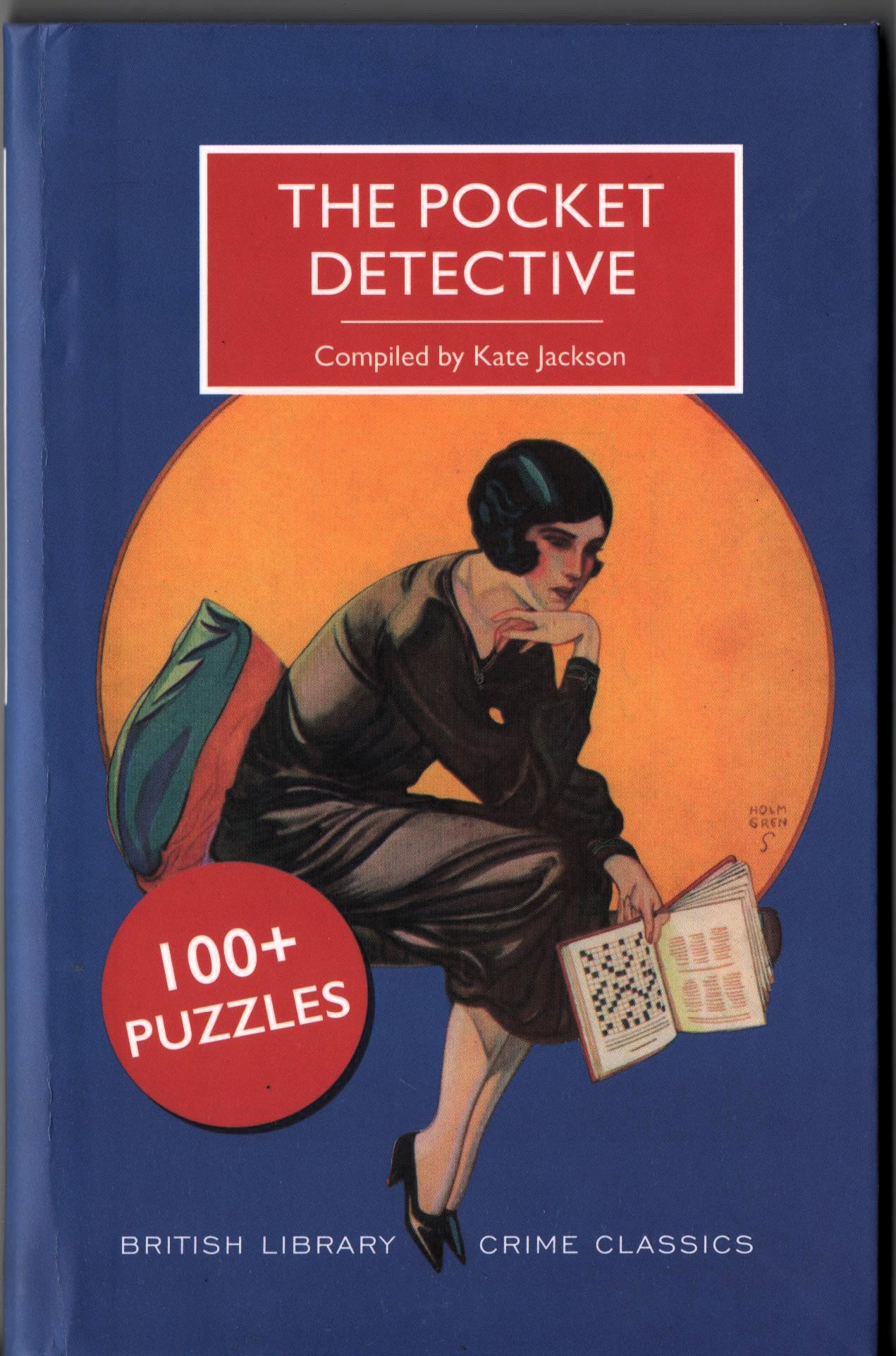
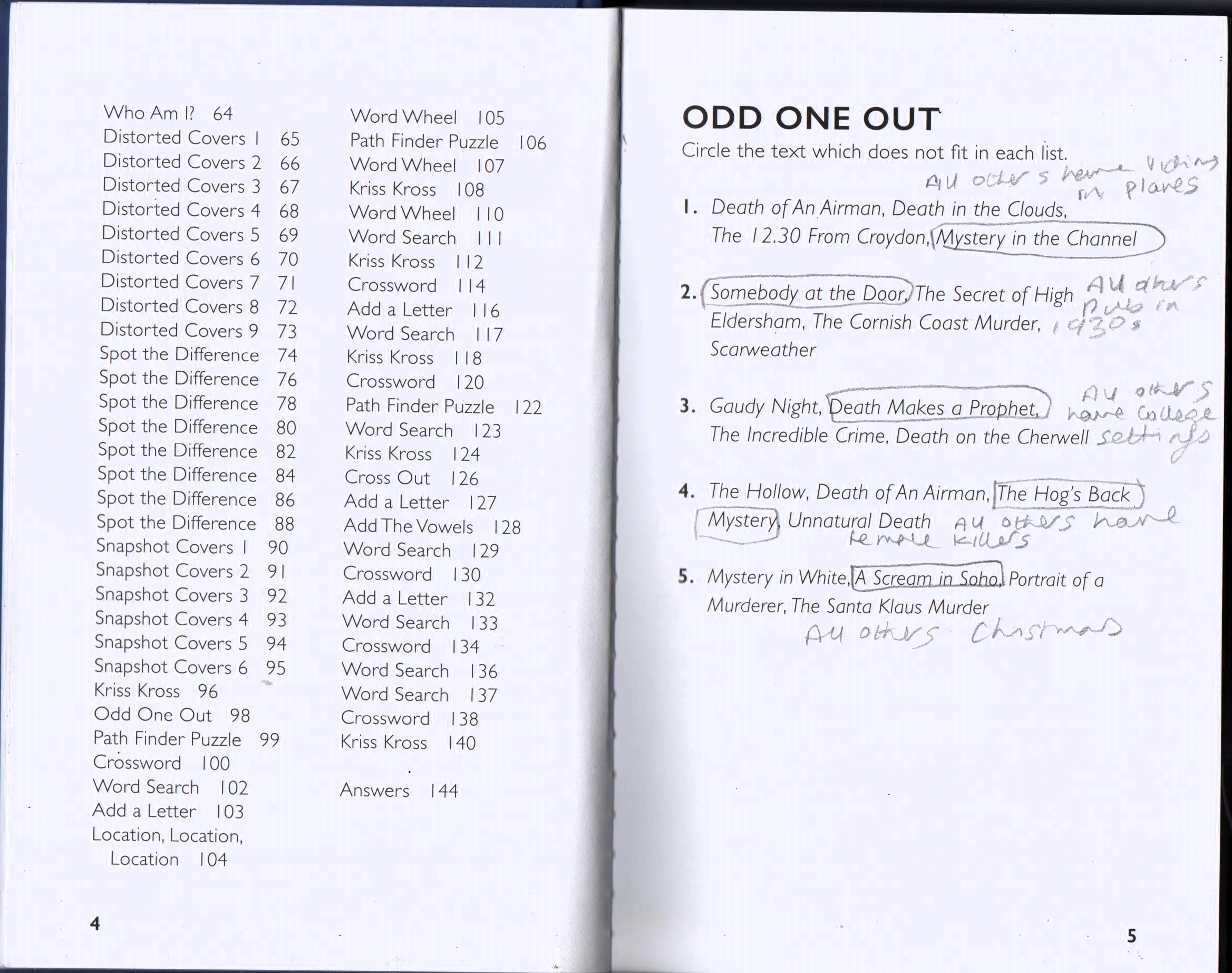
I was sorting through a pile of books on a shelf the other day, when I came across a little book published by the British Library Crime Classics series. It is a stocking filler that I received at the Christmas before last and that has been tucked away under other books for ages, in true Landing Tales tradition. This small tome is The Pocket Detective (2018) compiled by Kate Jackson, which contains more than a hundred crime fiction inspired puzzles. Now, the British Library editions are a bit of an enthusiasm of mine hence the gift of this puzzle book from He Who Put The Shelves Up. Not all of the brain teasers relate directly to titles in the series, some are more generally Golden Age related.

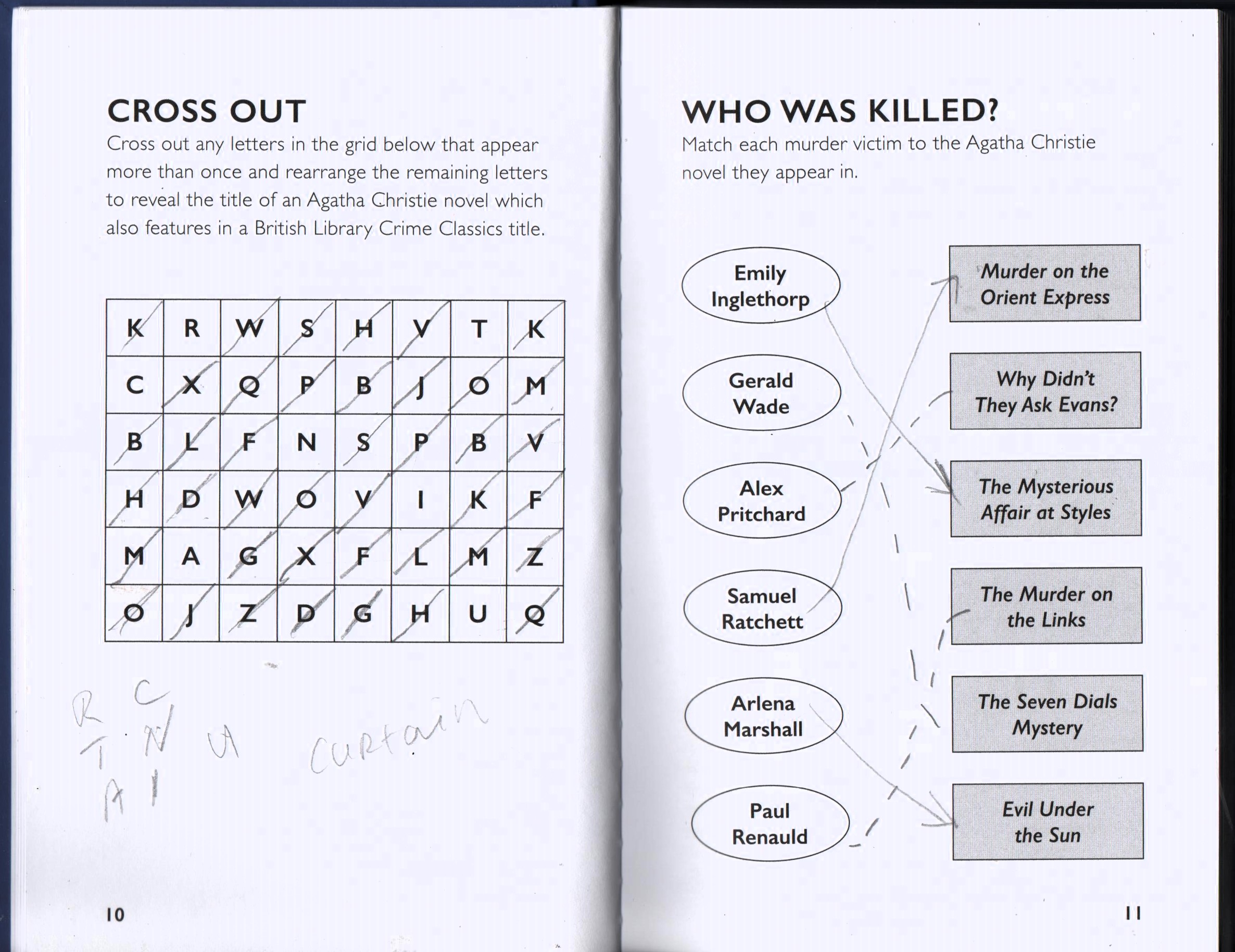
Sad to say, my knowledge of Agatha Christie murder victims, weapons and book titles is already shown to be wanting. My excuse is that it is many years since I read any of the books, though I could have sworn I was a bit of a fan (not in the specialist subject Mastermind kind of a way, but still…) The page I show here of questions on Christie murder victims is a case in point. I did manage to get two correct, but I had cheat and look the other answers up in the back of the book (yes, dear reader, there is instant relief from brain scratching!) But I am enjoying myself enormously despite the limits of my classic crime fiction knowledge.

I have now discovered that Kate Jackson runs a crime fiction book blog called crossexaminingcrime.com that looks well worth a browse and a follow. Not that I need any more books to read, if I am ever to make any further inroads into the Landing Book Shelves backlist. Actually, I wish that I could get hold of some titles in the British Library series in the Playaway format, which is great for commuting. As readers know, I am very fond of a little crime on the bus (so to speak).  

Anyway, it seems to me that that my little crime puzzler might be just the thing for some leisurely Bank Holiday activity next weekend. It is just a pity that I didn’t unearth it before Easter when we had a holiday break of solid rain and gardening wasn’t on the agenda. See you when I have run out of puzzles!

My Audio Crime Habit

I have previously written about my audio crime habit that livens up my rather tedious bus journeys into work. Well, I am here to tell you that both the audio and the crime bit are still going strong as part of my travel routine (that’s just as well as bus travel has been more than woeful in the last couple of weeks). Lately, I have been listening to a mixture of new-to-me authors as well as an old timer. And of course, I continue in my time-honoured habit of beginning any new series in the wrong place (in other words anywhere but at the beginning). My excuse is that I tend to pick up whatever catches my eye in the library, so that I often fail to get the titles in chronological order. Or at least, I don’t often have the patience to make a reservation from an author’s backlist so that I can ‘begin at the very beginning’ as Julie Andrews once so cheerfully sang.

I was particularly pleased finally to get around to Ray Celestin and his City Blues Quartet. Naturally, I inadvertently began at the end; but hey, at least I know who does and who does not end up dead by the final episode (never fear, I won’t plot spoil).  The last in the series is called Sunset Swing (2021) and is set in Los Angeles, Christmas 1967. The story features three recuring characters, retired private eye Ida Young; mafia fixer Dante Sanfelippo and the one and only Louis Armstrong. The city itself is a stunning character in its own right. Now I have to go back to the beginning at some point and see how it all began (Chicago, 1919 was the time and place) as I enjoyed this book so much. As always with an audio book, the narration is very important and can make or break an audio version of a novel; Christopher Ragland did a really good job.

Again, true to tradition I picked up Peter May’s The Lewis Man (2011) which is the second in the trilogy set on the Isle of Lewis (though I have spotted that a fourth book came out in 2024, so surely this is now actually a quartet whether originally intended or not). This is a murder mystery which begins with the discovery of a body in a bog where seasonal peat cutting is taking place. For me, the bog body was the hook, having long been fascinated by the discoveries explored in the National Museum of Ireland. Perhaps not surprisingly, in this story the body turns out to be much more modern than that; an Elvis tattoo was a dead giveaway on that score. Reading the (well, listening to) descriptions of the landscape of the Outer Hebridean islands made me really want to visit, despite, or perhaps because of the bleakness. At some point I will probably read the rest of the series, especially as I became quite invested into two of the main characters, Fin Macleod and Marsaili MacDonald.

Then for something completely different, I listened to Why Shoot a Butler? By Georgette Heyer (1933) a blast from my reading past as It has been quite a while since I last read any of GH’s novels, whether historical or detective. I started with her Regency romances as a teenager and then found my way to her contemporary crime novels later. In this novel the butler is the murder victim as opposed to the trope of ‘the butler did it.’ But of course, there had to be a motive for killing an apparently harmless servant. What is it? This is one of those Golden Age of crime plots where gifted amateur detective, barrister Frank Amberley runs rings around the rural police force. This probably isn’t my favourite GH crime novel, but still an entertaining listen with some very funny lines. If you have read her Regency novels you will be able to spot the character types that she has transposed to the contemporary setting.   

Sadly, not everything that I want to listen to is available in the Playaway MP3 unit format (see picture) which Is the audio version I favour for being out and about (or should I say, for being confined to public transport on wet mornings). Which, in a way is handy as I am likely to pick up something that I might not otherwise choose, if I find in a catalogue search that my first choice isn’t available in that edition. What I would love is if some of the British Library crime reprints were produced in the MP3 format. Now that woould make me a very happy bus traveller!

It is probably time to browse the library shelves again…

New Year TBR Pile: Status Update

This is the post where I talk about all those lovely books that I received for Christmas and that now adorn my never diminishing TBR Pile. I know that it is almost the end of January, but bear with me. I’m sure I’m not the only person always playing catch-up with the reading pile. Here’s a brief run-through of my latest acquisitions.

Two books in particular I had had my eye on for a while, so when I got word that a family member wanted gift ideas, well that was my opportunity. The two books in question were The Lost Rainforests of Britain by Guy Shrubsole (William Collins) and Where the Wildflowers Grow by Leif Bersweden (2022, 2023 Hodder). I have begun to read the former and I am already fascinated by the huge variety of lichens and mosses to be found around Britain. The only problem I am having is wrestling with the Latin names; as Shrubsole points out, very few lichens have common names unlike more well-known specimens in the wider plant world.

I also had a Christmas crime fix in my book stash (which was in addition to a couple of library crime books awaiting my attention) from He Who Put the Shelves Up. Now, these two sets of crime novels resemble two sets of twins. In each corner I have a Japanese classic crime novel and a British Golden Age crime novel. The similarity is quite uncanny really, or would be if my crime fiction tastes were not so well known to my nearest and dearest. The Japanese mystery is from an author new to me, Fūtarō Yamada (1927-2001). This is the intriguing sounding The Meiji Guillotine Murders (2012, translated 2023 Pushkin Vertigo), a historical crime story set in 1869, after a recent civil war. My second murder tale is Murder in Blue (Galileo 1937, 2021) by Clifford Witting (1907-68), another author new to me. This tells of a case of a murdered policeman, whose body lying alongside his bicycle is discovered by a local bookseller and writer out for an evening stroll. This reprint is of Witting’s first crime novel from an eventual sixteen. So far Galileo seems to have reprinted a couple of titles so maybe there will be more to come. The original books are apparently very collectable and rare now. I did find a first edition copy of Murder in Blue on ABE for, wait for it… £1,622.48 (plus postage and packing!) Thank goodness for good quality reprints is all I can say.

The stack of books that I had for Christmas
A stack of Christmas books

By way of a complete contrast to anything that has gone before, I received a copy of a collection of George Eliot’s essays (2023 Renard Press) from one of my sisters. The titular essay is, ‘Silly Novels by Lady Novelists’ in which Eliot lists the ‘qualities of silliness that predominates’ in the novels in question. As you will surely want to know, I will tell you that they are, ‘the frothy, the pious or the pedantic.’ This book contains a collection of four essays, all published in journals between 1854 and 1879. So I shall be dipping into Eliot in between crime novels I think.

Finally, my post-Christmas TBR pile includes a copy of Hilary Mantel’s A Memoir of my Former Self: A Life in Writing (2023 John Murray). This is a collection of Mantel’s writing collected and edited by Nicolas Pearson, Mantel’s longtime book editor. I have read several of Mantel’s novels including the Thomas Cromwell trilogy, but I haven’t read any of her articles or reviews.  I have dipped into this collection only a little so far, enjoying very much her essays on Anne Boleyn and Marie Antoinette. Mantel’s range is wide, so it looks to be an interesting anthology.

Now that is the Christmas present list wrapped up, but I did mention that I had a couple of library crime reads on the dreaded pile. The Japanese novel in my library pile is by Seishi Yokomizo (1902-1981), The Devil Comes and Plays his Flute (1979, translated 2023, Pushkin Vertigo). This features Yokomizo’s regular detective character, the rather eccentric but endearing Kosuke Kindaichi grappling with a very strange case indeed. I have read all of the Yokomizo titles reprinted by Pushkin Press and highly recommend them. The other library classic  is The White Priory Murders: A Mystery for Christmas by Carter Dickson (the pen name of John Dickson Carr), originally published in 1935 but reprinted in 2022 by the British Library. I did borrow this before the festive season, planning to read It over Christmas, but sadly that didn’t happen. I will squeeze it in while we are at least still in the wintery months!

My task now is to read all of those books, before the distraction of acquiring anything else to read. Why don’t you drop me a line and share your TBR Pile status?

Trinity Book Sale Buy: The Tiger in the Smoke

Margery AllinghamThe Tiger in the Smoke by Margery Allingham (originally Chatto and Windus, 1952) is yet another of my Trinity Book Sale purchases (TBS Purchases). As you might have gathered, my TBS purchases forms its own TBR pile within the main TBR Pile (phew!). This edition of The Tiger in the Smoke is a 1953 hardback edition, which was part of a monthly series called World Books, published by The Reprint Society at 4/6 (for members only apparently). I note from the back cover that postage and packing cost 9d extra, (you could also buy Gone with the Wind at 8/- for the same postage price which was certainly a bargain). I love the cover design with the signs of the Zodiac on them, but the publisher doesn’t credit a cover artist which is a pity.The Tiger in the Smoke

I haven’t read an Allingham crime novel for years so it was a nice indulgence to head back into the Golden Age of Crime. Margery Allingham (1904-1966) penned her first Albert Campion novel, The Crime at Black Dudley in 1929. He proved to be such a popular creation that he appeared in a total of eighteen novels and around twenty short stories. I was intrigued to discover that Allingham originally invented Albert Campion to be a spoof on Dorothy L Sayers’ character Lord Peter Wimsey. Over the course of time however, he became much more substantial than a mere jest and matured into a more complex character. Campion has an aristocratic background and his real name is as much a secret as were his missions during the war. Undoubtedly, my affection for Campion is influenced by the stylish BBC series from 1989/90 starring Peter Davison and Brian Glover. This comprised versions of eight of the novels, but not the first one, or indeed The Tiger in the Smoke. I can feel a DVD hunt at the local library coming on!

My last Landing TBR report was full of Elizabethan crimes, or at least political shenanigans and courtly dramas. This time, although we are still in the realms of dark doings, the century and location has shifted to post World War II London. The shady happenings take place in a particularly mysterious and gloomy setting here, as much of the book’s activity occurs in the midst of the worst pea souper in living memory. In fact, the atmosphere is quite Dickensian, there is a sense that Bill Sykes could swagger round a corner any minute. A motley crew of street musicians, threading its way around the alleyways, led by an albino called Tiddy Doll is suitably sinister.

The plot of The Tiger in the Smoke centres on an escaped criminal and former soldier, Jack Havoc who is trying to locate what he believes to be a treasure hoard, a secret he learned of during a wartime raid in France:

He was a man who must have been a pretty boy, yet his face could never have been pleasant to look at. Its ruin lay in something quite peculiar, not in an expression only but something integral to the very structure. The man looked like a design for tragedy. Grief and torture and the furies were all there naked, and the eye was repelled even while it was violently attracted. He looked exactly what he was, unsafe.
The Tiger in the SmokeHavoc’s commanding officer Martin Elginbrodde, who had hidden the treasure, was later killed in action. Elginbrodde had left coded instructions for his widow Meg to retrieve it in such an eventuality. The story opens five years after a Elginbrodde’s death, when photographs supposedly depicting Meg’s late husband alive and well, have appeared in her post after the announcement of her engagement to Geoffrey Levett. Meg is Campion’s cousin hence, his being called in to assist in unravelling the mystery of whether her husband is still alive or someone wants her to think that he is.

In this case, Allingham’s deceptively affable amateur detective makes a late-career appearance in a supporting role, alongside his ever-reliable criminal turned sidekick Magersfontein Lugg. The hunt for Havoc is largely in the hands of the Scotland Yard, in the person of the charismatic and forceful Charlie Luke. I remember Campion novels as being quite light-hearted, but this one is much darker in atmosphere. Perhaps this is because I read previously, novels that were set much earlier in Campion’s sleuthing career. Here he is middle-aged, with a wife (Lady Amanda Fitton) and young son (Rupert) and he is very much aware of what he has to lose at the hands of the psychopathic Jack Havoc, on the loose in the obscuring fog. Campion’s son is blithely unaware of any danger, as his father decides to send him to safety with Lugg as a bodyguard:

Mr Campion looked down at him. He was shocked at the intensity of his own emotion, and more afraid of it than of anything he had ever known. One half of his life, more than half, four foot tall and as gaily confident as if the world were made of apple pie.Note

As I said above, Campion does not have a starring role in this one, but (without giving too much away) he assists in the capture of the Elginbrodde impersonator and his intuition gets Geoffrey Levett out of a potentially fatal situation. The twin pillars taking the weight of the story are the opposing moral forces of Jack Havoc and Meg’s father, Canon Avril. The Canon is a gentle, unworldly man whose faith in God causes him to confront the murderer, because he knows it is something he must do. I won’t tell you how it turns out, but Havoc’s life philosophy, The Science of Luck, which Avril calls The Pursuit of Death is challenged by the one person able to understand.

This is not so much a who-dunnit as a mystery novel that also explores a London still getting back on its feet after the war. The Tiger in the Smoke deals with damaged humanity, not only the prowling Jack Havoc, but also the band of misfits in Tiddy Doll’s gang. In the end, when the mystery is solved and the treasure is finally discovered by Meg Elginbrodde, it seems that peace will finally arrive.

Additional picture credit: Wikipedia (with thanks)