The Garden Diary Re-visited

As we are almost at the end of May, I have decided that it is time for another Garden Diary post, having not ventured from The Landing region to the sunny uplands for ages. The Garden Diary (now into volume III) lives in the kitchen rather than on the Landing but as you know, technicalities of book location tend not to weigh too heavily hereabouts. The three volumes live on The Landing in spirit as it were, being something of an heirloom already and probably as dusty.

Since June 2021 (according to the note on the first page) I have been using a splendid new leather-bound notebook, a Christmas gift from a previous year. The cover is a lovely dark green, stitched around the edge; the front cover is decorated with an embossed image of a Green Man. Unlined pages of a thick creamy-white paper are stitched in five signatures. It arrived in its own cotton bag, so for a quite a while I was terrified that nothing would be good enough to write in it.

In June and July 2021, I am sure that I did have various horticultural activities, but nothing made it into the diary and I picked up the threads of the diary once more on 29 August. As I have mentioned before, I try to write up notes on what I have sown, transplanted, re-potted etc. I do generally ‘fess up to the failures in the interests of full disclosure to my future self. I enjoy keeping up the diary, although as you can see, I do fall beside the way sometimes and may let weeks or even months go by without making a note of my horticultural activities. I enjoy taking photos for the diary, attempting to document my garden progress. Houseplants occasionally get a look-in too.

I have also been trying to record the wild flowers that I have identified in the garden. Some are easier than others (think dandelion or daisy), while others have required the consulting of wildflower guides. Not to mention the use of a magnifying glass on tiny specimens. I am up to about twenty-six varieties of wildflowers recorded in my trusty diary. I think that the discoveries that delighted me the most were finding cowslip and ox-eye daisy in the grass. Along with red clover and creeping buttercup, the ox-eye daisies create a real meadow-like scene in the garden. I was particularly pleased that I was able to identify a plant called self-heal last summer with the aid of wildflower guides. I am far from being a specialist, so it is a true delight to be able to claim that I have successfully identified a flower (and for it to be happily living in my garden).

I have a handy guide, A Beginner’s Guide to Ireland’s Wild Flowers (Sherkin Island Marine Station) that I bought a few years ago at Magpie Books in Enniskerry (sadly no longer extant). I also use Zoё Devlin’s Wildflowers of Ireland website for identification. She has now published a wildflower guide which I have not yet got around to buying. My newest identification from the website has been a Lesser Hawkbit (see photo). All finds will duly go into the Garden Diary for posterity.

Now as it’s a sunny day, I am heading off outside with my diary!
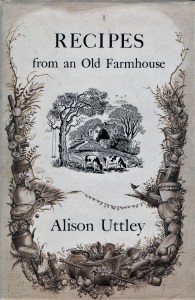
Recipes: from an Old Farmhouse by Alison Uttley

Cover of Recipes from an Old Farmhouse

An evocative image

I wanted to follow up on the last Landing post on foraging-related books with another foody feature. This book is part memoir of a Derbyshire country childhood and part recipe book by children’s writer Alison Uttley (1884-1976), who was best known for her Little Grey Rabbit series and also the Sam Pig books. The recipe book was first published by Faber and Faber in 1966 and I recently treated myself to the copy shown here, which is in very nice condition. Something to cheer me up during the spring Lockdown! It is a beautiful little hard back book decorated with black and white sketches by Pauline Baynes. The drawings complement the text beautifully. Recipes has been reprinted more recently, but I opted for a copy of the original edition and wasn’t disappointed.

Alison Uttley gives us recipes that her mother used in the farmhouse kitchen, including recipes given by friends and neighbours. These were named for the donor, for example ‘Mrs Lowe’s Parkin’. The book is divided into sections with anecdotes, reminiscences and recipes. If you wanted to try out any of the items, you would need to scale down and adapt the recipes as Uttley gives the quantities and methods as they would have been used by her mother at the end of the nineteenth century in the farmhouse oven. So, you would need to figure out the oven settings and alter the timings accordingly. The recipes aren’t laid out as recipes as we would find them in a cookery book nowadays, but they are easy enough to follow. I’m planning to try one or two of the cakes or puddings in smaller quantities.

I have found overlaps with my foraging post as in a few of the recipes given, Alison Uttley talks about foraged ingredients gathered by the family. I was particularly taken with her account of the annual cowslip gathering expedition with her mother. They took a clothes basket out with them to fill with blossoms. She describes it beautifully here,

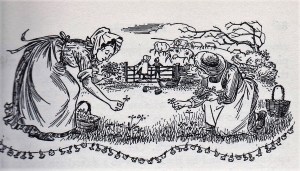
Black and white illustration of the author's mother and the maid picking cowslips, with the children in the background

Picking cowslips

One morning in April my mother would announce that we would pick cowslips for cowslip wine. We would set off after breakfast, the servant girl, my brother, my mother and I, with a clothes-basket, and several smaller baskets. It was exciting to run down the first big field, deep down to the gate that led to the cowslip field. By the gate we left the clothes-basket, and we each took another basket and began to gather the flowers.

It sounds idyllic but it was also hard work for all of them, Uttley describing herself as ‘dazed with stooping to the ground’ after a few hours of picking. It sounds as though the children were allowed to go off and play though, while her mother and the maid carried on for the whole day. But of course, the work didn’t stop there. What Uttley refers to as ‘peeping’ was the next task: removing the flowers from the stalks and calyces. That task must have been mind-numbingly tedious as well as an instigator of repetitive strain syndrome. I find it bad enough picking stalks off fruit for a modest sized batch of jam, so I’m not sure how I would have coped with that mammoth preparation session.

Black and white title page illustration for the chapter on beverages, showing entwined branches with culinary equipment hanging off them.

Chapter title page

I’d actually love to be able to try making a small batch of cowslip wine, but cowslips are quite rare now in Britain and also in Ireland according to Zoe Devlin’s website, wildflowersofireland.net. However, she does go on to point out that the plant has made a comeback in Ireland in recent years, so perhaps it will continue to spread.  In his foraging guide Food for Free, Richard Mabey suggests that the huge quantities of petals used in making ‘one of the very best country wines’ has probably contributed to the flower’s scarcity in Britain. He comments on the ‘devastation that some of these recipes must have wreaked on flower populations’. Thankfully now, you can buy cowslip seeds as well as other wildflower seeds to grow in your own garden and even up the balance a little. I somehow doubt that I will be able to grow enough flowers to make wine, though cowslip growing is to be one of my projects for next year (I have the seeds ready!) As far as beverages are concerned, I think I will have to stick to making elderflower cordial, the only problem there being that the best blooms always grow too high to reach!

I hope to return to the book for another Landing post, when I have had a go at some of the recipes. Meanwhile, I will decide where to go for August’s Landing Tales post when I have scoured the book shelves again!

Are there any Alison Uttley fans out there? Does anyone remember her Traveller in Time, televised by the BBC in 1978? I loved the series then, but wonder how it would stand up now.

(Pauline Baynes illustrations scanned from my copy of Recipes)