Reading Somerset Maugham on Emily Brontë

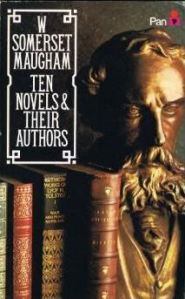
Ten NovelsI have been reading some of the literary criticism essays in Somerset Maugham’s book (mentioned in a recent post), beginning obviously enough with those about books that I have read. First, I turned to the essay on Emily Bronte and Wuthering Heights for the simple reason that I read Wuthering Heights so many years ago that it is probably due for a re-read. This essay seemed like a good way to begin to re-acquaint myself with both the book and the author. It also inspired me to dig out my copy of the Brontë family biography by Juliet Barker (1994).

Several writers have presented their views of the Brontë family since Somerset Maugham wrote his essay (1954), but Juliet Barker’s book, simply called The Brontës (1994) promises to be the definitive account. I somehow managed to miss a revised edition that came out in 2012. Perhaps I will give myself a very late Christmas present (I still have a voucher to spend) and upgrade my original copy. Meanwhile, it was interesting to see what Maugham made of Emily Brontë’s personality from the available sources. He did point out that to be able to talk about Emily; he needed to go back to her father’s origins and to approach Emily through her family, as she is difficult to know. Maugham’s portrayal of Patrick Brontë is much more negative than Barker’s image. She has painstakingly reconstructed hers from evidence culled from newspaper and church archives about Patrick’s political activities and presented a less one sided view.

It might seem obvious but the main fact to bear in mind when reading biographies about authors (or indeed any historical person) is that time and fresh documentary evidence often reveals a different picture. In some respects, that is not strictly true of Emily Brontë since she left very little personal testimony and apparently had no friends so there is a lack of social correspondence. Apart from her poetry, juvenilia and her only novel, evidence is indirect. However, over the years a much clearer picture of the whole family has emerged due in particular to Juliet Barker’s diligent archive research, which illuminates Emily’s character as far as it is possible to do so.

Here is a description of the fifteen-year-old Emily taken from Maugham’s essay, quoted here in full, as it seemed a shame to cut it short. Though he does not give the full reference, it was taken from the earliest biography of Emily by Mary Robinson, which was published by W.H. Allen in 1883 (I found this reference in Barker’s sources).

a tall, long-armed girl, full grown, elastic as to tread; with a slight figure that looked queenly in her best dresses, but loose and boyish when she slouched over the moors, whistling the dogs, and taking long strides over the rough earth. A tall, thin, loose-jointed girl – not ugly, but with irregular features and a pallid thick complexion. Her dark hair was naturally beautiful, and in later days looked well, loosely fastened with a tall comb at the back of her head; but in 1833 she wore it in an unbecoming tight curl and frizz. She had beautiful eyes of a hazel colour.

She was clearly an active girl, who loved the outdoors, perhaps one who would have been impatient with the restricted life of a well brought up lady. Physically she must have been what is often termed handsome, rather than conventionally pretty. Clearly, she ‘scrubbed up well’ as the saying goes. Emily was apparently painfully shy with anyone outside the family circle and Maugham quotes from Charlotte Brontë’s letters to show that the sisters at times had a difficult relationship. After learning from Juliet Barker that few writers have quoted from Charlotte’s original letters, using instead unreliable published ones, I am sceptical of Maugham’s conclusion, “One is inclined to think that Charlotte never knew her sister”.

It is illuminating to consider the different approaches to studying the Brontë family and Emily in particular. Due to the lack of straightforward biographical evidence, many writers have tried to find the real Emily through her writing. On the other hand, Juliet Barker considers it misguided to use literary criticism. As she says in her introduction, “Trawling through the Brontës fiction in search of some deeply hidden and autobiographical truth is a subjective and almost invariably pointless exercise”. She also rather scathingly refers to “theories of varying degrees of sanity” earlier in her introduction. I assume that she places in that category the theory, to which Maugham and other literary critics subscribe, that Emily Bronte was a lesbian. As far as I can recall, as it’s been twenty years since I read Barker’s biography, she doesn’t suggest this possibility from her study of contemporary sources.

One of the biggest myths that grew up around the Brontës was that they lived very harsh and isolated lives in a lonely moorland house. Maugham doesn’t perpetuate this idea, as after he visited Haworth, he described the house as situated at the top of a hill, “down which the village straggled”. However, he does mention that there was a graveyard on both sides of the parsonage, which some folks (but not perhaps curates) may have considered being a gloomy location. He also pointed out that the mood of the moorland varied with season and would not always have been wild and bleak. Indeed, he described his visit thus,

The countryside was bathed in a haze of silver-grey so that the distance, its outlines dim, was mysterious. The leafless trees had the elegance of trees in a wintry scene in a Japanese print, and the hawthorn hedges by the roadside glistened white with hoar frost. Emily’s poems and Wuthering Heights tell you how thrilling the spring was on the moor, and how rich in beauty and how sensuous in summer.

I didn’t find the location particularly bleak either when I was there a few years ago, and the house was solid and pleasant looking, though of course it would have been cold in winter without central heating. However, the Brontë sisters’ lives would have been no harsher than for any other country curate’s family in the nineteenth century. They could obviously afford a servant (Tabby Ackroyd) to help around the house. Emily helped with domestic chores, and I liked the image of her kneading bread with a book propped up in front of her as she worked. Industrious yet slightly impractical: (turning pages with a floury hand?)

The fact that Maugham included Wuthering Heights in his ten most important novels, despite asserting that it is very badly written, intrigued me. Maugham is critical of the construction of the novel (fitting two sets of events and characters into a unit) and the unrealistic dialogue that Emily gives Nellie Dean to say. However, his verdict is that, “It is a very bad novel. It is a very good one. It is ugly. It has beauty. It is a terrible, an agonizing, a powerful and a passionate book.” He discusses the unevenness of the novel and the reasons why Emily might have chosen to tell the story in the way she did, instead of perhaps choosing a first person narrative. He felt that she wanted to distance herself from events, in effect to in hide her from the passion. His reasons? Somerset Maugham’s theory located Emily as both Cathy and Heathcliff, “I think she found Heathcliff and Catherine Earnshaw in the depths of her own soul. I think she was herself Heathcliff, I think she was herself Catherine Earnshaw”.

Now I do really need to read it again…let me know what you think! Drop a line in the comment box.
Sheep, Sheep Everywhere….

This blog post is going to feature several sheep. Yes, that’s right I do mean the woolly, grass eating sort (as if there were any other). Having said that, my recent reading material has challenged any preconceptions that I might have had about sheep (even the grass-eating bit is suspect). Don’t ever let anyone tell you that sheep are boring because they are not (honestly) and they are not very docile either. They are however, very photogenic as the illustrations in my book testify (sheep are obviously shameless poseurs).

Counting Sheep

The Unknown Sheep….

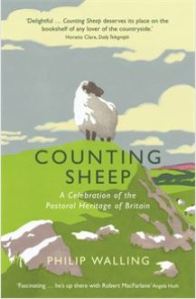
Thanks to a Twitter competition, I recently became the proud possessor of a book entitled Counting Sheep: a Celebration of the Pastoral Heritage of Britain by Philip Walling (Profile Books, 2014, 2015). I have to admit that when I entered the competition I did it on a whim and came up with an answer before I really considered the merits of any possible prize. The story of Britain’s sheep breeds and their place in the social and economic fabric of the country has proved to be an enthralling read. Some breed names were already familiar to me, but much of the sheep history was not. I can now claim at least a nodding acquaintance with Cheviot, Swaledale, Portland and Jacob breeds. Moreover, of course, this book is not just about sheep, but about people, the land, trade, clothing history and more besides.

Before we go any further, I will put you out of your misery regarding the non-grass eating sheep. This type of sheep, inhabiting North Ronaldsay in the Orkneys descends from animals around in Viking times. The sheep in question, habituated long ago to eating seaweed as their main source of food, do also graze more conventionally when breeding. The diet of seaweed came about a couple of centuries ago due to changes in land use. Crofters confined the sheep to the island’s foreshore for most of the year to free up land for growing crops. These sheep can even swim for goodness sake!

The sheep adapted and throve on a diet of Palmaria Palmata (Dulse) which they graze on the outgoing tide. Rather disconcertingly, the sheep have also evolved a taste for eating the legs and feet of sea birds (dead ones I hasten to add). These are some tough sheep indeed and they are not the only ones. Some sheep varieties can survive and prosper in incredibly poor conditions, still producing quality wool and or meat. Fortunately, the Scottish breeds have developed a taste for eating heather. You also realise that shepherding, while affording a degree of autonomy in the workplace must have been (and probably still is) a very demanding and skilled job.

I am still only about half way through the book, yet I have become acquainted with an alternative history of Britain through the medium of sheep. They have been part of the landscape since the early breeds brought by the Romans and Celts. The trade in sheep wool was once a hugely profitable enterprise and one that changed the landscape forever as land use changed to raising and developing flocks. In the eighteenth century, men such as Robert Bakewell brought new techniques into sheep farming, producing new breeds and establishing modern sheep farming. Sheep history is problematic, encompassing as it does the Highland clearances, which populated huge tracts of land with sheep rather than people. Progress in farming meant displacement for those in the way.

I can foresee that I will be going around sheep spotting with the aid of my newly acquired knowledge next time I am back in Blighty. I can honestly say that I appreciate sheep and their influence on British landscape and social history in a way that I didn’t before. I probably would not have picked this book up in a bookshop, and I am glad to have had a chance to read it.

What chance discoveries have you made lately?


A Landing Word Blight

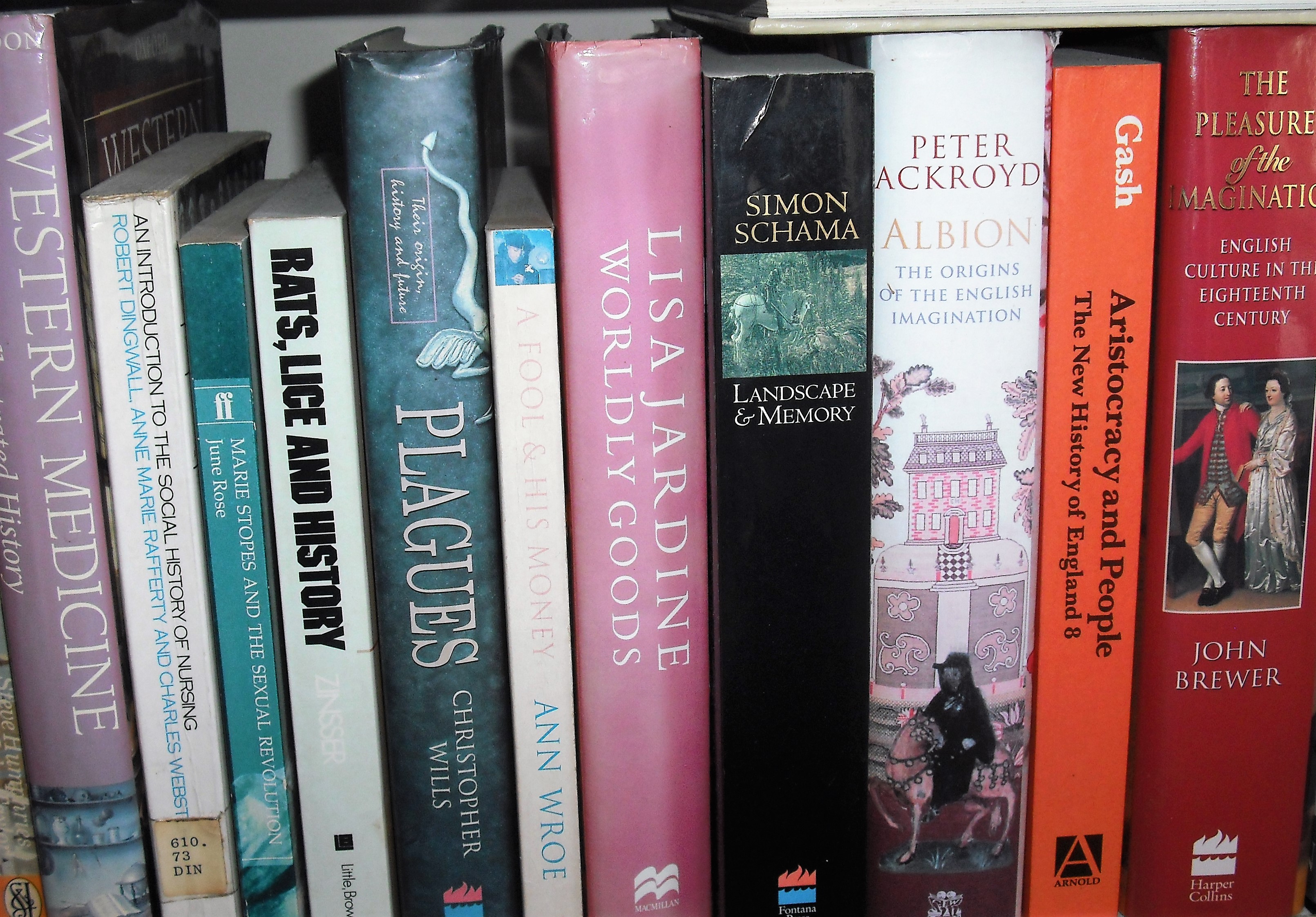
Non-Fiction titles on the book shelves.

I have been struggling to keep motivated with my Landing Book Shelves project lately, as you might have noticed. There has been a distinct lack of words appearing in the blog stream over the last couple of months. The reading part of the Landing Challenge has been making some progress but then the writing aspect has been falling by the wayside. Whether this has been to do with the so-called winter blues (I know it is supposed to be spring now but you cannot tell for the wind and rain), trying to tackle another project or life generally getting in the way, I am not sure. The sum total is a sad lack of posts written up for the Landing blog. I am not doing much better with the Landing’s sister blog Curiously, Creatively either. I am clearly being neither curious nor creative and that will have to change ere long.

Maybe I should have added that (in all honesty) a tendency to become sucked into reading the daily news on various online newspapers is also responsible for my poor output. The only thing that stops the rot is that the Irish Times limits the amount of free articles that one can access in a week. Once I reach my weekly quota then I have had it, no more news. While I appreciate that the company’s primary motive is pecuniary, I am grateful that the Irish Times cares so much about its readers wasting their time online that it blocks their viewing after ten articles. Without that consideration, I would be wasting even more time than I do already. Sadly, the Guardian and the Telegraph are not so public-spirited and I could lose myself in news and comment threads for hours.

Having said all of that, I should point out in my own defence that I have entered a couple of writing competitions this year. Therefore, all is not yet lost as I inch my way through 2015.

Nevertheless, as we move into spring, I intend to ‘up’ my blogging game somewhat, so watch this space….

A celebration and a giveaway of ‘We That are Left’

I thought I’d re-blog Juliet’s post to contribute to her anniversary celebrations for ‘We That are Left’. If you remember, last year she was kind enough to do a guest post for The Landing about some of the war time recipes that she discovered during her book research. I am forced to confess that I still haven’t tried the poppy seed cake!

Best wishes to Juliet for her continued success…

Month of Letters Update

I have written about tackling the February ‘Month of Letters’ challenge before on The Landing and on Writing.ie, so I thought that I would give you a progress report on my 2015 attempt. As usual, I began writing enthusiastically, but this time around, I entered a sort of sluggish phase part way into the month. The original rules of the challenge state that you don’t have to post on Sundays (nor, as the challenge was set by an American writer, on February 16 for President’s Day). On my first couple of attempts, I was enthusiastic enough to include Sundays (despite there being no mail collection on Sunday in Ireland) but this year I have observed the breaks and I feel slightly lazy for having done so. As I ignore the US Public Holiday, that means posting twenty-four items during February.

Card from Claire

Note from Claire

Missing the Sunday letter meant that I despatched my first mailing on 2 February – so far so good. I began the month with a list of possible suspects (in no particular order) and worked from that as the days went on. Originally I had conceived the idea of putting names of possible recipients into a hat and drawing one each day. I thought this would be great way to add a nice element of serendipity to the proceedings. Sadly, it was not to be due to my unfortunate inefficiency. Therefore, I am still working from the list but trying to maintain an air of randomness by not following the list in order. The down side to this is that I have noticed a distressing tendency to do the ‘soft options’ first. In other words, the people I see the most often and to whom I therefore wouldn’t send a long letter, but perhaps only a postcard or note.

Of course I worry that someone will think, ‘Hang on a minute, how come I am not getting a letter until the 23rd? Does this mean that I’m not as important as 22 other people?’ or words to that effect. Maybe I just worry too much. After all, as I write this blog post I am aware that I have yet to post a letter to one of my sisters but I don’t think she’s likely to take offence at that (I hope). Some folks do actually end up getting more than one billet doux as the challenge rules stipulate that you must reply to every letter received. If you really get into the spirit and rhythm of the challenge then there is no reason to post only one item a day. I could post two, three or even more.

As February moves on to meet the March lamb (or lion) I am feeling pleased that I have kept my pen diligently moving. I might even have a last minute flurry of scribbling to squeeze in a few extra people. As usual, I have factored in my dad’s birthday and my parent’s anniversary. I was probing my conscience as to whether I can claim dad’s birthday present as an item posted when I have already counted his card in. It seems rather sharp practice to me, so I might have to reprimand myself. As in previous years, I have been delighted when my recipients have responded in kind. I have scanned in a couple of replies, including Teri Farrell’s postcard with her original artwork. One to frame I think.

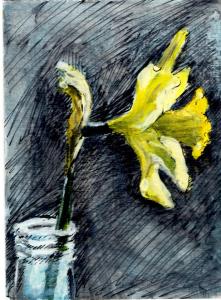
Daffodil from Teri

Daffodil from Teri

I am already thinking about how to make next year’s challenge a little bit different from previous years. The author of the challenge Mary Robinette Kowal suggests that you don’t have to actually send a letter, but something else such as a swatch of fabric as a keepsake. I like that idea, so perhaps I will collect miscellaneous items during the year and then decide whom to send them to next February. And as next year will be a leap year then it would be a great way to do something a little different.

Meanwhile, it’s back to the letter writing for 2015. Has anyone else been participating in Month of Letters?

Interview With Two Editors

As I attended the successful launch of Love on the Road last night, I thought I would re-blog Daniel Seery’s interview with the editors of the collection, Sam Tranum and Lois Kapila. Three of the short story writers attended the launch and read from their stories to whet the appetites of prospective readers.

If I had my Liberties Press hat on at present I would say that this book would be a great Valentine’s Day gift for the short story fan in your life. But as I don’t, just read on and decide for yourselves…

danielseery's avatarDaniel Seery

Writer, Lane Ashfeldt, describes the book Love on the Road 2015 as ‘Vivid tales of life across the globe that lets you travel while standing still.’ And this isn’t surprising when you look at the two editors behind the book. Their travels have taken them from the US to Calcutta and Kyrgyzstan while Sam has served in the Peace Corps in Turkmenistan with Lois working as a defence investigator in the District of Columbia.

Explorers and scribblers, they clearly have a love for the short story and I was more than delighted to get the chance to interview them for my blog ahead of the launch of their excellent collection this month. I just hope they don’t find too many revisions on this piece after I’ve stuck it up on the blog…

 Crates_Terrestrial_Sphere

even if you feel like you’ve never done much of the nuts-and-bolts of writing or editing, you…

View original post 1,038 more words

Maugham on Fiction: An Inspiration for an Essay Reading Challenge

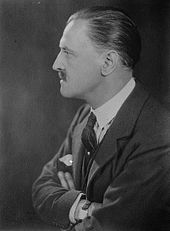
Maugham early in his career

An early career author picture

As I mentioned in my last post, I have been reading some of William Somerset Maugham’s essays from Ten Novels and their Authors (1954, 1978). I skipped through the book to pick out authors that I have read so far for The Landing TBR project. The collection has also reminded me (as if I needed it), that I have many books on the shelves that I have not yet tackled. Perhaps this essay collection will give me the impetus to explore writers, such as Balzac and Dostoyevsky that remain on the TBR Pile. Maugham includes Tolstoy and War and Peace in his Ten Novels selection and attentive Landing readers will recall that I finally got around to reading War and Peace last year. Reading Dostoyevsky would enable me to continue the Russian literature theme that developed after my reading of Tolstoy’s novel. Maugham also writes about Emily Bronte and Wuthering Heights, which caused me to want to re-read that novel, as well as to dig out the Juliet Barker biography of the Bronte family from the back bedroom stash to check a few facts.

What I do have in mind for this year however, is to begin a new Landing Challenge to explore some of the essay collections scattered around the house (not all of them live on The Landing). I was thinking of dipping into a few collections rather than solidly reading all of them. Some collections belong to me (and I am more likely to have read some of these) but the ones belonging to He Who Put The Shelves Up are largely still on my mental ‘to read sometime’ list. My plan would be to tackle a few of the essay collections spaced out over the year, in between reading other books. I might set out to cover (no pun intended) some literary essays first, since chance led me to the Maugham collection.

Ten Novels

A bargain at 90p!

I have been trying to read up a little on Maugham’s life and career but have found several apparent contradictions in online sources so I won’t give you more than brief biographical details here. I am however intrigued enough to attempt to track down a definitive account so when I do, I will post up about it. Somerset Maugham was born in the British Embassy in Paris in 1874 and died in Nice in 1965. His father Robert was a lawyer and his mother Edith Snell was a writer. Orphaned by the age of ten, an aunt and uncle in England brought him up. Maugham was a homosexual at a time when it was still illegal and therefore dangerous to admit publicly, though his orientation was accepted in the literary circles he frequented. He did however enter into what proved to be a short-lived marriage with interior designer Syrie Barnardo and had a daughter, Liza. But more of Maugham’s life and times when I have researched further.

Of the subjects in Maugham’s collection, I have read Pride and Prejudice, David Copperfield, Wuthering Heights and War and Peace, so I will read his essays on these books and talk about them in my next blog post.

And then there’s the remaining five novels that he discuses…..back to the TBR Pile!

Serendipity: Jane Austen, a family letter and Somerset Maugham

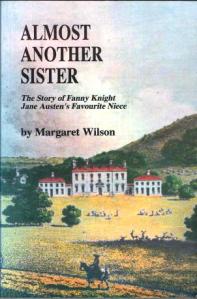
While I was over visiting my parents before Christmas, I had my usual riffle through their bookshelves in search of old friends. I came across a book that I had completely forgotten leaving behind. (Or did I lend it to someone?) The book in question was Almost Another Sister: The Story of Fanny Knight, Jane Austen’s Favourite Niece by Margaret Wilson (George Mann Books, 1998) which I see from my note on the flyleaf that I actually bought in the year of publication.

Fanny Knight book

The picture on the cover is Fanny’s childhood home, Godmersham Park

In the previous year were published biographies of Jane Austen by Claire Tomalin and David Nokes so I was well into Austen family history by the time I bought the Fanny Knight book. I can’t remember how I came to hear of it, but I must have ordered it especially as it wasn’t published by a mainstream publisher. The book represents the extensive research of archivist and former teacher Margaret Wilson, who embarked on a study of Fanny Knight while working at the Centre for Kentish Studies (formerly the Archives Office).

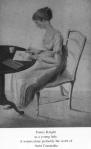
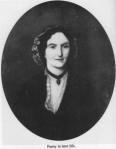
Frances (Fanny) Knight (1793-1882) was the daughter of Jane Austen’s elder brother Edward who had the good fortune to gain a benefactor in Thomas Knight, a wealthy cousin. He made Edward heir to his estates on condition that Edward took the family name. By the time that Edward took the name of Knight, his daughter Fanny was a young woman of nineteen. It must have been strange for her to change from Austen to Knight, given that she probably anticipated changing name yet again on marriage. In 1820, when she was twenty-seven, Fanny married Sir Edward Knatchbull a widower with five children. The couple went on to have a further nine children.

Margaret Wilson has delved into family archives, Fanny Knight’s diaries and surviving letters to paint what she calls a ‘cameo’ rather than a ‘full biography’. This is due to the patchy nature of the available sources, such as the brief diary entries and scraps enclosed which the author describes thus: ‘The overall effect is of a multitude of minutiae, like tiny fragments of a jigsaw picture which is too complex ever to complete in full yet offers tantalising glimpses of the finished scene’. Nevertheless, the book is a fascinating account of a life that bridged two centuries and saw many changes as the Regency period gave way to the Victorian age.

As Fanny grew up, she visited and corresponded with Jane and her sister Cassandra. There was a strong connection between the branches of the Austen family, Jane in Hampshire and Fanny’s family in Kent. Apparently, Fanny was particularly close to Aunt Jane, though sadly not many of their letters survive. A quote from one of Jane’s letters to Cassandra gives an idea of how fond Jane was of Fanny:

A young Fanny Knight

A Young Fanny Knight

I am greatly pleased with your account of Fanny; I found her in the summer just what you describe, almost another sister – and could not have supposed that a niece would ever have been so much to me. She is quite after one’s own heart; … I always think of her with pleasure.

At this point you are probably wondering where Somerset Maugham fits into the picture. It is simple (and highly serendipitous). I was skimming through the bibliography of Fanny Knight when I came across mention of a collection of essays by Maugham, Ten Novels and their Authors. (1954, Pan Macmillan 1978). This sounded familiar so I had a root around on the shelves (in the living room, not in the landing ones this time) and lo and behold, I unearthed the very book. I had picked it up at a second-hand bookstall in Wexford a couple of years ago and never got around to reading it since.

Maugham has an essay on Jane Austen and Pride and Prejudice, which he feels to be her best book. His collection of essays has its origins in a challenge issued to him (by the editor of a journal called Redbook) to pick out the ten greatest novels in the world. Maugham comments ‘Of course my list was arbitrary. I could have made one of ten other novels, just as good in their different ways as those I chose, and give just as sound reasons for selecting them’. But he goes on to speculate that if a hundred readers produced a similar list, selecting perhaps two or three hundred novels, then ‘I think that in all the lists most of those I have chosen would find a place’. 

Fanny Knight in later life

Fanny Knight (Lady Knatchbull)

Margaret Wilson makes use of Maugham for his discussion of a particular letter that Fanny Knight wrote to one of her sisters many years after Jane Austen’s death. If you are a clued-up Austen fan, you will know to what letter I refer, as Margaret Wilson says that ‘Fanny has acquired a poor reputation’ because of the much-debated letter. In this much quoted letter, Fanny is clearly responding to a query or alluding to a previous conversation about her late aunt when, in 1869 she writes,

Yes my love it is very true that Aunt Jane from various circumstances was not so refined as she ought to have been from her talent, & if she had lived 50 years later she would have been in many respects more suitable to our more refined tastes. They were not rich, & the people around with whom they chiefly mixed, were not at all high bred, or in short anything more than mediocre & they of course though superior in mental powers & cultivation were on the same level so far as refinement goes – …

Both Maugham and Wilson quote the offending passages and Wilson also includes the remainder of the letter in an appendix. The discussions about what Fanny did or did not mean by her remarks are interesting. It was all new to me as I had never heard about these criticisms of Aunt Jane. Key to understanding the letter seems to be the changing social times and also Fanny’s social elevation as the result of her marriage. I was amused by Maugham’s reflection that, ‘It is regrettable, but it is a fact, that children do not look upon their parents, or their relations belonging to another generation, with the same degree of affection as their parents, or relations, look upon them. Parents and relations are very unwise to expect it’. In other words he is, perhaps wisely, not particularly surprised that Fanny should be rather mean about the aunt who cared for her so much.

Ten Novels

A bargain in 1978 at 90p!

I would love to have Jane Austen’s thoughts on the offending letter. I am sure that would be worth reading! Since that is an impossibility I will have to make do with reading more of Maugham’s literary criticism. I feel sure that he would be a good subject for a further blog post as he has plenty to say on the art of fiction. Perhaps my new TBR Challenge should explore all of the lit crit lurking around on The Landing!

Any thoughts?

The Magi: in Art and Poetry

To mark the end of the Christmas season, I have returned to one of The Landing’s poetry collections for a suitable verse. You might recall that Read Me: A Poem for Every Day of the Year (chosen by Gaby Morgan) has appeared here before in poetry features.

The poem for 6 January is by poet and translator Christopher Pilling, who originally hailed from my hometown of Birmingham but who now lives in the Lake District. ‘The Meeting Place’ was originally published in Poems for Christmas (Peterloo Poets, 1982). It was inspired by a Rubens painting, The Adoration of the Magi so I have included it in the post. Rubens painted several versions of this painting, and this particular one now belongs to Kings College, Cambridge. If you want to discover more about the history of this representation of The Adoration of the Magi, then take a look at Patrick Comerford’s blog who has featured the painting today as the last in his Art for Christmas series.

The Meeting Place

(after Rubens: The Adoration of the Magi, 1634)

It was the arrival of the kings
that caught us unawares;
we’d look in on the woman in the barn,
curiosity you could call it,
something to do on a cold winter’s night;
we’d wished her well –
that was the best we could do, she was in pain,
and the next thing we knew
she was lying on the straw
-the little there was of it-
and there was a baby in her arms.

The Adoration of the Magi

The Magi

It was, as I say, the kings
that caught us unawares…
Women have babies every other day,
not that we are there –
let’s call it a common occurrence though,
giving birth. But kings
appearing in a stable with a
‘Is this the place?’ and kneeling,
each with his gift held out towards the child!
They didn’t even notice us.
Their robes trailed on the floor,
rich, lined robes that money couldn’t buy.
What must this child be
to bring kings from distant lands
with costly incense and gold?

And what were we to make of
was it angels falling through the air,
entwined and falling as if from the rafters
to where the gaze of the kings met the child’s
-assuming the child could see?
What would the mother do with the gifts?
What would become of the child?
And we’ll never admit there are angels
or that somewhere between
one man’s eye’s and another’s
is a holy place, a space where a king could be
at one with a naked child,
at one with an astonished soldier.
I love the almost gossipy way the event is being described, as though someone is just popping round from next door to see what’s going on. Being ‘caught unawares’ and almost not in on the action!

Once again, ‘A Happy New Year’ to all of my followers and thanks for reading!

Picture credit; Wikipedia, with thanks.

The Chimes by Charles Dickens

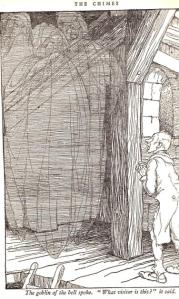
I have The Chimes on The Landing Book Shelves, in two editions. The one that I have had for the longest time is an abridged version contained within The Children’s Treasury of Classics, mentioned in a previous post. A second version is in an edition of Dickens’ Christmas Books (Collins Clear Type Press) that I bought second hand in Birmingham. It has no publication date printed inside (Collins brought this collection out in 1906 but I am not sure if my copy dates from then) but there is an inscription dated 1967. Both versions of the story are illustrated with black and white sketches; the latter is by Arthur. A. Dixon and the former by an un-credited artist. I must have read the children’s story at one time but I didn’t recall it very well, when I came to re-read the unabridged version recently. The drawings of The Treasury did however stay in my memory, the daunting image of the ghostly figures made quite an impression on me as a youngster. Dixon did not do an illustration of the ghosts so I don’t have a comparison to make. You can check out the link above to see his work for the Christmas Books and other Dickens works in the Collins editions.The Chimes

Dickens wrote this story in 1844, after the publication of A Christmas Carol and a year before he wrote The Cricket on the Hearth. As I featured the first of Dickens’ Christmas stories here previously I thought that it was high time that I moved on to the next one in the series. Actually, The Chimes is more of a New Year’s tale as it is set just as the old year is preparing to give way to the new. People are settling their accounts so that they may begin the New Year afresh. However, The Chimes is similar to its predecessor in that it is also a seasonal ghost story. A series of spirits show the main protagonist Toby (Trotty) Veck the error of his ways in the manner similar to that suffered by Mr Scrooge. Unlike wealthy but misanthropic Scrooge, the likeable Trotty is a poor ticket porter who struggles to earn more than a few pennies a day. His crimes against his fellow humans are less than are Scrooge’s but despite this, the spirits from the church bell tower take him to task over the course of an eventful New Year’s Eve.

But what are Trotty Veck’s crimes against humanity? Trotty is judged to be guilty that day of losing all hope in the future, of believing that the poor must really be as bad as the newspapers and the paternalistic middle classes say they are, and of losing compassion for the desperate plight of others of his class. Toby was sitting reading the paper on New Year’s Eve and he came to a report about a woman who was so desperate not to return to the workhouse that she tried to drown herself and her baby (Dickens was inspired by a real case):

“Unnatural and cruel!” Toby cried. “Unnatural and cruel! None but people who were bad at heart, born bad, who had no business on the earth, could do such deeds. It’s too true, all I’ve heard to-day; too just, too full of proof. We’re bad!”
The chimes took up the words so suddenly – burst out so loud, and clear, and sonorous- that the bells seemed to strike him in his chair.
And what was that they said?
“Toby Veck, Toby Veck, waiting for you, Toby! Toby Veck, Toby Veck, waiting for you, Toby! Come and see us, come and see us! Drag him to us, drag him to us! Haunt and hunt him, haunt and hunt him! Break his slumbers, break his slumbers! Toby Veck, Toby Veck, door open wide, Toby! Toby Veck, Toby Veck, door open wide, Toby-“ Then fiercely back to their impetuous strain again, and ringing in the very bricks and plaster on the walls.

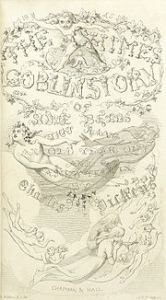
The Chimes title page

First edition

The spirits of The Chimes show Trotty a glimpse of the future, or at least a version of it. They tell him that he has been dead for nine years after falling from the church steeple. The future presented by the spirits turns to out to be very bleak for Trotty’s family and friends. I don’t want to give any more away to anyone who has not read this story, so I will just hint that if you think about Scrooge’s prospects after the spirits have visited then you may reassure yourself before you read.

The story has been overshadowed by the success of that of Ebenezer Scrooge, though The Chimes was very well received upon publication. I can’t help thinking that the spirits were rather hard on poor old Toby, but Dickens was making the point that Toby shouldn’t give up hope and start to believe that the poor were not entitled to a better existence. Dickens was also satirising those who people claimed to be friends of the poor – as long as they stayed in their place:

Oh, let us love our occupations,
Bless the squire and his relations,
Live upon our daily rations,
And always know our proper stations.

This nineteenth century story still has something to offer us and gives us an apt lesson for the beginning of the New Year. Less a resolution than a philosophy of life.

Happy New Year!

Credit: Additional illustration from Wikipedia, with thanks.