The Chimes by Charles Dickens

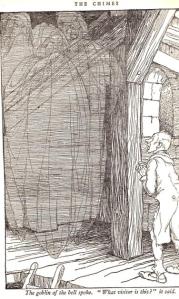
I have The Chimes on The Landing Book Shelves, in two editions. The one that I have had for the longest time is an abridged version contained within The Children’s Treasury of Classics, mentioned in a previous post. A second version is in an edition of Dickens’ Christmas Books (Collins Clear Type Press) that I bought second hand in Birmingham. It has no publication date printed inside (Collins brought this collection out in 1906 but I am not sure if my copy dates from then) but there is an inscription dated 1967. Both versions of the story are illustrated with black and white sketches; the latter is by Arthur. A. Dixon and the former by an un-credited artist. I must have read the children’s story at one time but I didn’t recall it very well, when I came to re-read the unabridged version recently. The drawings of The Treasury did however stay in my memory, the daunting image of the ghostly figures made quite an impression on me as a youngster. Dixon did not do an illustration of the ghosts so I don’t have a comparison to make. You can check out the link above to see his work for the Christmas Books and other Dickens works in the Collins editions.The Chimes
Dickens wrote this story in 1844, after the publication of A Christmas Carol and a year before he wrote The Cricket on the Hearth. As I featured the first of Dickens’ Christmas stories here previously I thought that it was high time that I moved on to the next one in the series. Actually, The Chimes is more of a New Year’s tale as it is set just as the old year is preparing to give way to the new. People are settling their accounts so that they may begin the New Year afresh. However, The Chimes is similar to its predecessor in that it is also a seasonal ghost story. A series of spirits show the main protagonist Toby (Trotty) Veck the error of his ways in the manner similar to that suffered by Mr Scrooge. Unlike wealthy but misanthropic Scrooge, the likeable Trotty is a poor ticket porter who struggles to earn more than a few pennies a day. His crimes against his fellow humans are less than are Scrooge’s but despite this, the spirits from the church bell tower take him to task over the course of an eventful New Year’s Eve.

But what are Trotty Veck’s crimes against humanity? Trotty is judged to be guilty that day of losing all hope in the future, of believing that the poor must really be as bad as the newspapers and the paternalistic middle classes say they are, and of losing compassion for the desperate plight of others of his class. Toby was sitting reading the paper on New Year’s Eve and he came to a report about a woman who was so desperate not to return to the workhouse that she tried to drown herself and her baby (Dickens was inspired by a real case):

“Unnatural and cruel!” Toby cried. “Unnatural and cruel! None but people who were bad at heart, born bad, who had no business on the earth, could do such deeds. It’s too true, all I’ve heard to-day; too just, too full of proof. We’re bad!”
The chimes took up the words so suddenly – burst out so loud, and clear, and sonorous- that the bells seemed to strike him in his chair.
And what was that they said?
“Toby Veck, Toby Veck, waiting for you, Toby! Toby Veck, Toby Veck, waiting for you, Toby! Come and see us, come and see us! Drag him to us, drag him to us! Haunt and hunt him, haunt and hunt him! Break his slumbers, break his slumbers! Toby Veck, Toby Veck, door open wide, Toby! Toby Veck, Toby Veck, door open wide, Toby-“ Then fiercely back to their impetuous strain again, and ringing in the very bricks and plaster on the walls.
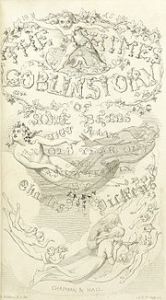
The Chimes title page

First edition

The spirits of The Chimes show Trotty a glimpse of the future, or at least a version of it. They tell him that he has been dead for nine years after falling from the church steeple. The future presented by the spirits turns to out to be very bleak for Trotty’s family and friends. I don’t want to give any more away to anyone who has not read this story, so I will just hint that if you think about Scrooge’s prospects after the spirits have visited then you may reassure yourself before you read.

The story has been overshadowed by the success of that of Ebenezer Scrooge, though The Chimes was very well received upon publication. I can’t help thinking that the spirits were rather hard on poor old Toby, but Dickens was making the point that Toby shouldn’t give up hope and start to believe that the poor were not entitled to a better existence. Dickens was also satirising those who people claimed to be friends of the poor – as long as they stayed in their place:

Oh, let us love our occupations,
Bless the squire and his relations,
Live upon our daily rations,
And always know our proper stations.

This nineteenth century story still has something to offer us and gives us an apt lesson for the beginning of the New Year. Less a resolution than a philosophy of life.

Happy New Year!

Credit: Additional illustration from Wikipedia, with thanks.


Summer at the Bookshop: it started with a sketch…

In honour of bookselling summers gone by (and fellow booksellers), I am re-posting an edited version of a blog article that I originally wrote for Writing.ie when I was working for Hughes and Hughes a few years ago. It was first posted on 31 May 2012 in the now discontinued Booksellers’ blog column. The post was inspired by the fun we had putting together a summer-themed table at the front of the shop. The book recommendations from 2012 still stand I think, so if you are looking for ideas for the kids then read on…

If anyone had told me twenty years ago, that bookselling would involve playing with bits of coloured paper and cotton wool; I would have raised a gently inquiring eyebrow. These days I am more experienced in such creative matters. Indeed, there are times when it feels less like working in a bookshop and more like being back in primary school. Thank heavens for all of those Blue Peter watching years when I was being inspired by Val’s and John’s handiwork.

Like most creations, our summer themed table began with the merest sketch of an idea. The tricky part is usually translating the idea into 3D reality (and serving customers at the same time). That was where the cotton wool came into play as we attempted to create a model of an ice-cream cone (complete with flake) for our shop front display table. With the addition of yellow wrapping paper and some crepe paper in a lovely shade of blue, we were well on the way to bringing the seaside to a Dundrum shop floor.

The table was truly a joint effort: Claire, Maeve and Michelle were responsible for some very bijou beach huts and a shoal of little Nemos. And did I mention the fierce-looking pirates? However, the pièce de résistance was Andrew’s larger than life ice-cream cone, which dominates the table, inviting thoughts of summer treats. Don’s original idea was very well realised by the team and we were very pleased with ourselves (she said modestly).

Summer Table

Our rather splendid summer scene

We have all had a great deal of fun cutting out shapes, but the serious purpose was obviously to make something a little more eye-catching than basic merchandising. We filled the table with stock aimed at parents and children, with a mixture of new summer titles, colouring and activity books and toys. We arranged some bright and cheerful gardening gear for kids, which include hats and gloves for any future ‘Bloom’ exhibitors out there. When I saw the little ‘Bug House’, I was reminded of Dick King-Smith’s enchanting ‘Sophie’ books. For anyone not familiar with the series, the plot of the first novel saw Sophie earnestly collecting garden bugs of all shapes and sizes for her mini farm. Not all parents would appreciate that one I suppose…

For parents travelling with younger children, sticker, activity and colouring books are usually a good idea. For example, the Airport Colouring Book will peacefully while away the inevitable waiting time. If not, there is always Julia Donaldson and Axel Scheffler to rely upon, with for instance the Tales from Acorn Wood Activity Book.

Usborne Books had the bright idea of bringing out a book made up of holiday postcards for children to colour. There’s no excuse for anyone not to send cards home to the grandparents then! We also have plenty of ideas for summer holiday reading. Gerry Boland’s new Marco adventure, Marco: Master of Disguise(O’Brien Press) is completely charming. Marco is an escaped tea drinking grizzly bear who is hiding out from the zoo authorities. Áine McGuiness’ illustrations are wonderful; you could just see yourself giving a home to a grizzly like Marco (always assuming that you had enough tea bags).

For children’s holiday reads, then look no further than to the winners of the CBI Book Awards, announced recently. For older readers, Celine Kiernan’s Into the Greyis a gripping and atmospheric story. Celine received the double whammy of the Book of the Year Award and the Children’s Choice Award. I’ll hazard a guess at which award she was most pleased to win.

At the other end of the reading scale, his delightful picture book Stuck will no doubt appeal to the many Oliver Jeffers fans around. Stuck won the ‘Honour Award’ for Illustration, beating off stiff competition. Jeffers’ new book, The Hueys in the New Jumperhas recently hit the bookshelves, and it promises to be another bestseller. I want a Huey of my own now please (complete with orange jumper). Mark O’Sullivan won the Judges’ ‘Special Award’, for My Dad is 10 Years Old; Paula Leyden won the Eilís Dillon Award for The Butterfly Heart, based on her own experiences of growing up in Zambia. Siobhán Parkinson had two titles in the shortlist and won the ‘Honour Award’ for Fiction with Maitriόisce, which explored five generations of a family. Last but by no means least, Roddy Doyle was lucky enough to win the schools’ ‘Shadowing Award’ for A Greyhound of a Girl, which is now out in paperback just in time for the holidays.

Congratulations to all of the winners mentioned above. I hope that I have given a few useful ideas for the holiday season, but if you need a bit of help choosing, just pop in and ask a bookseller.

I hope the post has inspired you to either pop into a real bookshop for your children’s summer reads, or to grab scissors and paper and have some creative fun during the holidays! The Bookworm read A Greyhound of a Girl when it first came out and thoroughly enjoyed it and going a little further back, was a firm Sophie fan. If you’ve never met Dick King-Smith’s feisty heroine then do give her adventures a read.

Picture credit: me (unfortunately I’ve lost the original jpeg file so the quality isn’t great) and also used on the Writing.ie blog post.

Ladies who take tea: Cranford

Over the last wee while, I have been reading Mrs Gaskell’s Cranford aloud to the Bookworm (usually on a Sunday morning for some reason) and we are now roughly half way through. I can’t honestly be sure if I have ever read it before but I do recall watching a BBC series some years ago. After a bit of searching I tracked down the series from 1972 that I remember watching with mum (it was dad’s cue to go and do the washing up, as he wasn’t a fan). When we get through the novel, unless I can dig up a copy of that series from somewhere, we are going to watch a DVD of the newer series from 2007 that I missed first time around, .

Cranford

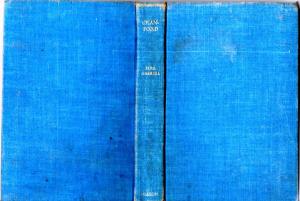
Dust jacket long since gone

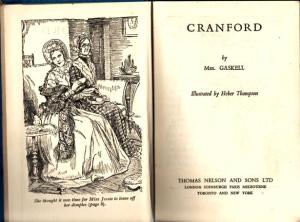
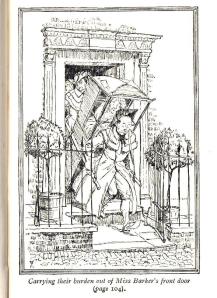
My edition of Cranford is a modest little Thomas Nelson hardback volume (undated) which is somewhat shabby after previous handling. Judging by the flyleaf I am the fourth owner of the book, but who knows for sure (I haven’t written in it, though I often do put my name in books). Heber Thompson illustrated the book with black and white sketches of various scenes from the story. I have chosen to scan a couple for the blog post that relate to events in the early chapters (see below).  We were particularly fascinated by the manoeuvres of the sedan chair men, not having realised that it was customary for the chairs to be carried into the house. And did you know that it was possible (and perhaps expected) to give up your dimples at a certain age?


Elizabeth Cleghorn Stevenson (1810-1865) married Rev William Gaskell, a Unitarian minister in 1832. She published most of her work under her married name including a collection of poems (Sketches Among the Poor) co-authored with her husband. The exceptions were early short pieces of fiction that were published under a pseudonym and Mary Barton (1848) her first novel which was initially published anonymously. Mrs Gaskell became very well-known for the first biography of Charlotte Bronte, which she wrote at Patrick Bronte’s request after his daughter’s death. She produced a highly sanitised version of Charlotte Bronte in the biography; I was reading a Guardian article by Tanya Gold who was quite scathing about the book. Not having read it, I can’t really comment though I have heard that criticism levelled at Gaskell before, who apparently began the mythologizing of Bronte’s life and work.

Cranford title page

Miss Matty looking a tad disapproving…

The Gaskell’s social circle included many from dissenting backgrounds and the couple were friends with reformers such as William and Mary Howitt and literary luminaries Charles Dickens and Harriet Beecher Stowe. Elizabeth Gaskell’s concern for the welfare of the poor and interest in women’s lives comes over in her work. In Cranford (based on Knutsford in Cheshire where she spent her early years), Gaskell details the lives of the female population of the town.

All of the petty economies made by widows and spinsters in straightened circumstances and the eagerness with which a new diversion to the predictable daily round was received, are minutely and sympathetically explored. The book doesn’t have a plot as such, being a series of episodes in the lives of the genteel ladies of the small town. This provides plenty of opportunity for gentle humour, as social events and minor scandals take place. These are seen through the eyes of a young woman Mary Smith, who  lived in Cranford as a child and now comes to stay for extended visits.

There are several sad episodes and one rather touching one is where an elderly spinster, Miss Matty relents in her prohibition of her maid Martha having ‘followers’. Poor Miss Matty has been recently reminded of how she lost her chance of marriage, and is willing to allow Martha to have a young man provided he passes inspection,

“God forbid!” said she, in a low voice, “that I should grieve any young hearts”.  She spoke as if she were providing for some distant contingency and was rather startled when Martha made her ready eager answer. 

” Please, ma’am, there’s Jem Hearn, and he’s a joiner making three-and -sixpence a day, and six foot one in his stocking-feet, please, ma’am; and if you’ll ask about him to-morrow morning, every one will give him a character for steadiness; and he’ll be glad enough to come to-morrow night, I’ll be bound.”

Though Miss Matty was startled, she submitted to Fate and Love.

Perhaps catching up with Elizabeth Gaskell’s books on both page and screen will become another offshoot of my TBR Pile reading project. I am certain of having read Cousin Phillis (1864), and Wives and Daughters (1865) in the dim and distant past, though they have now mysteriously disappeared from The Landing Book Shelves. There are a couple more novels that I would like to read as well as the Charlotte Bronte biography.

The Sedan Chair

It doesn’t look very safe..

I’m not sure how many more Sundays worth of reading lie ahead of us (distractions are many as I’m sure you’re aware) but I enjoy ‘grown-up’ reading aloud so I’m not in a hurry to finish. It doesn’t seem that long since we were on A very hungry Caterpillar; the years have suddenly flown by!

Do you ever read aloud? And if so, what are your favourites?

An Interview with Karen Vaughan…

This post from Daniel Seery’s blog is an interview with one of my colleagues, graphic designer Karen Vaughan. When I discovered from reading this that we share a liking for Edmund Dulac and Arthur Rackham, of course I had to give her a mention! It’s also worth checking out more of Daniel Seeery’s blog if you have the time. His first novel A Model Partner (Liberties Press) is being launched next week in Dublin. And it does have a great cover…

danielseery's avatarDaniel Seery

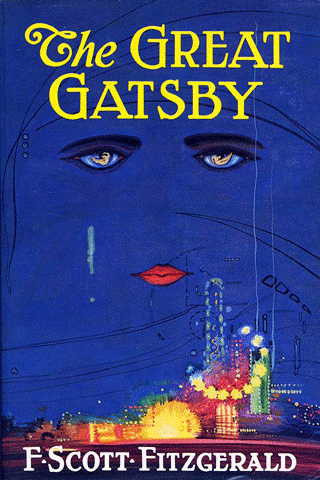
In 1925, an artist by the name of Francis Cugat was commissioned to design the cover of F. Scott Fitzgerald’s ‘The Great Gatsby’ despite the fact that the novel had yet to be completed.  When the author saw the cover, he was so enamoured with it that he told the publisher he had written it into the book. This is the power a cover illustration can have on a book.

Gatsby_1925_jacketRecently, I’ve been working with a fantastic cover artist by the name of Karen Vaughan.  Karen is an illustrator and designer working with Liberties Press. She has a particular love for pen and ink and examples of her work can be seen on her website –

http://kvaughan.com/

She is an artist to watch out for in the future and luckily I managed to get an interview with her…and here it is…

Karen, when did you first realise you wanted to…

View original post 499 more words

A Christmas Classic: A Christmas Carol

I hope you are all enjoying the Christmas break and managing to fit in a spot of reading in between dealing with the left-over turkey and stuffing. Here on The Landing we’ve been revisiting the old favourites, one of which is DickensA Christmas Carol (1843). I’ve been reading this aloud (but not, alas, in a very Dickensian manner) over the last couple of evenings. Last year we all went to see Clive  Francis performing his one man show of A Christmas Carol at the Mill Theatre in Dundrum, Dublin. While I can’t hope to emulate that fine version of the story, I have enjoyed our own reading of Scrooge’s Christmas journey towards a kinder, more generous life. And I still find Mr Fezziwig’s jolly party to be one of my most favourite episodes in Scrooge’s history.

A Christmas Carol

Searle’s take on Dickens

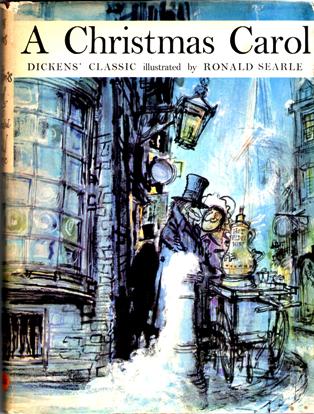
Last Christmas I featured Dickens’ A Christmas Tree in my Advent series so it’s about time his most famous story got a look in here. This edition of A Christmas Carol contains illustrations by the wonderful Ronald Searle and was first published by Perpetua Books in 1960. I can’t remember when I acquired it, suffice to say it was several years ago when I was living in Birmingham. According to the title page, the book used to belong to a family from Moseley; now it seems to be quite settled on The Landing in Dublin.

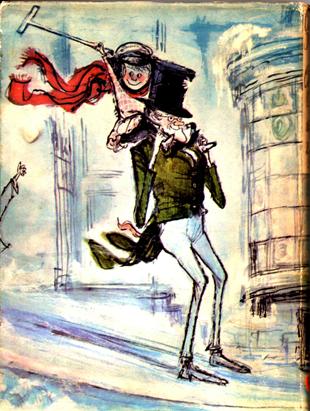
I would like to give you more of Searle’s illustrations, but I’ll have to content myself with scanning in the back cover for the present. You’d be hard pressed to find a better impression of Bob and Tiny Tim anywhere in print. And how else should the back cover be decorated except with a picture of Tiny Tim ‘who did NOT die’ and to whom Scrooge ‘became a second father’?

Tiny Tim and Bob Cratchit

A jolly way to end…

Wishing you all a very Happy Christmas from The Landing Book Shelves! 

First Day of Advent

This time last year I was just embarking on my Advent Calendar challenge for the Landing Book Shelves but this year’s December won’t be as bustling. I hope to do some seasonal posts but I’m continuing with the challenge of reading War and Peace too; my aim is to finish the book by Christmas.

As this is the first day of Advent the ritual of putting up the Advent Calendar has taken place in our house (the calendar having first been retrieved from the mysterious depths of the loft by He Who Put The Shelves Up). There is usually more than this one calendar in the house thanks to various friends and relations but they are mere bit part players. The perpetual Advent Calendar is the star of the show.

Advent Calendar

Advent Calendar

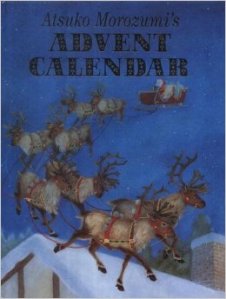
The calendar is a hard backed book that opens out into a 3 D scene of a living room with a fireplace, down the chimney of which Father Christmas will pop on Christmas Eve. The calendar is by writer and illustrator Atsuko Morozumi and published in 2006 by Mathew Price Ltd. I can’t remember when we first had the calendar but it has certainly been doing its duty for the last few years. A few creases have appeared but it is wearing well.

It’s hard to believe that Christmas is coming closer again, I really must get geared up for making mince pies and other seasonal goodies. The first door on the Advent Calendar is always a wake-up call to get planning and list-making. I’ve also had my first Christmas card.

Advent Calendar Interior

Interior of the Advent scene

If you have a favourite Advent Calendar at home do drop me a line in the comment box. By the way, does anyone else remember the Blue Peter team making an Advent decoration with wire coat hangers and tinsel?

Marc Chagall: Modern Master

The Landing Bookshelves have been rather quiet of late for one reason or another I’m afraid but I hope to shake off my dose of ‘Blogger’s Block’ as soon as possible. With a little bit of luck (as Alfred Doolittle once sang) normal service should resume shortly. Meanwhile, here’s a quick snapshot of a  new purchase for my TBR Pile...(!)

Chagall catalogue

Chagall exhibition catalogue

I went to visit the Marc Chagall (1887- 1985) exhibition at Tate Liverpool recently and indulged myself in a catalogue purchase with my birthday money afterwards. The last major Chagall exhibition held, which I also managed to visit, was Chagall: Love and the Stage at the Royal Academy in London, 1998.

I can still recall a feeling of being incredibly overwhelmed by the experience of looking at the paintings in the flesh as it were, that I had previously only seen in books. When I went on to study art history as a mature student later that year, I was able to choose Chagall as a topic in the assessment work for a couple of modules.

Not surprisingly I have yet to actually sit down and read my new catalogue properly but instead have been raptly gazing at the reproductions. One of my favourite paintings, The Promenade  (1917/18) depicting Chagall with his wife Bella floating in the air above him, is placed opposite the foreword. The rationale for this exhibition, according to the foreword, is to offer a reappraisal of Chagall’s work. This has  similarly also been essayed for Klimt, Picasso and Magritte in Tate Liverpool’s recent summer exhibitions.

The editors explain that the exhibition intends to represent Chagall ‘as a pioneering avant-gardist who responded to the initial problems and paradigms of abstraction with narrative elements, expressionist colour, nostalgia, fantasy and folklorist influences to create poetic and enduringly moving works.‘ Five essays by experts on Chagall’s work look these different aspects of his art, beginning with Simonetta Fraquelli on ‘Logic of the Illogical: Chagall’s Paintings 1911-1914’. The painting on the catalogue cover, I and the Village comes from this period; Chagall’s own particular view of the world is expressed in gorgeous colour in a brilliant composition.

Another essay in the catalogue explores Chagall’s influences from his Jewish heritage and his positioning of himself as a painter of a much wider world. Monica Bohm-Duchen (Marc Chagall: Russian Jew or citizen of the world?) discusses Chagall’s early life in Vitebsk, in a devout Hasidic household, his art studies in Russia and his eventual move to the cosmopolitan art world in Paris. Introducing her piece, Bohm-Duchen says that ‘an understanding of his complex relationship to his Russian-Jewish roots remains central to an understanding of his oeuvre’.

I look forward to settling down and reading these and the other essays in the book in the next few days. Chagall has featured in a previous blog post back in the #PoetryinJune series as the subject of an Alan Murphy poem. If you missed it first time round then do take a look at it.

More from the TBR Pile on the Landing Bookshelves soon. Drop me a line about your summer reading/activities if you have come across anything you’d like to share.

Back soon!

Jenny Joseph

This morning, on my #PoetryinJune Reading Challenge, you have the delight of listening to Jenny Joseph (b 1932) reading her poem Warning in a clip that I discovered on YouTube. I’ve given the text below as well in case the piece is unfamiliar to you. This poem was published in 1961 and I came across it in the late 1990s when I was working in a Birmingham bookshop (as it happens Jenny Joseph was born in Birmingham).

In 1997, Warning was published as a stand alone piece with illustrations by Pythia Ashton-Jewell (Souvenir Press) and I remember selling many copies at the time. It was a fantastic idea to publish the poem as a gift book (see picture of front cover) and Ashton’s drawings are a brilliant complement to the text. The giving of the poem as a gift (along with a red hat) by one particular woman gave rise to the establishment of the Red Hat Society (1998) in the USA.

Sue Ellen Cooper gave a copy of the poem with a red hat on friend’s 55th birthday in 1996, and the rest, as they say is history. The society now has many chapters in the US and world-wide. I would love to know whether Jenny Joseph is an honorary member of the RHS. Not many people can claim to have written a poem that has resulted in a global women’s movement. It is appropriate to have picked Warning for my #Poetryinjune feature as the Red Hat Society’s World Wide Hoot 2013 was held on 15 June. If had realised sooner I would have posted Warning up on the day, but belated best wishes to all of the Red Hatters out there.

And here is the poem that started it all:

Warning

When I am an old woman I shall wear purple
With a red hat which doesn’t go, and doesn’t suit me,
And I shall spend my pension on brandy and summer gloves

Jacket of Warning by Jenny Joseph

Souvenir Press, 1997

And satin sandals, and say we’ve no money for butter.
I shall sit down on the pavement when I’m tired
And gobble up samples in shops and press alarm bell
And run my stick along the public railings
And make up for the sobriety of my youth.
I shall go out in my slippers in the rain
And pick the flowers in other people’s gardens
And learn to spit.

You can wear terrible shirts and grow more fat
And eat three pounds of sausages at a go
Or only bread and pickle for a week
And hoard pens and pencils and beermats and things in boxes.

But now we must have clothes that keep us dry
And pay our rent and not swear in the street
And set a good example for the children.
We will have friends to dinner and read the papers.

But maybe I ought to practise a little now?
So people who know me are not too shocked and surprised
When suddenly I am old and start to wear purple.

I hope that has given you a mid-week smile. More #PoetryinJune tomorrow! Are any Red Hatters out there? If so, give me a shout…

Credits:  details shown at end of video (recorded 2008) – with thanks.

Ian Harrow

Gaugin to himself

Jacket of Polemos

Eperon Press, 1998

      (1897)

The girl sits on a stone to watch
Salt water brush her sturdy feet,
Cleansing thighs of dust from the road.
Her lips, with faint sea-fruit bouquet
Show, mocking and inflamed, the risk
Was yours. Swift as a day that life
When she asked you to let her go
And you felt the relief of one
Almost sacredly cast down…Here
Suddenly, your longing to be
Disappointed! What else schedules
Of days for, wandering unfree?
Mark with your secreta the sites
Of ghosts; take your place, a cornered
Wolf in a wreck of squealing cats.
More thrown back than resurrected.

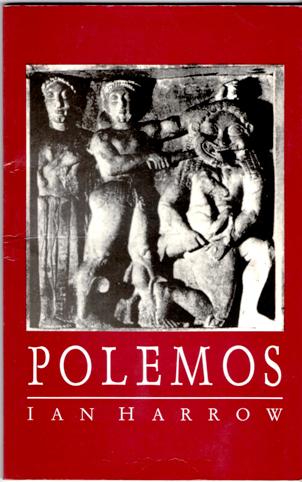
My rationale for choosing today’s poem is that as I was typing up the post about Alan Murphy’s verse on Marc Chagall my thoughts strayed to my days studying art history at the University of Central Lancashire. Ian Harrow was one of my lecturers when I started the course in September 1998. It seems a frighteningly long time ago now. I remember choosing Chagall as an essay topic in one of the modules that Ian taught but I have so far stopped short of digging the paper out of my archive. Probably best to let sleeping essays lie.

I’ve had this collection for a while, though I bought it after I had graduated. I’ve chosen the poem on Gaugin, partly to continue the art related theme generally and partly because of the specific topic.

A few years ago He Who Put the Shelves Up bought me a study of Gaugin’s work in Tahiti, Gaugin’s Skirt by Stephen F Eisenman (Thames and Hudson, 1997).  Eisenman’s fascinating book looks at Gaugin’s relationship with Tahiti, depiction of women, colonialism and contemporary Tahitians. Having being prompted by my poetry musing to pick it up again I might add it to my ever growing summer holiday list.

Ian Harrow has  a new collection published this year called Words Take Me (Lapwing Press). I’ve read a couple of poems from this collection on Poetry PF so take a look at the link.

Apologies for the late posting today – I was busy doing a bit of blog maintenance behind the scenes. Now to get working on tomorrow’s choice….

Alan Murphy on Marc Chagall

Catalogue for Marc Chagall exhibition

Spotlight on Chagall

The back story of today’s #PoetryinJune choice of Alan Murphy is that yesterday I heard from a friend about a major exhibition of Marc Chagall’s (1887-1985) work that has just moved to Tate Liverpool. The timing couldn’t be better as I usually go over to the UK on a summer visit. I realised with a vague sense of shock that it was as long ago as 1998 that I went to London to see ‘Chagall, Love and the Stage’ at the Royal Academy. It was a stunning experience so I am keen on fitting in a trip to Liverpool with our summer travel plans.

This then leads me to Alan Murphy, whom we first saw at one of the Mountains to Sea Festival events at the County Hall a couple of years ago. I bought his collection The Mona Lisa’s on our Fridge (2009) which the author kindly signed for my daughter. Apart from the title poem, the book also contains two other art related poems; one on Picasso and one on Chagall. I will just quote the first and last verses to give you an idea.

According to Marc Chagallbook cover of The Mona Lisa's on our Fridge

How does it rain if the rain runs upwards?
 -in the mind of Marc Chagall.
How can a bun turn into the sun?
 -by the power of Marc Chagall.
And when does a town recline on a cloud?
 -when its world is Marc Chagall’s.

So doff your hat but hold on to your head;
Just lose your logical limits instead,
And gamely greet green, orange and red
 -the music of Marc Chagall.

My 1998 exhibition guide says of Chagall’s Russian – Jewish background that ‘An intense belief in the supernatural and miracles was part of everyday life’ and this is expressed in his paintings. Alan Murphy’s poem beautifully translates Marc Chagall’s scenes into words and puts over the sheer delight and exuberance of the paintings where ‘gravity wanes and withers’ (2nd verse). If you had never seen a Chagall painting, this poem would be a great introduction as it conjures up the surreal world that you find in his art. Alan Murphy is an artist as well as a writer and I think that his engagement with art comes across in this poem in a way that children can appreciate. Adults (well me anyway) can enjoy the fun with art too; there’s a also great poem entitled Pablo Picasso in this collection which is fitting as he and Chagall were artistic rivals.

Alan Murphy is based in Co Waterford and has published a second volume of poetry for children Psychosilly in 2011.

I hope you’re having a good weekend so far. After today’s piece on Chagall, drop by tomorrow for a poem to commemorate Bloomsday.

Update August 2013:

I did actually get to see the Tate Liverpool exhibition this month and bought the catalogue which I have featured in a blog post on Chagall.