Advent Reading Challenge: Baubles

15th December

Bauble Blues by James Carter (taken from Read me and Laugh: A Funy Poem For Every Day Of The Year, chosen by Gaby Morgan),  Macmillan, 2005. This poem was originally published in Cars, Stars and Electric Guitars by James Carter, 2002.

This is another great collection of verse for children, and though you do not of course have to read the poems on their appointed day, the structure does encourage incorporating poetry into daily life. The verses vary in length and are from poets old and new covering a range of topics. I had a trawl through December and found this one and another which will appear on the blog next week.

As this is a concrete poem I have reproduced it in its entirety alongside the typed version:

oohhh! it’s not much fun as a Christmas decoration –
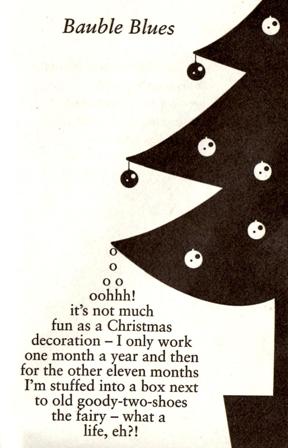
Bauble Blues concrete poem

Concrete thoughts…


I only work one month a year and then for the other

eleven months I’m stuffed into a box next to old goody-

two-shoes the fairy – what a life, eh?!

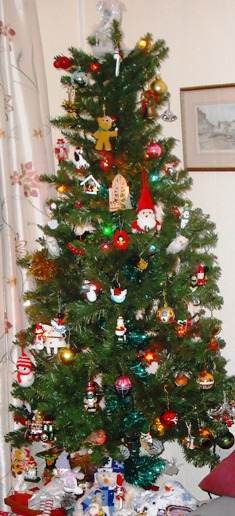
I had never thought of Christmas decorations having sad lives before reading this short poem, now I wonder whether I should simply keep them up all year round. It is also probably just as well that we have a star and not a fairy for the top of our tree.
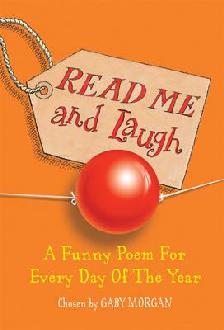
Read Me and Laugh

Funny poems galore


Advent Reading Challenge: Pancake Panic

14th December

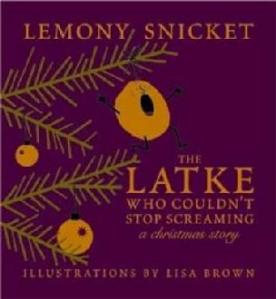
The Latke who couldn’t stop screaming: a Christmas Story by Lemony Snicket with illustrations by Lisa Brown (McSweeny’s Books, 2007)

This is a Christmas book with a difference as it tells the story of a frying Hanukah latke who escaped screaming from the pan. Here is

Latke

A Screaming Latke

the blurb to give you a flavour (pun intended) of this seasonal tale told in Snicket’s inimitable style:

‘Latkes are potato pancakes served at Hanukah. Lemony Snicket is an alleged children’s author. For the first time in history, these two elements are combined in one book. People who are interested in either one or both of these things will find this book so enjoyable it will feel as if Hanukah is being celebrated for several years, rather than eight nights.’

The story opens as the potato pancake runs away screaming thus: “AAAHHHHHHHH!!!”
‘This may seem like unusual behaviour for a potato pancake, but this is a Christmas story, in which things tend to happen that would never occur in real life.’ 

On his flight through town (still screaming), the latke meets a row of coloured lights, a candy stick and a pine tree who all try to convince him that he is really as much a part of Christmas as Santa Claus:

‘“Santa Claus has nothing to do with it,” the latke said. “Christmas and Hanukah are completely different things.”
“But different things can often blend together,” said the pine tree. “Let me tell you a funny story about pagan rituals.”
But before the pine tree could begin its story, a family came tramping through the snow, searching the forest carefully.’

You may be able to guess how this story ends, all things considered…

Advent Reading Challenge: Partridges and Pears

13th December

Twelve Days of Christmas (Correspondence) by John Julius Norwich (illustrated by Quentin Blake) Atlantic Books 2010. First published by Doubleday in 1998.

These are not quite the Twelve days of Christmas that you might recall from long ago. We have here an old rhyme with a new twist from John Julius Norwich, which has been brilliantly interpreted by Quentin Blake’s drawings. There is indeed a partridge, pear tree, hens, geese, swans and so on but these days a girl (Emily) is not so impressed by such gifts from her swain (Edward). Emily’s mother and the neighbours are generally not too keen either (noise and mess being a prime consideration).

Here are a couple of extracts from Emily’s letters, written in response to an increasingly strange tally of Christmas gifts. It all begins promisingly enough:

25th December

My dearest darling – That partridge, in that

Twelve Days of Christmas

Another twelve days…


lovely little pear tree! What an enchanting,

romantic, poetic present! Bless you and thank you.

Your deeply loving Emily

But Emily’s mood gradually change as more and more birds appear

(the five gold rings offering only a brief hiatus from the feathery flow):

30th December

Dear Edward – Whatever  I expected to find

when I opened the front door this morning,

it certainly wasn’t six socking great geese laying

eggs all over the doorstep. Frankly, I rather hoped

you had stopped sending me birds – we have no

room for them and they have already ruined

the croquet lawn. I know you meant well, but –

Let’s call a halt, shall we?

Love, Emily              

As usual, I shall not a breathe a word about the ending. I shall merely suggest that Edward’s example in the are of gift purchasing is not one to be followed with impunity.

Advent Reading Challenge: Another Bear

December 12th

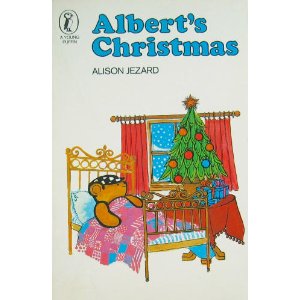
Albert’s Christmas written by Alison Jezard and illustrated by Margaret Gordon, Puffin Books, 1978, 1986. First published by Victor Gollancz in 1970.

Albert the Bear’s first appearance was in 1968 and the original Gollancz editions seem now to be quite collectible (I spotted a first

Albert's Christmas

Albert admiring his tree

edition offered for fifty pounds). Sadly, the Albert books now appear to be out of print. This friendly teddy bear lives in a cosy basement flat in Spoonbasher’s Row in the East End of London.

Albert’s Christmas adventures begin when he starts work as a seasonal postman to earn some extra money. The following extract is taken from chapter three, when Albert goes to do his Christmas shopping in a big department store:

‘Children were everywhere and their voices were full of excitement as they chose the things they wanted most.

Suddenly a little boy near to Albert pointed to him and said, “Please , Mummy, could I have that for Christmas? It’s the most beautiful Teddy Bear I have ever seen.” Albert turned around. ‘”I  beg your pardon, ” he said. The  little boy’s mouth fell open and he turned bright pink. “Oh, excuse me,” he said, “I thought – I mean -“

Albert raised his cap politely and said, “My name’s Albert and I’m afraid I’m not for sale.”‘

Fortunately Albert is not a teddy bear to take offence and he soon makes friends with the boy (Ian) and his mother. He is even invited to spend Christmas Day with the family. What with that, mistletoe gathering and playing the part of Father Christmas at a children’s party, Albert Bear has his best Christmas ever.

Albert should be the last bear to make an appearance….but you never can tell with bears…

Advent Reading Challenge: Wendy Cope

December 11th

The Christmas Life by Wendy Cope (taken from The Book of Christmas edited by Fiona Waters and mentioned in a previous post). This poem was previously published in If I Don’t Know (Faber).

I have been a fan of Wendy Cope’s verse for a long time, since someone gave me a present of Serious Concerns (Faber) when I worked in a Birmingham bookshop in the 1990s.

This festive poem celebrates the zest and spirit of Christmas: the living greenery brought inside the house with its hint of spring to come; bright colours on the tree; memories both happy and sad and the hopefulness of a new beginning for all of us.

Here are the first and last verses:

Decorated Christmas Tree

All Kinds of Everything…


Bring in a tree, a young Norwegian spruce,

Bring hyacinths that rooted in the cold,

Bring winter jasmine as its buds unfold,

Bring the Christmas life into this house.

Bring in the shepherd boy, the ox and ass,

Bring in the stillness of an icy night,

Bring in a birth, of hope and love and light,

Bring the Christmas life into this house.

I hope that you are enjoying these Advent snippets of poetry and prose both old and fairly new. It has proved to be an enjoyable writing and reading challenge for me and I am re-discovering many old favourites along the way.

(photo: Chris Mills)

Until tomorrow…

Advent Reading Challenge: Another Bear

December 10th

‘Christmas’ from More About Paddington by Michael Bond and illustrated by Peggy Fortnum (taken from The Adventures of Paddington, Collins, 1965, 1970).

Paddington's Christmas Pudding

Paddington with his pudding

When I first decided to tackle my Advent Reading Challenge I knew that Paddington would have to appear in it somewhere. That I have waited until the tenth day demonstrates either a great deal of will power or a highly developed sense of the power of delayed gratification.

Even now, many years after first discovering the small, determined bear from Darkest Peru, I can still find myself giggling at his many mishaps and misunderstandings. Peggy Fortnum’s wonderful drawings of the engaging Paddington also never fail to raise a smile. The copy that I have mentioned above came from a book sale in Birmingham and once upon a time belonged to the Bluecoat School, Harborne, Birmingham.

But, without further ado here is a taster of Christmas with Paddington and the Browns at number 32 Windsor Gardens:

‘Paddington found that Christmas took a long time to come. Each morning when he hurried downstairs he crossed the date off the calendar, but the more days he crossed off the farther away it seemed.’

Preparations for the festivities went on relatively smoothly except for an unfortunate incident with drawing pins and paper chains which ended with ‘Paddington hanging by his paws from the chandelier and Mr Brown dancing round the room rubbing his head’.

After an excellent Christmas dinner there was consternation all round when it appeared that Paddington had swallowed the sixpence in the pudding:

‘ ” Quick,” shouted Mr Brown, rising to the emergency. “Turn him upside down”.

Before Paddington could reply, he found himself hanging head downwards while Mr Brown and Mr Gruber took it in turns to shake him. The rest of the family stood round watching the floor.

“It’s no good,” said Mr Brown, after a while. “It must have gone too far”. He helped Mr Gruber lift Paddington into an armchair where he lay gasping for breath.’

If you want to know how it all ends you will have to read the whole story for yourself. Fortunately there is no danger of Paddington ever going out of print!

Illustration: by Peggy Fortnum taken from above edition.

Advent Reading Challenge: Pennies and Hats

December 9th

Christmas is Coming – a traditional Yuletide nursery rhyme (Anonymous). This is another verse taken from the children’s collection Read Me that I mentioned previously on the Advent Calendar.

As with many old rhymes, there are several different versions. Some say ‘goose‘ instead of ‘geese’ and some have ‘Please do put’ in place of ‘Please to put’ and so on. I did a YouTube trawl and, not surprisingly many singers have recorded Christmas is Coming in its several versions (including one by John Denver and The Muppets). The clip I have posted below is not a sung rendering of the verse, but a straightforward spoken one by someone whose name is only given as Andy.

I hope it makes you feel all Christmassy inside!

Christmas is coming,

Read Me

Do exactly as it says on the label…

  The geese are getting fat,

Please to put a penny

  In the old man’s hat.

If you haven’t got a penny,

  A ha’penny will do;

If you haven’t got a ha’penny,

  Then God bless you!

I hope you were joining in at the back there…

Many thanks to Andy who uploaded this video to YouTube exactly two years ago, on 9th December 2010.

Advent Reading Challenge: A Tiny Bear

8th December

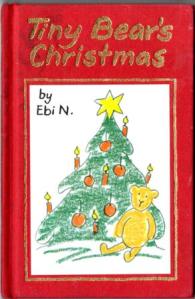
Tiny Bear’s Christmas by Ebi N (Eberhard Naumann) Ragged Bears Ltd, 1991
Published originally as Pules Weihnachtsfest

This charming book found its way into our Christmas collection some years ago via a second-hand shop. It has obviously had some enthusiastic handling as the marks on the cover of our copy testify. We have read it over and over again and I am sure its previous owners did too.

This is the text of the frontispiece:

Tiny Bear's Christmas

Tiny Bear and his Christmas tree

‘Poor Tiny Bear is left behind when the family leaves for the holiday. But Christmas is the time for miracles, and a small one can bring joy into the life of a tiny bear.

This whimsical story of naive charm and innocence brings the spirit of the season to readers young and old.’

The book is something of a curiosity as I have only ever come across this copy while browsing bookshops. It seems to be out of print now and when I did a book search before writing this piece only found a single copy available from Amazon. Either it was a very short print run or people tend to hang onto their copies.

If anything should be a candidate for a re-print then this seasonal tale of a teddy bear left all alone by his owners at Christmas must be a front-runner. After the family heads off for the Christmas holidays, Tiny Bear feels very sad and lonely. He tries all sorts of things to cheer himself up:

‘But no matter what he did, he was all alone on Christmas. Tiny Bear cried a little. Then he mopped a little. And then he lay down on his bed to think’.

Not to spoil the story for anyone unfamiliar with the book, I will merely mention that Tiny Bear finds some unusual friends and all ends happily in a very sociable Christmas celebration.

According to a note at the back of the book, the story was originally written by Eberhard Naumann (and I presume also illustrated by him) as a story for his young son. The tale was later discovered and published as a surprise for the author, whose birthday just happens to be on Christmas Day.

If you ever manage to spot a copy of Tiny Bear’s Christmas anywhere, snap it up quickly!

Advent Reading Challenge: Little Women

7th December

‘Christmas with the March sisters’

an extract from Little Women (which was the subject of a previous post ) Louisa M Alcott

Christmas Flowers

Christmas Flowers

Little Women opens with Meg, Jo, Beth and Amy regreting the prospective lack of Christmas presents. Mr March is away at war, which is naturally hard for the family left behind who miss him a great deal. Money is also scarce in the March household but Mrs March (Marmee) has assured the girls that there will be one special gift under each of their pillows:

Jo was the first to wake in the grey dawn of Christmas morning. No stockings hung at the fireplace, and for a moment she felt as much disappointed as she did long ago, when her little sock fell down because it was so crammed with goodies. Then she remembered her mother’s promise, and, slipping her hand under her pillow, drew out a little crimson covered book.

The book was John Bunyan’s The Pilgrim’s Progress and each sister received a copy that Christmas morning. Marmee had reminded the girls how much they had enjoyed playing at pilgrims when they were younger, taking bundles on their backs and travelling from the City of Destruction (the cellar) up to the Celestial City (the attic).

Marmee says to her daughters that they should ‘begin again not in play, but in earnest, and see how far you can get before father comes

Pilgrim's Progress

Christian bearing his bundle

home‘. In fact, the March girls begin their progress that very day by giving up their Christmas breakfast to a desperately poor family, the Hummels, living nearby.

The true spirit of Christmas in action…

Note: The Pilgrim’s Progress was first published in England in 1678. The illustration above is taken from a 1778 edition (thanks to Wikipedia).

Photograph: Chris Mills

Advent Reading Challenge: three ships

6th December

I Saw Three Ships (Anonymous)

line drawing of three ships

I saw three ships

This poem (which has also been set to music as a carol) features in a collection entitled Read Me: A Poem For Every Day Of The Year (10th anniversary edition) chosen by Gaby Morgan. This is a wide-ranging collection of poems guaranteed to encourage children’s enthusiasm for verse.

Here is the first verse of this old poem and as a festive treat I have also added below a clip of a recording of the carol by Blackmore’s Night (taken from Winter Carols)

Opinion differs on what the three ships represent: the Holy Trinity, Mary, Joseph and Jesus or the three wise men.

I saw three ships come sailing in,

Come sailing in, come sailing in,

I saw three ships come sailing in,

On Christmas Day in the morning.

Regular readers may recall from the interview with Paul Anthony Shortt that a song by Blackmore’s Night was an inspiration behind his novel Locked In. Thanks to Paul’s answers I have now discovered some new music!

Credits: clip uploaded to YouTube by Adiabatka on 08/06/2008 (with thanks)

illustration: Chris Mills