Advent Reading Challenge: Three Kings

16th December

Three Kings Came Riding by Henry Wadsworth Longfellow (1807-1882) another poem taken from The Book of Christmas

This is a long poem of fourteen verses telling the story of the journey of the Three Kings (Wise Men or Magi) to find the new saviour. I have known the poem since my own childhood and well remember the sense of romance about these mysterious figures making such a long journey. I also recall being absolutely baffled as to what frankincense and myrrh actually were.

I have just picked three verses to give a potted version of the story. The men set out following the star:
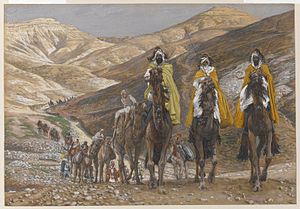
The Magi Journeying

The Magi Journeying (Les Rois Mages en Voyages)

1) Three Kings came riding from far away,

Melchior and Gaspar and Baltasar;

Three Wise Men out of the East were they,

And they travelled by night and they slept by day,

For their guide was a beautiful, wonderful star.

Along the way the travellers talk to people they meet of the child, and so Herod the Great hears.

He asks the Wise Men to bring him news from Bethlehem:

8) So they rode away; and the star stood still,

The only one in the grey of the morn;

Yes, it stopped it stood still of its own free will,

Right over Bethlehem on the hill,

The city of David where Christ was born.

The Three Kings found their way to the baby’s birth place and gave their gifts:
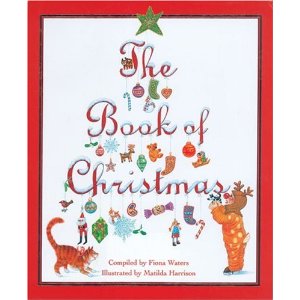
The Book of Christmas

The Book of Christmas

12) They laid their offerings at his feet;

The gold was their tribute to a King,

The frankincense, with its odour sweet,

Was for the Priest, the Paraclete,

The myrrh for the body’s burying.

After worshiping the new child, the Three Kings rode away and headed back to their homes in the East. They were wise enough not to return to King Herod, but travelled home a different way.

The painting here is by James Tissot which is in the Brooklyn Museum (image taken from Wikipedia).

Advent Reading Challenge: Another Bear

December 10th

‘Christmas’ from More About Paddington by Michael Bond and illustrated by Peggy Fortnum (taken from The Adventures of Paddington, Collins, 1965, 1970).

Paddington's Christmas Pudding

Paddington with his pudding

When I first decided to tackle my Advent Reading Challenge I knew that Paddington would have to appear in it somewhere. That I have waited until the tenth day demonstrates either a great deal of will power or a highly developed sense of the power of delayed gratification.

Even now, many years after first discovering the small, determined bear from Darkest Peru, I can still find myself giggling at his many mishaps and misunderstandings. Peggy Fortnum’s wonderful drawings of the engaging Paddington also never fail to raise a smile. The copy that I have mentioned above came from a book sale in Birmingham and once upon a time belonged to the Bluecoat School, Harborne, Birmingham.

But, without further ado here is a taster of Christmas with Paddington and the Browns at number 32 Windsor Gardens:

‘Paddington found that Christmas took a long time to come. Each morning when he hurried downstairs he crossed the date off the calendar, but the more days he crossed off the farther away it seemed.’

Preparations for the festivities went on relatively smoothly except for an unfortunate incident with drawing pins and paper chains which ended with ‘Paddington hanging by his paws from the chandelier and Mr Brown dancing round the room rubbing his head’.

After an excellent Christmas dinner there was consternation all round when it appeared that Paddington had swallowed the sixpence in the pudding:

‘ ” Quick,” shouted Mr Brown, rising to the emergency. “Turn him upside down”.

Before Paddington could reply, he found himself hanging head downwards while Mr Brown and Mr Gruber took it in turns to shake him. The rest of the family stood round watching the floor.

“It’s no good,” said Mr Brown, after a while. “It must have gone too far”. He helped Mr Gruber lift Paddington into an armchair where he lay gasping for breath.’

If you want to know how it all ends you will have to read the whole story for yourself. Fortunately there is no danger of Paddington ever going out of print!

Illustration: by Peggy Fortnum taken from above edition.

Advent Reading Challenge: Little Women

7th December

‘Christmas with the March sisters’

an extract from Little Women (which was the subject of a previous post ) Louisa M Alcott

Christmas Flowers

Christmas Flowers

Little Women opens with Meg, Jo, Beth and Amy regreting the prospective lack of Christmas presents. Mr March is away at war, which is naturally hard for the family left behind who miss him a great deal. Money is also scarce in the March household but Mrs March (Marmee) has assured the girls that there will be one special gift under each of their pillows:

Jo was the first to wake in the grey dawn of Christmas morning. No stockings hung at the fireplace, and for a moment she felt as much disappointed as she did long ago, when her little sock fell down because it was so crammed with goodies. Then she remembered her mother’s promise, and, slipping her hand under her pillow, drew out a little crimson covered book.

The book was John Bunyan’s The Pilgrim’s Progress and each sister received a copy that Christmas morning. Marmee had reminded the girls how much they had enjoyed playing at pilgrims when they were younger, taking bundles on their backs and travelling from the City of Destruction (the cellar) up to the Celestial City (the attic).

Marmee says to her daughters that they should ‘begin again not in play, but in earnest, and see how far you can get before father comes

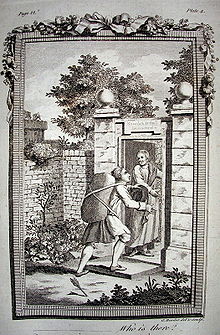
Pilgrim's Progress

Christian bearing his bundle

home‘. In fact, the March girls begin their progress that very day by giving up their Christmas breakfast to a desperately poor family, the Hummels, living nearby.

The true spirit of Christmas in action…

Note: The Pilgrim’s Progress was first published in England in 1678. The illustration above is taken from a 1778 edition (thanks to Wikipedia).

Photograph: Chris Mills

Advent Reading Challenge: Tolkien Letters

3rd December

A christmas Classic..

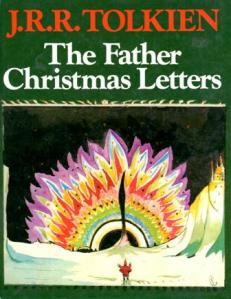
The Father Christmas Letters

The Father Christmas Letters by JRR Tolkien, edited by Baillie Tolkien (George Allen & Unwin Ltd, 1976). I have had this book for many years, though it was not bought new. Within its pages lurks a newspaper cutting on a new edition of Tolkien’s book from The Birmingham Post 23rd December 1995. I never did get around to buying a newer edition of The Father Christmas Letters

Tolkien wrote the first letter to his children in 1920, and for over twenty years continued to regale them with the goings-on at the North Pole. Father Christmas’ main helper was the Polar Bear, along with an assorted cast of characters including the bear’s nephews Paksu and Valkotukka.

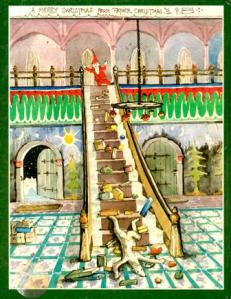
This is such a wonderful book that it was difficult to select a passage to quote here. I was about to resort to the time honoured tactic of letting the book fall open and picking a piece at random, when my daughter pointed out that it would be a good idea to choose the piece that featured on the back cover. Tolkien’s illustration captures the poor old Polar Bear’s accident beautifully. Parcels scattered down the stairs, Polar Bear sprawled at the foot and a rather vexed Father Christmas at the head of the stairs.

Polar Bear falling down the stairs

Polar Bear’s accident – one of Tolkien’s brilliant illustrations

Thursday December 20th 1928

‘What do you think the poor dear old bear has been and done this time?…Only fell from from top to bottom of the main stairs on Thursday! We were beginning to get the first lot of parcels down out of the store-rooms into the hall. Polar Bear would inist on taking an enormous pile on his head as well as lots in his arms. Bang Rumble Clatter Crash! awful moanings and groanings:

Never fear, it all turned out right in the end!

Advent Reading Challenge: Dickens

1st December


A Christmas Tree

Christmas with Dickens

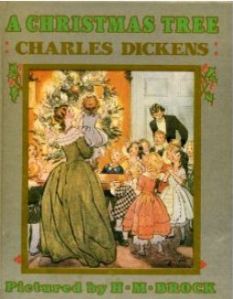
A Christmas Tree

by Charles Dickens

Illustrated by HM Brock (Guild Publishing 1969, 1986). This little book has sat on the shelves for quite a while and was bought second hand in Birmingham.

What better way to begin our Advent Reading Challenge than with  a little bit of Dickens? Just for a change though, I have not chosen to feature the more obvious Christmas Carol.

Here is a Christmas tree covered in all manner of delights including, ‘tambourines, books, work-boxes, paint-boxes, sweetmeat boxes, peep-show boxes, and all kinds of boxes…humming-tops, needlecases, pen-wipers, smelling-bottles‘ and much more besides.

After describing the tree, the narrator goes on to ask what item ‘we all remember best upon the branches of the Christmas Tree of our own young Christmas days’.

Now, if you were inspired by Charles Dickens,  there is a question for you. What do you remember best of all? Drop a comment in the box…

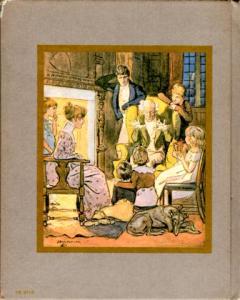
Fireside scene

Back cover – fireside tales


Christmas on the Landing: Advent Announcement

It can hardly have escaped anyone’s attention that we are edging ever closer to a certain celebratory time of the year, though I refuse to pay too much attention to the ‘x days shopping days left’ kind of pressure. Anyway, working in retail as I do it tends to be other people’s shopping that occupies most of my efforts during December. Christmas-itis generally strikes me at about halfway through the month and I just want to run away screaming. I generally just about manage to get around to my own purchases before the close of play on Christmas Eve.

The Book of Christmas

The Book of Christmas

Bearing all of that in mind, I have decided to devote December on the Landing Book Shelves to a seasonal Literary Challenge in an attempt to induce calmness. After much prowling of the bookshelves with a thoughtfully furrowed brow, I have come up with the (possibly not very original) idea of putting a Landing related Advent Calendar/Advent Reading Challenge together. I have compiled a list of Christmas poems and episodes in fiction and plan to post a mini blog each day in Advent.

My inner child has carried me away a little so this Advent Challenge feature will be entirely composed of snippets from children’s books lurking on our shelves. I have to admit to stretching the notion of Landing Book Shelves just a tad, as some of the Yuletide goodies live in either the loft or my daughter’s bookshelves. But I hope you will overlook that minor fudge in the cause of Christmastide.

I should point out however, that you will have to improvise a little for yourselves. My technological skills are not up to creating opening virtual doors so you will simply have to pretend. Of course if you follow this blog, then opening your email will, I feel, simulate the door opening bit quite satisfactorily. Each day should bring to you a seasonal literary morsel with a suitable illustration by way of accompaniment.  Well, that is the plan (and the challenge) anyway so fingers crossed that it all works out successfully.

Keep checking back during December to see what you find…(apologies in advance for the lack of chocolate in the Landing Advent Challenge Calendar).

L.P.Hartley: The past is a foreign country

The Go-Between

The winged messenger

I said that I would return to the topic of The Go-Between and so I have (with a certain amount of delay admittedly). I enjoyed the novel a great deal, which is set in a period and in a milieu that has always had a particular fascination for me. The Penguin Modern Classics edition (1997, 2000) has an excellent scholarly introduction by Douglas Brooks-Davies which I read before the novel, but that I wish I had left until afterwards as it gave away the details of the plot. Bearing that in mind, I will attempt to do no plot spoiling myself. Suffice to say that at one point I was irresistibly reminded of Aunt Ada Doom seeing something nasty in the woodshed at Cold Comfort Farm.

The novel recalls memories of a hot summer in 1900, in which Leo Colston has been invited to stay with his somewhat grander school friend Marcus Maudsley at Brandham Hall. Twelve-year-old Leo is the go between of the title, in his role of secret messenger between Marian Maudsley and Ted Burgess, a local farmer. These messages are mirrored by the errands he runs between Marian and the man her mother wishes her to marry, Viscount Trimingham.

Leo, as an old man looking through childish souvenirs in an old Eton collar box, recalls the details of that summer from long ago. The discovery of the box and its contents prompts memories that Leo has suppressed for his entire adult life. The book deals with loss of innocence (Leo’s) and class issues, as well as love, loyalty and friendship. The class barriers of the pre-war years are neatly encapsulated. The set pieces of the local cricket match and the post-match concerts show clearly the ‘them’ and ‘us’ aspects of the social life of the village. Against this background is set the affair between the lovely Marian and the attractive, but socially inferior Ted.

The Go-Between

First edition (1953) cover

The focus of the novel is on Leo’s naivety and the drastic effect that the discovery of adult sexuality has on his subsequent emotional development. He clearly at first has no idea of the nature of the relationship between Marian and Ted. It is hard to imagine that such innocence existed from our twenty-first century perspective. However, the narrative makes clear that life was very different then. Adults and children lived almost separate lives; indeed at first, Leo did not even realise that Marian was the sister of his school friend. All the adults seemed indistinguishable from one another. They even seemed to speak a different language from the public school patois he shared with Marcus. Leo, being of a humbler background than the Maudsleys (yet not lowly enough to be excluded from the delights of Brandham Hall) has at times to submit to being corrected about what is appropriate behaviour or language by the often insufferable Marcus. It has to be said that Marcus is (in my view at least) a very unappealing child in his snobbery towards the lower orders. No doubt however, his attitude to the villagers was common enough at the time.

If Marian fascinated Leo, then he was almost terrified of her mother and lived in dread of doing the wrong thing. Manners and behaviour were very important and obedience was expected from children. It was however, a time when children were left to their own devices for long stretches so the boys could escape adult supervision for hours on end. This of course facilitated Leo’s mission as Mercury, flying between the hall and the farm bearing messages with nobody being any the wiser.

I said I would try not to plot spoil The Go-Between, so I will leave it there and hope that my notes have whetted your appetitite if this is a novel that has so far passed you by. My only remaining task is to point out that the copy I have been reading actually belongs to ‘He who put the shelves up’ (with many thanks). 

Happy reading! 

Landing Eight Update: The Go-Between

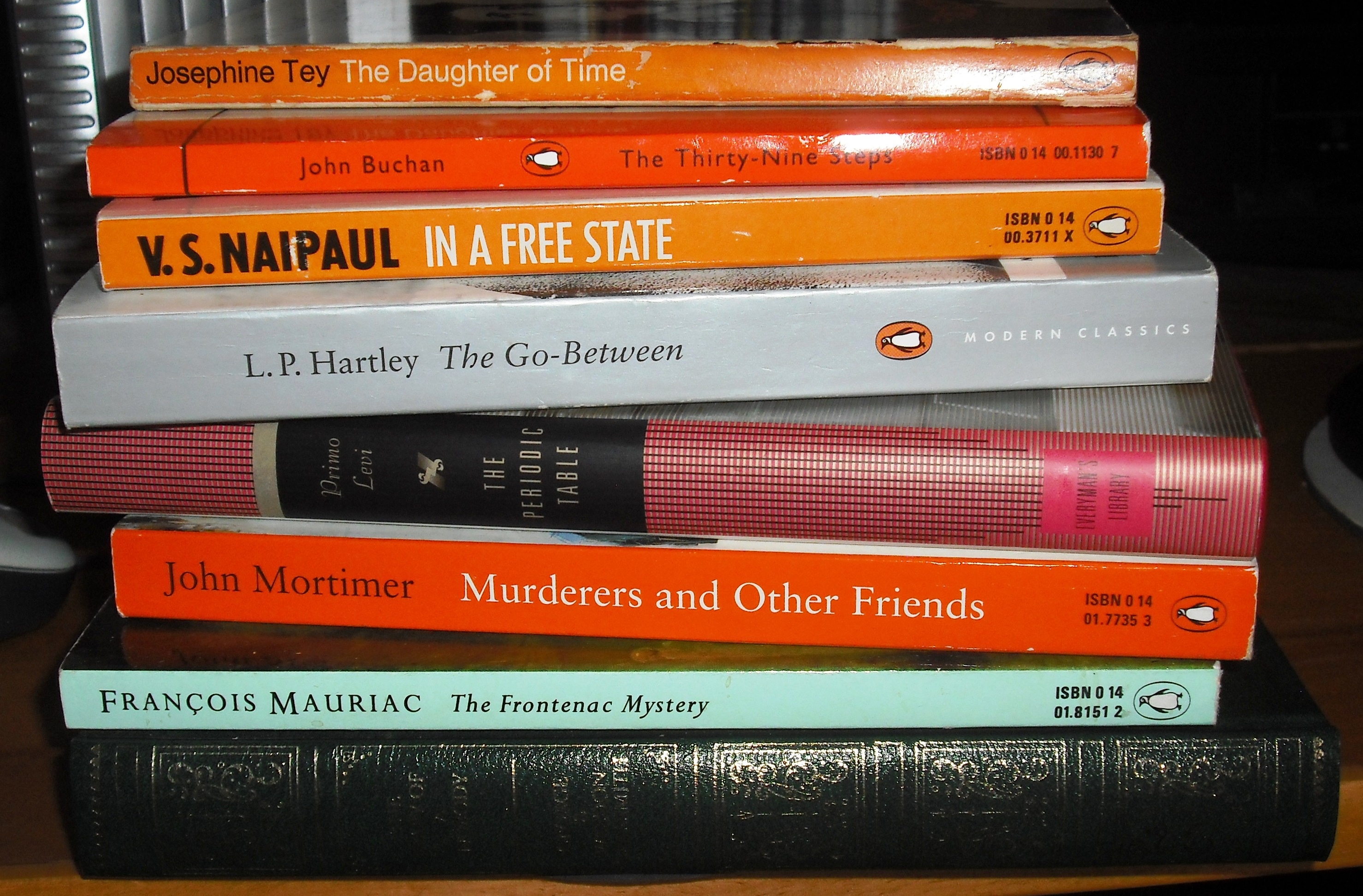
A pile of classic novels
Progress…

For anyone who has been wondering whether I will ever finish reading the Landing Eight pile, I would like to announce that finally I read The Go-Between, during a Bank Holiday weekend break in Kilkenny.

I will return to the book in another post, but for now suffice to say that I enjoyed sweltering in the heat of summer in 1900 (though I doubt if I would have been socially elevated enough to be invited to play croquet had I really been around at the time). I rather think I would have been considered to be what Marcus so charmingly described as one of the ‘plebs’.

As it is now autumn, almost Halloween in fact, I will leave you with a muse upon the tendency of shops to confuse Halloween with Christmas. I wrote this for Paragraph Planet a couple of years ago and was reminded of it again last week while looking at pumpkins in Marks and Spencer and becoming distracted by a nearby aisle of Christmas decorations. It was all too much…

Christween. No sooner is Halloween cleared away than Christmas is upon us. Though actually for a while the two festivals were running mates. Witches’ coven one side of the shopping centre; Santa’s house taking shape on the other. They could have been neighbourly and exchanged tricks for mince pies. Now alas, there are only rotting pumpkins to rival the tinselly explosion. Jolly Christmas lights and cheer all the way; the spooky darkness has been routed.

And if you have never had a look at Paragraph Planet before, stop by and take a look at what can be done in just 75 words …

Mary Robinette Kowal

Footnote: #LetterMo author Mary Robinette Kowal

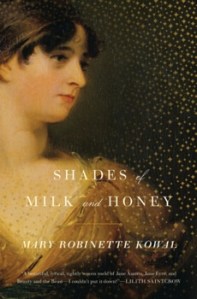
While having a quick browse in the recently returned section of the library last Thursday, I spotted a novel by Mary Robinette Kowal, Shades of Milk and Honey. Attentive readers of this blog will be aware that the American author was also responsible for organising the February letter writing challenge A Month of Letters in which I participated (with admittedly mixed results) this year. If you missed it, catch up with the post here.


Shades of Milk and Honey

A Tempting Read….

Kowal’s  novel is an Austen inspired comedy of manners with a fantasy element that was nominated for the Nebula Prize 2010 in the Best Novel category. One of the reviews (RT Book Reviews) says it ‘includes ethereal events, exquisite prose, delicately drawn characters, and tender emotions.’ It sounds temptingly delicious but I have just begun my book club novel, David Mitchell’s Cloud Atlas so it must remain firmly untouched on the bedside table for a while.
And as for the proper business of reading the next Landing Eight choice…..I leave you all to guess.

http://www.maryrobinettekowal.com/fiction-collectio/shades-of-milk-and-honey/

The Past is Another Country: Culture Night

I am truly sorry about the miss-use of  that quotation in the title and have no excuse except that it just popped into my head and it seemed a shame to waste it. Just for the record, I have not yet actually begun to read The Go-Between and am still reading Bring up the Bodies. Anne Boleyn’s downfall is edging closer as I write so be prepared for copious amounts of bloodletting. And now on to a snapshot of our Culture Night’s activity…

As I said in my last piece, I was itching to get out and about to catch up with a few as yet unvisited cultural venues. At risk of sounding rather like a cultural box ticker, I did manage to cross three places off my list of ‘I must it do sometime’ activities. My brochure was a mass of ticks by Friday evening so I knew that there would be no hope of doing everything on my list. As it turned out, the first port of call for my fellow culture vulture and I was a late entrant to the event, not even mentioned in the brochure (though listed on the website) so that counts as a bonus point.

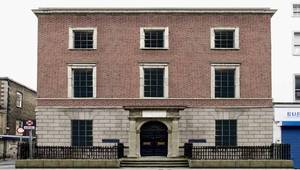
Assembly House

Dublin City Assembly House

Our bonus venue then, was the former City Assembly House in South William Street, which is due for a restoration programme by the Irish Georgian Society in partnership with Dublin City Council. I have long wanted to have a peek inside the elegant looking building but have never seen it open. Sadly, the interior fabric desperately needs attention from some dedicated craftspeople to restore its former glory. According to IGS’s literature, the group is looking to raise a staggering €2,000,000 to finance the restoration. When finished, the building will be the headquarters of the IGS and is also to be restored to its original function as a venue for exhibitions and other cultural events. The plan is to have the restoration completed in time for the building’s 250th anniversary.

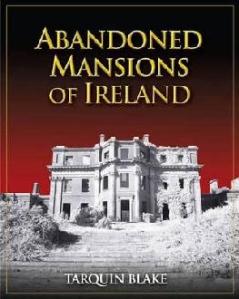
Abandoned Mansions

Tarquin Blake’s first volume

The building dates from 1765 and was the first purpose-built public exhibition gallery in Ireland. Wandering around the still gracious rooms, we could mentally step back in time and imagine how they must have looked. The double height octagonal exhibition room (once the city assembly’s meeting room) featured a collection of Tarquin Blake’s photographs of abandoned mansions of Ireland. He has recently brought out a second volume of images published by The Collins Press (see the illustration taken from the publisher’s site). It seemed strangely apposite to be viewing pictures of ruined buildings in this venue, which while not a ruin itself, clearly needs the planned intervention to prevent it becoming one. These images of ruined mansions and castles attest to a past that was indeed a very different place. Some of the mansions simply fell into disuse and became ruined while others were actively destroyed. Either way, looking at the pictures produces very mixed emotions. The owners of these houses lived very privileged and protected lives unlike the vast majority of people. Having said that, the house would have been a source of employment in the area and was a whole community in itself.

Abandoned Mansions II

More brilliant images…

I will follow the restoration process of the City Assembly House with interest and I hope one day to stroll around an exhibition in the finished rooms. If anyone is interested in the Irish Georgian Society’s activities, follow the link here and to check out Tarquin Blake’s gorgeous books click here.

And now, I’m off to read for a while…let me know what you’re reading at the moment!