Landing Author: Sarah Moore Fitzgerald

As previously promised, I am today hosting a new YA  author on The Landing Bookshelves. Sarah Moore Fitzgerald, a professor from Limerick University, publishes her first novel today. I was lucky enough to receive a proof copy of Back to Blackbrick before Christmas. I was immediately attracted by both the time travelling element of the story and the back drop of ‘The Big House’ where so many fascinating stories often lurk. It is clearly a fascination that many readers and writers share. The great houses of Ireland and Britain have long provided much food for thought.
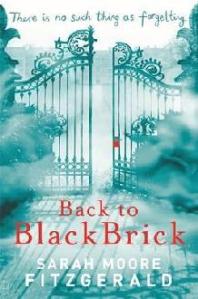
book cover with big iron gates

Back to Black Brick

This kind of setting always interests me for personal reasons, in that my late grandfather was a gardener at Grove Hall in Harborne, Birmingham (demolished in the 1970s) home of a prominent local family. The grounds are now a public park. I  recently spotted a large cedar tree in a photograph of the grounds of Grove Hall; it dawned on me that it must be the same tree that I played under as a child, when the grounds had been handed over to the council. Time travel of a sort, perhaps.

I asked Sarah to talk to us about the background to Back to Blackbrick and about the research that underpinned the novel. Like me, Sarah admits to a fascination with the life and history of the big country house. When we chatted last week, we talked a little about this, mentioning the brilliant Abandoned Mansions series of books by Tarquin Blake (see previous post).

Here is Sarah’s piece, written especially for #LandingAuthor, in which she talks about her influences:

How a history book helped to inform and inspire my first novel

At the centre of my first novel, there is a big house called Blackbrick Abbey. Two big avenues lead up to it – one from the south and one from the north. In the grounds there are stables, beautiful horses, big trees and an orchard with apple sheds and a gate lodge. Very early on in the story, Cosmo, the main character, gets a key to the gates of Blackbrick from his brilliant, lovely grandfather. But it’s only when Cosmo gets there, that he realises he’s been sent to the past in order to recover his granddad’s failing memory. The huge old house contains secrets that will help him to make sense of important things in his life.

I’ve always been kind of obsessed with the idea of ‘Big Houses’ and the complicated things they represent.  I was captivated, as generations of children were, by Misselthwaite Manor in The Secret Garden and later, by the strange evocative Anglo-Irish climate of Danielstown in Elizabeth Bowen’s The Last September, by Molly Keane’s descriptions of a family keeping up appearances in the crumbling manor of her deliciously dark Time After Time and to Evelyn Waugh’s heartbreaking Brideshead Revisited. In all of these stories, the big house sits silent and gigantic at the heart – symbolizing family identities and their labyrinthine dynamics and secrets.

I probably shouldn’t have been surprised that when I started to write my own novel, a house like this would somehow become a crucial part of the story’s backdrop. When the idea for Back to Blackbrick was being formed, I remember stumbling upon the non-fiction gem by historian Terence Dooley, entitled The Decline of the Big House in Ireland. That’s when a major part of the plot crystallized in my head, and I decided that my character was going to have to spend some time in the past. Writers often warn that too much research can distract novelists from getting on with the story – that if you get too immersed in the history of an era you disappear into the research, abandoning the novel. But when I read Dooley’s book, replete as it is with wonderful and impeccably researched historical descriptions, the opposite happened – it spurred the creative writing side of my brain with the curiosity to explore hints of a human story that could lie behind the historical facts.

While Back to Blackbrick is set in both the present and the past, and while I have tried to paint the historical references with a light touch, Terence Dooley’s book gave me a rich sense of themes that eventually became a really important part of the story – reminding me never to underestimate the power of historical non-fiction to provide luminous raw material for storytelling.
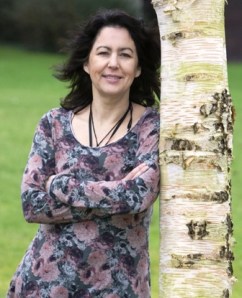
head and shoulders photo

Sarah Moore Fitzgerald

Sarah Moore Fitzgerald is a professor at the University of Limerick. Late at night, she writes stories for her children. Her first novel, Back to Blackbrick (Orion Children’s Books) is out on Feb 7th.

With many thanks to Sarah for joining me as a guest on #LandingAuthor and lots of luck with Back to Blackbrick. If you would like more infromation take a look at Sarah’s agent’s website here.

Photo credit: Liam Burke/Press 22
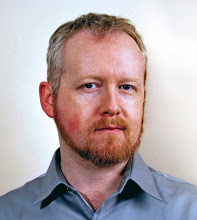
Landing Author: Paul Anthony Shortt: Locked Within

Paul Anthony Shortt

The Author…

Now as promised last week, here are the answers to a few questions that I put to debut author Paul Anthony Shortt on the publication of his urban fantasy, Locked Within. I was slightly worried that I had asked too many questions, but Paul gamely answered all of them most eloquently…

CM: You have talked about Ritchie Blackmore’s music being a starting point for Locked Within, and I wondered what other music you feel has influenced your work?

PAS: Wow, where to start? Music is integral to my writing. I have a large collection, a lot of it from film scores, and I listen to it daily. Once a particular piece sets in my mind, I’ll start imagining scenes that suit the music as though I were creating a movie in my head.   For Locked Within, of course “Locked Within the Crystal Ball” by Blackmore’s Night was essentially my main theme song. Another song of theirs, “The Circle,” was an influence as it is specifically about cycles of death and rebirth, and the question of whether we can break free from our own fates. I used Northern Kings’ cover of “We Don’t Need Another Hero” to get me in the mindset to write about a New York that has been beaten down by supernatural oppression.   I also listened to a lot of Nightwish, Bon Jovi, and film scores by the likes of Hans Zimmer as background music while I wrote. I love big, sweeping sounds, the kind that inspire a sense of epic myth. The recent Chris Nolan Batman movies, Transformers, Pirates of the Caribbean, even Rango and Shrek all have scores that fire my imagination and set my heart racing. I’d encourage anyone, regardless of how they feel about a specific movie, to take time to listen to the music. It’s a whole new dimension to explore.

CM: I was reading that the Greek legends were your favourite mythology, but do you have an Irish mythological hero?

PAS: Cú Chulainn, hands down. He’s our Hercules. The greatest warrior, cunning and brave, but still tragically flawed both by temper and commitment to oaths which eventually lead him into battle against his closest friend, Ferdia. My favourite stories are of characters who aren’t just extremely capable and can defeat any enemy with ease, but where they see that their strengths can’t resolve all problems, where they have to learn new ways of overcoming their foes, or face tragic consequences.

CM: Would you talk us though the process of planning out the main characters in Locked Within? What system do you use to keep track of important details of personality and character history?

PAS: When starting out I tend to just go with the flow. I’ll start out with a Word document that lists my characters by name and write brief descriptions of their appearance and personalities. Mostly that’s just to get the details clear in my head. When I’m not writing, I’m usually running through important scenes in my head, especially on the way to and from work and listening to music, so by the time I sit back down to write, the details have been repeated so much in my mind that I often never need to check back over my notes.

For me, writing is far more work than just typing the words. Every spare moment I have, I spend thinking about some aspect of my current work in progress. So while I have my notes as a back-up if I haven’t had a chance to work on it for a while, usually the act that I’m almost constantly thinking and planning means I can pull up whatever information I need as I write.

CM: You have said that you view New York city as being a character in its own right in your urban fantasy. How would you describe that character and what gender would the city be do you think?

book jacket with a man's face

Locked Within


PAS: I don’t think of the city in terms of gender. I think the soul, the essence of something as universally influential as New York would transcend gender completely. However if that soul were to take on a human form, I think it would present itself as female. New York is in many ways the capital city of the western world. It is central to popular fiction and for many years was the gateway to America for countless immigrants, with the Statue of Liberty looking on, serving as a mother to whole cultures and nations being reborn right there in her port as they started their new lives.   In Locked Within, New York is that grandmother who lived through the war and had to grow up hard, dealing with prejudice and hardship. It’s tough as nails, forged in fires as everyone looked to it for guidance. But it hasn’t lost its kinder side. It’s just tired and weary, so long left to fend for itself with no-one to help. Once it realises that someone still cares, it’ll stand back up and fight to the last to protect its family, its inhabitants.

CM: I was looking back to when you first began your blog in 2010. Can you explain to us how important your blog is to your novel-writing process?

PASMy blog has been absolutely essential. Quite honestly, if not for my blog I wouldn’t have my book deal. The managing editor of my publisher, WiDo Publishing, was actually one of my first blog followers, and it was through a contest she held that my book wound up being sent to WiDo.

Since then, the blog has been a place where I can pitch ideas, share details of how I work, and details of my own life. It’s helped me connect with so many people and make so many friends who have all give me incredible support on this journey. Just being able to announce something like the fact I had started writing the sequel, and getting that immediate feedback, is a great motivator.

CM: Paul, as you know, writing can be a lonely business, so many writers belong to groups for support and criticism of their work. Would you tell us about your own support network?

PAS: Some of my closest friends are writers as well, so that helps. I have a core team of critique partners, and we share our work with each other as we write, offering feedback and advice. I’d be utterly lost without them, which is why they’re both first on my acknowledgements page! I also have a group of friends who act as my beta readers, giving me critical feedback. They all keep pestering me for the next book and it really helps to see such enthusiasm.   Of course, my biggest supporter is my wife, Jen. She’s incredible. Always understanding if I need some extra time to write. Always making sure I eat properly and take regular breaks, or insisting we go to the cinema or meet some friends just so I can unwind and get my mind off my work. I would actually crack up without her to keep me in check. It’s just as well that I’ve got all my writing work for the year out of the way, because we’re having twins in December and it’s time for me to make sure she’s looking after herself now!

CM: Can you describe for the readers a typical writing day (if indeed there is such a thing). Is there a particular place in which you prefer to write?

PAS: Monday to Friday, I get into work at least an hour before I’m due to start so I can write. Then when lunch time comes around I spend that writing as well. If I’m really in the zone, I can get a full day’s work done in that time, but sometimes I need to do a little extra at home in the evenings. For weekends, I’ve long since given up on lie-ins and I’m up early to write for a couple of hours before breakfast.   My favourite place to write is in our front room where I have my desktop pc set up and my leather office chair. It’s the most comfortable chair I own and perfect for writing in. It also helps that I have my entire music collection transferred to my pc so I can run my playlists to keep me focused.

CM: And finally, Paul: if you were casting your book for a film production, who would you choose to play the main leads (assuming that money is no object) and which director would you want?

PAS: I love this kind of question! As it happens, I had certain actors in mind as I wrote the book, so here’s the “cast” list:

Nathan, the hero of the book: James McAvoy or Ewan McGregor (honestly can’t decide!)

Dorian, one of the primary antagonists: Michael Wincott

Ben, Nathan’s best friend: David Boreanaz

Laura, Nathan’s girlfriend: Rachel McAdams

Mike, Nathan’s dad: John Mahoney

Cynthia, Nathan and Laura’s friend: Olivia Wilde

Roland, a sort of mentor to Nathan: Steve Buscemi

Adams, a vampire-hunter: Dennis Haysbert

Lane, another vampire-hunter: Jason Statham

Cadence, a witch: Thandie Newton

Creek, Dorian’s right-hand man: Willem Dafoe

Eli, a vampire: Keifer Sutherland

As for a director, I love to see highly-detailed worlds created in a movie, and also well-choreographed action sequences. There’s a trend in movies to make it hard to see fight scenes taking place and I always feel a bit short-changed when I can’t see what’s going on. With that in mind, I think I’d choose Guillermo Del Toro to direct.

Many thanks to Paul Anthony Short for kindly answering a few questions about his work.

Good luck with Locked Within!


Announcing Landing Author: Paul Anthony Shortt

Next week (on the 15th November to be precise) I will be entertaining a second guest on my literary landing. Paul Anthony Shortt will be submitting himself to a gentle grilling as part of his blog tour to promote his debut novel Locked Within.

book jacket with a man's face

Locked Within

Locked Within officially released yesterday, launches on Thursday 8th November at Hughes and Hughes Bookshop in Dundrum, Dublin. This urban fantasy novel is set in New York, where the hero Nathan Shepherd feels he is destined to fight the supernatural predators that threaten the inhabitants of the city:
‘The supernatural realm and the mundane world have existed side by side since the dawn of time. Predators walk the streets, hidden by our own ignorance. Once, the city of New York was protected, but that was another age.

Now a creature emerges from the city’s past to kill again, with no-one to hear the screams of its victims. The lost and the weak, crushed under the heels of the city’s supernatural masters, have given up hope.

But one man finds himself drawn to these deaths. Plagued by dreams of past lives, his obsession may cost him friends, loved ones, even his life. To stop this monster, he must unlock the strength he once had. He must remember the warrior he was, to become the hero he was born to be.

His name is Nathan Shepherd, and he remembers.’

Well, that was just a little teaser taken from Paul Anthony Shortt’s blog (here) and next week I will be posting up answers to a few questions that I put to him about his writing and what influenced the creation of Locked Within. Paul will be talking about music, mythology and his favourite place to write. I also asked him about which actor he would choose to play his hero, should Hollywood come knocking!

Meanwhile, if you are in Dublin tomorrow pop along and meet the man himself and get ‘Locked Within’ Paul’s fantastic world…

An Enlightening Journey with Andrés Neuman

After my Q and A with Argentinian/Spanish writer Andrés Neuman here is my piece on his novel Traveller of the Century. At a hefty 584 densely packed pages it is a book that cries out for the luxury of a few hours solid reading time. As I found that to be impossible, I have followed the characters in fits and starts. Thankfully, the engrossing themes and threads of the novel guided me through the drama. When I first got my hands on Neuman’s first novel in translation and read Roberto Bolaño’s effusive praise in the introduction, I felt somewhat ambivalent about tackling the book. I am not much given to hyperbole so I find it rather hard to swallow in others. Bolaño claims that ‘the literature of the twenty-first century will belong to Neuman and a few other blood brothers of his’; (very gender specific; no blood sisters then?). Therefore, it was with some scepticism and a certain amount of trepidation that I began to read the novel. After I had finished reading, I felt that there had been so much going on in the novel that I would pull out a few themes and images that particularly struck me, to highlight here.

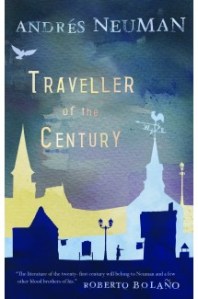
Cover of Traveller of the Century with silhouette of town

Traveller of the Century

Traveller of the century is set in nineteenth century Germany, after the European upheaval of the Napoleonic Wars. When the story opens, Hans, a translator and compulsive traveller is in a coach creaking its way through a bleak winter landscape.  Late at night, he plans to break his journey to Dessau in the town of Wandernburg and finds lodging in a rather shabby looking inn. As the story unfolds Hans, who never stays anywhere for very long, finds himself unable to leave. This is in part because of the strange qualities of the town and in part due to his increasing entanglement with the lives of the people he meets in Wandernburg.

A silken thread running through Traveller is the seeming ability of the geography of the town to shift around, almost as if the town itself does not want people to leave. In trying to find places that, he had found the previous day, ‘Hans had the strange feeling that the city’s layout somehow shifted while everyone was asleep’. He finds the market square to be the only location easy to pinpoint. This sense you get of the changing aspect of the town is unsettling and suggests unseen and unknown forces below the surface. Is it coincidence that Hans only gets to grips with the town’s geography when he is about to leave? Does he imagine this is happening; or is the town really playing with his perceptions?

Hans befriends a poor old organ grinder who usually plays in the town’s market square. As they become friendly, the organ grinder invites Hans to his home that turns out to be a cave just outside the town, where he lives with only his dog Franz for company. Hans starts to spend evenings at the cave talking to the organ grinder and two local workers Reichardt and Lamberg. There is much animated debate, discussion and cheap wine drinking carried on late into the night. One of the topics that the men discuss is the town itself; as a place to leave or to remain in. The organ grinder (who goes by no other name) is devoted to his town and sees beauty in the changing seasons of his home. The imagery of the men passionately talking and arguing into the early hours is very vivid and is a piquant contrast to Han’s elegant evenings with the town’s bourgeoisie.

Hans meets Sophie Gottlieb, a merchant’s daughter who is engaged to a local wealthy landowner, Rudi Wilderhaus. The philosophical discussions at the cave are mirrored by the Friday night Salons held at the Gottlieb house where the more socially elevated group debates the poetry, philosophy, history and literature of Germany and her neighbours. Hans is often in conflict with the hitherto leading light of the group, Professor Meitter though he finds a kindred spirit in Álvaro a Spanish merchant settled in Wandernburg. The Enlightenment is gradually gaining ground in this corner of Germany, even though the town seems otherwise rather set in its ways.

At the heart of Traveller of the Century is the illicit love affair between Sophie and Hans. Their relationship plays out against the background of often-intense discussions between the members of the two overlapping groups of debaters. Hans and later, Álvaro are equally at home in the two very different settings and Sophie is charmed by the organ grinder and his cave when Hans takes her to visit there. Apart from these encounters and the love affair between Álvaro and Sophie’s maid Elsa, the townsfolk stay in their allotted rigid social places. Enlightenment is also reaching Wandernburg’s women, as Sophie declares that ‘I for one don’t intend to spend my days with flour up to my elbows’. In tandem with discussing poetry and politics with Sophie, Hans is teaching the innkeepers daughter Lisa to read.

Translation is perhaps not surprisingly another recurring theme in Neuman’s book (see the Q&A for Neuman’s thoughts on translation of his own work). There is much discussion of language and nationality in the Friday salon and translation is also the means by which Hans earns his living. Translation becomes the means to enable Sophie and Hans’ affair to continue, as they begin to work together on Hans’ commissions. They in effect translate each other while they discuss the literature they are working on. The process of selecting the right words to use and then reading aloud their differing versions functions as a delicious foreplay, heightening their desire for one another.

There is a darker thread running through the drama, in the figure of the cloaked rapist who haunts the darker side streets of the city. I do not want to spoil the plot by mentioning the identity of the attacker. Suffice to say that the shadowy figure seems to be the antithesis of progress and enlightenment in Wandernburg. The police attempt to track the culprit by employing the appropriate rational means and careful reasoning. However, at one point Hans runs afoul of the local police and discovers that the law is not by any means as rational as it could be.

I hope I have succeeded in doing justice to a fascinating novel, that I am certain to read again. And was Bolaño right in his estimation of Traveller of the Century? Read it and judge for yourself!

Andrés Neuman: Q and A session

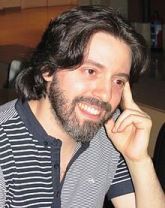
profile view of Andres Neuman

Andrés Neuman

As promised, here are the results of my LandingAuthor interview with author of Traveller of the Century Andrés Neuman:

CM: You have been featured on the list of Granta‘s Best Young Spanish language novelists and on the Bogotá 39 list. Do you feel that these lists achieve the result of bringing writers to the attention of a wider public and if so, has it benefited you in that way? 

AN: Well, there are so many lists around, that sometimes I think that the most effective one would be a list of never-listed authors. More seriously (or not), to be honest I don’t know the practical results of those two lists. Nevertheless, each one of them had a very interesting nuance in terms of literary theory. Granta’s one represented, if I’m not wrong, the very first time that such an influential Anglophone publication was fully dedicated to non-English language authors. Which was quite a hopeful sign I guess. Regarding Bogotá 39 list, when it came out I realized that at least half of the writers included on it hadn’t lived in their born countries for a long time, so that they already had a kind of mixed national identity; and two of them (Daniel Alarcón and Junot Díaz) didn’t even write in Spanish language, so they were twice peripheral. I feel quite close to these alternative ways of looking at the Latin American tradition, since I was born in an Argentine home but I grew up in Spain.


CM: Following on from the Bogotá 39 list, with which the Hay Festival was involved, I would like to ask you about participation in literary festivals. Do you enjoy doing festivals and meeting readers and fellow writers or do you perhaps feel obliged to make appearances? 

AN: Maybe both. On one hand, anything which implies leaving home painfully stops or at least delays the book you were working on. On the other hand, thanks to the festivals and book fairs you get to know two essential, yet often invisible for you, parts of your vocation: readers and colleagues. Most of the time you work alone, so when a reader appears you feel genuinely amazed: so they really existed! And they even had the patience of reading one of your books! When that happens, I’d like to apologize or returning them their money. In the end, I tend to think that travelling is literary healthy. Travels remind you that the world was much more complex than you thought. And that’s what literature is about, isn’t it?


 CM: You have written a book based upon your travels around South America, your own back yard as it were, but do you have an urge to explore any other places with a view to writing and if so, where would you like to go?

AN: That book (Cómo viajar sin ver. Latinoamérica en tránsito/ How to travel without seeing. Latin America in transit) actually tells a trip across the whole Latin America, which is an immense planet itself. It’s an amazing experience to feel a foreign person twenty times, without changing of language. That’s a little miracle that Spanish language allows us. Where else I’d like to go to and write about? I’d prefer not to plan it: I enjoy much more when a place takes me by surprise. Precisely that surprise is what stimulates the muscle of attention.


 CM: After having lived in both Spain and Argentina do you feel that you have a leaning towards the literature of one country more than the other?

AN: That’s a puzzling conflict which I have never got to solve. I have the inclination to look at Europe from a Latin American perspective, whereas when I’m in Argentina I often put myself in a Spaniard point of view. In fact, Argentine people usually ask me about Spain, and vice versa. So I’ve ended up assuming that’s my natural place: a sort of border between both countries or continents. I have a double citizenship and a double foreignness as well.


 CM: As a book hoarder myself, I was much struck by your account of your parents’ house clearance in which the books were piled up to be measured by the dealer. How attached are you to your books now? Do you keep everything you buy or have a purge every now and then?

AN: When my family left Argentina and we had to sell quickly almost everything we had (even the toys of my whole childhood, which was a painful thing to do at that time), I learned that collecting things is much less important than remembering them deeply –and telling them under the form of stories. I’m not too fond of collecting things now. I really don’t mind to drop or give any kind of stuff. But I must confess that I hate to lose (an even to lend, what a sin!) the books I have already read. I usually underline and take notes on them, so perhaps the only things I’d save from a sinking would be my read books -and my laptop. Will e-books eventually change our fetishistic attitude towards printed objects? Who knows. Maybe. I’ve got a kindle and I love it. Though I wouldn’t trust monster enterprises like Google, Amazon, Apple or Microsoft as the exclusive guardians of our memories.


 CM: I am interested in how it feels to have your work translated. No matter how good the translator, it must be somewhat dislocating to see your words rendered by him/her into another language. Can you talk about that a little?

AN: You’re right. Dislocating. And revealing too. I do feel that foreign languages teach you a lot about your mother tongue. Maybe that’s poetry about: looking at your mother tongue as it was a foreign one. That’s why I enjoy so much the whole translation process, both as a translator or as the translated one. Translators need to suspect of every single word, just as poets do. So, when your book is translated, you learn unforeseen meanings on it. As if the author wasn’t you. And actually you’re not. What translators do is not only transferring your own words into a different language. But radically transforming their connotations and nuances, often for good. Good translators (just like good mistakes!) are able to enhance the original intention. That’s why I don’t expect my translators to respect me too much: I rather to be shamelessly invaded by them.


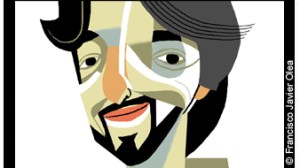
cartoon drawing of Andres Neuman

Andrés Neuman

CM: I was looking at your blog and Facebook pages and I was wondering whether you have willingly embraced the social media platforms that so many writers use to promote their work, or whether you have to be dragged kicking and screaming to the computer to engage with your virtual friends?

 AN:Interestingly, my personal blog and Facebook page are two very different, if not opposite, cases. The blog Microrréplicas  is entirely written and updated by me. I consider it just another part of my literary work, indeed not below the books. Whereas the FB profile was actually opened, and is still ruled, by a nice group of readers. They are the only ones who decide what to put on it, and when and how. I think that’s fair. Personal contact with readers can be really great, and sometimes deeply moving. But I guess that keep always interacting online can also be tricky for a writer, since a good book needs quite a lot of solitude and time to be written. And its feed-back is much more a long-term one. So maybe the most respectful thing that writers can do for those wonderful virtual friends is, precisely, to dedicate most of their time to work hard on their books. Which will be hopefully read, discussed, loved or hated on social networks.


CM: And finally….. I have based my blog content on tackling the unread books lurking on my bookshelves. Do you have a ‘TBR Pile’ and if so, what is on it?

AN: Oh, that’s my favourite wet dream: to read everything I haven’t read yet. I have no just one, but several ‘to be read’ piles everywhere at home. The most interesting pile is, of course, the bathroom one: the only place in which nothing can seriously interrupt our reading. What’s on that pile right now? Let’s see: a biography of Chéjov written by my beloved Natalia Ginzburg, the first volume of Philip K. Dick complete short stories, Houellebecq’s new novel, Pierre Michon’s penultimate, an anthology of Chilean poet Nicanor Parra, several young Argentine novelists, a very good half-read book of stories by James Lasdun, a collection of fragments by wonderful Spaniard philosopher María Zambrano, last Julian Barnes’ book, a manual of compared mythology (what the hell is doing that here?), a travel book about Italy by Stendhal, a political essay by Cameroon activist Achile Mbembe titled Necropolitics, an anthology of contemporary Welsh poets (recently found in Cardiff), a couple of comics, some old and crumpled and dirty newspapers… If I resurrected, I’d dedicate that extra life exclusively to pending books. I promise. Well, I don’t. Will there be a bathroom after death?

Many thanks to Andrés Neuman for taking the time to answer my questions. I’ll be posting up a blog post about Traveller of the Century shortly.

Picture credits: All of the illustrations used here were taken from Andrés Neuman’s official website with thanks.


Andrés Neuman: Traveller of the Century

Cover of Traveller of the Century with silhouette of town

Traveller of the Century

By no stretch of the imagination can I claim that Traveller of the Century has been lurking unread on the (admittedly over populated) landing bookshelves, therefore I will not attempt to justify reading what is patently a NEW book. My only defence is that the nice people at Pushkin Press offered me a copy and it seemed impolite to refuse the kind offer. (How does that sound?). In fairness, I do not think I ever claimed that I was never going to read a new book while perusing the backlog (and indeed have already allowed exceptions for library loans).

Next week I will be posting up a Q and A session with Andrés Neuman, the South American author of Traveller of the Century (recently published in translation by Pushkin Press). The publishers are arranging a series of email interviews between Neuman and literary bloggers.

My slot is to be next Wednesday 25th April so I shall be posting up the eight questions that I submitted to the author and his responses to them. I will also put together a piece about the novel for visitors to The Landing to read. It is the first time that I have ever had the opportunity to ask questions of a writer, so I was apprehensive about having a go.

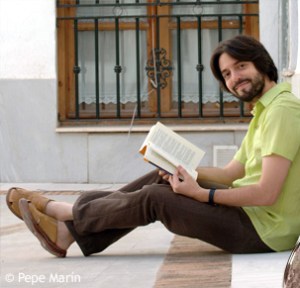
portrait of Andres Neuman

Andres Neuman

Pop back on Wednesday to see the results. Meanwhile, it is back to reading Traveller of the Century and making notes..