Landing Advent Calendar Day Twenty Two

22nd December

‘Twas the Night Before Christmas (or: Account of a visit from St Nicholas) illustrated by Matt Tavares (Published by Walker Books, 2010).

'Twas the Night Before Christmas

‘Twas the Night…

This well-known poem first appeared on 23rd December 1823, published anonymously in an American magazine, the Troy Sentinel as ‘Account of a visit from St Nicholas’. Several years later in 1844, authorship of the poem was claimed by Clement C Moore. Opinion continues to be divided on who really wrote the verses.

In the introduction to this edition, Matt Tavares points out that editors have often made changes to the spelling and punctuation of the original text, even changing the names of the reindeer. For this edition, Tavares has returned to the original version. I have quoted two snatches of the verse here to whet your appetite:

‘Twas the night before Christmas,
When all thro’ the house,
Not a creature was stirring,
Not even a mouse;
The stocking were hung
By the chimney with care,
In hopes that St. Nicholas
Soon would be there;

The magical figure of St Nicholas fills the stockings and disappears into the night, in his sleigh pulled by Dasher, Dancer, Vixen, Comet, Cupid, Dunder and Blixen, “Now dash away! dash away! dash away all!”

He sprung to his sleigh, to his team gave a whistle,
And way they all flew, like the down of a thistle:
But I heard him exclaim,
Ere he drove out of sight –
Happy Christmas to all,
And to all a good night.

We will be reading this poem again at Christmas (I may even get a little further in trying to learn it off by heart) and appreciating the lovely illustrations in this edition.

I will also be searching out the Christmas stockings ready for our seasonal visitor. Not long to wait now…
Advent Reading Challenge: Nativity Play

21st December

Read Me and Laugh

Funny poems galore


‘Just Doing my Job’ a poem by Clare Bevan (taken from Read me and Laugh, edited by Gaby Morgan, mentioned in a previous post). This poem was originally published in We Three Kings (ed. Brian Moses, Macmillan, 1998).

I love this poem, conjuring up as it does long forgotten memories of participating in the school Nativity Play. Not that I ever had a starring role, I hasten to add, my only ever role being as the inn keeper’s wife which only had one short line. Hardly a distinguished theatrical career.

The poem features several small boys in the role of ‘Herod’s Henchmen’, which no doubt required lots of parental assistance in the form of cardboard and tinfoil accessories. All of that charging around the school hall sounds great fun (not that fun was exactly the point of it all I suppose). But it probably burnt off excess end of term excitement in the process.

I have extracted three verses to give you a flavour of the activity:

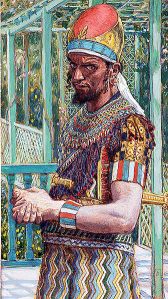
King Herod

King Herod by James Tissot


1, I’m one of Herod’s Henchmen.
    We don’t have much to say,
   We charge through the audience
    In a Henchman sort of way.

3, Our swords are made of cardboard
    So blood will not be spilled
    If we trip and stab a parent
    When the hall’s completely filled.

6, Yet when the play is over
    And Miss is out of breath
    We’ll charge like Henchmen through the hall
    And scare our Mums to death.

Of course, the sting behind the title of the poem is that a whole multitude of sins may be glossed over by employing the excuse of ‘just doing my job’. A lesson for children to learn while they enjoy reading the poem.

The striking painting of Herod the Great dates from 1886-1894 and is in the Brooklyn Museum (image courtesy of Wikipedia).

Advent Reading Challenge: More Pudding

20th December

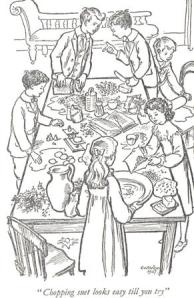
Conscience Pudding a story taken  from New Treasure Seekers written by E. Nesbit and illustrated by C. Walter Hodges (Ernest Benn Ltd, 1904, 1948)

line drawing of making the Christmas pudding

Making the Conscience pudding

I have always loved Edith Nesbit’s stories, particularly the three books about the enterprising Bastable children, Oswald, Dora, Noël, Alice, Dicky and H.O. who find imaginative ways of restoring the family fortunes when their father’s business fails.

This book is one of a bundle I picked up in a second-hand shop in Birmingham sometime in the early 1990s. It looked as though one family had been having a clear out as several volumes were inscribed with the name of ‘Arrowsmith’. It is not in brilliant condition, but certainly worth the few pennies I paid.

In this episode of the children’s adventures, the young entrepreneurs decide to make a Christmas pudding for themselves rather than suffer the ‘plain pudding’ that their father has instructed the cook to make. However, they have no money to buy ingredients and two of the younger children come up with an enterprising solution:

“It’s no good. You know we’ve got no tin.
“Ah,” said Alice, “but Noël and I went out, and we called at some of the houses in Granville Park and Dartmouth Hill – and we got a lot of sixpences and shillings, besides pennies, and one old gentleman gave us half a crown. He was so nice. Quite bald, with a knitted red-and blue-waistcoat. We’ve got eight-and –sevenpence.”

So after acquiring these riches, Alice and Dora sally forth to buy the ingredients from the grocer (who is kind enough to tell them that a cupful of ginger would be too much) and the children begin secretly to make the pudding:

“…we barricaded the nursery door and set to work. We were very careful to be quite clean. We washed our hands as well as the currants. I have sometimes thought we did not get all the soap off the currants. The pudding smelt like a washing-day when the time came to cut it open. And we washed a corner of the table to chop the suet on. Chopping suet looks easy till you try.” (see picture!)

Not exactly Jamie or Delia then! But where does the ‘conscience’ bit come in, I hear you ask. This is because the younger children collecting the money had asked for money to make a pudding for ‘poor children’. When the older children found out, they declared that the pudding had to be given away to some truly poor children, as it was dishonest to keep it.

This results in comical efforts to give the pudding way, ending in a trip to the workhouse in a desperate quest to salvage the family’s honour. This is not exactly a workhouse as depicted in Dickens, as the matron puts on Christmas entertainment for the older residents.

All’s well that ends well, when matron listens to the sorry tale and relieves the children of their ‘conscience pudding’ both literally and figuratively. An apt Christmas story in more ways than one…

Advent Reading Challenge: Little Grey Rabbit

19th December

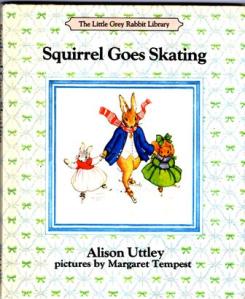
Squirrel Goes Skating written by Alison Uttley and illustrated by Margaret Tempest (William Collins 1986, 1988). This is an abridged edition of the original story published in 1934.

Squirrel Goes Skating

Skating Fun…

Again, during this reading challenge, I am indulging in an old family favourite, revisiting Little Grey Rabbit, Squirrel, Hare, and their countryside friends. In this snowy story, the animals gather to go skating on the pond at Tom Tiddler’s Way. The entire neighbourhood takes skates and food and sets off to have a day of fun on the ice:

Everything was frozen. Even the brook, which ran past little Grey Rabbit’s house on the edge of the wood, was thick with ice. Each blade of grass had a white fringe, and the black, leafless trees were patterned with shining crystals.
On every window of the house were Jack Frost’s pictures – trees and ferns and flowers in silver.

At last they reached the pond, which lay in the centre of a small field. Already many animals were on the ice, and the air was filled with merry cries. The newcomers sat down and put on their skates. Grey Rabbit placed her basket of food in the care of Mrs Hedgehog, who sat on a log, watching her son, Fuzzypeg.
Soon they were laughing and shouting with the others, as they skimmed over the ice.
Hare tried to do the outside edge, and got mixed up with the skates of a white duck. He fell down with a thump and bruised his forehead.

After Grey Rabbit, Squirrel and Hare had enjoyed a picnic with their friends Water-rat, Moldy Warp, Mrs Hedgehog and Fuzzypeg:

They all returned to the ice and skated until the red sun set behind the hills. Dark shadows spread across the fields as the animals removed their skates and set off home.
“It has been a jolly day,” said Grey Rabbit to Water-rat and Moldy warp. “Good-bye. Perhaps we will come again tomorrow.”
“Goodnight. Goodnight,” resounded round the pond.

I cannot claim this to be a Christmas piece exactly but it fulfils our nostalgic longing for those snowy winters where we can play for a while and then go and snuggle at home afterwards. We can enjoy the thought of snow without actually getting our feet wet and cold! Alison Uttley used her own country childhood experiences in her stories so I am sure that she once went skating on her local pond (though possibly not with hares and ducks).

Until tomorrow…

Advent Reading Challenge: Seven Stars

18th December

‘Christmas Shopping’ taken from Mary Poppins written by P.L. Travers and illustrated by Mary Shepard (Collins 1958, 1998). First published by Peter Davies Ltd 1934.

Mary Poppins

Practically Perfect…

As we head into the last full week before Christmas I am conscious of just how many festive poems and stories that I will not have room to put up on the Landing Advent Calendar. Nevertheless I am pleased that I have managed to include so many of our old family favourites along the way. Perhaps I will have to do it all again next year.

Today is the turn of everyone’s favourite nanny, Mary Poppins who was at various times the mainstay of the Banks’ household. In the Christmas shopping episode Mary Poppins has taken Michael and Jane into town. There they have a magical encounter with one of the Seven Sisters who has come to earth in human form to do a spot of seasonal shopping:

“Now you recognise me, don’t you? I’m the second of the Pleiades. Electra – she’s the eldest – couldn’t come because she’s minding Merope. Merope’s the baby, and the other five of us come in between – all girls. Our Mother was very disappointed at first not to have a boy, but now she doesn’t mind.”

“But what are you doing here?” demanded Michael, still very surprised.
Maia laughed. “Ask Mary Poppins. I am sure she knows.”
“Tell us, Mary Poppins,” said Jane.
“Well,” said Mary Poppins snappily, “I suppose you two aren’t the only ones in the world that want to go shopping at Christmas-“
“That’s it,” squealed Maia delightedly. “She’s quite right. I’ve come down to buy toys for them all. We can’t get away very often, you know, because we’re so busy making and storing up the Spring Rains…”

Maia has a lovely time choosing gifts for her sisters: A stove with silver saucepans for Electra; a skipping rope for Taygete; Alcyone gets The Swiss Family Robinson; Celaeno has a hoop; there is a spinning top for Sterope and a rubber duck for Merope.

If you want to know how an astral body pays for her shopping, or indeed what she receives for Christmas then look out for this Mary Poppins story. As is usual in any adventure with their mysterious nanny, the children are not sure whether they really saw what they thought they saw, or simply had a wonderful dream. And as Mary Poppins’ readers will know, she never tells anybody anything…

(The image of the Pleiades was sourced from Wikipedia)

The Pleiades

The Pleiades


Advent Reading Challenge: Mrs Pepperpot

17th December

Mrs Pepperpot’s Christmas  taken from Mrs Pepperpot’s Year  written by Alf Prøysen (1914-1970) and illustrated by Björn Berg (translated by Marianne Helweg). Published by Puffin Books 1981 (Hutchinson 1973).

Mrs Pepperpot's Year

Size is no barrier for Mrs Pepperpot!


As I am sure many of you know, Mrs Pepperpot is the woman from Norway who has the tendency to shrink to the size of a pepperpot at very inconvenient moments. In this story, true to form, she shrank just when she was planning to go Christmas shopping:

‘She wanted to buy a sheaf of corn for the birds’ dinner, and she wanted to get them a little bird-house where she could fee them every day. The other thing she wanted was a wreath of mistletoe to hang over the door, so that she could wish Mr Pepperpot a “Happy Christmas” with a kiss. But Mr Pepperpot thought this was a silly idea.

“Quite unnecessary!” he said.’

So of course Mrs Pepperpot had to find a way to make her husband buy exactly what she wanted at the market. To that end she hid in his knapsack as he headed out of the house.

‘At one stall stood a farmer selling beautiful golden sheaves of corn. As her husband walked past the stall Mrs Pepperpot climbed out from the knapsack pocket and disappeared inside the biggest sheaf of all.

“Hullo, Mr Pepperpot,” said the farmer, “how about some corn for the birds this Christmas?”

“Too dear!” answered Mr Pepperpot gruffly.

“Oh no, it’s not!” squeaked the little voice of Mrs Pepperpot.

“If you don’t buy this sheaf of corn I’ll tell everyone you’re married to the woman who shrinks”.’

Of course the poor man had no choice but to buy the best sheaf of corn. By the time Mrs Pepperpot had finished, her husband had bought a fine bird house and even a mistletoe wreath. After an adventure with a red balloon, Mrs Pepperpot returned home and grew back to her normal size.

Mrs Pepperpot's Christmas

Picture book edition

I enjoyed the Mrs Pepperpot tales when I was a child and so it is nice to see that she is going strong, with several stories still in print. Though I must admit that all of our editions are rather battered second-hand copies from the 1970s and 80s. But no less loved for all that…

Advent Reading Challenge: Three Kings

16th December

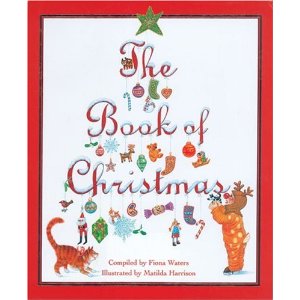
Three Kings Came Riding by Henry Wadsworth Longfellow (1807-1882) another poem taken from The Book of Christmas

This is a long poem of fourteen verses telling the story of the journey of the Three Kings (Wise Men or Magi) to find the new saviour. I have known the poem since my own childhood and well remember the sense of romance about these mysterious figures making such a long journey. I also recall being absolutely baffled as to what frankincense and myrrh actually were.

I have just picked three verses to give a potted version of the story. The men set out following the star:

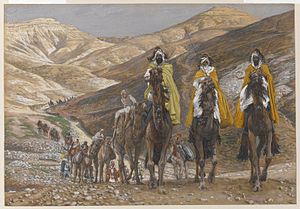
The Magi Journeying

The Magi Journeying (Les Rois Mages en Voyages)

1) Three Kings came riding from far away,

Melchior and Gaspar and Baltasar;

Three Wise Men out of the East were they,

And they travelled by night and they slept by day,

For their guide was a beautiful, wonderful star.

Along the way the travellers talk to people they meet of the child, and so Herod the Great hears.

He asks the Wise Men to bring him news from Bethlehem:

8) So they rode away; and the star stood still,

The only one in the grey of the morn;

Yes, it stopped it stood still of its own free will,

Right over Bethlehem on the hill,

The city of David where Christ was born.

The Three Kings found their way to the baby’s birth place and gave their gifts:

The Book of Christmas

The Book of Christmas

12) They laid their offerings at his feet;

The gold was their tribute to a King,

The frankincense, with its odour sweet,

Was for the Priest, the Paraclete,

The myrrh for the body’s burying.

After worshiping the new child, the Three Kings rode away and headed back to their homes in the East. They were wise enough not to return to King Herod, but travelled home a different way.

The painting here is by James Tissot which is in the Brooklyn Museum (image taken from Wikipedia).

Advent Reading Challenge: Baubles

15th December

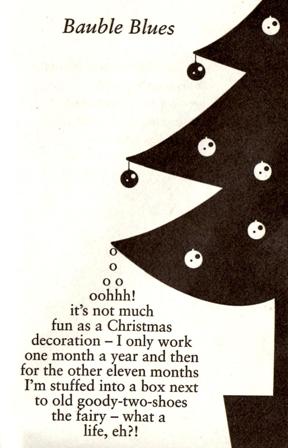
Bauble Blues by James Carter (taken from Read me and Laugh: A Funy Poem For Every Day Of The Year, chosen by Gaby Morgan),  Macmillan, 2005. This poem was originally published in Cars, Stars and Electric Guitars by James Carter, 2002.

This is another great collection of verse for children, and though you do not of course have to read the poems on their appointed day, the structure does encourage incorporating poetry into daily life. The verses vary in length and are from poets old and new covering a range of topics. I had a trawl through December and found this one and another which will appear on the blog next week.

As this is a concrete poem I have reproduced it in its entirety alongside the typed version:

oohhh! it’s not much fun as a Christmas decoration –

Bauble Blues concrete poem

Concrete thoughts…


I only work one month a year and then for the other

eleven months I’m stuffed into a box next to old goody-

two-shoes the fairy – what a life, eh?!

I had never thought of Christmas decorations having sad lives before reading this short poem, now I wonder whether I should simply keep them up all year round. It is also probably just as well that we have a star and not a fairy for the top of our tree.

Read Me and Laugh

Funny poems galore


Advent Reading Challenge: Pancake Panic

14th December

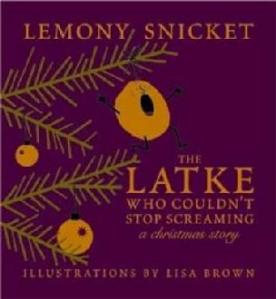
The Latke who couldn’t stop screaming: a Christmas Story by Lemony Snicket with illustrations by Lisa Brown (McSweeny’s Books, 2007)

This is a Christmas book with a difference as it tells the story of a frying Hanukah latke who escaped screaming from the pan. Here is

Latke

A Screaming Latke

the blurb to give you a flavour (pun intended) of this seasonal tale told in Snicket’s inimitable style:

‘Latkes are potato pancakes served at Hanukah. Lemony Snicket is an alleged children’s author. For the first time in history, these two elements are combined in one book. People who are interested in either one or both of these things will find this book so enjoyable it will feel as if Hanukah is being celebrated for several years, rather than eight nights.’

The story opens as the potato pancake runs away screaming thus: “AAAHHHHHHHH!!!”
‘This may seem like unusual behaviour for a potato pancake, but this is a Christmas story, in which things tend to happen that would never occur in real life.’ 

On his flight through town (still screaming), the latke meets a row of coloured lights, a candy stick and a pine tree who all try to convince him that he is really as much a part of Christmas as Santa Claus:

‘“Santa Claus has nothing to do with it,” the latke said. “Christmas and Hanukah are completely different things.”
“But different things can often blend together,” said the pine tree. “Let me tell you a funny story about pagan rituals.”
But before the pine tree could begin its story, a family came tramping through the snow, searching the forest carefully.’

You may be able to guess how this story ends, all things considered…

Advent Reading Challenge: Partridges and Pears

13th December

Twelve Days of Christmas (Correspondence) by John Julius Norwich (illustrated by Quentin Blake) Atlantic Books 2010. First published by Doubleday in 1998.

These are not quite the Twelve days of Christmas that you might recall from long ago. We have here an old rhyme with a new twist from John Julius Norwich, which has been brilliantly interpreted by Quentin Blake’s drawings. There is indeed a partridge, pear tree, hens, geese, swans and so on but these days a girl (Emily) is not so impressed by such gifts from her swain (Edward). Emily’s mother and the neighbours are generally not too keen either (noise and mess being a prime consideration).

Here are a couple of extracts from Emily’s letters, written in response to an increasingly strange tally of Christmas gifts. It all begins promisingly enough:

25th December

My dearest darling – That partridge, in that

Twelve Days of Christmas

Another twelve days…


lovely little pear tree! What an enchanting,

romantic, poetic present! Bless you and thank you.

Your deeply loving Emily

But Emily’s mood gradually change as more and more birds appear

(the five gold rings offering only a brief hiatus from the feathery flow):

30th December

Dear Edward – Whatever  I expected to find

when I opened the front door this morning,

it certainly wasn’t six socking great geese laying

eggs all over the doorstep. Frankly, I rather hoped

you had stopped sending me birds – we have no

room for them and they have already ruined

the croquet lawn. I know you meant well, but –

Let’s call a halt, shall we?

Love, Emily              

As usual, I shall not a breathe a word about the ending. I shall merely suggest that Edward’s example in the are of gift purchasing is not one to be followed with impunity.