Advent Reading Challenge: Christmas Pudding

2nd December

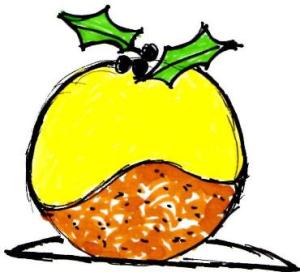
A rather rotund pudding...

A rather rotund pudding…

Pudding Charms, a seasonal poem  by Charlotte Druitt Cole

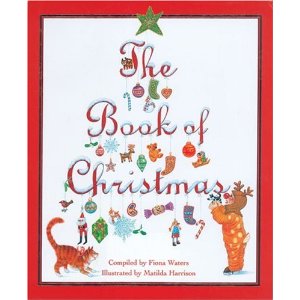
I found this poem in a children’s poetry collection The Book of Christmas, complied by Fiona Waters and illustrated by Matilda Harrison (Chrysalis Chilidren’s Books, 2004).

The Book of Christmas a was a gift to my daughter from my parents in 2007.  I hadn’t come across it before, but it has become a mainstay of our Christmas reading. Fiona Waters’ book is a wonderful collection of seasonal poems and stories and Matilda Harrison’s accompanying drawings are bright and lively.

I hope to feature one or two more poems from the compilation later in the month. Food is such an important part of the festive season, particularly Christmas pudding that I thought I should give over enough space to mouth watering goodies. Just the thought of all that sugar, spice and candied peel being mixed up ready for cooking. Druitt Cole also mentions the traditional charms that go into the pudding…a little bit of magic.

Here is a snatch from Charlotte Druitt Cole’s Pudding Charms:

Currants and raisins, and sugar and spice,

Orange peel, lemon peel – everything nice

Mixed up together, and put in a pan.

And out of her pocket a thimble she drew,

A button of silver, a silver horse – shoe,

And, whisp’ring a charm in the pudding pan popped them,

Then flew up the chimney directly she dropped them.

Hope you like today’s food related piece – edibles will surely feature again…

(illusration Chris Mills, 2012)

Advent Reading Challenge: Dickens

1st December


A Christmas Tree

Christmas with Dickens

A Christmas Tree

by Charles Dickens

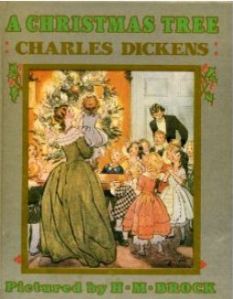
Illustrated by HM Brock (Guild Publishing 1969, 1986). This little book has sat on the shelves for quite a while and was bought second hand in Birmingham.

What better way to begin our Advent Reading Challenge than with  a little bit of Dickens? Just for a change though, I have not chosen to feature the more obvious Christmas Carol.

Here is a Christmas tree covered in all manner of delights including, ‘tambourines, books, work-boxes, paint-boxes, sweetmeat boxes, peep-show boxes, and all kinds of boxes…humming-tops, needlecases, pen-wipers, smelling-bottles‘ and much more besides.

After describing the tree, the narrator goes on to ask what item ‘we all remember best upon the branches of the Christmas Tree of our own young Christmas days’.

Now, if you were inspired by Charles Dickens,  there is a question for you. What do you remember best of all? Drop a comment in the box…

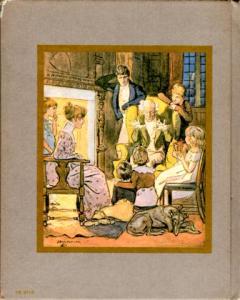
Fireside scene

Back cover – fireside tales


Christmas on the Landing: Advent Announcement

It can hardly have escaped anyone’s attention that we are edging ever closer to a certain celebratory time of the year, though I refuse to pay too much attention to the ‘x days shopping days left’ kind of pressure. Anyway, working in retail as I do it tends to be other people’s shopping that occupies most of my efforts during December. Christmas-itis generally strikes me at about halfway through the month and I just want to run away screaming. I generally just about manage to get around to my own purchases before the close of play on Christmas Eve.

The Book of Christmas

The Book of Christmas

Bearing all of that in mind, I have decided to devote December on the Landing Book Shelves to a seasonal Literary Challenge in an attempt to induce calmness. After much prowling of the bookshelves with a thoughtfully furrowed brow, I have come up with the (possibly not very original) idea of putting a Landing related Advent Calendar/Advent Reading Challenge together. I have compiled a list of Christmas poems and episodes in fiction and plan to post a mini blog each day in Advent.

My inner child has carried me away a little so this Advent Challenge feature will be entirely composed of snippets from children’s books lurking on our shelves. I have to admit to stretching the notion of Landing Book Shelves just a tad, as some of the Yuletide goodies live in either the loft or my daughter’s bookshelves. But I hope you will overlook that minor fudge in the cause of Christmastide.

I should point out however, that you will have to improvise a little for yourselves. My technological skills are not up to creating opening virtual doors so you will simply have to pretend. Of course if you follow this blog, then opening your email will, I feel, simulate the door opening bit quite satisfactorily. Each day should bring to you a seasonal literary morsel with a suitable illustration by way of accompaniment.  Well, that is the plan (and the challenge) anyway so fingers crossed that it all works out successfully.

Keep checking back during December to see what you find…(apologies in advance for the lack of chocolate in the Landing Advent Challenge Calendar).

Ghost Light: my treasure in the in-tray

Ghost Light

Molly Allgood…

As anyone who follows me on Twitter will be aware, this week I unearthed Joseph O’Connor’s Ghost Light (Harvill Secker 2010) from my in-tray where it has been languishing for the last few months. It is the trade paperback edition, purchased in a charity shop and put aside in favour of other things. As I am sure I have remarked before, there is a particular pleasure in coming across a book that you have completely forgotten ever buying. Finding it all over again is a treat in itself. O’Connor’s novel was chosen as the Dublin One City One Book title for 2011 but I never actually got around to reading it. (See this article in The Blurb pages for more on the annual event).

The novel brings to life the secret love affair between playwright John Millington Synge (1871-1909) and Abbey Theatre actress Mary (Molly) Allgood (1885-1952) from their meeting in 1905 until Synge’s death. Molly went on to become a well-known stage and film star (as Maire O’Neill) though Synge’s family and friends brushed aside her real-life role as Synge’s lover and muse. Her relationship with Synge had never been considered suitable owing to differences in their respective religious and social positions.

I am just over half way through Ghost Light now and enjoying it very much after taking a few pages to get into it. At first, I thought the novel was going to be too sad and dreary for what I wanted at the time. Certainly, persistence has paid dividends and, while the book has its sadness, there is plenty of humour too with some brilliant comic dialogue. Of course, Molly is a wonderful heroine, both in her fiery spirited youth and her resilient old age in a battered post-war London.

Portrait of Molly Allgood

Molly Allgood, by Yeats

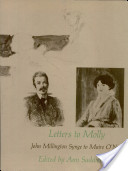
The more I progress with the novel, the more I want to know about Molly’s life and times. I found a lovely portrait, painted by John B Yeats on my internet trawl for more information. Molly made many films during her career, working up until the end of her life. She went on to marry twice (her first husband died and she was divorced from the second) and had two children. Apparently all of her letters to Synge were destroyed but an edition of his letters to Molly was published in 1971 by Harvard University Press (edited by Ann Saddlemyer). I think this is one volume I would like to add to my Landing Bookshelves letters collection. Perhaps a Christmas present to myself?

For more information take a look at Joseph O’Connor’s webpages: http://josephoconnorauthor.com/ and also an article he wrote for Prospect Magazine (from where the picture of Molly was taken): http://www.prospectmagazine.co.uk/magazine/the-playboy-and-his-muse/

Letters to Molly

Letters to Molly

L.P.Hartley: The past is a foreign country

The Go-Between

The winged messenger

I said that I would return to the topic of The Go-Between and so I have (with a certain amount of delay admittedly). I enjoyed the novel a great deal, which is set in a period and in a milieu that has always had a particular fascination for me. The Penguin Modern Classics edition (1997, 2000) has an excellent scholarly introduction by Douglas Brooks-Davies which I read before the novel, but that I wish I had left until afterwards as it gave away the details of the plot. Bearing that in mind, I will attempt to do no plot spoiling myself. Suffice to say that at one point I was irresistibly reminded of Aunt Ada Doom seeing something nasty in the woodshed at Cold Comfort Farm.

The novel recalls memories of a hot summer in 1900, in which Leo Colston has been invited to stay with his somewhat grander school friend Marcus Maudsley at Brandham Hall. Twelve-year-old Leo is the go between of the title, in his role of secret messenger between Marian Maudsley and Ted Burgess, a local farmer. These messages are mirrored by the errands he runs between Marian and the man her mother wishes her to marry, Viscount Trimingham.

Leo, as an old man looking through childish souvenirs in an old Eton collar box, recalls the details of that summer from long ago. The discovery of the box and its contents prompts memories that Leo has suppressed for his entire adult life. The book deals with loss of innocence (Leo’s) and class issues, as well as love, loyalty and friendship. The class barriers of the pre-war years are neatly encapsulated. The set pieces of the local cricket match and the post-match concerts show clearly the ‘them’ and ‘us’ aspects of the social life of the village. Against this background is set the affair between the lovely Marian and the attractive, but socially inferior Ted.

The Go-Between

First edition (1953) cover

The focus of the novel is on Leo’s naivety and the drastic effect that the discovery of adult sexuality has on his subsequent emotional development. He clearly at first has no idea of the nature of the relationship between Marian and Ted. It is hard to imagine that such innocence existed from our twenty-first century perspective. However, the narrative makes clear that life was very different then. Adults and children lived almost separate lives; indeed at first, Leo did not even realise that Marian was the sister of his school friend. All the adults seemed indistinguishable from one another. They even seemed to speak a different language from the public school patois he shared with Marcus. Leo, being of a humbler background than the Maudsleys (yet not lowly enough to be excluded from the delights of Brandham Hall) has at times to submit to being corrected about what is appropriate behaviour or language by the often insufferable Marcus. It has to be said that Marcus is (in my view at least) a very unappealing child in his snobbery towards the lower orders. No doubt however, his attitude to the villagers was common enough at the time.

If Marian fascinated Leo, then he was almost terrified of her mother and lived in dread of doing the wrong thing. Manners and behaviour were very important and obedience was expected from children. It was however, a time when children were left to their own devices for long stretches so the boys could escape adult supervision for hours on end. This of course facilitated Leo’s mission as Mercury, flying between the hall and the farm bearing messages with nobody being any the wiser.

I said I would try not to plot spoil The Go-Between, so I will leave it there and hope that my notes have whetted your appetitite if this is a novel that has so far passed you by. My only remaining task is to point out that the copy I have been reading actually belongs to ‘He who put the shelves up’ (with many thanks). 

Happy reading! 

Landing Author: Paul Anthony Shortt: Locked Within

Paul Anthony Shortt

The Author…

Now as promised last week, here are the answers to a few questions that I put to debut author Paul Anthony Shortt on the publication of his urban fantasy, Locked Within. I was slightly worried that I had asked too many questions, but Paul gamely answered all of them most eloquently…

CM: You have talked about Ritchie Blackmore’s music being a starting point for Locked Within, and I wondered what other music you feel has influenced your work?

PAS: Wow, where to start? Music is integral to my writing. I have a large collection, a lot of it from film scores, and I listen to it daily. Once a particular piece sets in my mind, I’ll start imagining scenes that suit the music as though I were creating a movie in my head.   For Locked Within, of course “Locked Within the Crystal Ball” by Blackmore’s Night was essentially my main theme song. Another song of theirs, “The Circle,” was an influence as it is specifically about cycles of death and rebirth, and the question of whether we can break free from our own fates. I used Northern Kings’ cover of “We Don’t Need Another Hero” to get me in the mindset to write about a New York that has been beaten down by supernatural oppression.   I also listened to a lot of Nightwish, Bon Jovi, and film scores by the likes of Hans Zimmer as background music while I wrote. I love big, sweeping sounds, the kind that inspire a sense of epic myth. The recent Chris Nolan Batman movies, Transformers, Pirates of the Caribbean, even Rango and Shrek all have scores that fire my imagination and set my heart racing. I’d encourage anyone, regardless of how they feel about a specific movie, to take time to listen to the music. It’s a whole new dimension to explore.

CM: I was reading that the Greek legends were your favourite mythology, but do you have an Irish mythological hero?

PAS: Cú Chulainn, hands down. He’s our Hercules. The greatest warrior, cunning and brave, but still tragically flawed both by temper and commitment to oaths which eventually lead him into battle against his closest friend, Ferdia. My favourite stories are of characters who aren’t just extremely capable and can defeat any enemy with ease, but where they see that their strengths can’t resolve all problems, where they have to learn new ways of overcoming their foes, or face tragic consequences.

CM: Would you talk us though the process of planning out the main characters in Locked Within? What system do you use to keep track of important details of personality and character history?

PAS: When starting out I tend to just go with the flow. I’ll start out with a Word document that lists my characters by name and write brief descriptions of their appearance and personalities. Mostly that’s just to get the details clear in my head. When I’m not writing, I’m usually running through important scenes in my head, especially on the way to and from work and listening to music, so by the time I sit back down to write, the details have been repeated so much in my mind that I often never need to check back over my notes.

For me, writing is far more work than just typing the words. Every spare moment I have, I spend thinking about some aspect of my current work in progress. So while I have my notes as a back-up if I haven’t had a chance to work on it for a while, usually the act that I’m almost constantly thinking and planning means I can pull up whatever information I need as I write.

CM: You have said that you view New York city as being a character in its own right in your urban fantasy. How would you describe that character and what gender would the city be do you think?

book jacket with a man's face

Locked Within


PAS: I don’t think of the city in terms of gender. I think the soul, the essence of something as universally influential as New York would transcend gender completely. However if that soul were to take on a human form, I think it would present itself as female. New York is in many ways the capital city of the western world. It is central to popular fiction and for many years was the gateway to America for countless immigrants, with the Statue of Liberty looking on, serving as a mother to whole cultures and nations being reborn right there in her port as they started their new lives.   In Locked Within, New York is that grandmother who lived through the war and had to grow up hard, dealing with prejudice and hardship. It’s tough as nails, forged in fires as everyone looked to it for guidance. But it hasn’t lost its kinder side. It’s just tired and weary, so long left to fend for itself with no-one to help. Once it realises that someone still cares, it’ll stand back up and fight to the last to protect its family, its inhabitants.

CM: I was looking back to when you first began your blog in 2010. Can you explain to us how important your blog is to your novel-writing process?

PASMy blog has been absolutely essential. Quite honestly, if not for my blog I wouldn’t have my book deal. The managing editor of my publisher, WiDo Publishing, was actually one of my first blog followers, and it was through a contest she held that my book wound up being sent to WiDo.

Since then, the blog has been a place where I can pitch ideas, share details of how I work, and details of my own life. It’s helped me connect with so many people and make so many friends who have all give me incredible support on this journey. Just being able to announce something like the fact I had started writing the sequel, and getting that immediate feedback, is a great motivator.

CM: Paul, as you know, writing can be a lonely business, so many writers belong to groups for support and criticism of their work. Would you tell us about your own support network?

PAS: Some of my closest friends are writers as well, so that helps. I have a core team of critique partners, and we share our work with each other as we write, offering feedback and advice. I’d be utterly lost without them, which is why they’re both first on my acknowledgements page! I also have a group of friends who act as my beta readers, giving me critical feedback. They all keep pestering me for the next book and it really helps to see such enthusiasm.   Of course, my biggest supporter is my wife, Jen. She’s incredible. Always understanding if I need some extra time to write. Always making sure I eat properly and take regular breaks, or insisting we go to the cinema or meet some friends just so I can unwind and get my mind off my work. I would actually crack up without her to keep me in check. It’s just as well that I’ve got all my writing work for the year out of the way, because we’re having twins in December and it’s time for me to make sure she’s looking after herself now!

CM: Can you describe for the readers a typical writing day (if indeed there is such a thing). Is there a particular place in which you prefer to write?

PAS: Monday to Friday, I get into work at least an hour before I’m due to start so I can write. Then when lunch time comes around I spend that writing as well. If I’m really in the zone, I can get a full day’s work done in that time, but sometimes I need to do a little extra at home in the evenings. For weekends, I’ve long since given up on lie-ins and I’m up early to write for a couple of hours before breakfast.   My favourite place to write is in our front room where I have my desktop pc set up and my leather office chair. It’s the most comfortable chair I own and perfect for writing in. It also helps that I have my entire music collection transferred to my pc so I can run my playlists to keep me focused.

CM: And finally, Paul: if you were casting your book for a film production, who would you choose to play the main leads (assuming that money is no object) and which director would you want?

PAS: I love this kind of question! As it happens, I had certain actors in mind as I wrote the book, so here’s the “cast” list:

Nathan, the hero of the book: James McAvoy or Ewan McGregor (honestly can’t decide!)

Dorian, one of the primary antagonists: Michael Wincott

Ben, Nathan’s best friend: David Boreanaz

Laura, Nathan’s girlfriend: Rachel McAdams

Mike, Nathan’s dad: John Mahoney

Cynthia, Nathan and Laura’s friend: Olivia Wilde

Roland, a sort of mentor to Nathan: Steve Buscemi

Adams, a vampire-hunter: Dennis Haysbert

Lane, another vampire-hunter: Jason Statham

Cadence, a witch: Thandie Newton

Creek, Dorian’s right-hand man: Willem Dafoe

Eli, a vampire: Keifer Sutherland

As for a director, I love to see highly-detailed worlds created in a movie, and also well-choreographed action sequences. There’s a trend in movies to make it hard to see fight scenes taking place and I always feel a bit short-changed when I can’t see what’s going on. With that in mind, I think I’d choose Guillermo Del Toro to direct.

Many thanks to Paul Anthony Short for kindly answering a few questions about his work.

Good luck with Locked Within!
 

Announcing Landing Author: Paul Anthony Shortt

Next week (on the 15th November to be precise) I will be entertaining a second guest on my literary landing. Paul Anthony Shortt will be submitting himself to a gentle grilling as part of his blog tour to promote his debut novel Locked Within.

book jacket with a man's face

Locked Within

Locked Within officially released yesterday, launches on Thursday 8th November at Hughes and Hughes Bookshop in Dundrum, Dublin. This urban fantasy novel is set in New York, where the hero Nathan Shepherd feels he is destined to fight the supernatural predators that threaten the inhabitants of the city:
‘The supernatural realm and the mundane world have existed side by side since the dawn of time. Predators walk the streets, hidden by our own ignorance. Once, the city of New York was protected, but that was another age.

Now a creature emerges from the city’s past to kill again, with no-one to hear the screams of its victims. The lost and the weak, crushed under the heels of the city’s supernatural masters, have given up hope.

But one man finds himself drawn to these deaths. Plagued by dreams of past lives, his obsession may cost him friends, loved ones, even his life. To stop this monster, he must unlock the strength he once had. He must remember the warrior he was, to become the hero he was born to be.

His name is Nathan Shepherd, and he remembers.’

Well, that was just a little teaser taken from Paul Anthony Shortt’s blog (here) and next week I will be posting up answers to a few questions that I put to him about his writing and what influenced the creation of Locked Within. Paul will be talking about music, mythology and his favourite place to write. I also asked him about which actor he would choose to play his hero, should Hollywood come knocking!

Meanwhile, if you are in Dublin tomorrow pop along and meet the man himself and get ‘Locked Within’ Paul’s fantastic world…

Landing Eight Update: The Go-Between

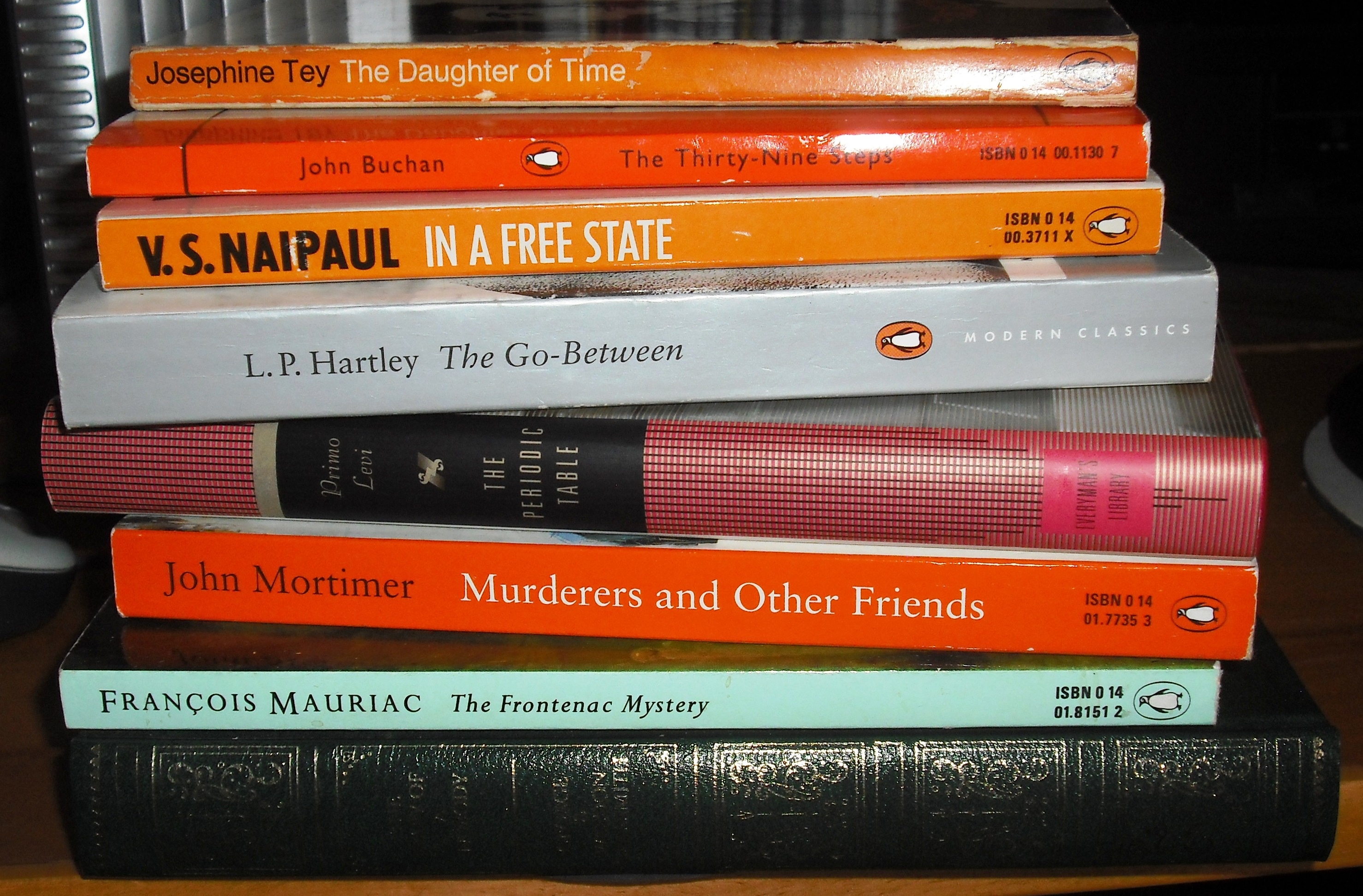
A pile of classic novels
Progress…

For anyone who has been wondering whether I will ever finish reading the Landing Eight pile, I would like to announce that finally I read The Go-Between, during a Bank Holiday weekend break in Kilkenny.

I will return to the book in another post, but for now suffice to say that I enjoyed sweltering in the heat of summer in 1900 (though I doubt if I would have been socially elevated enough to be invited to play croquet had I really been around at the time). I rather think I would have been considered to be what Marcus so charmingly described as one of the ‘plebs’.

As it is now autumn, almost Halloween in fact, I will leave you with a muse upon the tendency of shops to confuse Halloween with Christmas. I wrote this for Paragraph Planet a couple of years ago and was reminded of it again last week while looking at pumpkins in Marks and Spencer and becoming distracted by a nearby aisle of Christmas decorations. It was all too much…

Christween. No sooner is Halloween cleared away than Christmas is upon us. Though actually for a while the two festivals were running mates. Witches’ coven one side of the shopping centre; Santa’s house taking shape on the other. They could have been neighbourly and exchanged tricks for mince pies. Now alas, there are only rotting pumpkins to rival the tinselly explosion. Jolly Christmas lights and cheer all the way; the spooky darkness has been routed.

And if you have never had a look at Paragraph Planet before, stop by and take a look at what can be done in just 75 words …

New literary travel guide from Oxygen Books

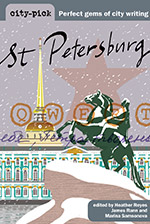
St Petersburg Guide

Another delicious literary guide…

Quick Post: New literary travel guide from Oxygen Books

This is by way of a brief ‘thank you’ to Malcolm at Oxygen Books for my lovely copy of the latest in the City-Pick  series: St Petersburg (edited by Heather Reyes, Marina Samsonova and James Rann). I have had it tucked away for a wee while and have only now started dipping into it. I began with some pieces on the Marinsky Theatre, Anna Pavlova and extracts from Truman Capote’s visit to the city on a cultural exchange tour in 1957.  After reading about St Petersburg in the snow I am feeling quite Christmassy already.

My first City-Pick guide was the Dublin guide which I originally wrote about for Hackwriters and which has seen plenty of wear in the meantime. If you want to read this piece I have now tweaked it and re-posted. (here). Similarly you might like to take a look at Amsterdam (here) which I wrote about after a weekend trip in 2011. Now all I need is a holiday in Russia….

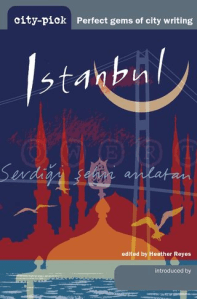
Update ( June 2013) – I have been sitting on the Istanbul guide for a while and have been inspired to take it out after seeing the Bollywood film Ek Tha Tiger (Salman Khan and Katrina Kaif) in which part of the action takes place in this lovely city. Whether the book contains any anecdotes about secret agents (of any stripe) remains to be seen though. Mind you the plot of the film began in Dublin, so if there’s ever a revised edition of the Dublin guide perhaps it might include reminiscences from the Bollywood film crew. Now there’s a thought…

cover of Istanbul guide with cresent and minarets

‘perfect gems of city writing’…

The end of summer: Sculpture at the Bots

You know that the end of summer draws near, when the annual Sculpture in Context exhibition opens at the National Botanic Gardens in Glasnevin. Now in its twenty-sixth year, Sculpture in Context, hosted very successfully by the Botanic Gardens for eleven of those years, goes from strength to strength. It is an event that I look forward to immensely and one that I have not missed seeing since I first came to Dublin several years ago.

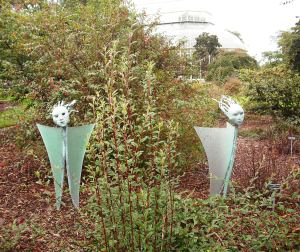
Wood Nymphs

Wood Nymphs by Maureen Bushe

As the editorial in the exhibition catalogue explains, the gardens ‘offer a challenging venue which gives the artist the rare opportunity of realising large scale work’. The editorial goes on to highlight the aspect of the exhibition that I like most, that of ‘sometimes finding sculptures in the most unusual places’. In fact you need to keep your eyes peeled as you walk around the gardens as artworks could be in the water, up a tree or in amongst the flowerbeds. The organisers kindly provide a map with the catalogue (€3) to aid in your quest to discover 130 pieces of sculpture. To be fair, not all of the pieces are scattered over hill and dale because there is an indoor element to the exhibition too (this is a blessing on wet and chilly days).

How you approach the exhibition is entirely up to you; either the systematic approach or the ramble around and see what turns up method are possible. I tend to favour the latter, as the ensuing randomness of the experience is much more rewarding. As I have said, you do need to be observant, as well as to be prepared to perform an abrupt about turn when another artwork is spotted. Sometimes I have found myself poised between two pieces several metres apart, in a mad moment of indecision. Visitors have an opportunity to vote for their favourite piece in the exhibition but I usually find it much too difficult to decide.

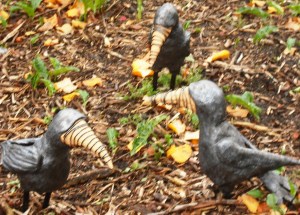
Murder of Crows

Murder of Crows by Bernadette Doolan

This year’s exhibition is due to close at 5pm on 19th October so you still have time to squeeze in a visit. On a clear autumn day, there are few nicer places to be than the Botanic Gardens and the sculptures are a wonderful bonus. Look out for ‘Wood Nymphs’, a ‘Murder of Crows’, a ‘Pigeon Situation’ and some ‘Travelling Birds’ (parrots). There is bog oak, recycled plastic, glass, ceramic, marble and limestone and much, much more. I only go to look, but the artworks are actually for sale so you might find just the right piece to fit that awkward corner.

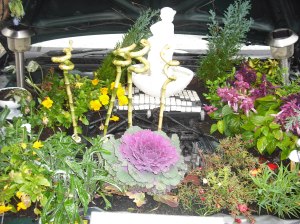
If you have a very large corner, look at Claire Halpin and Madeleine Hellier’s piece ‘Car Park’. This is a 1996 green Nissan Almera, which has ‘many additional features including formal gardens, sun dial, cactus house … and hubaceous borders’. This will be sold by silent auction, bid deadline at 4pm on 17th October so if you have houseroom (sorry, garden room) why not put in a bid.

Flowers planted under car bonnet

Car Park by Claire Halpin & Madeleine Hellier

More information www.sculptureincontext.com
Until Friday 19th October

(Photo credits: Verity – with thanks)