Vanity Fair and Queen Semiramis

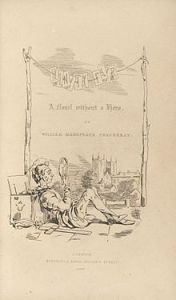
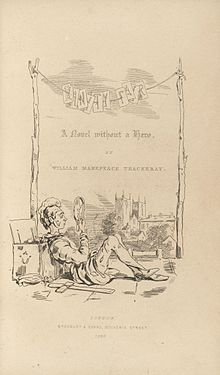
Title page Vanity Fair

Original title page

I was all prepared to give the readers of The Landing blog my thoughts upon reading Vanity Fair, when one of the minor female characters, Miss Pinkerton, side tracked my intentions. I ended up delving into Brewer’s Dictionary of Phrase and Fable and Wikipedia for a bit of research into Thackeray’s historical allusions relating to the character. Finally, I came to the conclusion that this particular Thackeray creation bears a startling resemblance to a formidable maiden aunt in one of my favourite children’s stories.

Now read on….

Vanity Fair opens in the Pinkerton Academy for Young Ladies, when two of the main protagonists in the story are preparing to leave for the wide world. The two girls were Amelia Sedley and Becky Sharp, but for me, the redoubtable principal Miss Barbara Pinkerton (an ‘austere and godlike woman’ who was ‘as tall as a grenadier) stole the opening chapter. She is shown here parting from Becky Sharp, her least favourite pupil, who has the audacity to address the principal in perfect French:

Miss Pinkerton did not understand French; she only directed those who did: but biting her lips and throwing up her venerable and Roman nosed head (on the top of which figured a large and solemn turban), she said, ‘Miss Sharp, I wish you a good morning.’ As the Hammersmith Semiramis spoke, she waved one hand by way of adieu, and to give Miss Sharp an opportunity of shaking one of the fingers of the hand which was left out for that purpose.

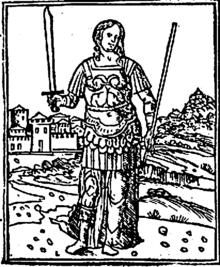
Semiramis Regina

A no-nonsense kind of a woman…

That was the second time that Thackeray referred to Miss Pinkerton’s affinity with Semiramis, the first being at the opening of the chapter, where we are told ‘that majestic lady: the Semiramis of Hammersmith’ had been a friend of celebrated literary luminaries Dr Samuel Johnson and Mrs Hester Chapone. Now, I have to confess that I had only a vague recollection that Semiramis had been a queen or possibly a goddess of some sort, hence the dive into Brewer’s Dictionary of Phrase and Fable. The entry describes a legend about a woman who was the daughter of the goddess Derceto and an un-named Assyrian who went on to marry Ninus, King of Assyria. Brewer points out that this and many other legends grew up around a real Assyrian princess who lived circa 800 BC.

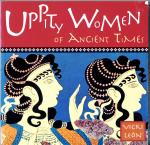
I assumed that Thackeray was comparing his redoubtable principal to the historical princess (who married King Shamsi-Adad V of Assyria), rather than the mythological Semiramis, but it is hard to say. Murder and suchlike heinous goings on were some of the activities of the legendary queen, so maybe it was a bit of a stretch to use her as a role model. However, the real Semiramis (ruled 810-806 BC) according to Vicki León in Uppity Women of Ancient Times was quite a strong capable ruler so perhaps she is a more likely source. The illustration from this book portrays the queen in soft woman-hood mode, so I can’t see her as an indomitable leader, but apparently she was. Apart from the questionable claims that she invented trousers for women and chastity belts for men, Semiramis achieved great things:Uppity Women of Ancient Times
Under her leadership, a new system of canals and dikes irrigated the flatland between the Tigris and Euphrates Rivers, and the twin cities of Nimrud and Nineveh became the bright lights of Assyria. A true power player, Semiramis led military expeditions against the Medes as far afield as India, and forged tactical alliances as far west as Turkey.
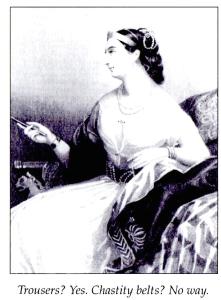
Semiramis

Not a weapon in sight…

Perhaps we may safely assume that Miss Pinkerton ran her school with the authority, determination and majesty of an Assyrian Queen. The mythological Semiramis was rumoured to have slept with her son after her husband’s death, which would not have been at all a respectable thing for a principal of a select girls’ school, especially since Semiramis had put Ninus to death in the first place. I cannot help wondering if this was a joke on Thackeray’s part. Would his readers have been aware of the two aspects of Semiramis I wonder? She was obviously as proud as any queen, but I presume that contemporary readers would have been familiar with the Semiramis comparison.

I also gleaned from Brewer’s Dictionary that a couple of European female monarchs were honoured with the nickname ‘Semiramis of the North’. One of these was Catherine II of Russia, (1729-1796) whose deeds were a little murky; the other was Margareta of Norway, Sweden and Denmark (1353-1414) who seems to have been a capable ruler, without the vexatious tendency to murder her relatives. Clearly, Miss Pinkerton is one of a very select band of inspiring rulers whose achievements know no bounds.

Talking about inspirational, magisterial rulers, I will finish by bringing you a wonderful creation from
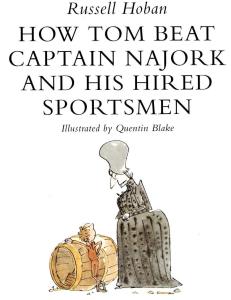
Aunt Fidget

Enough to terrify anyone…

Russell Hoban, brilliantly illustrated by Quentin Blake, called Miss Fidget Wonkham-Strong. This is the character I mentioned in my introduction. I am sure that you will see instantly her kinship with both the aforementioned school principal, Miss B Pinkerton and Queen Semiramis herself. As I was reading Vanity Fair, Blake’s drawing of  remarkable Aunt Fidget popped into my head and wouldn’t go away. Hoban describes her thus, ‘She wore an iron hat and took no nonsense from anyone’. She was as assured of the benefits of regular reading of the Nautical Almanac as Miss Pinkerton was of Dr Johnson’s Dictionary. However, I do hope that Miss Pinkerton never said ‘Eat your mutton and your cabbage-and-potato sog’ to her pupils, or fed them with greasy bloaters as Aunt Fidget was fond of doing.

I seem to have come some distance from Thackeray, via an Assyrian Queen and Quentin Blake, but I hope you enjoyed the journey!

Credits: additional images from Wikipedia, with thanks.
Vanity Fair: Next on the List

Title page Vanity Fair
Original title page

Here is a little holding post while I finish reading Vanity Fair, (William Makepeace Thackeray) which I mentioned in a previous post as a future TBR Pile target. I haven’t seen any filmed versions of the book but I thought I’d watch this 2004 film with Reese Witherspoon once I have digested the original story. I have a feeling that the BBC did a series a few years ago but I haven’t checked yet.

I am over half-way through and really enjoying the book, though I could do with an edition that has notes to explain some of the references that nineteenth century readers would have easily understood. Look out for a more detailed post soon!

Credit: Trailer video from YouTube, uploaded on July 18, 2006 by The Adventures of Ricey (with thanks)  

Book Temptation in Blessington

This will be a brief post, its purpose to illustrate just how difficult my task of reading around the Landing Bookshelves is going to be. The difficulty, I am forced to add, is entirely of my own making as I find it almost impossible to pass the ‘Just Returned’ or ’New Titles’ shelves in any library that I happen to visit. In this case, my little difficulty was in discovering a new bookshop on a recent trip to Blessington. Not one, but two bookshops can Blessington boast, one being the lovely Blessington Bookstore and cafe and the other, a second hand and antiquarian emporium.

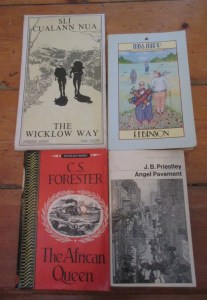
Four Books

Too tempting to resist!

We had been in the former, where we enjoyed a browse, a beverage and some yummy cake at the end of our day trip to the Blessington Lakes. We were waiting at the bus stop over the road, when I spied what I thought was a sign saying ‘Books’ over in the as yet unexplored shopping centre. At that distance, despite my long sightedness I could have been seeing ‘Boots’ but I wasn’t about to take any chances. As the bus timetable declared a wait of more than thirty minutes, there was certainly time to explore the potential bookshop. Off we trotted in eager anticipation.

I am here to inform you that it was indeed a bookshop (Broadford Books), one that we didn’t even get inside of before we had found three books (plus an old map of The Wicklow Way) to buy. Booksellers shamelessly put stock outside at bargain prices to tempt us from our good intentions. Here is the result of our brief shopping spree: Miss Mapp by EF Benson, Angel Pavement by JB Priestly and CS Forester’s The African Queen. I was particularly pleased to spot The African Queen having recently watched the film version for the first time in years. He Who Put The Shelves Up is reading it at the moment so I will have to wait awhile. The Bookworm has now been introduced to the delights of Miss Mapp’s social circle and is keen to read the rest of the Mapp and Lucia books.

So, we had a very successful day out, which is good, but I am a step backwards in my mission to conquer the TBR Pile! I did however resolutely ignore an Arthur Rackham illustrated book of fairy stories…maybe next time…

Have you spotted any bargains lately? Do tell!


Picture Credit: The Bookworm (with thanks)


Puzzling Over Literature: John Sutherland on C19 Fiction

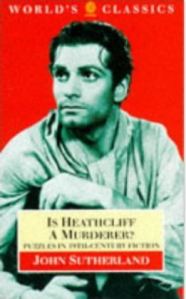
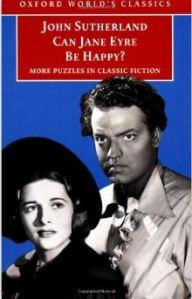
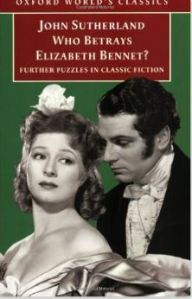
This blog post returns to the subject of essays, literary essays in particular, in the shape of John Sutherland’s collection of pieces delving behind the scenes of some well-known nineteenth century novels. Not surprisingly, the book’s title Is Heathcliff a Murderer? (OUP, 1996) attracted me straightaway. I can’t remember how long Sutherland’s book has been on the TBR Pile, but I probably bought it in the year of publication. Sutherland later wrote follow-up collections of articles on literary puzzles called Can Jane Eyre be Happy? (1997) and Who Betrays Elizabeth Bennet? (1999) neither of which I have got around to buying, which given the parlous state of the unread pile is probably just as well.

Is Heathclif a Murderer?

Literary Puzzles…

I have dipped into Sutherland’s collection at various times over the years, but this time I set out to read all of the essays (thirty-four) in the book. The pieces vary in length from about three and a half pages up to eight pages, so I found them ideal for bus and Luas journeys. I began, as I did when I read the Somerset Maugham essays, with those discussing books that I have read. Obviously, the literary puzzle that Sutherland dissects has more resonance if you have read the original work. Even so, there were certainly things that I had never noticed before; such are the benefits of a very close textual reading. I have discovered that there is a definite plot spoil element to my mission. I won’t however reveal these to you, dear reader. Suffice to say that  I will know what plot features and anomalies to look out for in for instance, Jude the Obscure, The Master of Ballantrae and Phineas Finn when I finally get around to tackling them.

In his introduction, John Sutherland acknowledges that his solutions may not be the most plausible. He explains the rationale behind his exploration of these literary brainteasers, which he defends from any accusation of mere frivolity:

But I would argue that however far my solutions are fetched the problems which inspire them are not frivolous. It is worthwhile for readers to be curious where Sir Thomas Bertram’s wealth comes from, or to wonder why The Picture of Dorian Gray is so ‘queerly’ disturbing, or to inquire why George Eliot and Henry James consciously flawed the printed endings to their greatest novels. It is less crucial, but no less thought-provoking, that Henry Esmond –the highly literate creation of a highly literate author-should quote from a work forty years before it will be written. The questions which have provoked this book are, I maintain, good questions.

If you are the kind of reader that says, ‘But hang on a minute, didn’t that…’ or ‘That timing doesn’t make Can Jane Eyre be Happy?sense’ or who argues about what the author really meant in writing the closing paragraphs, then this is the book for you. Some of the puzzles can be shown to be errors as the result of hasty writing; perhaps due to mistakes in plotting; or inaccuracies arising from the pressure of producing a story in instalments. Others are more intriguing (and as Sutherland points out, not in any way frivolous), such as the question of whether Thomas Bertram’s wealth was acquired on the backs of slaves. Some questions are of identifying plot location, explaining seasonal oddities or tracing missing days. Other questions arise simply out of the passage of time, as the modern reader misses allusions that would have been familiar to a contemporary reader.

The solutions that Sutherland offers in his essays have either been sending me back to re-read or have inspired me with an urge to read the original. One of the books with a mystery is Vanity Fair, which has been on my shelves since the 1980s. It is part of my classics series with the green/gold binding (Book Club), so as they all look alike, I won’t scan in a picture. Not only have I never read Vanity Fair, I have never read anything else by Thackeray so this seems as good a moment as any to rectify that omission. Be prepared for updates on my experiences with the folks inhabiting Vanity Fair. For obvious reasons, I will not even tell you the title of Sutherland’s piece on the mystery in Vanity Fair. You will just have to read it yourself (after reading the book of course!)

Has anyone else read any of the books in this series? Do drop me a line…

Who Betrays Elizabeth Bennet?

Picture Credits: Book jackets taken from Amazon.


Landing Author: Caitriona Lally on Writers, Rituals and Routines

Caitriona Launch Reading

The launch of ‘Eggshells’

Here as promised on Thursday, is Caitriona Lally’s guest post for The Landing Book Shelves, marking my 200th blog post:

I tend to get obsessive about writers and read everything they’ve ever written as quickly as I can. I love writers who see things with fresh eyes, who write with ferocity and are fearless about telling fictional truths. I don’t need to like the characters, but I need to not completely hate them. In recent years, I’ve glutted myself on the works of Henry Miller, Anne Enright, Kevin Barry, Aleksandar Hemon, Lorrie Moore, W. G. Sebald, Mary Costello, Alice Munro, Rachel Cusk, James Salter, and Lydia Davis. When I read such writers, I soak up their gorgeous sentences, but to motivate me to actually write, I read books about writers’ routines. I have yet to figure out a routine of my own, and tend to stuff my writing into whatever time-gaps appear in my day, so I find the notion of a habit or ritual encouraging. When I’m asked about my writing routine, it’s very tempting to describe a rigid regime that makes me look highly disciplined and hugely prolific, interspersed with a few quirks to make me seem eccentric and interesting (I can only write on vellum from month-old Friesian calves using yellow pencils sharpened with a miniature cleaver.)

I love the book Daily Rituals, by Mason Currey, which gives details of the precise preferences of various writers, artists, and composers. Their eating habits in particular fascinate me: so many writers seem to focus on their brains at the expense of their bellies, which is beyond my comprehension. My stomach clenches in knots at the idea of such foodlessness – I can’t have a cup of coffee without cake or chocolate, and I drink a lot of coffee when I’m writing. According to Currey, Proust ate croissants, but far too few for my liking. Patricia Highsmith worked from bed with a doughnut “and an accompanying saucer of sugar” which makes me think she and I would be kindred spirits.

I like knowing that W. H. Auden and Graham Greene took amphetamines to help them to write; it makes me feel smug if I can get words onto a page with only caffeine and sugar for a buzz. It’s also nice to know that Proust needed caffeine tablets and barbital sedatives to keep writing his masterpiece, that Balzac may have drunk up to fifty cups of coffee a day, and that Truman Capote preferred to work from bed or horizontally at least. Reading about writers’ habits instead of forming your own ones can be a kind of procrastination, however, and it gets addictive.

Anne Lamott’s Bird by Bird and Annie Dillard’s The Writing Life are books I return to when I feel low on motivation. Both are meditations on why we write, and how to live and write. They’re full of wit and compassion and sheer bewilderment at why we do this to ourselves, this endless torment of trying to write the perfect sentence, when we could be doing sensible jobs with normal hours. I find Dillard’s almost monastic approach to food fascinating – she describes writing for a whole day with nothing in her belly but coffee and reheated soup. Lamott’s title refers to a family story: when her brother was ten and had left a school report on birds until the last minute, he sat at the kitchen table surrounded by unread books, overwhelmed by the task ahead. Lamott’s father put his arm around the boy and said “Bird by bird, buddy. Just take it bird by bird.” It’s a quote I love – any writer could substitute word or sentence for bird, and it’s the perfect advice. When I read these books, I feel like I’m not alone in my efforts to battle procrastination, to will myself to stick with it. Keep going, I tell myself, just another few hundred words; come on, bird by bird.

***************************

I hope that Caitriona’s post has both given you some reading inspiration (there are writers mentioned that I haven’t got around to yet) and the impetus to keep on writing….word, by word….

Eggshells


Thanks very much to Caitriona Lally for taking the time from her Eggshells publicity round, to contribute to The Landing. If you want to hear about Caitriona’s readings and events, follow @CaitrionaLally. You can find out more about the process of writing Eggshells in Caitriona’s article for Writing.ie and also purchase a copy direct from Liberties Press.

Picture Credits: Liberties Press & Liberties Upstairs.


Introducing Landing Author Caitriona Lally and ‘Eggshells’

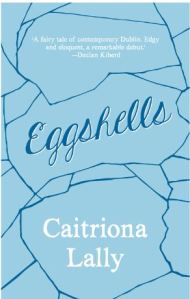
Eggshells

Published by Liberties Press, 2015. Cover design by Karen Vaughan.

After quite a long gap, I am pleased to be hosting another Landing Author guest post. Over the last couple of years, I have had guest posts from some lovely writers, beginning with Andrés Neuman in April 2012 and most recently, Juliet Greenwood last August. As you can see, it has been quite a while… In looking back, I note that I have said the very same thing before so perhaps I need a better ‘Author Routine’ to keep me regular.

My impetus for (trying) to get into gear again with guest posts, was Caitriona Lally giving a talk at our Liberties Upstairs Culture Club event recently. In parallel, we read Eggshells for the Upstairs book club. I mentioned in my last post that I would like to ask her to contribute a Landing post, and she very kindly agreed. I will post up Caitriona’s piece on Friday 17 July and leave you with a taster for now.  As I have now declared my Liberties Press interest[i], I am not going to offer a review of Eggshells. What I will do however is to give you part of Sarah Gilmartin’s review in the Irish Times (6 June) to introduce you to Eggshells, and its unusual protagonist Vivian Lawlor:


Vivian is a self-professed changeling, left by fairies to compete with her parents’ human child, also called Vivian. With the parents dead, the two adult Vivians are all that remain. Human Vivian is married with children and uninterested in her sister’s strange ways. The narrator lives alone in her great-aunt’s house, filling her days with sugary treats, dressing up and a variety of bizarre pastimes as she seeks a way out of this world and back to her own.

It is an interesting set-up, with a clever ambiguity surrounding the narrator. The book is rooted in the natural world of contemporary Dublin, but to Vivian’s eyes this is a fairytale world, full of rules of threes and sixes, and potential gateways to supernatural lands. How much of her changeling status is fictional, the delusions of a severely disturbed character, is left for the reader to puzzle over. This question gives momentum to Vivian’s escapades. It also, somewhat unexpectedly, provides plenty of laughs in a book full of one-liners.

Much of the humour comes from the author’s preoccupation with language and wordplay. Vivian tells a social worker enquiring about her job prospects: “I am open-minded. Sometimes I wear my slippers on the opposite feet to change my worldview.” As she searches for portals across the city – St Stephen’s Green, Glasnevin cemetery, the canals, the Liffey bridges – her literal take on language brings about many absurd situations. The need for precision in language is a major theme, with Vivian constantly drawing attention to the gap between speech and meaning. “I wake on a damp pillow,” she tells us. “My dreams must have leaked.”

A loose plot develops out of this affinity with language when Vivian pins a notice to a tree: “I want a friend called Penelope. When I know her well enough, I’ll ask her why she doesn’t rhyme with Antelope.” The new friend, actually called Elaine, is another oddball character. Struggling herself with mother issues and an obsession with painting cats, Elaine/Penelope doesn’t judge. More importantly, she promises she’ll organise a vertical burial for Vivian, which is all Vivian has ever wanted in a friend.

The black comedy gives the book a jaunty quality that complements the dazzling trip around Dublin. From the “soot-streaked backs of the buildings at the junction of George’s Street and Dame Street” to the “fierce bang of hops from the Guinness factory, a smell somewhere between meat and toffee”, Lally uses Vivian’s otherworldly perspective to bring the city to life.


Caitriona, a lover of words who confesses to having no proper writing routine, has written a post for us about her obsession with other writers and their routines. I won’t spoil the blog post by telling you about any writerly habits that you may or may not wish to emulate (on Friday you can judge the wisdom of those mentioned).

I was delighted to realise that Caitriona’s post will be the 200th post on The Landing! See you on Friday…

Caitriona Lally

Caitriona Lally

About the author:

Caitriona Lally studied English Literature in Trinity College Dublin. She has had a colourful employment history, working as an abstract writer and a copywriter alongside working as a home help in New York and an English teacher in Japan. She has travelled extensively around Europe, Asia, the Middle East, and South America. Her essay about Grangegorman appeared in a recent issue of We Are Dublin. Eggshells was selected as one of twelve finalists in the Irish Writers Centre Novel Fair 2014.

[i] Since I have been associated with Liberties Press, I have similarly featured the books of Bethany Dawson (guest blog post) and Daniel Seery (Q and A).

Picture credits: Liberties Press and the Irish Times.

Cold War publishing: The Zhivago Affair

A recent library visit found me as usual scanning the ‘New Titles’ and ‘Just Returned’ shelves for any likely contenders for a bedside table slot. Sometimes I have a deal with myself that I won’t take yet another book home (to distract me from the TBR Pile) if I can get out of the building without anything on the two aforementioned shelves catching my eye. Well, dear reader, as is so often the case something did catch my eye, thus pushing another book back a notch in the reading order. I should really ban myself from libraries until I have nothing left to read on The Landing.

Anyway…

The Zhivago Affair by Peter Finn and Petra Couvée was the title that grabbed my attention and threatened the status of the bedside table pile. The subtitle: The Kremlin, the CIA and the Battle over a Forbidden Book at first made me assume that the book was fiction. It sounded like a literary caper that would be right up my street. As it happens, the book is a real life literary caper that indeed proved to be right up my street. One of those ‘the truth is stranger than fiction’ or you ‘couldn’t make it up’ reading experiences. It really was like reading a Cold War spy novel but with added poetical asides and royalty disagreements to add piquancy.

The Zhivago Affair

My library find…

Finn and Couvée’s book tells the story of the battle to get Doctor Zhivago published and in particular reveals the CIA involvement in publishing and distributing a Russian language edition in 1958. As might be supposed, the CIA involvement had as much, if not more to do with propaganda than literature. According to one of Pasternak’s sons, Yevgeni, the author wasn’t at all happy about his work being used for Cold War propaganda purposes. Over the course of several years of research, Finn and Couvée uncovered the complicated saga of Doctor Zhivago with the help of previously classified CIA files. I could not help feeling that releasing the files was in itself yet another propaganda act. This is the CIA saying, ‘look it’s not all guns, we’re really nice guys and we love culture, and books and stuff’. It’s hard to judge whether the people in the organisation actually cared about the book or Pasternak, or whether they just cynically used a golden opportunity to poke the USSR. In these days of Twitter, Facebook and Instagram, the idea of a novel being such a powerful propaganda tool may seem quaint but it truly was that important in the West’s campaign against Communist ideology.

As you might recall, I read Pasternak’s book last year, many years after I first saw the film version and fell in love with Omar Sharif and the wonderful Russian scenery (which of course wasn’t Russian at all). The first edition of Doctor Zhivago was published in 1957 in Italy, as Pasternak was unable to get his first and only novel published in his own country. Pasternak told Italian publishing agent Sergio D’Angelo that ‘In the USSR, the novel will not come out. It doesn’t conform to official cultural guidelines’. Literature was very important in Soviet Russia, however the chilling fact was that it had to be the correct sort, as was made clear by Stalin in a 1932 speech at a gathering of writers to launch the ‘new literature’,

The production of souls is more important than the production of tanks…Here someone said that a writer must not sit still, that a writer must know the life of a country. And that is correct. Man is remade by life itself. But you, too, will assist in remaking his souls. This is important, the production of souls. And that is why I raise my glass to you, writers, the engineers of the human soul.

Doctor Zhivago: First Edition

Italian First Edition

If Golslitizdat, the state literary publisher did not consider a writer’s work suitable (not sufficiently productive of souls), then it would not see the light of day. There may also be serious consequences for the unfortunate author, despite the apparent thaw since Stalin’s death. As Doctor Zhivago had no merit in the eyes of the state publisher, Pasternak’s manuscript was smuggled out of Russia by D’Angelo. He was acting on behalf of Giangiacomo Feltrinelli, a Milanese publisher (a member of the Italian Communist party). Pasternak handed the manuscript over knowing that he was potentially putting his life at risk, as well as those of his family. He rather theatrically said to D’Angelo, ‘You are hereby invited to my execution’ after handing over his work with the words ‘This is Doctor Zhivago. May it make its way around the world’. I wonder if he had rehearsed those lines?

Having read the book, I would now like to read a straightforward biography of Pasternak, as this book obviously focuses on the Zhivago story. From what I have gleaned from this book, Boris Pasternak’s character was contradictory and he was probably not the easiest person to live with (whether his second wife Zinaida or his lover Olga). He had an unshakeable belief in his own talents yet was also unassuming, modest and personally engaging. It is hard to get to grips with, and understand Pasternak’s character. He seems to have been selfish enough to pursue publication even knowing that it could rebound badly upon his family. In fact, his mistress Olga Ivinskaya was twice imprisoned for her part in the affair, the second time after his death in 1960. Yet, according to the evidence, Pasternak was courageous enough to support the family members of those writers sent to the Gulag when others kept a distance.

Reading The Zhivago Affair has given me more leads to follow, not only on discovering more about Pasternak and his family but also about other writers mentioned in the text such as Osip Mandelstam and Anna Akhmatova. One book that I did read a few years ago was a fictionalised account of Isaac Babel’s imprisonment in the Lubyanka, The Archivist by Travis Holland which I would highly recommend. It’s not a happy read as you might expect, but there is still a bit of hope for humanity and the written word in it. Which brings us back to Pasternak’s work making its way around the world despite the repressive regime under which he lived.

If anyone has got any related recommendations, I would love to hear them…

Picture credit for the Italian First Edition : Wikipedia, with thanks.
Culture Club at Liberties Upstairs

I have borrowed my post from the Members’ Blog on Writing.ie, in which I talk about a new venture that I am involved in organising for Liberties Press In Dublin. The main reason I want to mention the Culture Club venture here is that the first session features a previous #LandingAuthor, Daniel Seery (author of A Model Partner). Sometime soon I hope to include a guest post from Caitriona Lally (Eggshells) as well so that’s a another reason for borrowing my blog post. Of course, I’m also not averse to spreading the word about the Liberties Upstairs Bookshop’s Culture Club either!

A Model PartnerThis post sees me wearing my Liberties Press (Liberties Upstairs) hat, as I want to spread the word about a new venture that I’ve been involved in organising for the Liberties shop. Inspired by the positive experiences of organising the Liberties Upstairs Saturday morning book club (running since November 2014), I have decided to try setting up a monthly Culture Club. My aim is to have a varied programme, drawing on the resources of Liberties Press authors, publishing insiders and the arts and crafts contributors at Liberties Upstairs. The pattern of the sessions will be a talk and or reading followed by the opportunity for questions and discussion over wine or coffee. We might even rustle up a few biscuits to keep up our strength for the Q and A (well, what’s sauce for the book club….)

As the Liberties book group runs in a morning, we‘ve opted for an evening culture club, which we hope will be similarly supported by the local community. Indeed, some book club members have already expressed an interest in the new Liberties venture. The club will run on the last Wednesday of the month, with the inaugural event on 24 June at 7.30 pm. For this session, I am delighted to have debut authors Daniel Seery (A Model Partner) and Caitriona Lally (Eggshells), both alumni of the Novel Fair to talk about writing, pitching and getting a publishing contract. Both writers will speak and give a short reading, so it will be a packed evening to start our series of events. It should be a lovely beginning to our new programme; Daniel and Caitriona are looking forward to appearing, so I hope that a good time will be had by all.

Events and launches are an important part of any bookshop’s strategy in the ceaseless quest to increase footfall, that dread word. The Liberties Upstairs bookshop has hosted several events since setting up Liberties Upstairs in November 2013. However, this is the first time for embarking on organising a series of events. Initially I have planned a programme of six sessions with a further six in the pipeline for next year if all goes well. We plan to announce the first part of the programme at the June meeting. I hope that some people will be keen enough to sign up for the whole six sessions. My technology skills (!) have enabled a booking facility through our online shop (€5 euro per event) so I felt quite a sense of achievement when receiving the first confirmation.Eggshells

I’m looking forward to next week’s event; perhaps our author talks will inspire at least one would be writer to give it a go and aim for the Novel Fair. You never know what might happen…

Look out for a future post on The Landing from Caitriona Lally, and if you’re Dublin based, look out for future Culture Club events in Liberties Upstairs!


My Nerdish ‘Book of Books’

Recent thoughts of belatedly backing up blog content have led to my pondering nostalgically about the books I have read over the past few years. To keep track, I have set up a bibliography within the Landing Tales pages although I am not very good at keeping it up. As they say, it seemed a good idea at the time. I borrow regularly from the library (actually from two county councils!) and I have discovered that I can access a list of borrowings for the last six months or so (such is the benefit of online services). I am sure that a certain amount of books fall by the wayside, but these information sources documents my recent reading quite well.

Book List

So many books…

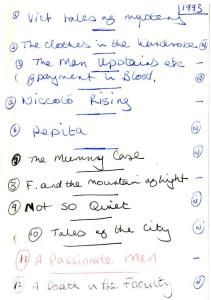
But let me take you back to the dark time, before the internet acquired a window into my reading soul. Once upon a time, in 1993 to be precise I embarked on a mission to record every book that I read, whether owned or borrowed. I don’t recall why I thought it was a good idea to keep this information, and even now I struggle to think of a convincing reason for faithfully noting each and every book read. I did keep an authors’ book during my schooldays (inspired by something my mum suggested) in which I jotted down authors I had read. Sadly, that notebook is no longer extant, so now I have only book jottings of a more recent vintage.

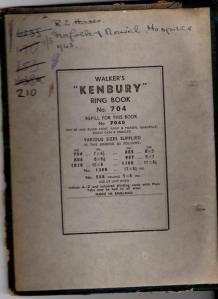
Sometime before 1993, I began writing down authors’ names, in a sort of homage to my schooldays ritual,  and the listing of the year’s books came later. It all sounds very book nerdish and perhaps it was (confession: it still is). Then, it has taken me a long time fully to accept that I will never read all of the books in the world. If I can see exactly what I have read, then I feel that there’s hope for the as yet unread books. I am still planning to get though as many as possible however, which is probably where the idea of nerdish-ly writing down my reading habits for posterity first started.Ring Binder Cover

The ‘Book of Books’ is not in reality a book at all, but a mini ring binder with A-Z dividers that I acquired second-hand. A previous owner’s inscription on the inside front cover dates the binder to 1943 and it originally cost 11/6. I assume that the dividers were originally included, but it had no paper when I bought it. I cut sheets of A4 paper to the right size (not particularly neatly, I might add). I haven’t added any names to the A-Z list of ‘authors wot I have read’ for a long time, so this part is a tad out of date. Mind you, now that I have dusted off the book I am feeling an almost irresistible urge to fill in the authorial gaps.

Inside Cover

A second-hand bargain

But returning to 1993, I jotted down every book read for the whole year, also marking with a letter ‘N’ where a writer was new to me. This exercise has all of the hallmarks of a New Year’s resolution that despite my best efforts, managed to stay the course. In fact, I kept up my records in the old binder for several more years (even unto the next century), despite curtailing reading for pleasure while I studied for my degree, and later had a baby. That first recorded year I read thirty books (including fourteen new authors), which may not be a large tally by some standards, but seemed reasonable enough to me. The totals varied from year to year and I used to feel compelled to note if the book was a re-read so the record was true.

Looking back over the books listed makes me want to settle into a protracted period of re-reads, such is the lure of nostalgia. I may however, have to settle for a mere couple of such indulgences so that I can continue with the pressing needs of the un-read. I am also reminded that despite reading the first three volumes of Dorothy Dunnett’s Niccolò series in 1993, I still have not completed the series…maybe this will be the year to do it. Most of the books still linger in my memory, though a couple have faded to the extent that I can’t remember a plot outline. I wonder how many would stand the test of re-reading after twenty years? Clearly PG Wodehouse is a stayer, as is also Helen Zenna Smith’s Not So Quiet and I think there would be much still to enjoy in the Victorian Tales of Mystery and Detection. And that’s only the start of the book…

Reading though the lists creates all sorts of pictures in my head, of words and images; covers and pages; and scenes and people, both on the pages and in real life. What I am looking at is my lived life though the prism of my reading life, so my list is a fascinating resource to have to hand. A good reason to keep on adding to it perhaps? In recent years I have moved on to a new record book, but more of that another time.

Meanwhile, I would love to know if anyone else does a similar thing, and if so, where do you keep your list?

Yes, We Have No Oranges (Nor Bananas)…

Last year author Juliet Greenwood (We That Are left, Honno Press)) wrote a guest blog post on the topic of producing and preparing food for the Home Front during the First World War. In her novel, the main protagonist, Elin goes back to her mother’s old recipe book to help her produce nutritious recipes for wartime. Recipes from the period were reproduced at the end of the book, some of which you can find on Juliet’s guest post. I have gradually tried out Juliet’s recipes, most recently the seed cake, which I have blogged about over on Curiously Creatively this week. It was most delicious!

Few Eggs and No Oranges

Reprinted edition

As Juliet pointed out at the time, rationing only came about towards the end of World War I, and lessons learned from this conflict influenced rationing decisions in the Second World War. I was reminded of this when I was browsing recently in Hodges Figgis and spotted a reprint of a Second World War diary. Few Oranges and No Eggs (Persephone, 1991, 2010) was the work of Birmingham born Vere Hodgson (1901-1979) who began work in London in 1935 and stayed there throughout the war. She worked for the Greater World Christian Spiritualist Association in a welfare role and helped to produce the association’s newspaper. The office was in a house (named The Sanctuary) in Lansdowne Road and Vere lived nearby in Ladbrooke Road, though she often spent the nights of The Blitz at The Sanctuary taking a turn on fire watch duty. Although the diary entries continue until VE Day, I have just quoted from the early part of the book to give you some idea of Vere’s life. The diary actually began life as letters sent around to family members and then posted out to a cousin in Rhodesia. Only one batch of letters ever got lost en route. Not bad for a war-time postal service!

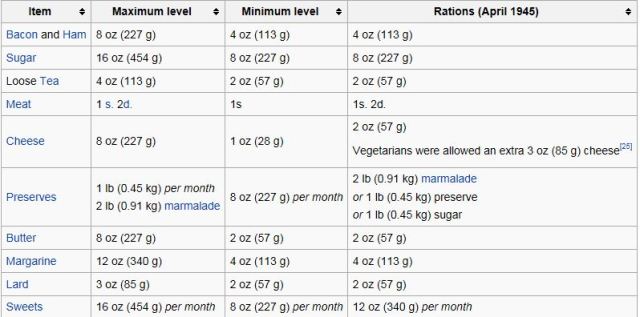
As the book’s title suggests, one of the major preoccupations of the author was obtaining food during the lean years of the war. On 9th July 1940, Vere Hodgson was recording that “We are to have six ounces of butter cum margarine, and two ounces of cooking fat” and on 16th July she was writing of the shortage of eggs in London, declaring, “I shall have to switch over to baked beans”.   Rationing restrictions changed over the years, but began in January 1940 with bacon, butter and sugar. Later, several other food products were added to the rationed list and supplies of fresh fruit and vegetables were limited, though not rationed. Tinned products were un-rationed but you needed points to buy the food. The chart I have included (taken from Wikipedia) will give some idea of the range of weekly rationing, from lowest to highest. Not on the chart are eggs (one per week) and milk (3 pints per week). There were increased milk rations for children, pregnant women and invalids and oranges, when available were usually only for children or pregnant women.

World War II Rations

Ration Chart

Vere’s observations marked the daily difficulties of obtaining scarce supplies and the alteration in the rations. Despite fruit not being rationed, imported fruits such as bananas and oranges were obviously hard to come by at all. Prices of homegrown produce varied a great deal as this entry from February 1941 shows, “Bought a pound of apples yesterday for one shilling…what a price. No oranges at all, at all. Very annoying.”  Later that month she notes that the cheese rationing will probably amount to a one inch cube per week. At that point, it was immaterial as none was available in her area anyway.

One of the effects of rationing and shortages appeared to be that people craved that which they would not ordinarily have eaten, such as in this case, onions. “Mr Booker was saying that though he hates onions, when once more we can get them he will sit down and really enjoy one. I think we shall go in for onion binges when the war is over”. (16th February 1941) I have a vision of Vere tucking into endless plates of fried onions after the war. In many entries such as this one, Vere displays that sense of humour and stoicism that enabled many people to carry on despite the shortages. I will just finish with this excerpt from 22nd February 1941, which details the proceeds of a shopping expedition:

Managed to get a few eating apples yesterday to my great joy. I treated myself – they are one shilling and one penny per pound. I carried them home as if they were the Crown Jewels. Also had some luck over cheese. Went for my bacon ration and while cutting it had a word with the man about the Cubic Inch of Cheese. He got rid of the other customers and then whispered, ‘Wait a mo’.’ I found half a pound of cheese being thrust into my bag with great secrecy and speed!

Then going to the Dairy for my butter ration I was given four eggs and a quarter of cheese! Had no compunction in taking it, for I went straight to my Mercury Cafe and gave it to them….they had said they did not think they could open the next day as they had no meat and only a morsel of cheese. I could not resist, when I got in, cutting off a hunk of my piece and eating it there and then. I always sympathised with Ben Gunn when he dreamed of toasted cheese on that desert island.

If you’ve never come across this diary, I recommend it for the day-to-day picture of war-time life. The experiences are particular to one educated, middle class woman but it does give you a vivid picture of what life must have like for Londoners and Brummies in all walks of life as they coped with the destruction and privation on the Home Front. This is one book that I am sure I will dip into again and again. Vere Hodgson’s voice is lively and compassionate; her conscientious recording of all that happens draws the reader into her world.

I have also written a piece for Headstuff if you would like to read it too: http://www.headstuff.org/2015/05/exploring-a-wartime-diarist-vere-hodgson/

Until next time!