Maugham on Fiction: An Inspiration for an Essay Reading Challenge

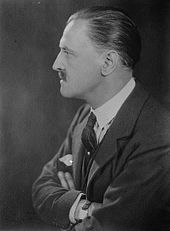
Maugham early in his career

An early career author picture

As I mentioned in my last post, I have been reading some of William Somerset Maugham’s essays from Ten Novels and their Authors (1954, 1978). I skipped through the book to pick out authors that I have read so far for The Landing TBR project. The collection has also reminded me (as if I needed it), that I have many books on the shelves that I have not yet tackled. Perhaps this essay collection will give me the impetus to explore writers, such as Balzac and Dostoyevsky that remain on the TBR Pile. Maugham includes Tolstoy and War and Peace in his Ten Novels selection and attentive Landing readers will recall that I finally got around to reading War and Peace last year. Reading Dostoyevsky would enable me to continue the Russian literature theme that developed after my reading of Tolstoy’s novel. Maugham also writes about Emily Bronte and Wuthering Heights, which caused me to want to re-read that novel, as well as to dig out the Juliet Barker biography of the Bronte family from the back bedroom stash to check a few facts.

What I do have in mind for this year however, is to begin a new Landing Challenge to explore some of the essay collections scattered around the house (not all of them live on The Landing). I was thinking of dipping into a few collections rather than solidly reading all of them. Some collections belong to me (and I am more likely to have read some of these) but the ones belonging to He Who Put The Shelves Up are largely still on my mental ‘to read sometime’ list. My plan would be to tackle a few of the essay collections spaced out over the year, in between reading other books. I might set out to cover (no pun intended) some literary essays first, since chance led me to the Maugham collection.

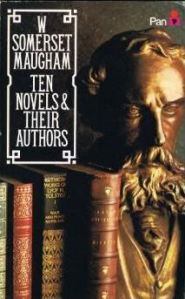
Ten Novels

A bargain at 90p!

I have been trying to read up a little on Maugham’s life and career but have found several apparent contradictions in online sources so I won’t give you more than brief biographical details here. I am however intrigued enough to attempt to track down a definitive account so when I do, I will post up about it. Somerset Maugham was born in the British Embassy in Paris in 1874 and died in Nice in 1965. His father Robert was a lawyer and his mother Edith Snell was a writer. Orphaned by the age of ten, an aunt and uncle in England brought him up. Maugham was a homosexual at a time when it was still illegal and therefore dangerous to admit publicly, though his orientation was accepted in the literary circles he frequented. He did however enter into what proved to be a short-lived marriage with interior designer Syrie Barnardo and had a daughter, Liza. But more of Maugham’s life and times when I have researched further.

Of the subjects in Maugham’s collection, I have read Pride and Prejudice, David Copperfield, Wuthering Heights and War and Peace, so I will read his essays on these books and talk about them in my next blog post.

And then there’s the remaining five novels that he discuses…..back to the TBR Pile!

Serendipity: Jane Austen, a family letter and Somerset Maugham

While I was over visiting my parents before Christmas, I had my usual riffle through their bookshelves in search of old friends. I came across a book that I had completely forgotten leaving behind. (Or did I lend it to someone?) The book in question was Almost Another Sister: The Story of Fanny Knight, Jane Austen’s Favourite Niece by Margaret Wilson (George Mann Books, 1998) which I see from my note on the flyleaf that I actually bought in the year of publication.

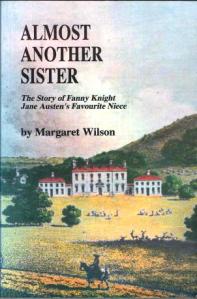
Fanny Knight book

The picture on the cover is Fanny’s childhood home, Godmersham Park

In the previous year were published biographies of Jane Austen by Claire Tomalin and David Nokes so I was well into Austen family history by the time I bought the Fanny Knight book. I can’t remember how I came to hear of it, but I must have ordered it especially as it wasn’t published by a mainstream publisher. The book represents the extensive research of archivist and former teacher Margaret Wilson, who embarked on a study of Fanny Knight while working at the Centre for Kentish Studies (formerly the Archives Office).

Frances (Fanny) Knight (1793-1882) was the daughter of Jane Austen’s elder brother Edward who had the good fortune to gain a benefactor in Thomas Knight, a wealthy cousin. He made Edward heir to his estates on condition that Edward took the family name. By the time that Edward took the name of Knight, his daughter Fanny was a young woman of nineteen. It must have been strange for her to change from Austen to Knight, given that she probably anticipated changing name yet again on marriage. In 1820, when she was twenty-seven, Fanny married Sir Edward Knatchbull a widower with five children. The couple went on to have a further nine children.

Margaret Wilson has delved into family archives, Fanny Knight’s diaries and surviving letters to paint what she calls a ‘cameo’ rather than a ‘full biography’. This is due to the patchy nature of the available sources, such as the brief diary entries and scraps enclosed which the author describes thus: ‘The overall effect is of a multitude of minutiae, like tiny fragments of a jigsaw picture which is too complex ever to complete in full yet offers tantalising glimpses of the finished scene’. Nevertheless, the book is a fascinating account of a life that bridged two centuries and saw many changes as the Regency period gave way to the Victorian age.

As Fanny grew up, she visited and corresponded with Jane and her sister Cassandra. There was a strong connection between the branches of the Austen family, Jane in Hampshire and Fanny’s family in Kent. Apparently, Fanny was particularly close to Aunt Jane, though sadly not many of their letters survive. A quote from one of Jane’s letters to Cassandra gives an idea of how fond Jane was of Fanny:

A young Fanny Knight

A Young Fanny Knight

I am greatly pleased with your account of Fanny; I found her in the summer just what you describe, almost another sister – and could not have supposed that a niece would ever have been so much to me. She is quite after one’s own heart; … I always think of her with pleasure.

At this point you are probably wondering where Somerset Maugham fits into the picture. It is simple (and highly serendipitous). I was skimming through the bibliography of Fanny Knight when I came across mention of a collection of essays by Maugham, Ten Novels and their Authors. (1954, Pan Macmillan 1978). This sounded familiar so I had a root around on the shelves (in the living room, not in the landing ones this time) and lo and behold, I unearthed the very book. I had picked it up at a second-hand bookstall in Wexford a couple of years ago and never got around to reading it since.

Maugham has an essay on Jane Austen and Pride and Prejudice, which he feels to be her best book. His collection of essays has its origins in a challenge issued to him (by the editor of a journal called Redbook) to pick out the ten greatest novels in the world. Maugham comments ‘Of course my list was arbitrary. I could have made one of ten other novels, just as good in their different ways as those I chose, and give just as sound reasons for selecting them’. But he goes on to speculate that if a hundred readers produced a similar list, selecting perhaps two or three hundred novels, then ‘I think that in all the lists most of those I have chosen would find a place’. 

Fanny Knight in later life

Fanny Knight (Lady Knatchbull)

Margaret Wilson makes use of Maugham for his discussion of a particular letter that Fanny Knight wrote to one of her sisters many years after Jane Austen’s death. If you are a clued-up Austen fan, you will know to what letter I refer, as Margaret Wilson says that ‘Fanny has acquired a poor reputation’ because of the much-debated letter. In this much quoted letter, Fanny is clearly responding to a query or alluding to a previous conversation about her late aunt when, in 1869 she writes,

Yes my love it is very true that Aunt Jane from various circumstances was not so refined as she ought to have been from her talent, & if she had lived 50 years later she would have been in many respects more suitable to our more refined tastes. They were not rich, & the people around with whom they chiefly mixed, were not at all high bred, or in short anything more than mediocre & they of course though superior in mental powers & cultivation were on the same level so far as refinement goes – …

Both Maugham and Wilson quote the offending passages and Wilson also includes the remainder of the letter in an appendix. The discussions about what Fanny did or did not mean by her remarks are interesting. It was all new to me as I had never heard about these criticisms of Aunt Jane. Key to understanding the letter seems to be the changing social times and also Fanny’s social elevation as the result of her marriage. I was amused by Maugham’s reflection that, ‘It is regrettable, but it is a fact, that children do not look upon their parents, or their relations belonging to another generation, with the same degree of affection as their parents, or relations, look upon them. Parents and relations are very unwise to expect it’. In other words he is, perhaps wisely, not particularly surprised that Fanny should be rather mean about the aunt who cared for her so much.

Ten Novels

A bargain in 1978 at 90p!

I would love to have Jane Austen’s thoughts on the offending letter. I am sure that would be worth reading! Since that is an impossibility I will have to make do with reading more of Maugham’s literary criticism. I feel sure that he would be a good subject for a further blog post as he has plenty to say on the art of fiction. Perhaps my new TBR Challenge should explore all of the lit crit lurking around on The Landing!

Any thoughts?

The Chimes by Charles Dickens

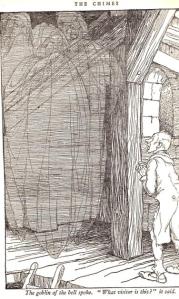
I have The Chimes on The Landing Book Shelves, in two editions. The one that I have had for the longest time is an abridged version contained within The Children’s Treasury of Classics, mentioned in a previous post. A second version is in an edition of Dickens’ Christmas Books (Collins Clear Type Press) that I bought second hand in Birmingham. It has no publication date printed inside (Collins brought this collection out in 1906 but I am not sure if my copy dates from then) but there is an inscription dated 1967. Both versions of the story are illustrated with black and white sketches; the latter is by Arthur. A. Dixon and the former by an un-credited artist. I must have read the children’s story at one time but I didn’t recall it very well, when I came to re-read the unabridged version recently. The drawings of The Treasury did however stay in my memory, the daunting image of the ghostly figures made quite an impression on me as a youngster. Dixon did not do an illustration of the ghosts so I don’t have a comparison to make. You can check out the link above to see his work for the Christmas Books and other Dickens works in the Collins editions.The Chimes

Dickens wrote this story in 1844, after the publication of A Christmas Carol and a year before he wrote The Cricket on the Hearth. As I featured the first of Dickens’ Christmas stories here previously I thought that it was high time that I moved on to the next one in the series. Actually, The Chimes is more of a New Year’s tale as it is set just as the old year is preparing to give way to the new. People are settling their accounts so that they may begin the New Year afresh. However, The Chimes is similar to its predecessor in that it is also a seasonal ghost story. A series of spirits show the main protagonist Toby (Trotty) Veck the error of his ways in the manner similar to that suffered by Mr Scrooge. Unlike wealthy but misanthropic Scrooge, the likeable Trotty is a poor ticket porter who struggles to earn more than a few pennies a day. His crimes against his fellow humans are less than are Scrooge’s but despite this, the spirits from the church bell tower take him to task over the course of an eventful New Year’s Eve.

But what are Trotty Veck’s crimes against humanity? Trotty is judged to be guilty that day of losing all hope in the future, of believing that the poor must really be as bad as the newspapers and the paternalistic middle classes say they are, and of losing compassion for the desperate plight of others of his class. Toby was sitting reading the paper on New Year’s Eve and he came to a report about a woman who was so desperate not to return to the workhouse that she tried to drown herself and her baby (Dickens was inspired by a real case):

“Unnatural and cruel!” Toby cried. “Unnatural and cruel! None but people who were bad at heart, born bad, who had no business on the earth, could do such deeds. It’s too true, all I’ve heard to-day; too just, too full of proof. We’re bad!”
The chimes took up the words so suddenly – burst out so loud, and clear, and sonorous- that the bells seemed to strike him in his chair.
And what was that they said?
“Toby Veck, Toby Veck, waiting for you, Toby! Toby Veck, Toby Veck, waiting for you, Toby! Come and see us, come and see us! Drag him to us, drag him to us! Haunt and hunt him, haunt and hunt him! Break his slumbers, break his slumbers! Toby Veck, Toby Veck, door open wide, Toby! Toby Veck, Toby Veck, door open wide, Toby-“ Then fiercely back to their impetuous strain again, and ringing in the very bricks and plaster on the walls.

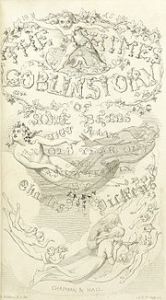
The Chimes title page

First edition

The spirits of The Chimes show Trotty a glimpse of the future, or at least a version of it. They tell him that he has been dead for nine years after falling from the church steeple. The future presented by the spirits turns to out to be very bleak for Trotty’s family and friends. I don’t want to give any more away to anyone who has not read this story, so I will just hint that if you think about Scrooge’s prospects after the spirits have visited then you may reassure yourself before you read.

The story has been overshadowed by the success of that of Ebenezer Scrooge, though The Chimes was very well received upon publication. I can’t help thinking that the spirits were rather hard on poor old Toby, but Dickens was making the point that Toby shouldn’t give up hope and start to believe that the poor were not entitled to a better existence. Dickens was also satirising those who people claimed to be friends of the poor – as long as they stayed in their place:

Oh, let us love our occupations,
Bless the squire and his relations,
Live upon our daily rations,
And always know our proper stations.

This nineteenth century story still has something to offer us and gives us an apt lesson for the beginning of the New Year. Less a resolution than a philosophy of life.

Happy New Year!

Credit: Additional illustration from Wikipedia, with thanks.


A New Reading Challenge?

shelves of classics

Tantalising Glimpse

I have been thinking about ways of revitalising my Landing Book Shelves challenge for 2015 and beyond. Many books remain to be read, especially if I count in all of the books belonging to He Who Put The Shelves Up as well. This means that I have plenty to be going on with for the foreseeable future. The astute amongst you will no doubt point out that if I stopped going to the library then I could concentrate better on the Landing Backlog. Book club books and miscellaneous items of review copies that come my way have also regularly distracted me. Alas, ‘twas ever thus (and it will probably remain ever thus!).

I have set myself ‘mini challenges’, challenges within the main challenge as it were, over the last couple of years of this blog. You might cast your minds back (assuming that you have been with me that long) to the Christmas Advent Challenge/Calendar, Poetry in June and The Landing Eight Challenge. All of these literary challenges duly documented, have appeared within these virtual pages. The first two were time specific and featured poetry, rhymes and fiction extracts. I really enjoyed doing those as it was rewarding to rootle through the shelves and search out pieces to read/reread and talk about on the blog. The third challenge centred on my reading a random selection of books from the shelves. This actually drifted on for longer than I had planned and I was relieved to finish my self appointed task. What is next for the Landing TBR Pile Reading Challenge? Some literary planning is urgently required, to give the Landing Blog some fresh topics to feature.

I need to choose a challenge theme first; then to establish a period for the challenge. A month is quite a handy length, as it is long enough to look at extracts from a few volumes but not too long, that I will be in danger of going off the page (as I so frequently do). That would work for poetry or short stories, or for selecting extracts or essays to feature. Or I could aim for a longer (more in depth) challenge of a few months, reading one book per month (book club style).

Now, the task is to work out a few options and make a decision; easier said than done methinks. One choice would be to select a publisher or an imprint and read one title a month perhaps. I could tackle some unread Penguin Classics, Orange Penguins, Modern Classics or Twentieth Century Classics. Then there is a batch of Canongate Classics and several Pimlico non-fiction titles. Not to mention my green and gold ‘Book Club’ classics series (of which Diary of a Nobody was one). Several remain unread to this day, so perhaps that would be the way to go….

I’ll let you know when I have managed to come to a decision!

Mary Wollstonecraft by Claire Tomalin

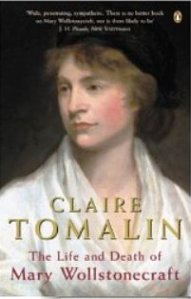
Book jacket

Old Penguin edition, now re-jacketed

I have recently been re-reading a biography of Mary Wollstonecraft (1759 -1797) by Claire Tomalin that I bought some years ago. The Life and Death of Mary Wollstonecraft is one of several literary biographies by Tomalin that I have read and enjoyed. This biography was first published in 1974 and I came across the revised and expanded 1992 paperback edition when I was working in a Birmingham bookshop. Of Tomalin’s other books, I can also recommend The story of Nelly Ternan and Charles Dickens and Jane Austen: A Life; particularly Nelly’s story as there was a real prospect of her history being lost forever amongst the Dickens mythology. I still haven’t managed to get around to buying Claire Tomalin’s volume about the great man himself, despite having listened to her give an excellent talk about Dickens which fired my interest.

Moving away from the literary world to the stage was Mrs Jordan’s Profession, the history of actress Dorothy Jordan who became William, Duke of Clarence’s mistress. She bore him around ten children (I think) and they were a very happy family until the duke was forced to end his morganatic relationship and marry respectably. The future of the crown was at stake after the death of the Prince of Wales’ only daughter Charlotte in childbirth. Both this book and the biography of Nelly Ternan give you some idea of how precarious life on the stage was for women in the eighteenth and nineteenth centuries. Neither fish nor fowl, their place away from the theatrical world was ambiguous. Nelly Ternan and Dorothy Jordan had to live their lives around society’s expectations of ‘respectable’ women and both suffered because of these expectations.

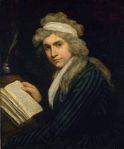
Mary Wollstonecraft portrait

A Studious pose by J. Opie.

Mary Wollstonecraft similarly lived an unconventional life, though in her case it was for the reasons of her political and philosophical views. As a young woman, she became involved in the Dissenting circles that had grown up in Newington Green, at that time still a village outside the bustle of London. Her introduction was through Dr Richard Price, the minister from the Dissenting Chapel who was well known to radical intellectuals, reformers and scientists of the day. He corresponded internationally, with Condorcet in France and with Franklin and Jefferson in America so he was very well informed. Taken together with his local political and reforming connections, he was an ideal person to begin the process of stimulating Wollstonecraft’s yet unfocused intellect and energies.

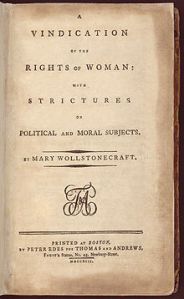
Mary Wollstonecraft was a fascinating and complicated woman, far ahead of and often out of step with the social attitudes of her time. However, I’m not sure whether we would have been bosom pals judging by Claire Tomalin’s observations on Mary’s ‘sense of grievance’ (which I feel is never an attractive character trait). But perhaps this sense of grievance was the necessary spur that drove her onwards and paved the way for Vindication of the Rights of Woman, published in 1792 as a response to Thomas Paine’s Rights of Man.

Vindication

American edition

Mary Wollstonecraft certainly had reasons to question the way things were done: her father had tended towards drinking and violence to the extent that Mary had needed at times to protect her mother. Education for Mary and her two sisters was barely adequate whereas their brother Ned attended school and went into law. Ned was also to inherit a considerable portion of his grandfather’s estate but the girls received nothing. I wonder if feminist history would have been vastly different if Mary had not experienced the unfairness of societies attitudes from such an early age? But perhaps her enquiring and lively mind would have taken her in much the same direction whatever her personal circumstances.

This was yet another diversion from reading more of the unread books on The Landing, and I am even contemplating another re-read of the books I’ve mentioned above. At this rate, the day that I can safely say that the day I have read everything tucked away on the book shelves is still a long way away!


How are your challenges going, fellow readers?

Picture credits: Wikipedia, with thanks


The Enchanted Wanderer: Adventures Aplenty

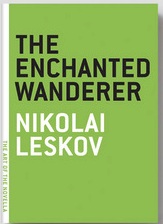
The Enchanted Wanderer

Simple and Elegant…

After becoming very sidetracked on a previous post on Nikolai Leskov, I am going to stick to my original intention of discussing The Enchanted Wanderer (Melville House, 2012) which I finished quite a while ago. The novella was a quick read as it fair rattled along with the adventures and comic miss-adventures of the protagonist Ivan Severyanych, the wanderer of the title. Ian Dreiblatt translated Leskov’s novella for this edition; first published in a serialised form in Russkiy Mir in 1873. The style of the translation gives the language a very contemporary tone, so the work has a freshness that belies its age. Being unable to read in the original Russian, I think I can safely assume that Dreiblatt has captured Leskov’s voice, as the characters leap from the page in every scene.

The story is told from the Ivan’s perspective as he relates various hair-raising episodes from his life story to fellow passengers aboard a boat sailing across Lake Ladoga. Ivan joins the boat at a place called Konevets and at first he is unregarded by the travellers. However, once he enters the general conversation they wonder how they could possibly have failed to notice him:

He was, for one thing, enormously tall, with darkish skin, an openness in his expression, and thick, curly hair the color of lead, a graying mane that poured forth in a terribly strange way. He was dressed in a short cassock, with the wide leather belt of a monk, and, in black cotton, a high ecclesiastical hat…Our new passenger, a man we would soon be fascinated by, seemed at least fifty; and from the looks of him, he was in every sense a bogatyr, and at that s humble, kindly Russian bogatyr…It seemed he would be at home not traipsing around in a cassock but rather sitting on the “dappled steed” of an adventure story…

Three Bogatyrs

Adventures await…

This quotation neatly encapsulates the basis of the plot of The Enchanted Wanderer, where we hear about all of Severyanych’s adventures (on various steeds) that lead to his present life in a monastery. I’ve put in an illustration from Wikipedia to give an idea of what our character might have looked like. A bogatyr (plural bogatyri) was a sort of hero or knight errant in epic folk stories (byliny) from Russian history. Some of the stories featured historical characters while some were purely mythological. There is an interesting article on Russiapedia if you want to know more about the bogatyri. Ilya Muromets, one of the bogatyri depicted in this painting (middle) is referenced in the description of Severyanych.  The text specifically mentions a painting of Muromets by Vasily Vereschagin, but as I can’t locate an image of that I’ve included this one by  Viktor Vasnetsov (1898) to give you an idea.

Meanwhile, our bogatyr Severyanych began his life as a serf on a Count’s estate in the Orlovsky region, where his father was one of the Count’s coachmen. The boy grew up with horses and developed an affinity with them, having a particular admiration for the wild horses from steppes who hated being broken for training. The young Ivan’s adventures really began one night, after a misguided prank that day had brought about the death of an old monk from a nearby monastery. The monk later appeared to Ivan in a dream saying, “you did me in without a chance at repentance!” Ivan isn’t particularly apologetic, saying that he didn’t mean to do it and anyway it was too late to do anything about it. During the conversation the monk reminds Ivan that he was his mother’s prayer-son (conceived after much prayer and long-awaited) and tells him that he is also a promised son (promised to God). A disbelieving Ivan asks for a sign that this message truly came from his dead mother.

“The sign,” he answers, “is that you’ll live all your life on the very brink of death, and never actually manage to die, until the day appointed you finally dawns, and then you’ll remember the promise of your mother and become a monk.”

“Wonderful,” I reply. “I’ll await that day”.

A clearly sceptical Ivan has a second encounter with the dead monk during a nap the following day. A short while later there was a near fatal carriage accident. Our hero is flung down a hillside and only survives by landing on a lump of clay that then slides to the bottom. That is just the beginning of his brushes with violent death. Ivan Severyanych goes on to wander Russia and to experience many adventures in which he comes very near to death on numerous occasions just as the monk foretold. At various times he was a Tatar slave, horse thief and a knight-errant. He even had an interesting encounter with the devil (I’ll leave you to guess who won that contest).

At the close of the wanderer’s tales, the reader is left to speculate on whether Ivan will take up arms again…

After reading this novella, I would like to read more from Leskov, but I also think that the Melville House editions of novellas from European and American literature are worth exploring. Apparently some of these appear in book form for the first time.

If anyone has any recommendations from the series, do let me know!

Picture Credit – Wikipedia (with thanks)


Leskov and Shostakovich on The Landing

Following on from the Landing Book Shelves foray into Russian literature, with Tolstoy and Pasternak, we have Nikolai Leskov (1831-1895) with The Enchanted Wanderer (first serialised in Russkiy Mir, St Petersburg, 1873) which was translated by Ian Dreiblatt. Technically this isn’t by any stretch of the imagination a Landing book, since I only bought it this year and it has sat on my bedside table more or less ever since. I have been reading it over the last week or so in between a couple of the inevitable library finds (I must do a library books blog post soon with a few ‘recommends’).

I had been browsing in the Rathfarnham Map and Bookshop but I was about to leave empty handed when this smart Melville House edition (2012) of the Leskov caught my eye. Melville House is another of those publishers that has had the smart idea of publishing lesser known classics (Hesperus  and Persephone are also publishers of forgotten classics) and in particular Melville specialises in novellas. The blurb on the back jacket says that many of the titles published have never been seen in book form before. I’m already lusting after more books from the publishing list, but they will have to join the mental book queue.

The Enchanted Wanderer

Simple and Elegant…

I hadn’t heard of Leskov before, but when I read the back jacket for some biographical details, I let out a small cry of delight. At this point you should be warned that I am about to digress somewhat from the topic of The Enchanted Wanderer. The reason for that unseemly public outburst was my discovering that Leskov had written a novella called Lady Macbeth of Mtsensk (first published in 1865). The significance of that piece of information is that it provoked in me a burst of nostalgia. I went to see the operatic adaptation of Lady Macbeth by Dmitri Shostakovich (1906-1975) on an Art College trip to London with my sister several years ago. The production was an English National Opera piece at the Coliseum. Our night at the opera was the final item in a packed day of sightseeing. I remember being in the bar of the coliseum feeling tired, footsore and too scruffy for the wonderful surroundings. Strangely enough, I don’t recall that anyone else batted an eyelid even though everyone seemed much smarter than we were.

I have been trying to pin down the date of the London trip because unusually for me, I don’t have a programme saved. As far as I can tell from my friend Google, it was the spring of 1987 though I don’t know the exact date as I’m not sure how long the  opera ran. This was to be my first opera and a dramatic start to opera going it proved to be indeed. Our seats were up the Gods, for the princely sum of £5 if my memory serves me correctly. It still amazes me that you could go to a production of such quality for so little cost at that time and of course, in such a fabulous building.

Leskov’s book ticks all the dramatic boxes for passion, murder and jealousy and it was turned into a four act opera with some changes in the action. I’ll just briefly set the scene so as not to spoil the plot too much. The plot of Lady Macbeth tells the story of  provincial merchant’s wife Katerina Ismailova, who is unhappily married to Zinovy Ismailov. She is Zinovy’s second wife and is  constantly berated by her father in law Boris for not producing an heir for the estate. Enter a new farmhand called Sergei who is attracted to Katerina and the plot thickens.  Set against the background of provincial life, Leskov tackles the themes of adultery, the subservient role of women and murder. Here’s a plot summary of the book if you want to know who dun what and to whom.

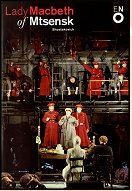
Lady Macbeth of Mtsensk

Programme from 2001 revival

Shostakovich’s opera was written in 1932 and first performed in 1934, but fell foul of Stalin in 1936 and disappeared from the public eye until the 1960s. I discovered from an article in the Guardian from 2004 that the sex and violence in the opera didn’t go down too well with the party leadership, though Lady M had been a great success with audiences in Moscow and St Petersburg. When it first re-surfaced, the opera was produced in a bowdlerised form but later staging of the opera returned to the original version. Here’s a review that I dug up from The Spectator of 5 June 1987:

No problems whatsoever with David Pountney’s shattering production of Shostakovich’s second opera. The tragedy is that it should have been his last: Stalin’s notorious denunciation of 1936 effectively silenced a 27-year-old opera composer of genius. For this reason if no other, Pountney’s updating the work to the 1930s and setting it in an abattoir is an act of neat gallows-humour revenge. Brimming with pole-axing coups de theatre, brilliantly conducted by Mark Elder and graced with a central performance by Josephine Barstow [Katerina]that is remarkable even by that singing actress’s own Himalayan standards, this is without doubt the best show in the West End, and to miss it would be sheer insanity. Oh, and it was absolutely ready on the first night.

I remember that the whole production, from the music to the singing, to the spectacular set design absolutely overwhelmed me. It probably wouldn’t have been the opera that anyone would recommend as beginner’s choice, but for me it was a brilliant way to start. You were picked up by the scruff of the neck and flung in at the deep end. And it was sung in English, which helped considerably. I think it was also the first time that I heard Willard White (Boris) sing and though I can’t claim to be an operatic expert, even I can tell that he had (and probably still does have) a wonderful voice and a charismatic stage presence.

We might have been high up in the theatre, but the opening bars of the music made an immediate impact on us. You should have seen weary students (and me), preparing to settle down in the comfortable seats and recover from the day’s exertions, jerk upright at the first dramatic notes of Shostakovich’s score. This is the first time I’ve thought about that trip for years and even now I can remember the excitement and the shocking action of the plot. I don’t think it will surprise anyone too much if I mention that Katerina (Lady Macbeth) comes to a sad and sticky end, as tragedy seems to be a staple ingredient of operatic stories. I was reading about the later revival of the opera by ENO  a few years ago and I’ve included a picture of the programme as I can’t locate one from 1987. Maybe sometime I’ll get to see Lady Macbeth of Mtsensk again, but I’ll certainly look out for a copy of the book.

All this was quite a digression from The Enchanted Wanderer, so I may have to return to him in another blog post. Meanwhile, I hope you are all enjoying your summer reading. Any recommendations?

Cranford on the small screen

After reading Cranford recently, The Bookworm and I decided to indulge in a DVD binge and we watched the entire BBC Cranford production from 2007 in one day of entranced viewing. Rest assured that we did manage a meal and beverage break in the midst of the nineteenth century. I had already done a little light Googling and so we were aware that the series wasn’t a straightforward adaptation of the novel. Even so, after having read and enjoyed the activities of the Cranford ladies so recently, it was strange to find the Cranford we knew had been turned upon its head. The scriptwriters, for some reason known only to themselves decided to mash Cranford up with a couple of other short novels and a spot of seasoning. I must stress that we did thoroughly enjoy all of the episodes of the drama. However at the same time, it just wasn’t the Cranford life that we’d just been reading about, which was rather vexing.

The television series, for those unfamiliar with its intricacies,  was constructed from plots and characters taken from My Lady Ludlow, Mr Harrison’s Confessions and Cranford. I was intrigued to read (on Wikipedia) that the scriptwriters had also worked themes from a non-fiction work called The Last Generation in England into the drama. Gaskell wrote the latter piece about the town in which she grew up (Knutsford) upon which she later based Cranford. I felt that it therefore made sense for a drama to return to the original source of Gaskell’s inspiration. I wasn’t so convinced by the idea of putting episodes from three entirely unrelated novels into the dramatic blender. If you take a look at the trailer below, you’ll see what I mean about the mixed plot lines and crossed characters.

After having searched around for details of the plots from the other books, I can see where the scriptwriters have fitted them in and where they have shifted the original Cranford plots to accommodate them. It was confusing enough after having read Cranford, but it must have completely baffled anyone doing it the other way around. As far as I can see, the various pieces of fiction are entirely unrelated to one another and I don’t think there’s a character overlap anywhere. The bonus here is that I have now discovered the existence of these novellas so I’m planning to buy them as soon as possible. I was skimming through My Lady Ludlow on the Project Gutenberg but I would rather obtain a printed version, the more to savour Lady Ludlow’s story. However, there is a delicious irony in reading about the traditionally minded lady in such a new-fangled way (and me a common person able to read!)

Part of the way through writing this post, I stopped to watch the DVD’s extra feature on how the series was made. I have to admit that The Bookworm and I are rather fond of the behind the scenes type of extra bits. Call it research, call it plain nosiness, but we like going behind the cameras for a while. The various people involved in the writing and production of the re-imagined Cranford village seemed to be real Elizabeth Gaskell enthusiasts. Given that, I couldn’t see why they would then want to muck about with her text so much. Why was it not possible to adapt a straightforward Cranford? Was it just to go one better than the earlier BBC series? Surely, the other novellas could have been adapted into wonderful television plays. I suspect that it was all about money really, and what would make a better merchandising package, to say nothing about the possibility of the Return to Cranford series.

Since I have now had a bit of a grouse about the re-writing of the novel, it is only fair to remind you that as I said before, we both enjoyed watching the drama. The ensemble cast was a dream and the costumes and settings were marvellous, taking me back to those long-ago Sunday evenings watching the current BBC adaptation. I suppose you just have to separate the programme from its original source material(s).

Don’t be surprised if we succumb to temptation and borrow Return to Cranford from the library!

Credits: YouTube – BBC trailer uploaded by Luthi3n84 on 28 April 2008 – with thanks

Ladies who take tea: Cranford

Over the last wee while, I have been reading Mrs Gaskell’s Cranford aloud to the Bookworm (usually on a Sunday morning for some reason) and we are now roughly half way through. I can’t honestly be sure if I have ever read it before but I do recall watching a BBC series some years ago. After a bit of searching I tracked down the series from 1972 that I remember watching with mum (it was dad’s cue to go and do the washing up, as he wasn’t a fan). When we get through the novel, unless I can dig up a copy of that series from somewhere, we are going to watch a DVD of the newer series from 2007 that I missed first time around, .

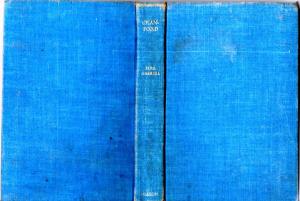
Cranford

Dust jacket long since gone

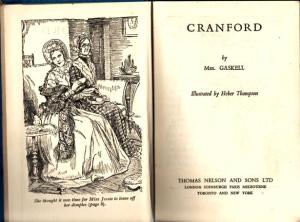
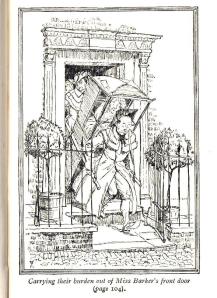
My edition of Cranford is a modest little Thomas Nelson hardback volume (undated) which is somewhat shabby after previous handling. Judging by the flyleaf I am the fourth owner of the book, but who knows for sure (I haven’t written in it, though I often do put my name in books). Heber Thompson illustrated the book with black and white sketches of various scenes from the story. I have chosen to scan a couple for the blog post that relate to events in the early chapters (see below).  We were particularly fascinated by the manoeuvres of the sedan chair men, not having realised that it was customary for the chairs to be carried into the house. And did you know that it was possible (and perhaps expected) to give up your dimples at a certain age?


Elizabeth Cleghorn Stevenson (1810-1865) married Rev William Gaskell, a Unitarian minister in 1832. She published most of her work under her married name including a collection of poems (Sketches Among the Poor) co-authored with her husband. The exceptions were early short pieces of fiction that were published under a pseudonym and Mary Barton (1848) her first novel which was initially published anonymously. Mrs Gaskell became very well-known for the first biography of Charlotte Bronte, which she wrote at Patrick Bronte’s request after his daughter’s death. She produced a highly sanitised version of Charlotte Bronte in the biography; I was reading a Guardian article by Tanya Gold who was quite scathing about the book. Not having read it, I can’t really comment though I have heard that criticism levelled at Gaskell before, who apparently began the mythologizing of Bronte’s life and work.

Cranford title page

Miss Matty looking a tad disapproving…

The Gaskell’s social circle included many from dissenting backgrounds and the couple were friends with reformers such as William and Mary Howitt and literary luminaries Charles Dickens and Harriet Beecher Stowe. Elizabeth Gaskell’s concern for the welfare of the poor and interest in women’s lives comes over in her work. In Cranford (based on Knutsford in Cheshire where she spent her early years), Gaskell details the lives of the female population of the town.

All of the petty economies made by widows and spinsters in straightened circumstances and the eagerness with which a new diversion to the predictable daily round was received, are minutely and sympathetically explored. The book doesn’t have a plot as such, being a series of episodes in the lives of the genteel ladies of the small town. This provides plenty of opportunity for gentle humour, as social events and minor scandals take place. These are seen through the eyes of a young woman Mary Smith, who  lived in Cranford as a child and now comes to stay for extended visits.

There are several sad episodes and one rather touching one is where an elderly spinster, Miss Matty relents in her prohibition of her maid Martha having ‘followers’. Poor Miss Matty has been recently reminded of how she lost her chance of marriage, and is willing to allow Martha to have a young man provided he passes inspection,

“God forbid!” said she, in a low voice, “that I should grieve any young hearts”.  She spoke as if she were providing for some distant contingency and was rather startled when Martha made her ready eager answer. 

” Please, ma’am, there’s Jem Hearn, and he’s a joiner making three-and -sixpence a day, and six foot one in his stocking-feet, please, ma’am; and if you’ll ask about him to-morrow morning, every one will give him a character for steadiness; and he’ll be glad enough to come to-morrow night, I’ll be bound.”

Though Miss Matty was startled, she submitted to Fate and Love.

Perhaps catching up with Elizabeth Gaskell’s books on both page and screen will become another offshoot of my TBR Pile reading project. I am certain of having read Cousin Phillis (1864), and Wives and Daughters (1865) in the dim and distant past, though they have now mysteriously disappeared from The Landing Book Shelves. There are a couple more novels that I would like to read as well as the Charlotte Bronte biography.

The Sedan Chair

It doesn’t look very safe..

I’m not sure how many more Sundays worth of reading lie ahead of us (distractions are many as I’m sure you’re aware) but I enjoy ‘grown-up’ reading aloud so I’m not in a hurry to finish. It doesn’t seem that long since we were on A very hungry Caterpillar; the years have suddenly flown by!

Do you ever read aloud? And if so, what are your favourites?

Westwood by Stella Gibbons

Alighting on Westwood as the next Landing read was the first result of my rummage and dusting session, and it is a mere whippersnapper at only a couple of years of residence. Vintage Books re-printed Westwood in 2011 and I bought it along with Conference at Cold Comfort Farm in I think, 2012. I’ve since read this sequel to Cold Comfort Farm (which I enjoyed, having been terribly afraid of being disappointed) but not got around to Westwood until now. Writing this post has reminded me that at some point I would like to get hold of Christmas at Cold Comfort Farm.
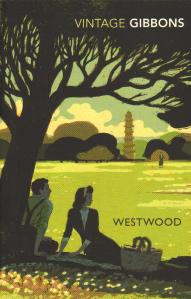
Westwood

A picnic at Kew

When I first spotted the Stella Gibbons (1902 – 1989) re-prints I was probably as guilty as most people in thinking that she had written just one book. In her introduction to this edition of Westwood, Lynne Truss says, ‘This is what everyone knows about Stella Gibbons: she wrote only book, but it was a very, very good one’. Fortunately, I now know better; Gibbons went on to write in total, twenty-five novels, three volumes of short stories and four volumes of poetry. She started out as a journalist, working for amongst other papers, the Evening Standard, having studied her craft at University College, London. No mere flash in the pan then, you’d have to admit, though nothing ever attained the critical and public success of Cold Comfort.

Cold Comfort Farm, published in 1932 was Gibbons’ first novel but she began her literary career as a poet with a collection entitled The Mountain Beast in 1930. Westwood was published just after World War II, in 1946 and was set in a war ravaged London landscape. The book may be set in a city, and a damaged one at that, but Gibbons was able to find the same natural beauty in London, that she describes in Cold Comfort Farm and juxtapose it with the grim reality of blitzed houses,

‘The ruins of the small shapely houses in the older parts of the city were yellow, like the sunlit houses of Genoa; all shades of yellow; deep, and pale, or glowing with a strange transparency in the light…Pink willow-herb grew over the white uneven ground where houses had stood, and there were acres of ground covered with deserted, shattered houses whose windows were filled with torn black paper.’
Conference at Cold Comfort Farm

One of the sequels


Set against the background of wartime privation, Westwood is a satirical comedy of relationships focussing on two very different friends, Margaret Steggles and Hilda Wilson. Margaret is plain, bookish, serious and not particularly attractive to men (as her mother had no compunction in telling her) whereas Hilda is lively, down to earth, very pretty and has any number of service boys. Margaret feels that she is never likely to meet a man who will want to marry her, while Hilda just wants to have fun without getting too involved with any of her ‘boys’.  Independently of each other, they both encounter the same man; a distinguished, rather pompous playwright called Gerard Challis (based on real life writer Charles Morgan) who lives a somewhat charmed life despite the war, in a lovely old house called Westwood in Hampstead.

Margaret is drawn into the Challis family circle because of finding a ration book on Hampstead Heath which proves to belong to Challis’ daughter Hebe Niland. When she belatedly remembers to return it, the spoilt Hebe, rushing off to a party leaves her two children in Margaret’s care until Grantey (Mrs Grant), the family’s old retainer comes to baby sit. Margaret adores Challis’ plays and is thrilled to have the chance to make the acquaintance of the writer and his family: his elegant wife Seraphina, the beautiful Hebe and artist son-law Alex Niland. Margaret also becomes friendly with Zita Mandelbaum, a refugee who helps around the house. Zita is passionately fond of music and the two young women go to concerts together, which opens up a new world of experience for Margaret.

In contrast, Hilda meets Gerard Challis as they both travel home on the tube one evening after blackout. Gerard has spotted Hilda, admires her hair and eyes, and sees in her an opportunity for a romantic dalliance. As he gallantly offers to see her home in the dark (her torch has broken), he gives his name only as Marcus since Hilda doesn’t realise his celebrity status. Gerard is convinced that since Hilda looks like a Daphne or a Thetis, she must have a poetic soul that he can nurture, but he is sadly mistaken as he gradually realises over several months of clandestine cultural outings. Hilda feels quite sorry for ‘Marcus’; she feels he is a lonely old thing, doesn’t take him terribly seriously and has no time for mythical references,

‘Hilda was beginning to feel annoyed. She was not used to this sort of talk, and for Thetis and enchanted paths, she could not have cared less. She said suddenly:
“Are you on the B.B.C?”
“Good heavens, no!” he replied, shuddering. “You odd child, why do you ask?”
“ You talk like one of the announcers; Robert Robinson, I think his name is. “And you sound like one, too,” she added darkly.
“No,” he said after a pause, “no, I have nothing to do with that institution for perverting the taste and moulding the opinions of the masses.
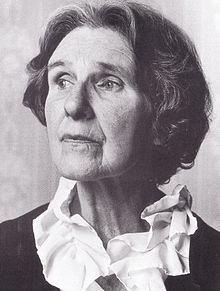
Stella Gibbons

Portrait from the 1980s


As you can see by his maligning of the output of Britain’s national broadcaster, Gerard Challis had a well-developed sense of his own cultural superiority. However, he also was fond of moulding the minds of those around him, particularly the women in his life. Clearly there were times when this didn’t work, such as during his courtship of Seraphina twenty years previously. Gerard Challis has spent so much of his life in writing about his ‘Ideal Woman’ that he is unable to appreciate the qualities of any flesh and blood ‘ordinary’ females. Is it possible that he doesn’t actually really like women, as his wife suspects, since he keeps on wanting to ‘improve’ them,

“You were such a pet, always wanting to improve my mind.”
“My desire seems to have remained unfulfilled,” said Mr Challis dryly.
“Well, you must remember me trying to read all those alarming books you unloaded on me…I did try…only somehow there was never any time for anything;…”

There is a wonderful cast of supporting characters including Hilda’s kind-hearted, jolly mother, two American servicemen (Lev and Earl) and Lady Challis (Gerard’s mother) who runs a virtual commune in a row of converted cottages. Westwood doesn’t have a conventional love story ‘Happy Ever After’ ending though there are romantic entanglements a-plenty (don’t worry, I’m not going to tell you what does happen).  Suffice to say that by the end of the novel Margaret has learned much about herself and is a much happier person than she was at the beginning. Gibbons leavens the sadness and poignancy of the book with her sharp humour and a very funny set-piece during a picnic at Kew Gardens.

And what of Hilda, Gerard, Zita, Lev and Earl et al? Well, I’ll leave you to find that out for yourselves. Meanwhile I’m off for another rummage on the shelves. Are there any more Stella Gibbons fans out there?

Picture credit: portrait of Stella Gibbons taken from Wikipedia, with thanks.