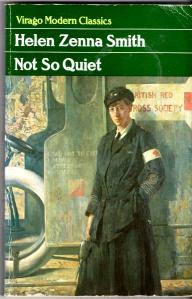
Not So Quiet by Helen Zenna Smith

While I was working on Juliet Greenwood’s guest material, I was reminded of a short review that I wrote of Not So Quiet by Helen Zenna Smith (my edition is Virago). This was published in the reader review column of Herstoria in 2009:

One of my all-time favourites...

One of my all-time favourites…


Not So Quiet  Helen Zenna Smith (Feminist Press at the City University of New York)

I first read this novel sixteen years ago and it has since stayed with me, literally and metaphorically. The title first caught my attention, its nod to Remarque’s All Quiet on the Western Front (1929) intriguing. I discovered that the author Evadne Price, a children’s writer and journalist had been asked to write a parody of All Quiet.  Fortunately for the canon of First World War literature, she declined to do so. She said, ‘that wonderful book…. anybody would be mad to make fun of.[it]’.  Instead Price, in the guise of ambulance driver Helen Smith wrote a vivid, unforgettable novel (1930) based on the war time journal of Winifred Young.

Price gives a view that complements that of Remarque‘s book. She graphically illustrates the experiences of the women struggling to get wounded soldiers to the field hospitals. They slogged day after day, night after night in appalling conditions, the night  driving often in blackout conditions under heavy bombardment. They had poor rations, lice infestation, very little sleep and a tyrannical commanding officer, nicknamed ’Mrs Bitch’ by the ambulance drivers. They may not have seen themselves as heroes, but they were. This makes it for me an inspiring read, written as it is without sentimentality.

Young’s family were proud of her ‘doing her bit’, but not keen to face the reality of her experiences. In having her journal reworked as a novel she publicised the truth. The attitude of  armchair patriots is clearly condemned in the novel. There is a terrible, chilling competitiveness amongst the committee sitting, sock knitting mothers,  about who is giving the most (in the form of their offspring) to the war effort. The book is harshly critical of both war itself and those patriotic souls who pressured others into risking both their lives and their sanity. But it also shows us the toughness, resilience, camaraderie and humanity of the women who volunteered. There were clashes of personality and perspective but the women functioned as a courageous team. I often wonder how I would have fared in the same situation.  I like to think that if the need ever arose, I would do as well as they did.


Since this is the 100th anniversary of the outbreak of World War I, it seems a good occasion to re-read Not So Quiet in tribute to the women who worked so hard for the war effort and faced dangers that they could never have imagined…

Westwood by Stella Gibbons

Alighting on Westwood as the next Landing read was the first result of my rummage and dusting session, and it is a mere whippersnapper at only a couple of years of residence. Vintage Books re-printed Westwood in 2011 and I bought it along with Conference at Cold Comfort Farm in I think, 2012. I’ve since read this sequel to Cold Comfort Farm (which I enjoyed, having been terribly afraid of being disappointed) but not got around to Westwood until now. Writing this post has reminded me that at some point I would like to get hold of Christmas at Cold Comfort Farm.
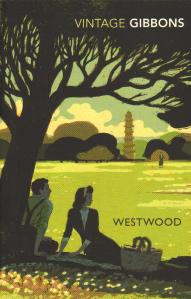
Westwood

A picnic at Kew

When I first spotted the Stella Gibbons (1902 – 1989) re-prints I was probably as guilty as most people in thinking that she had written just one book. In her introduction to this edition of Westwood, Lynne Truss says, ‘This is what everyone knows about Stella Gibbons: she wrote only book, but it was a very, very good one’. Fortunately, I now know better; Gibbons went on to write in total, twenty-five novels, three volumes of short stories and four volumes of poetry. She started out as a journalist, working for amongst other papers, the Evening Standard, having studied her craft at University College, London. No mere flash in the pan then, you’d have to admit, though nothing ever attained the critical and public success of Cold Comfort.

Cold Comfort Farm, published in 1932 was Gibbons’ first novel but she began her literary career as a poet with a collection entitled The Mountain Beast in 1930. Westwood was published just after World War II, in 1946 and was set in a war ravaged London landscape. The book may be set in a city, and a damaged one at that, but Gibbons was able to find the same natural beauty in London, that she describes in Cold Comfort Farm and juxtapose it with the grim reality of blitzed houses,

‘The ruins of the small shapely houses in the older parts of the city were yellow, like the sunlit houses of Genoa; all shades of yellow; deep, and pale, or glowing with a strange transparency in the light…Pink willow-herb grew over the white uneven ground where houses had stood, and there were acres of ground covered with deserted, shattered houses whose windows were filled with torn black paper.’
Conference at Cold Comfort Farm

One of the sequels


Set against the background of wartime privation, Westwood is a satirical comedy of relationships focussing on two very different friends, Margaret Steggles and Hilda Wilson. Margaret is plain, bookish, serious and not particularly attractive to men (as her mother had no compunction in telling her) whereas Hilda is lively, down to earth, very pretty and has any number of service boys. Margaret feels that she is never likely to meet a man who will want to marry her, while Hilda just wants to have fun without getting too involved with any of her ‘boys’.  Independently of each other, they both encounter the same man; a distinguished, rather pompous playwright called Gerard Challis (based on real life writer Charles Morgan) who lives a somewhat charmed life despite the war, in a lovely old house called Westwood in Hampstead.

Margaret is drawn into the Challis family circle because of finding a ration book on Hampstead Heath which proves to belong to Challis’ daughter Hebe Niland. When she belatedly remembers to return it, the spoilt Hebe, rushing off to a party leaves her two children in Margaret’s care until Grantey (Mrs Grant), the family’s old retainer comes to baby sit. Margaret adores Challis’ plays and is thrilled to have the chance to make the acquaintance of the writer and his family: his elegant wife Seraphina, the beautiful Hebe and artist son-law Alex Niland. Margaret also becomes friendly with Zita Mandelbaum, a refugee who helps around the house. Zita is passionately fond of music and the two young women go to concerts together, which opens up a new world of experience for Margaret.

In contrast, Hilda meets Gerard Challis as they both travel home on the tube one evening after blackout. Gerard has spotted Hilda, admires her hair and eyes, and sees in her an opportunity for a romantic dalliance. As he gallantly offers to see her home in the dark (her torch has broken), he gives his name only as Marcus since Hilda doesn’t realise his celebrity status. Gerard is convinced that since Hilda looks like a Daphne or a Thetis, she must have a poetic soul that he can nurture, but he is sadly mistaken as he gradually realises over several months of clandestine cultural outings. Hilda feels quite sorry for ‘Marcus’; she feels he is a lonely old thing, doesn’t take him terribly seriously and has no time for mythical references,

‘Hilda was beginning to feel annoyed. She was not used to this sort of talk, and for Thetis and enchanted paths, she could not have cared less. She said suddenly:
“Are you on the B.B.C?”
“Good heavens, no!” he replied, shuddering. “You odd child, why do you ask?”
“ You talk like one of the announcers; Robert Robinson, I think his name is. “And you sound like one, too,” she added darkly.
“No,” he said after a pause, “no, I have nothing to do with that institution for perverting the taste and moulding the opinions of the masses.
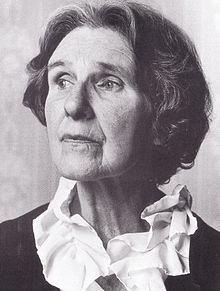
Stella Gibbons

Portrait from the 1980s


As you can see by his maligning of the output of Britain’s national broadcaster, Gerard Challis had a well-developed sense of his own cultural superiority. However, he also was fond of moulding the minds of those around him, particularly the women in his life. Clearly there were times when this didn’t work, such as during his courtship of Seraphina twenty years previously. Gerard Challis has spent so much of his life in writing about his ‘Ideal Woman’ that he is unable to appreciate the qualities of any flesh and blood ‘ordinary’ females. Is it possible that he doesn’t actually really like women, as his wife suspects, since he keeps on wanting to ‘improve’ them,

“You were such a pet, always wanting to improve my mind.”
“My desire seems to have remained unfulfilled,” said Mr Challis dryly.
“Well, you must remember me trying to read all those alarming books you unloaded on me…I did try…only somehow there was never any time for anything;…”

There is a wonderful cast of supporting characters including Hilda’s kind-hearted, jolly mother, two American servicemen (Lev and Earl) and Lady Challis (Gerard’s mother) who runs a virtual commune in a row of converted cottages. Westwood doesn’t have a conventional love story ‘Happy Ever After’ ending though there are romantic entanglements a-plenty (don’t worry, I’m not going to tell you what does happen).  Suffice to say that by the end of the novel Margaret has learned much about herself and is a much happier person than she was at the beginning. Gibbons leavens the sadness and poignancy of the book with her sharp humour and a very funny set-piece during a picnic at Kew Gardens.

And what of Hilda, Gerard, Zita, Lev and Earl et al? Well, I’ll leave you to find that out for yourselves. Meanwhile I’m off for another rummage on the shelves. Are there any more Stella Gibbons fans out there?

Picture credit: portrait of Stella Gibbons taken from Wikipedia, with thanks.
 

Lewis Chessmen and Noggin the Nog

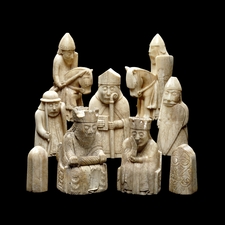
Last Saturday afternoon The Bookworm and I went along to one of the National Gallery of Ireland’s regular showings of made for television art documentaries. This week’s film was on the Lewis Chessmen and their strange history. We have (or should I say He Who Put The Shelves Up has) a replica set of the Lewis Chessmen and even though I’ve never mastered the game I’m very fond of the little men (fiendish to dust though they are).

The Lewis Chessmen

Incredible Carving

The history of the chessmen is shrouded in mystery as they were discovered sometime prior to April 1831 (when they were exhibited in Edinburgh) having been at some point buried in sand on the Isle of Lewis in the Outer Hebrides. It is now thought likely that the figures which were carved from walrus ivory, were made in Norway between 1150-1200 AD. But how they came to be where they were found and who owned them is still, and will probably remain unknowable. The most likely theory is that they were being taken by a merchant to be sold. Even the details of the actual discovery of the carvings seems vague and uncertain.

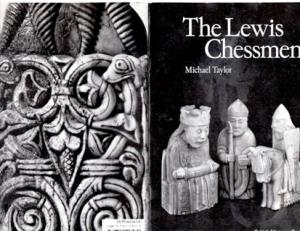
The hoard found consisted of seventy-eight chess pieces plus fourteen counters and a belt buckle. The chess pieces are all exists  from four chess sets but the remaining pieces have never been discovered. The known pieces are all in public hands, with sixty-seven in the British Museum and eleven in the Museum of Scotland and they do also apparently go on tour. The cover shown here is from a British Museum booklet that we have on our bookshelves. I scanned the back too because it gives a good idea of the tremendous detail in the carving. In the documentary, a craftsman explained how difficult and with what skill the ivory figures were carved.

Lewis Chessmen Book

The Story of the Chess Set

But where does Noggin the Nog come into it I hear you ask? The answer is that the creator of the BBC Children’s Television series Peter Firmin was inspired by his visits to see the Lewis Chessmen to tell ‘their’ story. The result was a delightful saga of Noggin the Nog and his kingdom. As a child I loved this series so much that it is an indelible paart of my childhood memories. For anyone out there who has never heard of Noggin, or indeed of Nogbad the Bad, if you have trawl though YouTube you will find plenty of excerpts. The series was made by Peter Firmin and Oliver Postgate and was first broadcast in 1959, originally in black and white.

Every episode began something like this (I think it was Oliver Postage’s voice):

Listen to me and I will tell you the story of Noggin the Nog, as it was told in the days of old”, or “In the lands of the North, where the Black Rocks stand guard against the cold sea, in the dark night that is very long the Men of the Northlands sit by their great log fires and they tell a tale … and those tales they tell are the stories of a kind and wise king and his people; they are the Sagas of Noggin the Nog. Welcome to Northlands, a tribute to Noggin, King of the Nogs and the People of the Northlands.

I am now feeling very nostalgic for old television programmes. I also have a renewed interest in one day going to see the original chessmen in either location. There have been calls for all of the pieces to be relocated to Scotland but there’s probably not much likelihood of that happening in the near future. However, the history society in Uig, Isle of Lewis has said that it doesn’t support calls to remove the men from London and is happy for them to remain where they are. Now, if anyone ever proves where the chess pieces were actually made then no doubt there will be another claim put foward for return to rival that of Lewis.

Credits: Lewis Chessmen image taken from British Museum pages.

Noggin the Nog quotation taken from Wikipedia. 

The First Bulletin on War and Peace

As I’m sure my readers will be pleased to know, my War and Peace challenge is making relatively good progress. Note that I’m hedging a bit here by using the word ‘relatively’ to describe my rate of reading. I have actually reached page eighty-five and I’m at the point where Count Bezuhov has suffered his sixth stroke and is not expected to live. Naturally enough the heirs presumptive are getting anxious as they can see a fortune slipping from their hands into those of Bezuhov’s illegitimate son Pierre.  I wonder what skullduggery may be afoot in the aftermath of the count’s death.

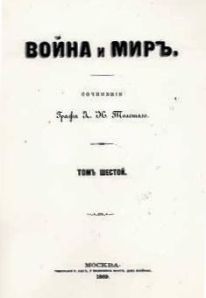
First Edition of War and Peace

First Edition, 1869

Already many aspects of human nature have popped up during the drama; I’ve met a diverse cast of characters in the action occurring between Moscow and St Petersburg. Not surprisingly I was rather taken with the younger players in the story, who were enjoying (and suffering) their first pangs of love. Natasha Rostov is delightful and I am almost apprehensive about what vicissitudes her life will throw at her, but I’m trying not to leap ahead and plot spoil for myself. I’ve never seen a film version of War and Peace and I’m studiously avoiding plot summaries that I’ve come across.

The thing that I find particularly fascinating is the sheer number of princes and princesses in the novel, to the extent that I’m tempted to try to find out just how many there were in Imperial Russia at that time. It also seems that having the title of prince or princess didn’t necessarily mean that you were wealthy. Having consulted Wikipedia, I’ve discovered that the titles of prince and princess belong to the titled nobility (which could be acquired) as opposed to the ancient hereditary nobility. Wikipedia goes on to point out that,

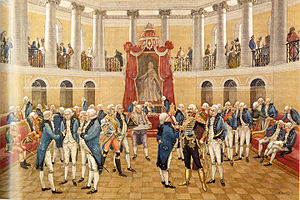
By 1805, the various ranks of the nobility had become confused, as is apparent in War and Peace. Here, we see counts who are wealthier and more important than princes. We see many noble families whose wealth has been dissipated, partly through lack of primogeniture and partly through extravagance and poor estate management. We see young noblemen serving in the Army, but we see none who acquire new landed estates that way’.  

A Noble Assembly

Nobles in the time of Catherine the Great

So presumably that accounts for poor old Princess Anna Drubetskoy desperately trying to obtain a placement and funding for her son Boris. This little bit is quite telling, ‘The mother smoothed her dyed silk gown, glanced at herself in the massive Venetian mirror on the wall and briskly mounted the carpeted staircase in her down-at-heel shoes’. A few lines above, her cloak is described as ‘threadbare’ which is noticed by a sharp-eyed servant.

I’m going to dive back into Imperial Russia now, having had a short break to finish a couple of library books, so I’ll hope to post up again soon with a further update.

Back soon….and if anyone else is tackling a hefty tome at the moment please let us know about it!

Picture Credits: Thanks to Wikipedia for the illustrations.

A Landing Bonus Book: The Herbalist by Niamh Boyce

He just appeared one morning and set up shop in the market square. It was drizzling. Everything was either a shade of brown or a shade of grey. He was the lightest thing there, the one they called the black doctor. He wore a pale suit, a straw hat and waved his arms like a conductor. The men spat about dark crafts and foreign notions, but the women loved him. Oh, the rubs, potions, tinctures and lotions he had. Unguents even.

As a break from my regular Landing Book Shelves task, I have been reading The Herbalist, the first novel from Niamh Boyce who was winner of the Hennessy XO New Irish Writer of the Year in 2012. The book was kindly offered by Penguin Ireland and has not tarried for too long on the TBR Pile due to The Herbalist’s very tempting prologue, from which I quoted above.

The Herbalist by Niamh Boyce

‘An elegant morality tale’ (Sunday Times)

Niamh Boyce based her title character on a real person called Don Rodrique de Vere who was practising as a herbalist in Athy in 1942. I won’t say any more for fear of giving away the germ of the novel’s plot, but if you do want to know more about the inspiration behind the character, click on Athy Eye on the Past blog or read Niamh Boyce’s interview with Sinead Gleeson in the Irish TimesThe Herbalist is set in a small midlands town in the late 1930s and is told through the voices of four women of differing ages and social positions. Emily, Carmel, Sarah and Aggie are all well drawn, strong characters.  Boyce adds to her strong cast with several minor characters such as Mai and Birdie; also with the beautiful Rose whose quieter voice interweaves throughout the narrative.

This was an era when people’s lives (and arguably women’s in particular) were structured and controlled to a great degree and it wasn’t done to stick out too far against the perceived norm. Into this repressed social mix comes a half –Indian herbalist who promises much to the enthralled women of the town. Most of the towns women seem to have dealings with the herbalist; an exotic stranger who upsets the balance of the town where everyone knows everyone else’s business (or thinks they do).

Impressionable teenager Emily develops an infatuation with the healer (known as The Don) and becomes the talk of the town as a result. He indulges her fantasy for his own reasons, promising Emily a new life far away from the town where her family is regarded as less than respectable and nobody thinks she will amount to much good. Emily’s voice comes clearly down the years and you can well imagine a lively Hollywood obsessed girl itching for more than her life seems to promise. The reader sees before she does, that Emily’s route out will be her exquisite skill with a needle and thread. But before that, she will have to stand up and attempt to put right an injustice with all of her reserves of courage. I’ll say no more lest I plot-spoil.

The novel has plenty of fascinating insights into life for people (and in particular the women) in small town Ireland of seventy years ago. Banned books, the need to be respectable, the pressure on married couples to conceive, shameful secrets lurking behind closed doors and young women disappearing into Magdalene Laundries (often as a result of rape) are all themes in the novel. The book carries all this lightly however and there isn’t a feeling of being overburdened as Boyce tucks her threads so neatly together. There are obviously plenty of darker shades in the story, but these are well handled and leavened with gritty humour.

I was intrigued to discover that the banning of books in fact led to a thriving black market in racy books such as Lady Chatterley’s Lover, Bird Alone and Tender is the Night. In the novel, both Birdie and Carmel have an under the counter trade in illegal books to bring in a few extra shillings. There is a funny scene where Carmel’s husband Dan discovers the stash and claims to be so shocked, yet he can’t put the book down and he avidly reads the awful material, ‘ He slammed it shut, glared at his wife. Opened it again…read a section, snapped it shut. Glared. Opened it…on he went, over and over again, with the same exaggerated expression of wide-eyed horror’.

The herbalist may have used his potions to charm the women of the town, but Sarah’s aunt Mai is also a skilled herbalist, using her ancient talents in her role as a midwife in her village. Mai’s kitchen in the throes of violet tincture production was beautifully described. Again with a touch of humour, as Mai and Sarah hide the poitín used in the process from the local school master’s sharp eyes. Boyce reminds us both how important a woman like Mai would have been in her community and how little money there was at the time to pay for the services of a midwife. Mai more often than not had to accept payment in kind, because as she pointed out to Sarah ‘you couldn’t shove a baby back in’.

I thoroughly enjoyed The Herbalist and look forward to reading more from Niamh Boyce in the future. In the meantime, I have one more Landing Eight title to report back on and then a new Landing Reading Challenge awaits me! All will be revealed shortly…

Back soon and don’t forget to drop a comment in the box if you’ve read anything good lately.

The Swerve: Philosophical Dynamite

The Swerve

How the Renaissance Began

As I think I have mentioned in a previous post, I have had The Swerve: How the Renaissance Began (Stephen Greenblatt) on my bed side table for a few months. I bought it just after Christmas with a book token from my daughter but it has lain neglected until our summer trip. If I tell you that I was reading this at 1am while sitting at Holyhead Port awaiting an overnight ferry (it’s a long story), then perhaps that might indicate just how well Stephen Greenblatt teases out the strands of his story into an enthralling read.

Greenblatt sets out to tell the story of the re-discovery in 1417 of a copy of an ancient poem origin by the Roman poet Titus Lucretius Carus (c 99 BCE – c 55 BCE), a follower of Epicurus (341 BCE – 270 BCE). By the 1400s, all of Lucretius’ writings seemed to have been lost, except for quotations in the work of Ovid and Cicero.

Luctretius’ work De Rerum Natura (On the Nature of Things) was re-discovered by a Papal Scribe with humanist leanings called Poggio Bracciolini (1380 – 1459). As Greenblatt makes clear, Bracciolini was more interested in the poetic quality of the work than the Epicurean inspired philosophical ideas contained within the  text. The content of Lucretius’ work would have been somewhat in conflict with his role as the Pope’s amanuensis.

De Rerum Natura

De Rerum Natura

Greenblatt goes on to trace the effects of De Rerum Natura over the centuries that followed. Provocative ideas had been quietly mouldering away, contained within a manuscript in a monastery scriptorium, copied by some long ago hand. But what were the ideas, the ones that were destined to inspire writers and thinkers for generations?  The one that really surprised me was Lucretius’ theory that everything was made of atoms. I had no idea that a theory along those lines existed so many centuries ago. One of the most shocking ideas that Lucretius put forward must have been the assertion that the world and all that it held wasn’t made by any divine being. Everything that happened in the universe had a natural explanation and wasn’t the result of gods throwing their weight about. And furthermore, that there is no life after death, no heavenly rewards.

The spread of Lucretius’ ideas down the years from reader to reader and from country to country makes for fascinating reading. Also fascinating to read about was the desperate reaction of the Catholic hierarchy as they sought to contain all traces of new (or rather old) ideas and philosophy from the Pagan past. Greenblatt traces Lucretius influence running through the works of Machiavelli, Montaigne, Ben Jonson and Shakespeare. Apparently Thomas Jefferson owned several copies of De Naturum Rerum and Moliere wrote a verse translation.

I’ve only skimmed the surface here to give you an idea, but even if you don’t have a bent for history this is a fascinating read, touching as it does on so many aspects of life and philosophy. Well worth a read!

Let me know if you have any thoughts…

Credits: addtional illustration courtesy of Wikipedia, with thanks.
The Swerve

The Swerve:

This book was mentioned previously in a post that I have re-blogged from Interesting Literature. The writer of Book Shares subsequently urged me to get around to reading The Swerve, so I may have to move it up the pecking order a little. This also means yet again tackling the technical issue of reading books that aren’t actually part of the Landing Book Shelves TBR Pile.

But, I’m pretty sure I gave myself a generous exclusion clause…TBR Pile? What TBR Pile?!

bfootgrrl's avatarBook Shares

I always thought I received an above-average education from my rural Pennsylvania high school and from the state college just a few miles away. After all, many people I met after college didn’t seem to know much or care about literature, music, art, language, or history, not to the extent that I did. Yet, as I made my way in the world, I learned that I was sorely deficient in one area: classical antiquitySwerve_TipIn_FINAL.indd. I had no clue whether Virgil was Greek or Roman; whether Aristophanes wrote in the same century as Sophocles or Euripides, much less what they wrote; who sent the big wooden horse into Troy; why Rome was a republic but all the leaders seemed to be emperors; what Plato said that was different from Socrates; and I hadn’t even heard of Herodotus, Thucydides, Polybius, or Lucretius.

I picked up some info along the way, and…

View original post 711 more words

30 Day Book Challenge – day 9: A book I’ve read more than once

I’ve shared this post, from a great blog that I follow, as it’s nice to see that someone else is a fan of a book previously featured on The Landing.

Maybe one day I’ll get around to a few more Josephine Tey re-reads!

E A M Harris's avatare a m harris

I don’t often read books more than once, but lately re-enjoyed one I’d read years ago.

The book is Josephine Tey‘s Daughter of Time. It was first published in 1951, but in my 77661opinion has aged well and is still relevant and fun.

A detective, Alan Grant, is convalescing in hospital and is bored. A friend suggests that he puts his skills to work on a historical crime. Grant selects Richard III and the question of whether or not he murdered the princes in the Tower.

With friends doing any actual legwork, Grant reassesses the evidence and comes to the conclusion that Richard has suffered from a bad press and was probably not as evil as history (and Shakespeare) has painted him.

I think that today there’s enough doubt about Richard’s wickedness for most people to regard him as possibly maligned. But this is a recent happening and…

View original post 151 more words

Lymond and Niccolò: Dorothy Dunnett

Niccolo set

The House of Niccolo

I was inspired to take down my Dorothy Dunnett books when I read Susan Condon’s recent blog post about re-reading. Dunnett (1923-2001) has written two brilliant historical series, one set in the sixteenth century, the Francis Crawford of Lymond series (1961-1975) and the House of Niccolò series (1986-2000), which takes place roughly a century earlier. In between times, she has also written the Johnson Johnson series of mystery novels and the book that Dunnett considers her masterpiece, King Hereafter (1982).

A school friend, who gave me a copy of Checkmate (paperback 1976) for my birthday one year, unintentionally began my subsequent relationship with Dunnett’s books. My friend Julie bought me the book, knowing that I liked historical fiction, yet not realising that it was the final part of the Lymond series. I did actually read Checkmate before, rather perversely, going back to the beginning with The Game of Kings (1961). I gradually built up the rest of the Lymond saga, acquiring a couple as I recall from a second-hand bookshop in Cardiff.

But here I have to make the shameful confession that I never actually (for various complicated reasons) finished reading the Niccolò series. The last two volumes, Caprice and Rondo and Gemini languish unread on my shelves to this very hour. I have long promised myself a truly mammoth Niccolò binge; ideally this would mean returning to the beginning and starting all over again. I think however, for present practical purposes I will have to content myself merely with backtracking as far as To Lie with Lions and going on from there. Technically these books do not come under the remit of the Landing blog, as they live in our bedroom, but I may give myself dispensation on that point (after all all’s fair in love and reading). And it would be wonderful to return to that world for a summer break from the twenty-first century.

Dunnett Society Logo

Dorothy Dunnett Logo

Because of mentioning my idea of returning to them this summer, I discovered via Twitter that a Dorothy Dunnett Society exists which publishes a newsletter called Whispering Gallery for members. The society is actually a registered charity under Scottish law, founded in 2001 by Dorothy Dunnett. The society aims to promote interest and research into the periods she wrote about and to support the cataloguing and preservation of her papers and research materials, which Dunnett bequeathed to the National Library of Scotland:
“•advance the education of the public concerning the history,  politics, culture and religion of the 11th, 15th and 16th centuries by promoting the study of and research into such subjects generally and into such subjects particularly as they relate to the works of Dorothy Dunnett, and to disseminate to the public the results of such research.
 •foster the appreciation and recognition of the literary works of Dorothy Dunnett.
 •ensure that the manuscripts, letters, reference materials and research papers of Dorothy Dunnett are preserved and are accessible.”

It is incredible to realise just how many Dunnett fans are out there. To finish up with here is a a testimonial from a Dorothy fan. I came across this short clip about Dorothy Dunnett’s Lymond series on YouTube, which was recorded in a bookstore in the States. The interviewee, Anna Kaufman, also discusses another Dorothy, the crime writer Dorothy L Sayers, whom I may well feature on the Landing in the future. There is also an excellent interview with Dorothy Dunnett on the Society’s website, recorded in 1989 for Off the Page.

Now, I must just go and plan the summer’s reading. What will you be reading (or re-reading) this summer?

Video credit: Uploaded to YouTube 24 March 2010

Anna Kaufman, Diesel Bookstore, Brentwood

Logo: taken from the Dorothy Dunnett site

Photo: from Amazon (for technical reasons: camera not charged!)

On final, final note I have come across The Idle Woman’s Literary blog who is also a great Dorothy Dunnett fan if you want to read up a bit. But watch out for unintended spoilers.

Landing Author: Sarah Moore Fitzgerald

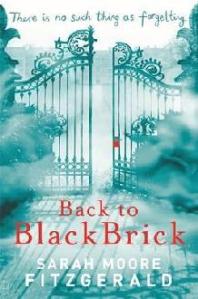
As previously promised, I am today hosting a new YA  author on The Landing Bookshelves. Sarah Moore Fitzgerald, a professor from Limerick University, publishes her first novel today. I was lucky enough to receive a proof copy of Back to Blackbrick before Christmas. I was immediately attracted by both the time travelling element of the story and the back drop of ‘The Big House’ where so many fascinating stories often lurk. It is clearly a fascination that many readers and writers share. The great houses of Ireland and Britain have long provided much food for thought.

book cover with big iron gates

Back to Black Brick

This kind of setting always interests me for personal reasons, in that my late grandfather was a gardener at Grove Hall in Harborne, Birmingham (demolished in the 1970s) home of a prominent local family. The grounds are now a public park. I  recently spotted a large cedar tree in a photograph of the grounds of Grove Hall; it dawned on me that it must be the same tree that I played under as a child, when the grounds had been handed over to the council. Time travel of a sort, perhaps.

I asked Sarah to talk to us about the background to Back to Blackbrick and about the research that underpinned the novel. Like me, Sarah admits to a fascination with the life and history of the big country house. When we chatted last week, we talked a little about this, mentioning the brilliant Abandoned Mansions series of books by Tarquin Blake (see previous post).

Here is Sarah’s piece, written especially for #LandingAuthor, in which she talks about her influences:

How a history book helped to inform and inspire my first novel

At the centre of my first novel, there is a big house called Blackbrick Abbey. Two big avenues lead up to it – one from the south and one from the north. In the grounds there are stables, beautiful horses, big trees and an orchard with apple sheds and a gate lodge. Very early on in the story, Cosmo, the main character, gets a key to the gates of Blackbrick from his brilliant, lovely grandfather. But it’s only when Cosmo gets there, that he realises he’s been sent to the past in order to recover his granddad’s failing memory. The huge old house contains secrets that will help him to make sense of important things in his life.

I’ve always been kind of obsessed with the idea of ‘Big Houses’ and the complicated things they represent.  I was captivated, as generations of children were, by Misselthwaite Manor in The Secret Garden and later, by the strange evocative Anglo-Irish climate of Danielstown in Elizabeth Bowen’s The Last September, by Molly Keane’s descriptions of a family keeping up appearances in the crumbling manor of her deliciously dark Time After Time and to Evelyn Waugh’s heartbreaking Brideshead Revisited. In all of these stories, the big house sits silent and gigantic at the heart – symbolizing family identities and their labyrinthine dynamics and secrets.

I probably shouldn’t have been surprised that when I started to write my own novel, a house like this would somehow become a crucial part of the story’s backdrop. When the idea for Back to Blackbrick was being formed, I remember stumbling upon the non-fiction gem by historian Terence Dooley, entitled The Decline of the Big House in Ireland. That’s when a major part of the plot crystallized in my head, and I decided that my character was going to have to spend some time in the past. Writers often warn that too much research can distract novelists from getting on with the story – that if you get too immersed in the history of an era you disappear into the research, abandoning the novel. But when I read Dooley’s book, replete as it is with wonderful and impeccably researched historical descriptions, the opposite happened – it spurred the creative writing side of my brain with the curiosity to explore hints of a human story that could lie behind the historical facts.

While Back to Blackbrick is set in both the present and the past, and while I have tried to paint the historical references with a light touch, Terence Dooley’s book gave me a rich sense of themes that eventually became a really important part of the story – reminding me never to underestimate the power of historical non-fiction to provide luminous raw material for storytelling.

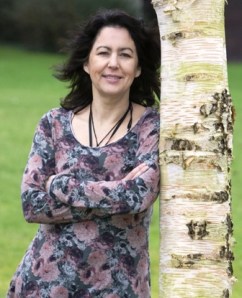
head and shoulders photo

Sarah Moore Fitzgerald

Sarah Moore Fitzgerald is a professor at the University of Limerick. Late at night, she writes stories for her children. Her first novel, Back to Blackbrick (Orion Children’s Books) is out on Feb 7th.

With many thanks to Sarah for joining me as a guest on #LandingAuthor and lots of luck with Back to Blackbrick. If you would like more infromation take a look at Sarah’s agent’s website here.

Photo credit: Liam Burke/Press 22