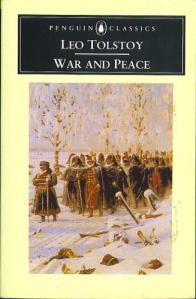
Cover shows detail from ‘The 1812 Retreat – The Battle of Borodino’ by Vereschagin
I promised you an announcement on the next stage of the Landing Book Shelves Reading Challenge and here it is at long last. As you will no doubt guess from the illustration, the challenge is the reading of War and Peace (Leo Tolstoy, 1828 -1910) a big hurdle if ever there was one. This worthy challenge has been put on the Landing Book Shelves agenda because it also happens to be my book group’s project at the moment, this killing the proverbial two birds. I’m not sure how long it will take me to read War and Peace (or how long it will take my fellow book clubbers for that matter) but I undertake to offer my blog readers reasonably regular progress updates. Weighing in at 1444 pages, this lengthy tome will be read in stages in between various other books.
It is just as well that the idea of reading War and Peace for book group came up as it is likely that it would have sat on the Landing Book Shelves almost indefinitely. I say ‘almost’ because I really and truly meant to get around to reading it sometime. I bought my copy in May 1992 with the intention of reading Tolstoy’s epic during my summer holidays. After all this time I can’t recall what I did read that summer, but it certainly wasn’t Tolstoy. So, it’s better late than never on the Russian classics front I suppose.
War and Peace was first published in 1869 (I’ll fill in the publication history in a future post) and the paperback edition that I have on The Landing was first published by Penguin Classics as a two-volume edition in 1957. The one volume edition came out in 1982; the translation is by Rosemary Edmonds from 1957 with revisions in 1973. I’m by no means an expert on the virtues of one translation over another so I will have to trust to the reliability of Penguin Classics in this instance. There are more recent translations available (for example from Penguin Classics and Vintage), but as this is the copy I have on The Landing, I’ll go with this one unless any reader out there tells me that I would be better served with a different translation.
I will be embarking for nineteenth century Russia just as soon as I’ve finished my library book and a couple of review books….I promise…
‘Before beginning a novel I re-create inside myself its places, its milieu, its colours and smells. I revive within myself the atmosphere of my childhood and youth – I am my characters and their world’(François Mauriac).
This is the moment that you’ve all been waiting for (well I have at any rate) when finally I tackle the last novel in my Landing Eight sequence of books. After that I have another Reading Challenge lined up to tell you about, but more of that in due course. In the meantime I’ll put The Frontenac Mystery to bed and cross it off my TBR Pile with a sense of satisfaction. There have been many distractions along the way but I’ve finally completed reading the eight titles that I picked out last year. Still got lots yet to read though; but for now let’s move on with the book in hand…
I picked this book (one belonging to He Who Put the Shelves Up in fact) as part of my Landing Eight Challenge since I hadn’t read anything by François Mauriac (1885-1970) before and this seemed as good an opportunity as any to start. The edition of The Frontenac Mystery that we have at home is a Penguin Twentieth-Century Classics edition from 1986; the text was translated by Gerard Hopkins for the Eyre & Spottiswoode edition of 1951. Le Mystère Frontenac was originally published in 1933 by Bernard Grasset. For some background information on Mauriac here’s a link to his biography on the Nobel Prize page (he was given the Nobel Prize for Literature in 1952).
At the centre of the novel is the Frontenac family, a landed gentry family from the Bordeaux region (Mauriac’s birthplace); BlancheFrontenac has been widowed with five children to bring up and a family reputation and tradition to uphold. Her brother-in-law Xavier helps her as a fellow guardian and as a custodian of the family’s business and estate. As the novel opens, Blanche has been widowed for eight long years; she was a ‘tragic mother with the black eyes, and the sick, lined face, in whom the traces of a former beauty still warred with wrinkles and approaching age. Her greying, rather untidy hair gave her the neglected look of a woman who has nothing to look forward to’.
Blanche has become subsumed into the family into which she married and carries the pride and ‘mystery’ of the Frontenac name within her. Having said that, she resents Xavier for apparently being unable to see her as a person; he sees Blanche only as the mother of the next generation of Frontenacs and she believes that he doesn’t even really see her as a Frontenac anyway. Similarly, he also sees in the children the glory of the family and therefore ‘what gave them value in his eyes had nothing to do with individual qualities’. But it transpires that Xavier has a secret that would not reflect well upon the august name of Frontenac were it to become widely known.
The novel follows the lives of the family as the children grow up and assume their place within the mystique of the Frontenac name. The boys Jean-Louis (the eldest sibling), Jose and Yves are all very different characters and Mauriac explores their contrasting hopes and ambitions. The two sisters Danièle and Marie don’t receive so much attention, probably because the times and social position they were in would never have allowed them much choice. Tellingly, at one point in their childhood they are described by Mauriac thus, ‘ They were two little brood-mares in the making, and found an outlet for their maternal cravings in ministering to the children of various washerwomen and chars’.
I’m not sure whether I really liked this novel as I didn’t feel much of a connection with or sympathy for many of the characters. They all seemed to be trapped in a web of their complex family history (and their pride in it) that they all at times kicked against, yet ultimately submitted to maintaining. I did however, feel sorry for Xavier’s secret woman Josefa (who is not as much of a secret as he thinks) who lives patiently in the background since she isn’t deemed to be worthy of a life amongst the family Frontenac. Xavier has conflicting emotions towards her, referring to as ‘shop-soiled’ but at the same time, ‘She was a kindly creature with a strong maternal instinct who did not laugh at him’.
Mauriac’s prose is beautiful and elegant but I think that the overall effect is cold and that the novel lacks that certain something that would draw me into the lives of the family. Perhaps it’s just that times have changed so much that it’s hard to imagine anyone devoting themselves so entirely to a collective without any consideration for the individual needs. The social segregation of Josefa from the family and her humble attitude towards them is hard to swallow. I would however, like to read something else by Mauriac (I will probably read this one again at some point) to delve a bit further into his world. It would perhaps help to read more on his life and the influences upon his work I think. Another project for the future.
And don’t forget that I promised an announcement on the next chapter of the Landing Book Shelves TBR Pile Reading Challenge! Tune in next time folks for an update…
If you’re also in Ireland, have a great Bank Holiday weekend.
I discovered ‘Library Loot’ on ‘The Captive Reader’ while browsing though a backlog of un-read posts on my ‘Followed’ list. It sounds a great idea to have a go at if you are a library-going regular. I presume it’s open to readers wherever in the world they happen to be located. I hadn’t thought of doing a library post before as I’m trying to mostly post up about my TBR Pile. But those library loans do keep sneaking in and distracting me so I should give them some space I guess…
Library Loot is a weekly event co-hosted by Claire fromThe Captive Reader and Marg from The Adventures of an Intrepid Reader that encourages bloggers to share the books they’ve checked out from the library. If you’d like to participate, just write up your post-feel free to steal the button-and link it using the Mr. Linky any time during the week. And of course check out what other participants are getting from their libraries.
This re-blog of my Irish News Review post is by way of a reminder that Sculpture in Context finishes tomorrow so your last chance to visit is rapidly aproaching. Do pop along if you’re in the area (and do let me know if you find the artwork numbered 146 in the catalogue)…
On a rather chilly Saturday morning my companion and I ventured forth to our annual, much-anticipated visit to the Sculpture in Context exhibition at the Botanic Gardens in Glasnevin. Unlike previous years, we actually managed to make our way around the entire exhibition and were satisfied that we had seen absolutely everything (except for exhibit number 146 which appeared to be missing). The chilliness of the weather proved to be an important factor in the success of the day’s activities; we achieved this magnificent result because the day was too cold to dawdle around as much as on sunnier visits. Added to that we initiated an unusually organised approach (in other words, we had a plan) to our seasonal cultural activity of sculpture spotting.
As fellow fans of architectural Dublin will know, Open House Dublin fell in the first weekend of October (Friday 4th – Sunday 6th). I’ve mentioned Open House before on The Landing since it’s one of my favourite cultural events. As usual many buildings of architectural merit across a wide variety of age and purpose were open to the public at no charge. Guided tours to buildings such as The Chocolate Factory, the Lighthouse Cinema and the Alliance Française were on offer as well as government, institutional and educational buildings. Some tours were available by public lottery only (such as for Freemasons Hall) but unfortunately I wasn’t geared up enough in time to enter. Maybe next year I will be better organised; I picked up the map and leaflet in good time but failed to follow-up. Having said all of that, we had a good day of building bagging despite the lack of forward planning and we went home quite satisfied (and very footsore) with our discoveries.
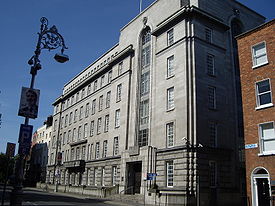
A view of the front on Kildare Street
Our last port of call on a busy day was to the Department of Industry and Commerce building on Kildare Street where we just squeezed onto Open House’s final tour. We were really lucky because the organisers took double the optimum number of people round so as not to leave anyone out. We certainly fared better here than at Earlsfort Terrace where the volunteers were saying they were booked out for the last tour. I couldn’t help wondering whether it would have really hurt them to allow a few extras since they were turning away enthusiastic visitors. That’s one to bookmark for next year’s event I suppose. Anyway, back to the over-subscribed government building tour.
The tour was conducted by Angela Rolfe, an OPW architect who wrote a book to commemorate the fiftieth anniversary of the building and so is therefore an expert on the construction and features of the purpose-built (completed in October 1942) government building. The building was designed by J.R. Boyd Barrett and the building contractors were John Sisk & Son. It now houses two departments: the Department of Jobs, Enterprise and Innovation and the Department of Arts, Heritage and the Gaeltacht. I have to admit that apart from the interest of seeing the interior features of a building that I wouldn’t normally be able to enter; there is a certain degree of plain nosiness in wanting to peek behind the scenes. Not that you get to see anything shocking, apart from the possibilities of seeing who has the untidiest office and leaves dirty coffee cups around. And in fact, it was all pretty tidy by and large.
The interiors still have most of the original features, apart from it seems some alterations to facilitate modern health, safety and fire regulations. Sadly, the glossy finish on the Australian walnut panelled walls has been a victim of this since the surface was deemed to be a fire hazard. The panelled lobbies and minister’s corridor are still impressive but the walls must have looked wonderful without the more practical matt finish. The craftsmanship of the whole building was very much in evidence as also was the obvious care with which the building has been looked after during its seventy-one years. The sash windows still function and the specially made linoleum is still in pristine condition. But then it was pretty posh lino in the first place I suppose, no bargain basement stuff here. The building seems to have been well designed for the benefit of the people working there and not just for appearances sake, with attention paid to the quality of lighting, space and ventilation.
Gabriel Hayes’ design
I was interested in trying to obtain a copy of Angela Rolfe’s book (47 pp, Office of Public Works, 1992,) but it seems to be quite hard to track down. The only copy I found was listed on ABE Books as a first edition at €25 which is rather more than I wanted to pay. I might just have a look at the copy in the National Library instead. I can’t find an image of it to post up either so I’ve added a picture of the building and a link to the National Inventory of Architectural Heritage instead, so that you can see a couple of shots of the carved exterior panels by Gabriel Hayes (1909-78). There’s also more detail about the features of the building if you want to read more. Gabriel Hayes had a long career and amongst many achievements, she designed some of the decimal coins, brought out in 1971 (see picture attachment page for more information).
I’ll be back with more Landing Challenge book news soon but I’d love to hear if anyone else in Dublin was touring the city for Open House this year so drop a line in the box if you have any news…
He just appeared one morning and set up shop in the market square. It was drizzling. Everything was either a shade of brown or a shade of grey. He was the lightest thing there, the one they called the black doctor. He wore a pale suit, a straw hat and waved his arms like a conductor. The men spat about dark crafts and foreign notions, but the women loved him. Oh, the rubs, potions, tinctures and lotions he had. Unguents even.
As a break from my regular Landing Book Shelves task, I have been reading The Herbalist, the first novel from Niamh Boyce who was winner of the Hennessy XO New Irish Writer of the Year in 2012. The book was kindly offered by Penguin Ireland and has not tarried for too long on the TBR Pile due to The Herbalist’s very tempting prologue, from which I quoted above.
‘An elegant morality tale’ (Sunday Times)
Niamh Boyce based her title character on a real person called Don Rodrique de Vere who was practising as a herbalist in Athy in 1942. I won’t say any more for fear of giving away the germ of the novel’s plot, but if you do want to know more about the inspiration behind the character, click on Athy Eye on the Past blog or read Niamh Boyce’s interview with Sinead Gleeson in the Irish Times. The Herbalist is set in a small midlands town in the late 1930s and is told through the voices of four women of differing ages and social positions. Emily, Carmel, Sarah and Aggie are all well drawn, strong characters. Boyce adds to her strong cast with several minor characters such as Mai and Birdie; also with the beautiful Rose whose quieter voice interweaves throughout the narrative.
This was an era when people’s lives (and arguably women’s in particular) were structured and controlled to a great degree and it wasn’t done to stick out too far against the perceived norm. Into this repressed social mix comes a half –Indian herbalist who promises much to the enthralled women of the town. Most of the towns women seem to have dealings with the herbalist; an exotic stranger who upsets the balance of the town where everyone knows everyone else’s business (or thinks they do).
Impressionable teenager Emily develops an infatuation with the healer (known as The Don) and becomes the talk of the town as a result. He indulges her fantasy for his own reasons, promising Emily a new life far away from the town where her family is regarded as less than respectable and nobody thinks she will amount to much good. Emily’s voice comes clearly down the years and you can well imagine a lively Hollywood obsessed girl itching for more than her life seems to promise. The reader sees before she does, that Emily’s route out will be her exquisite skill with a needle and thread. But before that, she will have to stand up and attempt to put right an injustice with all of her reserves of courage. I’ll say no more lest I plot-spoil.
The novel has plenty of fascinating insights into life for people (and in particular the women) in small town Ireland of seventy years ago. Banned books, the need to be respectable, the pressure on married couples to conceive, shameful secrets lurking behind closed doors and young women disappearing into Magdalene Laundries (often as a result of rape) are all themes in the novel. The book carries all this lightly however and there isn’t a feeling of being overburdened as Boyce tucks her threads so neatly together. There are obviously plenty of darker shades in the story, but these are well handled and leavened with gritty humour.
I was intrigued to discover that the banning of books in fact led to a thriving black market in racy books such as Lady Chatterley’s Lover, Bird Alone and Tender is the Night. In the novel, both Birdie and Carmel have an under the counter trade in illegal books to bring in a few extra shillings. There is a funny scene where Carmel’s husband Dan discovers the stash and claims to be so shocked, yet he can’t put the book down and he avidly reads the awful material, ‘ He slammed it shut, glared at his wife. Opened it again…read a section, snapped it shut. Glared. Opened it…on he went, over and over again, with the same exaggerated expression of wide-eyed horror’.
The herbalist may have used his potions to charm the women of the town, but Sarah’s aunt Mai is also a skilled herbalist, using her ancient talents in her role as a midwife in her village. Mai’s kitchen in the throes of violet tincture production was beautifully described. Again with a touch of humour, as Mai and Sarah hide the poitín used in the process from the local school master’s sharp eyes. Boyce reminds us both how important a woman like Mai would have been in her community and how little money there was at the time to pay for the services of a midwife. Mai more often than not had to accept payment in kind, because as she pointed out to Sarah ‘you couldn’t shove a baby back in’.
I thoroughly enjoyed The Herbalist and look forward to reading more from Niamh Boyce in the future. In the meantime, I have one more Landing Eight title to report back on and then a new Landing Reading Challenge awaits me! All will be revealed shortly…
Back soon and don’t forget to drop a comment in the box if you’ve read anything good lately.
In this country in Africa there was a president and there was also a king. They belonged to different tribes. The enmity of the tribes was old, and with independence their anxieties about one another became acute. The king and the president intrigued with the local representatives of white governments.
As I mentioned before, the Landing Book Shelves* edition of In a Free State contains alongside the title piece, four other short stories. Two are first person travel narratives, extracts from a journal which bookend the stories as a prologue and epilogue. Following the prologue are two short stories, ‘One out of many’ and ‘Tell me who to kill’. All of the pieces comprising In a Free State have themes of alienation, displacement and racial tensions. People such as Santosh in ‘One out of many’ have emigrated, and now find themselves struggling to make sense of a new environment where they cling to the periphery of an unfamiliar society. All of the pieces give you plenty of food for thought while not being particularly cheery reads. I just want to focus here on the title piece (which has since been published separately) to give you an idea of the themes running through the book as a whole.
The lines I’ve quoted above are from the deceptively benign opening to the novella In a Free State, sounding somewhat like the start of a simple fable of two warring factions. You imagine that it will all probably come out alright in the end. But a few lines further in when the reader learns that despite the king being more popular with the white people, they are going to support the president because he is stronger, then you suspect that things are not going to be straightforward. By the time you finish the first paragraph you know that armed conflict between the president (who is in control of the army) and the king and his people is inevitable. The president having the support of the white people naturally tips the balance of power.
The structure of the plot is based around a car journey, which is a useful device to develop characters and introduce places and events. The road trip sees a couple of white travellers, Bobby and Linda making the 400 mile journey from the capital where they had been attending a seminar to what is still, despite independence, known as the ‘Southern Collectorate’ . Bobby is a government official and we first encounter him in a hotel trying unsuccessfully to pick up a young Zulu man with whom he shares a drink. Linda, a colleague’s wife and Bobby aren’t friends, despite or perhaps because of the claustrophobic nature of compound life. Their road relationship fluctuates between being companionable and prickly during the journey as events overtake them; and also as they discuss their feeling towards Africa, its people and its politics. Bobby, sporting a ‘native shirt’ seems anxious to fit in and show solidarity with the African population, having a ‘brisk, friendly, simple voice he used with country Africans’. At one point Linda challenges his attitude over giving a couple of African hitchhiker a lift by saying, ‘I’m not going to get myself killed simply because I’m too nice to be rude to Africans’.
Naipaul successfully builds up the tension during the drive as Bobby and Linda become aware that inter-tribal antagonism is building up to the extent that the President’s camp is hunting the King down. Part of the way into the trip Bobby and Linda discover from an American acquaintance that a 4 o’clock curfew is in place in the Southern Collectorate which will mean breaking the journey with an overnight stop. They stay in a run-down hotel where the owner, an elderly white colonel treats his black members of staff just as appallingly as he would have done in colonial days. A distinct atmosphere of menace hangs over the few hours they spend at the decaying hotel. The next day on the home stretch, Bobby and Linda are caught up in a tense, violent incident at a checkpoint, before they finally make it back to the apparent security of the government compound.
After reading Naipaul’s Booker Prize winning novel I was left feeling rather jaded and very disillusioned with human nature. Few of the characters in the story seem very appealing and many, such as the colonel are pretty unpleasant. Naipaul doesn’t seem to spare any of the races: he paints an unattractive picture of most of the white, black and Asian characters. It is hard to find any warmth in the novel, gripping as it is, and there seems to be little optimism for the future in this un-named African state. Greed, corruption, apathy and violence punctuate the action in the story. Naipaul provides no easy answers to questions on the nature of post-colonial society.
My final Landing Eight book will feature in an up-coming blog post and then I will be trawling the shelves for more material. I do hope to introduce a couple more #LandingAuthor items in the near future too. I also hope to ensure that things aren’t so quiet on The Landing during the autumn months as they’ve been lately.
All for now, and in the meantime drop me a line if you have any thoughts on Naipaul’s work.
.
* And thanks to He Who Put the Shelves Up since I’ve been using his copy!
I’ve re-blogged my piece on Granby Park because I think the Upstart project is such a great initiative that I thought I’d give it another plug. With Culture Night coming up on 20th September, it’s worth bearing Granby Park in mind as another cultural stop on the city tour. I’m planning to make a return visit so I hope to be posting up another piece about Granby Park at some point.
On Saturday we took a trip up to Granby Park, the pop-up park built by Upstart on a derelict site on Dominick Street. I had vaguely heard about the plan a while ago but hadn’t realised that it was now open to the public until my other half picked up an advertising flier. After its grand opening, held on 22 August , Granby Park was open for business, hosting a range of events for the whole family until it closes with a concert on 22 September. All of the park’s family friendly amenities and attractions have been built by volunteers and use donated and re-cycled materials.
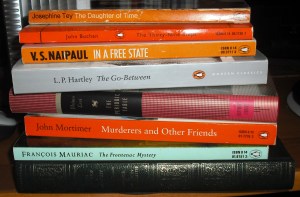
It has now been at least a year since I began reading through what came to be known as the Landing Eight selection. If you remember, (assuming that you have been with me that long) I picked eight titles at random as a way of starting my challenge to read all of the un-read books on the Landing Book Shelves. So far so good; but since several other books came my via the library, random acquisition and review copies, at times my Landing Eight sub-challenge has struggled a little. Having said all of that, I can now report that finally I have finished reading the last two books on my list. All that remains for me to do now is to write-up a couple of posts about the books and I can then move on to tackling more of the TBR Pile. And there’s certainly plenty of titles on the shelves for scope!
This was the original Landing Eight list culled from the huge TBR Pile. For my own satisfaction, I’ve crossed off the books that I have read and posted about (there is something greatly rewarding in crossing items off a list; it’s either really therapeutic or very childish and possibly both at once)
The Landing Eight:
Progress…
The Daughter of TimeJosephine Tey (Orange Penguin)
The Frontenac MysteryFrançois Mauriac (Penguin Modern Classics)
The Go-Between L P Hartley (Penguin Classics)
In a Free StateV S Naipaul (Orange Penguin)
The Periodic TablePrimo Levi (Everyman)
The Diary of a NobodyGeorge & Weedon Grossmith (Guild Publishing)
Murderers and Other FriendsJohn Mortimer (Orange Penguin)
The Thirty-Nine StepsJohn Buchan (Orange Penguin)
I will write-up In a Free State next, since I have already flagged this one up, though I became side-tracked by Naipaul’s letter and then one thing led to another. The Frontenac Mystery will follow on from that and then my mini reading challenge will be complete.
At that point I’ll have to decide what to read next. Maybe I’ll have a non-fiction series next.
Any thoughts on a reading method will be gratefully received, just drop them in the comment box! Until next time…happy reading…
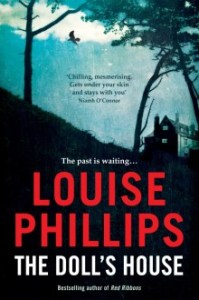
Here as promised is Louise Phillips to add a touch of darkness to The Landing as she answers a couple of my questions about delving into loss and deeply buried emotions. I also couldn’t resist asking a question about Louise’s experience with her promotional video and if you click on the link below you can enjoy a chill down your spine.
I met Louise perhaps not surprisingly, through my job as a bookseller but I have dear old Twitter to thank for enabling us to keep in touch, thus paving the way for this opportunity to have Louise as a guest. Many thanks to the future ‘Grande Dame’ of crime for including me in her Blog Tour and for the thoughtful answers to my questions.
Now, on with the Q & A:
CM: In both of your novels you’ve dealt with the themes of lost children/childhood. Can I ask you what drew you to examine this kind of emotional and physical loss?
LP:I think the ‘who’ of ourselves is found in childhood. I had a challenging one, and it’s made me very aware of beginnings and how the past forms us. With Red Ribbons, I dealt with the loss of a child, and as a mother, this was particularly difficult for me to write. However, just because something is difficult, doesn’t mean you should back away from it. Being a mother certainly helped the writing, and many of the reviews focused on how the narrative dealt with the emotional bond between a mother and her child. I must have done something right, seeing as how it was shortlisted for Best Crime Novel of 2012 in the Irish Book Awards, and despite the difficult nature of the story, it was a story worth telling.
The Doll’s House is very different, and is a story which questions the notion that the past cannot harm you because it has already happened. In The Doll’s House, the main protagonist, Clodagh Hamilton delves deeply into the area of hypnosis and regression. The child and the adult Clodagh Hamilton get to meet via her fragmented recall of memory whilst under hypnotic regression – this was a fascinating concept to me as the writer, the idea that the child self and the adult self could meet. By and large, stories pick you, and it’s not surprising to me that I use a character’s childhood as the backdrop to the ‘who’ of themselves, and also, why they do the things they do. But a great question, and one I will reflect more on.
CM: Psychological thriller novels such as your own work can be very unsettling to read, leaving the reader somewhat less sure of his/her own world. How does the writing process affect you, as you are so involved in the material?
Dare you enter…?
LP:In many ways, the fictional world is totally real to me when I’m writing it. It has to be, because if it doesn’t feel real to you, it won’t feel real to the reader either. Without wanting to sound over the top about it, I’m drawn to stories and emotions that force me to question and examine things. It nearly always starts with a question ‘why?’ and then ‘how?’, until I become utterly gripped. In some strange way, there are times when it feels like someone else is writing the novel. Despite being close to the material, I also have to separate myself from it. Readers want a great story that is well written, it’s not my opinion that counts, or what I feel about an individual character or what they’ve done. Maybe that protects me in a way, it certainly doesn’t frighten me. The only thing that frightens me about the writing, is first drafts – they are scary, but thankfully a long way from the finished story!
CM: Moving on to a different aspect of writing: You’ve been involved in producing a publicity video for The Doll’s House and I was just wondering whether you enjoy being a part of the promotional aspect of being a writer.
LP:It’s very different from the writing side of things, and I certainly can’t do any major promotional work while I’m writing. Do I enjoy it? Yes, in the main, but it can be hard work too. You have to put yourself out there, and that means taking risks. I was petrified the first time I was on radio, and then on television. When I did my first newspaper interview, it was the same. Now, I’d still be apprehensive, but I don’t let the apprehension stop me, and once I don’t make a mess of it, I’m happy enough. Things like making a book trailer or looking at other imaginative ways of promoting the novel are great fun. I write, so I love coming up with new ideas. The bottom line is that in today’s world it’s very difficult for a new author to get noticed, and the reason you look to be noticed, is that you want readers to read your book. If they do, hopefully, they will return for more. The recession has hit the book industry in a very dramatic way and readers when making their purchase will usually buy a novel by a writer they are familiar with and trust, namely the well-established names. As a new player in the field, it’s an uphill struggle, and anything you can do to encourage others to read your work, is a positive thing, even if it means asking your son-in-law to pretend to be a dead body in the canal!!
And here is that video….be warned…it’s rather creepy!
ABOUT THE AUTHOR
Louise Phillips
Born in Dublin, Louise Phillips returned to writing in 2006, after raising her family. That year, she was selected by Dermot Bolger as an emerging talent. Her work has been published as part of many anthologies, including County Lines from New Island, and various literary journals. In 2009, she won the Jonathan Swift Award for her short story Last Kiss, and in 2011 she was a winner in the Irish Writers’ Centre Lonely Voice platform. She has also been short-listed for the Molly Keane Memorial Award, Bridport UK, and long-listed twice for the RTE Guide/Penguin Short Story Competition. Her bestselling debut novel, Red Ribbons, was shortlisted for Best Irish Crime Novel of the Year (2012) in the Irish Book Awards. The Doll’s Houseis her second novel.
Both Red Ribbonsand The Doll’s House can be ordered by clicking: http://www.louise-phillips.com/index.php/books/order or just pop into your local Easons (3 for 2 offer on at the moment) or Dubray branch, or indeed (as the saying goes) any good bookshop.
Thanks again to Louise for taking the time to answer my questions. If you want to join in the conversation, drop a note in the box below.
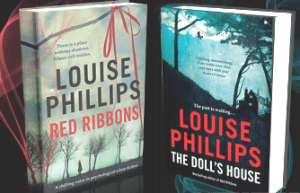
Credits: promotional material and images supplied by the author with thanks.





 Tales From the Landing Book Shelves
You must be logged in to post a comment.