A new book from Landing Author Louise Phillips: Last Kiss

Regular readers of The Landing Book Shelves will know that Louise Phillips was a guest here after the publication of her last book The Doll’s House in 2013. She’s back with her latest novel which has been very well reviewed, with the Independent critic saying that “Louise Phillips goes from strength to strength…. Last Kiss is superior and takes her writing to another, more intense level.”  This all means that I’ve become distracted from whatever I was supposed to be reading from the Landing TBR Pile to get stuck into Louise’s novel. Many thanks to Louise and her publishers Hachette for my copy of Last Kiss; it’s always nice to answer the door to a postman bearing a parcel that looks as though it contains a book.

I admit that I did put this aside for a while before reading it as I was involved in school holiday activities and travel plans. Unfortunately I missed the launch of Last Kiss as I was away visiting my family. When I finally settled down to read my book, I became totally caught up in it to the extent of a couple of late nights when I didn’t want to stop reading. The only reason that it was over two late nights and not one, was that I didn’t want to do what I have done so many times before and crashed on reading, only to spoil the book by reading it too fast.
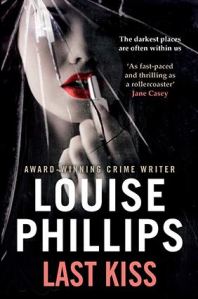
Last Kiss

Darkness awaits you…

Louise Phillips’ thriller Last Kiss is Dr Kate Pearson’s third outing as a criminal profiler with the Dublin police. When we meet Kate again, she is in the process of deciding (or more accurately delaying deciding) whether she and her husband Declan have a future together. They are separated and juggling childcare for their son Charlie, who misses his dad. Kate’s emotional struggle is complicated by the return to the force of DI Adam O’Connor to help in the hunt for the perpetrator of the ritualised knife murder of an art dealer in a Dublin hotel room.

The story begins with an eerie flashback to 1982 when a young girl called Ellen hides away in woodland to give birth to her child. The girl doesn’t feel as if she is quite alone as she labours in the chill of early morning but she sees nobody. The episode raises intriguing questions about what relevance Ellen and her baby will have to the events that will follow and it gives a chilling tone to the novel:

“The child wailed, scrunching its face like a piece of shrivelled rotten fruit, a primal instinct kicking in, telling it that something wasn’t right.”

The elements and motives of the murder case prove to be difficult to unravel and Kate’s work on the criminal’s profile suggests that the murder probably wasn’t the first one to be committed by this person. Will some research into cold cases reveal a similar crime that could provide a lead? Kate is intrigued by the ritual elements of the crime that indicate that the killer is using Tarot cards. But for what purpose? Revenge perhaps? I was fascinated by the details about the Tarot card readings as it’s not something I know anything about.

In her structuring of the novel, Louise Phillips takes the risk of presenting the murderers’ point of view, in alternating chapters:

“I have reasons for doing what I do. You may not know them yet, because I haven’t told you, but that doesn’t mean they don’t exist. It’s too early for judgement calls, far too early for that… I kill people. I could dress it up, say all kinds of stuff about it, but for now, all you need to know is that I do.”

I said risk, because for an author to try to create a murderer with whom a reader might feel some sympathy/empathy is a tricky manoeuvre to pull off. I think however, that Louise Phillips does so. I wanted to learn more about the killer and to understand the whys and wherefores of the elaborate crime. Why did the murderer feel driven to kill? Is the killer evil or perhaps terribly damaged? This plot device also successfully adds to the twists and tension of the action while building up the history of the murderer and a set of motives.

At the same time as Kate Pearson and Adam are working to solve this case, Sandra Regan becomes increasingly disturbed by a strange presence in her life. She has become convinced that her husband Edgar is having an affair and that the other woman is stalking her and moving objects around in her home, though her friends don’t believe her. The reader must figure out what connects Sandra Regan to the murder under investigation. Is this mysterious ‘other woman’ the Tarot killer?

I don’t want to say too  much more for fear of giving away vital clues. I’ll leave you to read the book and work it out for yourselves. I often feel a sense of dissatisfaction after reading thrillers, a sense of ‘so that’s it then’ when all the twists are over. However, I didn’t get that familiar feeling from the denouement of Last Kiss. The ending was a satisfying conclusion to the case and I have to say that I didn’t guess the killer’s identity before the plot revealed it to me.

As I mentioned above, I was lucky enough to receive a copy of Last Kiss from the publishers, so thanks again for that. If anyone out there would like to have my copy (I’m not a heavy handed reader so it’s still as good as new) then drop me a line in the comment box. Deadline is midnight Sunday and then I’ll put names in a hat on Monday morning and pick  out a winner. Good luck!

Finally, if you want to read more on Louise Phillips, here’s a link to a re-blog from Rebecca Bradley on the question of first drafts that I posted recently
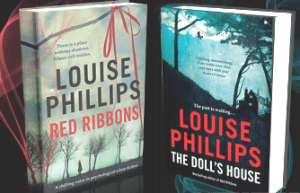
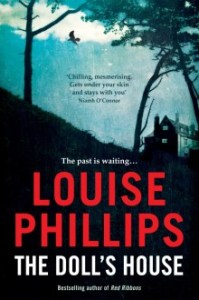
Landing Author: Louise Phillips

Red Ribbons & The Doll's House

A Brace of Thrillers

Here as promised is Louise Phillips to add a touch of darkness to The Landing as she answers a couple of my questions about delving into loss and deeply buried emotions. I also couldn’t resist asking a question about Louise’s experience with her promotional video and if you click on the link below you can enjoy a chill down your spine.

I met Louise perhaps not surprisingly, through my job as a bookseller but I have dear old Twitter to thank for enabling us to keep in touch, thus paving the way for this opportunity to have Louise as a guest. Many thanks to the future ‘Grande Dame’ of crime for including me in her Blog Tour and for the thoughtful answers to my questions.

Now, on with the Q & A:

CM: In both of your novels you’ve dealt with the themes of lost children/childhood. Can I ask you what drew you to examine this kind of emotional and physical loss?

LP: I think the ‘who’ of ourselves is found in childhood. I had a challenging one, and it’s made me very aware of beginnings and how the past forms us. With Red Ribbons, I dealt with the loss of a child, and as a mother, this was particularly difficult for me to write. However, just because something is difficult, doesn’t mean you should back away from it. Being a mother certainly helped the writing, and many of the reviews focused on how the narrative dealt with the emotional bond between a mother and her child. I must have done something right, seeing as how it was shortlisted for Best Crime Novel of 2012 in the Irish Book Awards, and despite the difficult nature of the story, it was a story worth telling.

The Doll’s House is very different, and is a story which questions the notion that the past cannot harm you because it has already happened. In The Doll’s House, the main protagonist, Clodagh Hamilton delves deeply into the area of hypnosis and regression. The child and the adult Clodagh Hamilton get to meet via her fragmented recall of memory whilst under hypnotic regression – this was a fascinating concept to me as the writer, the idea that the child self and the adult self could meet. By and large, stories pick you, and it’s not surprising to me that I use a character’s childhood as the backdrop to the ‘who’ of themselves, and also, why they do the things they do. But a great question, and one I will reflect more on.

CM: Psychological thriller novels such as your own work can be very unsettling to read, leaving the reader somewhat less sure of his/her own world. How does the writing process affect you, as you are so involved in the material?

The Doll's House

Dare you enter…?

LP: In many ways, the fictional world is totally real to me when I’m writing it. It has to be, because if it doesn’t feel real to you, it won’t feel real to the reader either. Without wanting to sound over the top about it, I’m drawn to stories and emotions that force me to question and examine things. It nearly always starts with a question ‘why?’ and then ‘how?’, until I become utterly gripped. In some strange way, there are times when it feels like someone else is writing the novel. Despite being close to the material, I also have to separate myself from it. Readers want a great story that is well written, it’s not my opinion that counts, or what I feel about an individual character or what they’ve done. Maybe that protects me in a way, it certainly doesn’t frighten me. The only thing that frightens me about the writing, is first drafts – they are scary, but thankfully a long way from the finished story!

CM: Moving on to a different aspect of writing: You’ve been involved in producing a publicity video for The Doll’s House and I was just wondering whether you enjoy being a part of the promotional aspect of being a writer.

LP: It’s very different from the writing side of things, and I certainly can’t do any major promotional work while I’m writing. Do I enjoy it? Yes, in the main, but it can be hard work too. You have to put yourself out there, and that means taking risks. I was petrified the first time I was on radio, and then on television. When I did my first newspaper interview, it was the same. Now, I’d still be apprehensive, but I don’t let the apprehension stop me, and once I don’t make a mess of it, I’m happy enough. Things like making a book trailer or looking at other imaginative ways of promoting the novel are great fun. I write, so I love coming up with new ideas. The bottom line is that in today’s world it’s very difficult for a new author to get noticed, and the reason you look to be noticed, is that you want readers to read your book. If they do, hopefully, they will return for more. The recession has hit the book industry in a very dramatic way and readers when making their purchase will usually buy a novel by a writer they are familiar with and trust, namely the well-established names. As a new player in the field, it’s an uphill struggle, and anything you can do to encourage others to read your work, is a positive thing, even if it means asking your son-in-law to pretend to be a dead body in the canal!!

And here is that video….be warned…it’s rather creepy!

ABOUT THE AUTHOR

Louise Phillips

Louise Phillips

Born in Dublin, Louise Phillips returned to writing in 2006, after raising her family. That year, she was selected by Dermot Bolger as an emerging talent. Her work has been published as part of many anthologies, including County Lines from New Island, and various literary journals. In 2009, she won the Jonathan Swift Award for her short story Last Kiss, and in 2011 she was a winner in the Irish Writers’ Centre Lonely Voice platform. She has also been short-listed for the Molly Keane Memorial Award, Bridport UK, and long-listed twice for the RTE Guide/Penguin Short Story Competition. Her bestselling debut novel, Red Ribbons, was shortlisted for Best Irish Crime Novel of the Year (2012) in the Irish Book Awards. The Doll’s House is her second novel.

If you would like to contact Louise Phillips:

http://www.louise-phillips.com

@LouiseMPhillips

http://www.facebook.com/LouisePhillips

Both Red Ribbons and The Doll’s House can be ordered by clicking: http://www.louise-phillips.com/index.php/books/order  or just pop into your local Easons (3 for 2 offer on at the moment) or Dubray branch, or indeed (as the saying goes) any good bookshop.

Thanks again to Louise for taking the time to answer my questions. If you want to join in the conversation, drop a note in the box below.

Credits: promotional material and images supplied by the author with thanks.

Landing Author Expected: Louise Phillips

In the next couple of days, The Landing is moving away from the foggy distant past and right bang up to date with a new #LandingAuthor guest spot. My guest this time will be psychological thriller writer Louise Phillips who has published her second novel The Doll’s House (Hachette Ireland) on the 1st August. If the reviews are anything to go by, The Doll’s House is looking to be as gripping a read as her first novel Red Ribbons.

Louise Phillips held a very successful launch party at Bob Johnston’s Gutter Bookshop on 7  August which I sadly missed as I was away on my hols. Arlene Hunt did the honours on the night and I gather a good time was had by all.

Louise Phillips

#LandingAuthor Louise Phillips

I am very pleased to be involved with Louise’s promotional blog tour for her follow-up to Red Ribbons and to have the opportunity to put a couple of questions to her. Look out for The Landing leg of Louise Phillip’s blog tour on Thursday 29th August.

Just to whet your appetite, here is the blurb for The Doll’s House as a little taster before Thursday:

The Doll's House

Dare you enter…?

PEOPLE SAY THAT THE TRUTH CAN SET YOU FREE.
BUT WHAT IF THE TRUTH IS NOT SOMETHING YOU WANT TO HEAR?

Thirty-five years ago Adrian Hamilton drowned. At the time his death was reported as a tragic accident but the exact circumstances remained a mystery.

Now his daughter Clodagh, trying to come to terms with her past, visits a hypnotherapist who unleashes disturbing childhood memories of her father’s death. And as Clodagh delves deeper into her subconscious, memories of another tragedy come to light – the death of her baby sister.

Meanwhile criminal psychologist Dr Kate Pearson is called in to help in the investigation of a murder after a body is found in a Dublin canal. When Kate digs beneath the surface of the killing, she discovers a sinister connection to the Hamilton family.

What terrible events took place in the Hamilton house all those years ago? And what connect them to the recent murder?

Time is running out for Clodagh and Kate.

See you on Thursday with Louise Phillips!

30 Day Book Challenge – day 9: A book I’ve read more than once

I’ve shared this post, from a great blog that I follow, as it’s nice to see that someone else is a fan of a book previously featured on The Landing.

Maybe one day I’ll get around to a few more Josephine Tey re-reads!

E A M Harris's avatare a m harris

I don’t often read books more than once, but lately re-enjoyed one I’d read years ago.

The book is Josephine Tey‘s Daughter of Time. It was first published in 1951, but in my 77661opinion has aged well and is still relevant and fun.

A detective, Alan Grant, is convalescing in hospital and is bored. A friend suggests that he puts his skills to work on a historical crime. Grant selects Richard III and the question of whether or not he murdered the princes in the Tower.

With friends doing any actual legwork, Grant reassesses the evidence and comes to the conclusion that Richard has suffered from a bad press and was probably not as evil as history (and Shakespeare) has painted him.

I think that today there’s enough doubt about Richard’s wickedness for most people to regard him as possibly maligned. But this is a recent happening and…

View original post 151 more words

Landing Author: Jacqueline Jacques (Part II)

Head and shoulders portrait of Jacqueline Jacques

Jacqueline Jacques

I hope you enjoyed the first part of the Q and A with writer Jacqueline Jacques, published here yesterday. Follow the link to Part I if you missed it and if you also missed my original introduction of Jacqueline’s historical crime novel on Thursday, then click over to that first to catch up with us! I am working on a piece about the book (which I enjoyed very much) at the moment. I really liked the idea of making the main character an artist who, through his role sketching crime suspects, becomes involved in the events which follow. And of course, Walthamstow was a fascinating character in its own right, at the heart of the novel and all the action.

And now, to the second half of my email interview with Jacqueline…

When you decided to go ‘darker’, did you have any idea in which direction it would take your work?  Did the difficult subjects you chose to deal with in Mary Quinn’s life affect you as you worked?

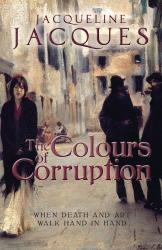
book cover of Victorian street scene

Colours of Corruption

I’ve tried the paranormal and outgrown it.  Horror wasn’t for me, so I guessed that my next novel would probably be crime fiction of some sort. I didn’t want to be bogged down in police procedurals, clues, clever deductions and red herrings, so I set an artist on a voyage of discovery.  He was the one to find out how ordinary, law-abiding people could become the victims of unscrupulous predators.  I hadn’t, at that point, read any crime fiction apart from Stef Penney’s The Tenderness of Wolves, so I fell back on my own studies in sociology, on various news stories, on a story structure recommended by the crime writer, Michelle Spring, and on my imagination.  Eventually, after the third or fourth draft I knew exactly where I was going.  And yes, I was very moved by Mary’s suffering, what she was forced to do to survive. I wanted to make life easier for her, but I couldn’t.  It was horrible but it happened and I had to record it.

I read on your website that you used to be a teacher.  I wondered if you would ever be inspired to write novels for children as other former teachers, such as Roddy Doyle have done.

Possibly, if time allows, but I have a number of adult novels I should like to write first.
I went to a Kate Atkinson interview recently, in which she was asked what minor character in her fiction she would like to revisit and why?  May I ask you the same question?

I’d be interested to see how little Clara grows up, given the trauma I’ve put the poor child through (I feel a little responsible for her.)  I suppose I might get the chance if I write more books about Archie Price.

Just to close with, can I ask you why you decided to move from the short story form to the novel and will you perhaps go back some day?

I find I need the longer form of story-structure in order to explore and develop my characters and plot.  Short stories cannot always contain all I need to say.  If I returned to short-story writing it would be purely as an exercise, I think, to test myself against a word count or the discipline of making a story believable in a few words. I once heard Beryl Bainbridge say, ‘Why waste characters and a good plot on a short story when you can write a book?’

Many thanks to Jacqueline for taking the time to answer my questions about her work. As I mentioned yesterday, she is in the running for the fiction award in the People’s Book Prize 2013 in which the voting is open until 20th May. As well as being a successful writer, Jacqueline is also an artist and you can check out her website for more information on her work. You could also look up her author page on Honno Press, for earlier novels such as her science fiction novel Skin Deep (2004).

cover showing half of a woman's face

Skin Deep, Honno Press, 2004


Thanks for reading the Jacqueline Jacques interview and don’t forget to drop a line in the box if you have any comments or suggestions for future posts.

Landing Author: Jacqueline Jacques (Part I)

As I promised on Thursday, here are the results of an email interview that I conducted with author Jacqueline Jacques about her new novel, The Colours of Corruption. I have actually divided Jacqueline’s Q and A into two sections as it is quite a long piece and I will post Part II up tomorrow. Since reading the book and working on the questions, I have learnt that The Colours of Corruption has been put forward by Honno Press for inclusion in the People’s Book Prize 2013. There is still time to cast your vote as the polls close on 20th May (I have already cast mine!).

book cover of Victorian street scene

Colours of Corruption

Art plays a large part in The Colours of Corruption.  Can you start by telling us a little about why you decided to make a painter your protagonist?

 I wanted to write a crime novel from the point of view of someone who was neither criminal nor victim, policeman nor private detective.  I don’t know enough about police procedurals to write confidently about them, but I do know a bit about painting and painters.  Listening to Woman’s Hour one day I heard Lois Gibson talking about her work as a forensic artist, drawing the perpetrators of crime from their victims’ descriptions.  I researched further and was astonished at how large a part such artists play, even today, in the solution of crime.  Archie Price, with his extraordinary gift for almost reading a witness’s mind, would have been invaluable to the police, at a time when photography was in its infancy.  Passionate about his painting, he is, at the same time quite naive about the real world and unprepared for the vicious criminals he comes up against.  He has all-too-human frailties, is weak, is charming.  An unreliable hero.  Perfect.

I am a dyed-in-the-wool Brummie, but I still love reading fiction based on London’s many layered past. You said on your blog that Walthamstow features in most of your fiction.  Can you tell us what it is in the place that keeps pulling you back to it in your work?

As a child I felt that it was the best place on earth to grow up in.  It had (still has) an incredible bustle of creativity about it. Easy access to the forest gave me trees to climb, paths to ramble, changing seasonal moods to fire my imagination. There was the wonderful High Street market to explore, the library to feed my soul, the Town Hall grounds to play in, the marshes, the river, Lloyd Park for swings and roundabouts, and London, only half an hour away by train. Why Walthamstow? It was my home and I loved it.

Your engaging and courageous hero, Mary Quinn is an Irish woman whose family had all travelled over to England to find work.  I was wondering if you have any Irish connections yourself.

Probably.  My grandmother spoke of ‘Black Irish’ genes (Spanish Irish) in the family, and of ‘Great Uncle Archie coming over from Ireland,’ but I haven’t done any research on this.  

You really evoke a convincing sense of life in this often sordid part of Victorian England.  How did you set about researching the period?  And I was fascinated by the underground passages.  Did they really exist?

Black and white photo of Jacqueline Jacques

Jacqueline Jacques

 I borrowed books and maps, studied photographs and paintings of the period.  I went for walks on the Walthamstow marshes, through the streets and in Epping Forest.  I trawled the Internet for social history, facts about the police, housing, tile patterns, music hall.  But mostly I relied on my memory. I felt I knew these people; that I’d grown up among them.  I may be a few generations removed from the characters in the book, but we, too, were poor (after the war) and struggled to stay afloat just as they must have done.  My father, who grew up in Walthamstow in the 1920s, once told me about connecting cellars beneath the High Street shops, used by villains on the run from the police.  It may have been a myth for all I know.  My Dad was also a teller of tales. Truth or fiction?  Who knows?  I’m a writer.  I’ll use anything to make a good story.

Following on from the research behind The Colours of Corruption, I was wondering if, while you plotted the novel you knew early in the process where your characters would be at the end of the story.

 I vaguely knew that Archie would be drawn deeper into the criminal network but I had no idea what would happen to the other characters until the very end.  In fact I wrote several endings, none of which worked to my satisfaction.  As I got to know the characters, their histories, their motivations, they more or less told me how they would behave in any given circumstance and I wrote it down.  Sometimes I would drop a fact into the mix, like Mary’s sweet singing voice, or a sword-stick, or a pair of gold cufflinks, just to see where it would take me.  Sometimes it worked, sometimes it didn’t.  It’s a haphazard way of working, but there’s nothing like it for excitement.

I hope you enjoyed that look behind the scenes, more from Jacqueline Jacques on The Colours of Corruption to follow shortly.

Jacqueline Jacques and Victorian Corruption

This is just a quick post to flag up a new guest on The Landing, Jacqueline Jacques who will be answering questions about her new book Colours of Corruption (Honno Press, January 2013).

Jaqueline Jaques

Jaqueline Jacques

Just to whet your appetite, this the publisher’s  synopsis of Jacqueline’s engrossing crime novel, set in Victorian England:

Mary, a desperately poor cleaner, is a witness to murder. Archie, one of the first artists to work for the police, to support his other work, draws the man she says she saw at the scene. Fascinated by her ‘face full of bones’, he persuades her to sit for a portrait, but the man who buys the picture really wants to buy Mary. When he realises he’s betrayed her, Archie takes her to hide with his friends, but doesn’t realise what he’s started. He has no idea how this one woman links his wealthiest clients, the poorest slums, terrible secrets, and a violent thug who is now looking for Archie – the man Mary described to the police.
 
As this gripping thriller uncoils, Jacqueline Jacques paints an intricate, vibrant picture of the layers of Victorian London, where the poor are commodities, criminals have nothing to lose and the rich can buy anything.
 
And the murders go on…

colours_corruption

I plan to post up Jacqueline’s responses to my gently probing questions on Saturday 20th April so stop by and take a look. In the meantime follow the link above to Jacqueline’s website to find out more about the author and her previous novels:

Lottie  (Honno  1997)

Someone to Watch Over Me   (Piatkus 1997)

Wrong Way Up the Slide  (Piatkus 1998)

A Lazy Eye  (Piatkus  2000)

Skin Deep  (Honno 2004)

Sharp eyed viewers may recall that Honno Press has featured on these pages before, as I have previously reviewed one of their classic reprints, Winter Sonata by Dorothy Edwards  for Belletrista.

I’ll be back on Saturday….

Picture credits: Honno Press (with thanks)

The Landing Eight: Mortimer on Rumpole

Murderers and Other Friends

Legal Memoirs…

As you may recall, I have been re-reading Murderers and Other Friends (Penguin, 1995) as part of the Landing Eight mission. Due to the rather inconvenient fact of being aware that I was to lose my bookselling job come the end of March, my concentration has been somewhat fragile. Consequently, reading anything, even from an old familiar face has been rather a struggle. But, as I am nearing the end of my Landing Eight pile I have determined to soldier on regardless. Judging by experience, any sort of ‘readers block’ that I have ever encountered wilts quickly enough if I batter it into submission. After all temptation is always (and only) a Landing Bookshelf away.

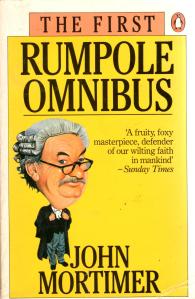
First Rumpole Omnibus

Legal Eagle…

This is John Mortimer’s second volume of autobiography, the first being Clinging to the Wreckage (1982). He also wrote a play about his father’s life as a barrister entitled A Voyage Around my Father (first broadcast as a radio play in 1963). In Murderers and Other Friends, Mortimer picks up the threads of his life’s story in the 1970s, embarking upon his second marriage and acting in the Oz trial. Accounts of legal cases interweave with reminiscences of family and friends. He is an engaging writer who has a wealth of amusing and perceptive stories to tell about the great and the good, as well as the frankly criminal. The book stands up well on the whole to re-reading. However I did find that Mortimer’s more hedonistic adventures with various friends and acquaintances tried my patience somewhat. However, my present state of mind might have a strong bearing on that reaction.

As a confirmed Rumpole fan, I have re-read this book with him in mind, looking out for Rumpole related anecdotes. John Mortimer explains how he put together the various character traits that we see in Rumpole from several sources. For instance, a couple of Mortimer’s colleagues inspired Rumpole’s habit of referring to judges that he disliked, as  ‘old darling’. Closer to home, Mortimer’s father was the source of the Wordsworth quotations at inopportune moments and a waistcoat regularly adorned with cigar ash. The author does however, very modestly disclaim any resemblance to his fictional legal counterpart, ‘I lack his courage, his stoicism and the essential nobleness of his character’.

Rumpole A La Carte

Stern Pose…

As I said in the previous post, Horace Rumple’s first appearance was in a BBC Play for Today, which was later developed into a series. The character was actually created for television, something that I failed to realise on first seeing the Thames Television series in the late 1970s. Mortimer talks about Rumpole’s beginnings, explaining how Leo McKern took on the role of the Old Bailey hack for the first television episode. Mortimer is eloquent in his praise of McKern’s talent, ‘His acting exists where I always hope my writing will be: about two feet off the ground, a little larger than life, but always taking off from reality’. In his memoir, John Mortimer mentions having written the part of Rumpole with nobody in particular in mind to play the part though he felt that ‘Alastair Sim would be excellent in the part, but sadly Mr Sim was dead and unable to take it on’. No doubt Alastair Sim (had he been still alive) would have made an excellent Rumpole, but like many fellow fans, to me Rumpole will always be Leo McKern…

Now what remains to be read of the Landing Eight?

The two adventures of Rumpole illustrated here are two collections from the Landing Bookshelves:

The Omnibus (1983) contains: Rumpole of the Bailey (1978), The Trials of Rumpole (1979) and Rumple’s Return (1980). 

Rumpole a La Carte was published by Penguin in 1991. 

Mortimer and Rumpole Illustrated

Murderers and Other Friends

Legal Memoirs…

Lately I have been re-reading John Mortimer’s volume of memoirs, Murderers and Other Friends in between reading a couple of library books which I needed to tackle before they were due back. Still on the library pile is Jeet Thayil’s Narcopolis which I have fortunately been able to renew while I finish Lindsey Davis’ Roman crime novel Saturnalia.

I have long been a fan of Davis’ private eye, Marcus Didius Falco who gets embroiled in the seamy underbelly of Roman society with the able assistance of his formidable patrician wife Helena Justina. As I think I have mentioned, I have been having a crime binge lately (apart from reading Mortimer’s memoirs) thanks to my local library.

I hope to discuss the topic of crime novels in a future post, but for the moment I shall return to Mortimer and his well-known creation Horace Rumpole of the Bailey. While doing a Google search on John Mortimer (1923-2009) I came across this short video of an exhibition of caricaturist Tony Healey’s original watercolour Rumpole paintings. If you have not read any Rumpole stories or watched the television versions starring Leo McKern (1920-2002), then these glimpses of the irascible old barrister might inspire you to explore further. The exhibition also includes several lively portraits of John Mortimer.

The exhibition and the video were the work of a London gallery called Illustrationcupboard which specialises in featuring the work of contemporary book illustrators. This definitely sounds like a place to see when I next visit London. Check out the gallery’s website for some fabulous artists such as Jane Hissey, Edward Ardizzone, Brian Wildsmith and Lauren Child.

On  a separate note, I have recently set up a new chapter on the Landing entitled Booksellers Beyond which is aimed at showcasing the talents of various former booksellers who have gone on to explore other creative avenues. My first guest artist is an old friend with whom I used to work in Birmingham, Valleri Jillard who has forged a new career as a mixed media artist. Take a peek at some examples of her work over in Booksellers Beyond by following the links. I hope to add more to this section soon so keep checking back.

But now, back to Mortimer and Rumpole…

Video credit: Illustrationcupboard, uploaded to YouTube 12 March 2012 (exhibition 20 February – 10 March) – with thanks.

We’ve Been Caught! Yes, New Island Publishes Quality Crime Fiction

I’ve borrowed this piece in honour of St Patrick’s Day – and also because I’ve been having something of a crime binge myself lately (of that, more anon). So here’s wishing you all a happy St Patrick’s Day (despite the rain) from me (in the dry) on The Landing