Fanny Burney: Novelist and Diarist

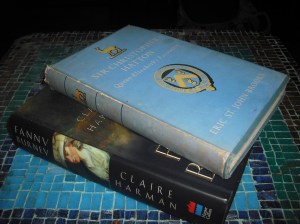
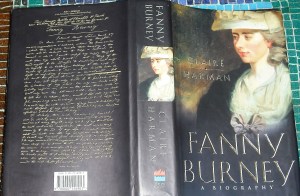
Cover of Fanny Burney: a BiographyFor today’s post, I want to return to one of the books I mentioned in my summer 2017 round-up, a biography of Fanny Burney (1752-1840) to talk about her in a little more detail. I have had a long acquaintance with the novelist and diarist. As I mentioned previously, a novel called A Coach for Fanny Burney by Florence Bone (1938) captured my interest as a teenager. At the time, I had no idea who she was, it was the title that caught my attention (I can’t say it was the cover as the hardback book had long since lost its dust jacket). That book was still tucked away on a shelf in my mum’s spare room, so it came to mind instantly when I spotted Claire Harman’s Fanny Burney: A Biography (Harper Collins, 2000) at last year’s Trinity Book Sale. We could digress at this point and discuss the inevitability of another of my TBS finds finding its way into a blog post, and how this is not actually tackling the TBR Pile proper, but we won’t.

As Fanny Burney came to know everyone who was anyone in eighteenth century literary society (see pictures of Hester Thrale and Samuel Johnson below), she has tended to pop up in other people’s biographies, but this is the first detailed account of her life that I have read. It is a veritable tome indeed but a very readable one at that, covering Burney’s eventful life and times. She could have been a heroine in a novel herself; she married an emigre French aristocrat and soldier Alexandre d’Arblay with whom she lived on a shoestring until d’Arblay had the opportunity to return home to attempt to serve the new regime and reclaim a portion of his property. This resulted in the couple being unable to leave post-revolutionary France for ten years. One story that most impressed me when I first heard it was that in her later years, Fanny heroically underwent a mastectomy without anaesthetic. It almost doesn’t bear thinking about, but the redoubtable Fanny lived to tell the tale and left an account of it for posterity into the bargain.Portraits of the Burney family
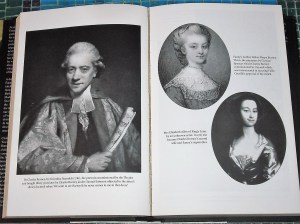
Fanny Burney wrote four novels, Evelina (1778), Cecilia (1782), Camilla (1796) and The Wanderer (1814), several plays and also edited her musician father’s memoirs (1832). Her letters and diaries were not published until after her death, the earliest edition edited by her niece Charlotte Barrett and running to six volumes (1842-6). A more recent and comprehensive edition comprises twelve volumes (edited by Joyce Hemlow et al, 1972-1984) in a project yet unfinished. Claire Harman discusses the reliability of Burney’s diaries, her editorship of her father’s papers and the vast quantity of the Burney family’s archives which include letters from her siblings. Harman talks about Fanny’s phenomenal recall for events and conversations, but also acknowledges that she carefully presented a certain image of herself and her family. The family came from relatively humble origins, as expressed in Hester Thrale’s damming comment, ‘The Burneys are I believe a very low Race of Mortals’, furthermore, Fanny was ‘not a Woman of Fashion’. At this point Dr Burney taught music to Mrs Thrale’s daughter, but in later years Fanny attempted to gloss over parts of her family history.

Claire Harman’s biography is so comprehensive that I thought I would take a quick look at one episode of Fanny Burney’s life for this blog post. As both the British and Irish press have been talking about British royal weddings lately, I decided to cast an eye over Burney’s brush with royalty. She was appointed Second Keep of the Robes to Queen Charlotte, a post that naturally was supposed to be seen as an honour to her and her family. Fanny was not initially keen and only agreed to the appointment for her family’s sake. The appointment came about after Fanny made the King and Queen’s acquaintance through Mrs Mary Delaney, a highly cultured woman who was well-regarded by the royal couple. The first time she met George III, he had called unannounced to visit Mrs Delaney and Fanny later described what happened in a letter, likening the incident to a scene in a drama,

It seemed to me we were acting in a play. There is something so little like common and real life, in everybody’s standing, while talking, in a room full of chairs, and standing, too, so aloof from each other, that I almost thought myself upon a stage, assisting in the representations of a tragedy, …

Fanny went on to describe the various roles in this drama, adding her own part as that of ‘a very solemn, sober, and decent mute’.

Even before Fanny was offered her court position, she was having fun with the niceties of court etiquette. This is a snippet from ‘Directions for coughing, sneezing, or moving, before the King and Queen’ which she wrote and sent to her sister Hetty in December 1785.

In the first place, you must not cough. If you find a cough tickling in your throat, you must arrest it from making any sound; if you find yourself choking with the forbearance, you must choke – but not cough.

In the second place, you must not sneeze. If you have vehement cold, you must take no notice of it; if you nose-membranes feel a great irritation, you must hold your breath; if a sneeze still insists upon making its way, you must oppose it, by keeping your teeth grinding together; if the violence of the repulse breaks some blood-vessel, you must break the blood-vessel – but not sneeze…

Fanny goes on to explain that you must not ‘stir either hand or foot’ even if by terrible bad luck ‘a black pin runs into your head, you must not take it out…’
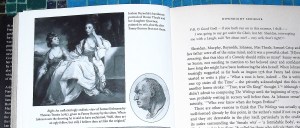
Mrs Thrale & Dr Johnson

I suppose we can only assume that things have changed for the better in court circles since Fanny’s time. When her court appointment was offered, considered and reluctantly accepted, Fanny’s new position paid her £200 a year, she had apartments in Windsor Castle and a footman. Fanny was allowed to have family and close friends to visit but her own freedom to travel was curtailed. Fanny was to be at court for five years, before begging her father to arrange her release from duties. Fanny likened her new commitment to marriage in a letter to her sister Susan saying,

I was averse to forming the union, and I endeavoured to escape it, but my friends interfered – they prevailed – and the knot is tied. What then now remains but to make the best wife in my power? I am bound to it in duty, and I will strain every nerve to succeed.

Fanny’s tenure coincided with the period of George III’s ‘madness’, though that is too large a topic to cover in this post. Suffice to say that Fanny was a first-hand witness of signs of his imminent recovery, when she accidentally encountered him walking with Dr Willis and his attendants one morning. Fanny was apprehensive as the King had been violent at the height of his illness, but he greeted her and questioned her about recent news saying, ‘I have lived so long out of the world, I know nothing!’ as Fanny recorded it. He also kissed her on the cheek, a great lapse of protocol. The whole experience was the ‘severest personal terror’ to Fanny Burney who did not know what to expect. However, she was able to pass to the queen this encouraging report (though as Harman remarks, Fanny no doubt kept the royal embrace to herself).

I will leave Fanny Burney’s court life there, but I hope I have said enough to pique your interest in her life and work. I have to confess that despite reading about Fanny Burney and her literary circle over the years, I have not yet read one of her novels. Another item on my virtual TBR Pile, to go with the actual TBR Pile groaning upstairs!

I hope your 2018 reading is proving fruitful so far. Do let me know what you are reading!
I didn’t mean to go to the Trinity Book Sale again…

Trinity Book Stash

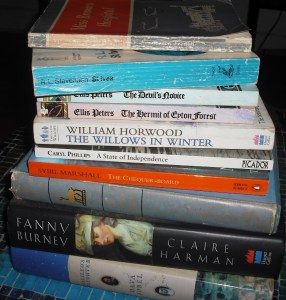
My (our) latest stash

Well, when I say that, I really mean that I fleetingly considered not going to the Trinity Book Sale this year as I still have the inevitable pile of un-read books. However, as I managed to miss last year’s event due to its move away from an end of the week spot, I thought that I would make the effort and toddle along. The more I considered the matter, the less I wanted to risk missing any book bargains, especially as I am an aficionado of the half–price last day. Previously held on a Saturday, but now a Thursday, it is my ultimate book bargain pleasure.

This year, my final tally was seven volumes for a modest six euro; though two of the books were for The Bookworm, (I also blame her for drawing another couple of titles to my attention). As is usual at book sales, I felt that I could easily have gone along picking up books left, right and centre. I have done this at a library sale before now and virtually needed a fork lift truck to carry my purchases home. On this occasion, only a carrier bag was required to lift the spoils.

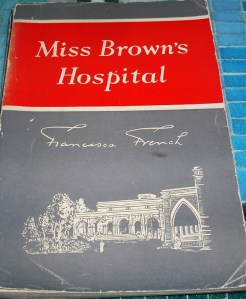
Miss Brown's Hospital

An early pioneer of women’s medical training.

As you can see from the photos shown here, I brought home an interesting mix of fiction, biography and classic works. The Bookworm sneaked in an extra visit on the previous day, so here is our combined haul of reading matter for the next wee while. I was particularly struck by the little book, Miss Brown’s Hospital by Francesca French (1954). This is the story of Dame Edith Mary Brown who was the founder of Ludhiana Medical College in Eastern Punjab. I had not heard of her before, but Miss Brown apparently had ‘many claims to distinction: as scholar, doctor, educationalist and pioneer’. She was a graduate of Girton College, Cambridge, studied for a medical diploma in Scotland and obtained her MD in Brussels.

Edith Brown was also devoutly religious and ‘at the back of her mind was the unswerving determination that in applying her medical skill to the benefit of mankind she must combine it with the great emancipating power of the Gospel of Jesus Christ’. She decided to focus both her medical skills and her spirituality upon the women of India in the role of a medical mission. Her appointment in 1891 to the medical mission at Ludhiana gave her the opportunity she sought. This led to her establishing a medical training centre for Indian women. I hope to return to Miss, or rather Dr Brown in a future blog post when I have had a chance to read the book properly and perhaps also to delve a little more into the period and the location.

Sir Christopher Hatton

Elizabethan statesman and courtier

I was particularly pleased to discover the book on Sir Christopher Hatton (Eric St. John Brooks) as I have been having an extended Tudor-related reading period. This ties in quite nicely with a few other books that I have read over the past few months (some previously featured on this blog). Christopher Hatton was one of Elizabeth I’s favourites, a statesman and councillor who held the office of Lord Chancellor. As the lives of the courtiers in Elizabeth’s hotbed of political scheming were inextricably entwined, Hatton has popped up in my historical reading several times. This book, first published in 1946 was apparently an attempt to present a balanced view of Hatton’s life and achievements. The blurb claims that ‘Hatton’s part in the history of his times has been largely misunderstood’. It may be that later scholarship has superseded Brook’s study, so I will check to see if anything has been published on Hatton since then. Anyway, after enjoying an account of Sir Walter Raleigh’s life recently (Margaret Irwin), I shall look forward to reading it. No doubt I will meet up with Raleigh again as I read about Hatton, as I note that he merits several entries in the index.


Now, I am off to decide which of my Trinity Book Sale acquisitions to tackle first!


Trinity Book Sale Buy: The Tiger in the Smoke

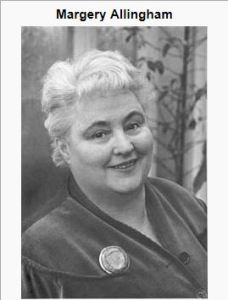
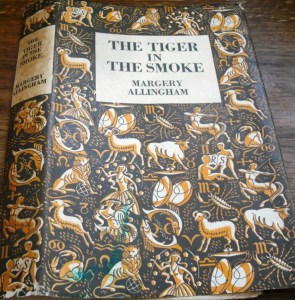
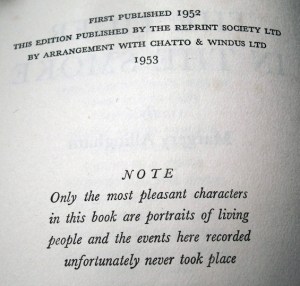
Margery AllinghamThe Tiger in the Smoke by Margery Allingham (originally Chatto and Windus, 1952) is yet another of my Trinity Book Sale purchases (TBS Purchases). As you might have gathered, my TBS purchases forms its own TBR pile within the main TBR Pile (phew!). This edition of The Tiger in the Smoke is a 1953 hardback edition, which was part of a monthly series called World Books, published by The Reprint Society at 4/6 (for members only apparently). I note from the back cover that postage and packing cost 9d extra, (you could also buy Gone with the Wind at 8/- for the same postage price which was certainly a bargain). I love the cover design with the signs of the Zodiac on them, but the publisher doesn’t credit a cover artist which is a pity.The Tiger in the Smoke

I haven’t read an Allingham crime novel for years so it was a nice indulgence to head back into the Golden Age of Crime. Margery Allingham (1904-1966) penned her first Albert Campion novel, The Crime at Black Dudley in 1929. He proved to be such a popular creation that he appeared in a total of eighteen novels and around twenty short stories. I was intrigued to discover that Allingham originally invented Albert Campion to be a spoof on Dorothy L Sayers’ character Lord Peter Wimsey. Over the course of time however, he became much more substantial than a mere jest and matured into a more complex character. Campion has an aristocratic background and his real name is as much a secret as were his missions during the war. Undoubtedly, my affection for Campion is influenced by the stylish BBC series from 1989/90 starring Peter Davison and Brian Glover. This comprised versions of eight of the novels, but not the first one, or indeed The Tiger in the Smoke. I can feel a DVD hunt at the local library coming on!

My last Landing TBR report was full of Elizabethan crimes, or at least political shenanigans and courtly dramas. This time, although we are still in the realms of dark doings, the century and location has shifted to post World War II London. The shady happenings take place in a particularly mysterious and gloomy setting here, as much of the book’s activity occurs in the midst of the worst pea souper in living memory. In fact, the atmosphere is quite Dickensian, there is a sense that Bill Sykes could swagger round a corner any minute. A motley crew of street musicians, threading its way around the alleyways, led by an albino called Tiddy Doll is suitably sinister.

The plot of The Tiger in the Smoke centres on an escaped criminal and former soldier, Jack Havoc who is trying to locate what he believes to be a treasure hoard, a secret he learned of during a wartime raid in France:

He was a man who must have been a pretty boy, yet his face could never have been pleasant to look at. Its ruin lay in something quite peculiar, not in an expression only but something integral to the very structure. The man looked like a design for tragedy. Grief and torture and the furies were all there naked, and the eye was repelled even while it was violently attracted. He looked exactly what he was, unsafe.

The Tiger in the SmokeHavoc’s commanding officer Martin Elginbrodde, who had hidden the treasure, was later killed in action. Elginbrodde had left coded instructions for his widow Meg to retrieve it in such an eventuality. The story opens five years after a Elginbrodde’s death, when photographs supposedly depicting Meg’s late husband alive and well, have appeared in her post after the announcement of her engagement to Geoffrey Levett. Meg is Campion’s cousin hence, his being called in to assist in unravelling the mystery of whether her husband is still alive or someone wants her to think that he is.

In this case, Allingham’s deceptively affable amateur detective makes a late-career appearance in a supporting role, alongside his ever-reliable criminal turned sidekick Magersfontein Lugg. The hunt for Havoc is largely in the hands of the Scotland Yard, in the person of the charismatic and forceful Charlie Luke. I remember Campion novels as being quite light-hearted, but this one is much darker in atmosphere. Perhaps this is because I read previously, novels that were set much earlier in Campion’s sleuthing career. Here he is middle-aged, with a wife (Lady Amanda Fitton) and young son (Rupert) and he is very much aware of what he has to lose at the hands of the psychopathic Jack Havoc, on the loose in the obscuring fog. Campion’s son is blithely unaware of any danger, as his father decides to send him to safety with Lugg as a bodyguard:

Mr Campion looked down at him. He was shocked at the intensity of his own emotion, and more afraid of it than of anything he had ever known. One half of his life, more than half, four foot tall and as gaily confident as if the world were made of apple pie.Note

As I said above, Campion does not have a starring role in this one, but (without giving too much away) he assists in the capture of the Elginbrodde impersonator and his intuition gets Geoffrey Levett out of a potentially fatal situation. The twin pillars taking the weight of the story are the opposing moral forces of Jack Havoc and Meg’s father, Canon Avril. The Canon is a gentle, unworldly man whose faith in God causes him to confront the murderer, because he knows it is something he must do. I won’t tell you how it turns out, but Havoc’s life philosophy, The Science of Luck, which Avril calls The Pursuit of Death is challenged by the one person able to understand.

This is not so much a who-dunnit as a mystery novel that also explores a London still getting back on its feet after the war. The Tiger in the Smoke deals with damaged humanity, not only the prowling Jack Havoc, but also the band of misfits in Tiddy Doll’s gang. In the end, when the mystery is solved and the treasure is finally discovered by Meg Elginbrodde, it seems that peace will finally arrive.

Additional picture credit: Wikipedia (with thanks)


Arabella Stuart and Bess of Hardwick

I mentioned in the last post immersing myself in some dubious sixteenth century doings. Wreath for Arabella by Doris Leslie (Hutchinson 1948) was the book that started me off on my tour of historical skulduggery. This is one of the spoils from a previous Trinity Book Sale. I feel sure that I must have read Leslie’s books before, but perhaps it’s just that I remember my mum having them from the library (along with Miss Reed and Mazo de la Roche). Doris Leslie (1891-1982) was a British novelist and historical biographer who originally wanted to be an artist, then studied drama and finally discovered a talent for writing, publishing her first book in 1927. I didn’t know anything about her before lighting on a biographical note by the Southborough Society who have put up a blue plaque in Leslie’s honour. She does not seem to be particularly well known today. Although she was writing contemporaneously with Georgette Heyer whose books are still widely available, her books have since slipped through the publishing cracks.

Wreath for Arabella is a lively, well-written fictionalised account of the life of the ill-fated Arabella (Arbella) Stuart (1575-1615), a cousin of Queen Elizabeth I (1533-1603). Both women descended from Henry VII: Elizabeth was his granddaughter (Henry VIII’s daughter) and Arabella his great great granddaughter (her father Charles Stuart was descended from Henry VIII’s sister Margaret of Scotland). Elizabeth apparently favoured choosing Arabella as her successor to the throne, only to change her mind in later years. From her earliest years, Arabella was educated as befitted as princess, studying Hebrew, French, Greek and Latin. In the end, Elizabeth’s choice of successor settled upon another cousin, James Stuart, the son of Mary Queen of Scots, so the careful preparation was to no avail. England was not to have three women (four queens if you count Lady Jane Grey) in a row on the throne after all.

As you might imagine, being a potential heir to the throne was not a particularly safe place to be. In fact, Elizabeth had taken it amiss that Arabella’s parents had married in the first place, due to the likelihood of creating yet another claimant to the throne. Arabella’s grandmothers languished in the infamous Tower of London for a while. In such family circumstances, probably it would be wiser to keep your head down (lest you lose it) and to be of a very shy and retiring disposition. Unfortunately, according to Leslie’s novel, Arabella was anything but shy and retiring and consequently earned the queen’s displeasure on more than one occasion. Elizabeth once sent Arabella away from court for flirting with her current favourite, the young Earl of Essex. More seriously, Arabella was the focus of various Catholic plots to remove Elizabeth from the throne, though admittedly she was not directly involved. Whether that was loyalty or merely the lesson learned from her cousin Mary Queen of Scots’ bad judgment, it is hard to ascertain from the novel. Suffice to say that many political figures would have liked to use Arabella as a pawn in their schemes (see, I told you there was skulduggery afoot).

This slideshow requires JavaScript.

Stuart family history in general has always fascinated me, but as a bonus, Arabella’s story meshes with the most formidable woman of the era (apart from Elizabeth herself that is), her maternal grandmother, and known to history as Bess of Hardwick (1527-1608). From relatively modest origins, Elizabeth Hardwick rose to become the richest woman in England with a penchant for building beautiful houses such as Hardwick Hall. She came very close to being the grandmother of a queen, after engineering the marriage of Arabella’s parents and coming into conflict with her royal namesake. Unfortunately as I have said, Bess’s ambition didn’t allow her to achieve her final goal, but she still left her descendants very well placed in Tudor society. She even managed to survive the other Elizabeth by five years, and lived to see Arabella welcomed at the court of the new monarch James I (VI of Scotland) and his wife Anne of Denmark.

Bess would probably not have been a very comfortable relative to have around, but her drive and her energy were undeniable. Moreover, in an era when women’s role was to play a quiet domestic part, Bess had a public status not common at the time. Bess of Hardwick organised her own life very effectively, as well as those of her extended family, whether they liked it or not. The lady of Hardwick was the one moving the pieces across the chessboard and not the other way around. She married four times, each time carefully moving further up the social scale and acquiring more land and property. Her first marriage to Robert Barlow was very short and both bride and groom were only teenagers. After her husband’s death, Bess married a widower, Sir William Cavendish, with whom she had several children, six surviving into adulthood. After marrying and burying Sir William St Loe within a few short years, her crowning achievement was to become a countess upon her fourth marriage to another widower, George Talbot, Earl of Shrewsbury. She then very shrewdly married two of her children with two of the young Talbots to keep assets within the family. Oh, and in later years she had a very public marriage breakdown. Twentieth century celebs have nothing on Bess!

One of the short live series, Kate Hubbard’s A Material Girl from Short Books (belonging to He Who Put The Shelves Up) is a great introduction to this most fascinating of women. I first came across Bess of Hardwick many years ago via a BBC television programme but I can’t find any trace of it on the usually reliable YouTube. However, you can watch some more recent biographical clips if you want to look. Reading these two books has reminded me that I have yet to get around to visiting Hardwick Hall, so maybe I will manage to fit it in during my next trip over to see the family. I will also keep a look out for more of Doris Leslie’s historical novels (or perhaps not depending on the state of the TBR Pile!)

Meanwhile, I will continue with reading more of my Trinity Book Sale bargains…

Extra picture credits: the Doris Leslie plaque taken from the Southborough Society page (see above)

Book Shelves on the Move: A Reading Renaissance?

Book Shelves

A Fresh Reading Start?

The Landing Book Shelves (the actual shelves that is, as opposed to the blog) have had a bit of a shake-up in recent weeks, because of some building work involving window replacement. The upshot is that one set of shelves is no longer on the landing, but in the hall. As other shelves have similarly moved around somewhat, many books are now in different locations and a certain amount of confusion and mixing of genres has arisen. On the other hand, this has been a great opportunity to re-discover overlooked titles and authors. It has also had the slightly depressing result of making me realise just how many books in the house (let alone on The Landing Book Shelves) remain un-read. I shy away from doing a serious count (as Cathy at 747 Books has bravely done) because I don’t want to lower my literary morale any further. Although I am now beginning to consider re-naming the blog ‘The Household Book Shelves’ since that is a more realistic picture of the challenge ahead. At this rate I may have to ban myself from going to the library.

More Book Shelves

Plenty of Penguins

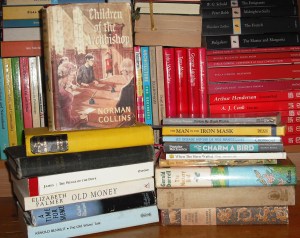
In the spirit of a spring renaissance I have therefore decided to take a positive view of the un-read books and to try see them all as so much bookish potential, rather than as a task to be completed. I think that if I persist in treating them as items to be ticked off a list, then I might as well give up the whole enterprise, since it will no longer be any pleasure. With that in mind, I have been enjoying myself by making mental note of a few random titles that had previously slipped off my radar. So far, I have accumulated about half a dozen novels, belonging to either me or He Who Put The Shelves Up, that have been floating around for a while. Some of them, such as The Llangollen Ladies (Mary Gordon) and The Children of the Archbishop (Norman Collins) are Trinity Book Sale purchases from a couple of years ago. Perhaps it is no bad thing that we missed this year’s event due to a change in dates. The half-price Saturday could be a very tempting affair indeed and consequently, inestimably dangerous to the state of the TBR Pile.

A Small Book Shelf

Mainly Children’s Books

Therefore, the next few posts will I hope, feature some true examples unearthed from the TBR Pile because of the new shelf arrangements. It has been quite nice to discover books that have languished un-noticed for months (or even years). It has even been nice to do some very necessary dusting of books and shelves as everything was put back in place. Now, at least I have clean books to read! I have even been toying with the idea of creating a proper catalogue as an excuse to practice my very rusty data base skills. I have come as far as naming a file in this worthy enterprise and that’s about all.

I am not sure yet which title will feature in the next post, but I am leaning towards political skulduggery in the sixteenth century so I have a couple of options to consider. Drop by again soon if you want to see what pops up on The Landing Book Shelves.

New Year, Not So New Literary Challenge

My literary blogging (and to some extent, the background reading also) has been somewhat sporadic of late, leading to a sad lack of posts in November and December. I am however, fighting shy of embarking upon any New Year resolutions to rectify this matter. The words ‘reading’, ‘blogging’ and ‘resolution’ just don’t seem to me to go together, making something that should be pleasurable into a mundane chore. Rather, I am hoping to put together a plan, a timetable, a routine (anything but make a resolution) to keep both the Landing Book Shelves and my reading challenge alive and kicking throughout 2016 and even beyond. Therefore, The Landing will remain a resolution free zone as I try to buck my ideas up (as my mum often told us to do we were kids) and get this blog firmly back on the literary road.

As part of this bucking my ideas up thingy, I thought that I would cast an eye over the blog as it approaches its fourth birthday on 2 February. As a starting point, I re-read my Prologue and the first blog post where I explained my aims for The Landing. I was supposed to be reading around the unread contents of the book shelves on the landing at home, rather than adding any more new books to the dreaded  To Be Read Pile. Over the years however, one or two wee get out clauses have crept into my challenge (in cases of literary deprivation) that I have taken advantage of many a time. My main get out clause is the library, since I have set no limit on my borrowings. In practice, I do usually only pick up one or two books at a time. I may have mentioned before on The Landing, my particular library method, which is to scan the New Titles and Just Returned sections and take potluck with what I find. Serendipity is a splendid thing…

I have also included the occasional review copy and books that I received as gifts. This has been stretched to books bought with gift vouchers (including, but not necessarily only book tokens). As you can see, I have  managed to get my hands on some fresh literary blood without too much effort. I know that reading new stuff was not really the point of the exercise, but at least I’m not going out and buying more books willy-nilly. That is unless you count my forays into second hand bookshops (particularly where I have discovered a new shop such as in Blessington) and the annual Trinity Book Fair, where I have spotted books simply begging to be purchased and loved. So that’s alright then, isn’t it?

Well perhaps not, but I think I’m stuck with my bookish urges, so I will just have to make the best of the situation and keep reading around the landing TBR pile, regardless. I believe that I did once ponder about the situation where at the same time as reading the existing landing books stock, I am relentlessly adding to it. The only thing I can say in my defence is that the rate of acquisition has slowed down enormously over the last few years, as I attempt to explore the wealth of books already here.

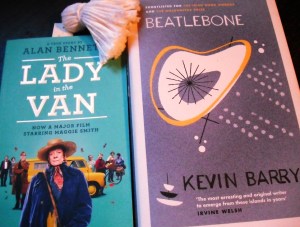
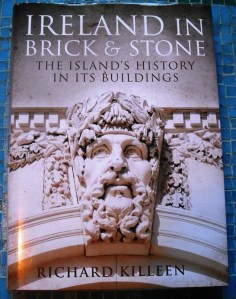
I will just close by mentioning that I had three books for Christmas (see photographic evidence), which naturally I will be forced to read…(watch this space).

Lady in the Van/BeatleboneIreland in Brick and Stone

‘A Happy Reading New Year’ to one and all!

Spoils from the Trinity College Book Sale

As regular readers probably realise, I  don’t need to be adding any more books to the huge TBR Pile that is the Landing Book Shelves but nevertheless I brought a few new additions home recently.  I hasten to add that the photographic evidence shown here is slightly misleading in that some of the books belong to one of the other book bugs in the household. Note that I’m attempting to fudge the numbers here.

Book Sale Purchases

Now where to put them…

I was particularly pleased to spot a Noel Streatfeild novel, When the Siren Wailed that I had not come across before. This was originally published in 1974 (William Collins) with the Collins Lions paperback edition I found dating from 1984. The book retains its Eason price sticker, originally costing £1.54. The blurb on the back from The Birmingham Post says, ‘Noel Streatfeild vividly recreates the atmosphere of blitz-torn London with all its friendliness, horror, confusion and tragedy. Her book cannot fail to impress young readers.’ The books tells the story of three children despatched with their school mates to safety as part of Operation Pied Piper.

Stories from the blitz interest me because my mum was evacuated from Birmingham during the war and she was lucky enough to make a lifelong friend as a result. I don’t think she ever had any exciting adventures as a result of being an evacuee though. I was struck by the fact that Laura the eldest sibling in the story,  was nine at the beginning of the war when the evacuation programme began. She was given the responsibility of looking after her two younger brothers Andy and Tim on a journey to an unknown destination with a train load of strangers. My mum was also nine years old at the outbreak of war but as an only child would have been sent away without the comfort of brothers or sisters. It’s hard to imagine now a circumstance where you would send a child away alone with a luggage label attached to a coat, a suitcase and a gas mask. Fortunately it all turned out well for my mother in her temporary home.

Closeup Books

Which one?

Now the only question remaining (apart from where to put the books when one bookshelf already covers the only landing window) is what to read next…I’ll keep you posted on that one.

I’d love to hear from anyone else who loves second hand book sale bargains too!

All should have bonnets: a letter from Louisa M Alcott

After the dedication of my #LetterMo writing challenge efforts have faded gently away, I have decided to return to the compendium of historic letters that I mentioned in one of my earlier entries. Having struggled to post at least one item of correspondence every day for a month, I can truly say that I stand (pen poised) in awe of the sheer effort involved in letter writing pre-Microsoft Word technology. After all, even keeping up with just a few relatives in the last century would have been a Herculean task. But thank goodness that so many people did just that, providing a mine of information and insight that would otherwise have been lost to later generations.

One of the epistles in The World’s Great Letters is one from Louisa M Alcott to her sister Anna and while it could not be claimed to hold huge historical importance, it does give you a glimpse into the life of a would-be writer who was struggling to support her family. Alcott was also mired in domestic chores as well as suffering the frustration of waiting for editors to reply to her story submissions.

Alcott’s letter, written around 1861 describes the trials and tribulations of fashioning a decent bonnet (a social necessity) with only one dollar to spend; the contents of Alcott’s ribbon box supplemented the lack of cash. She makes the whole enterprise into an entertaining anecdote for Anna Alcott, but she clearly would have loved to be able to go out and buy a smart piece of headgear. She describes her attempts to trim the one-dollar bonnet thus:

I extracted the remains of the old white ribbon (used up, as I thought, two years ago), and the bits of black lace that have adorned a long line of departed hats. Of the lace I made a dish, on which I thriftily served up bows of ribbon, like meat on toast.  Inside put the lace bow, which adorns my form anywhere when needed. A white flower A.H. gave me sat airily on the brim, – fearfully unbecoming, but pretty in itself, and in keeping. Strings are yet to be evolved from chaos. I feel that they await me somewhere in the dim future.


book cover with portrait of L.M. Alcott

Louisa May

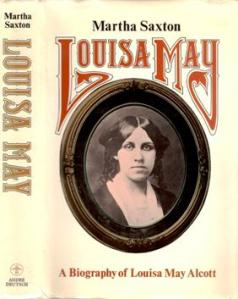
All this occurred before Alcott struck gold with the phenomenally successful Little Women, which was published in 1867. At that time, she was still a ‘young woman with one dollar, no bonnet, half a gown and a discontented mind’ as she described herself. In one of those moments of literary serendipity, I spotted Louisa May (Martha Saxton, 1978) while rummaging in the Trinity Booksale on Saturday. I was meaning to re-read Little Women after seeing the sell out production last month at Dublin’s The Gate Theatre.  As Little Women and its sequels reside on the landing I can justify doing just that, but I will have to make (yet another) exception for reading the Louisa May Alcott biography. But, one of the joys of reading is that you never know what is going to be around the next corner of the bookshelf!

What have you discovered this week? And how is your Reading Challenge going? Drop a line in the comment box…