Getting Carried Away with Christmas Cards

Bells CardChristmas does seem to have passed The Landing by this year, but as we are still within the Twelve days of Christmas I am going to try to squeeze in a couple of seasonal related posts. I have been busy over Christmas and if you want to check out Curiously, Creatively you can see what The Bookworm and I have been doing in the way of seasonal activities.

Earlier this month I was musing a little on the writing of Christmas cards. We made our own this year for a change using some of the sketches that I drew for the Advent blog posts in 2012. Christmas card writing is either a chore or a pleasure depending on your point of view (and on how many or how few you need to send). I enjoy writing cards, though ideally I do like to set a comfortable scene before I set to inscribing my Christmas missives. Suitable music is required as well as a little something to keep up my strength. I would settle for tea and mince pies, but probably wine and chocolate would be my ideal stamina enforcers. Then it’s down to the writing…once I have decided which pen I want to use (not that I’m obsessive about pens you understand).

The tricky part about writing Christmas cards is overcoming my temptation to squeeze a whole year’s worth (or six months at a pinch) of updates onto one side of the card. I usually only intend to jot down a couple of quick pieces of news, but the pen in my hand seems to develop a mind of its own. Before I know it, I have reached the bottom edge of one side of the card and I am trying to finish a sentence by sneaking over the bottom edge of the opposite page. Words snake around the available blank space in smaller and smaller letters. I have the same problem with post cards. Either the cards are too small or I try to write too much, I’m not sure which. Moreover, before anyone mentions the dreaded phrase ‘Round Robin’, I will just say that I can’t bring myself to do one. In some respects, I can see the sense in it if you are playing catch-up with many correspondents, but it seems so regimented an approach to take that it’s not for me.Merry Christmas Card
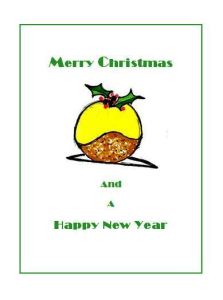
But if there is not to be a photocopied rundown of the year’s family events (neatly folded and inserted) then how shall I tackle each card? Perhaps I should work out a series of bullet points detailing the year’s events before I start so that I can condense all of the salient facts into bite-sized pieces (carefully adapted for each recipient so that I don’t slip into an RR mode). Then I am sure that I could manage to stick to one side of the Christmas card (well, depending upon the size of the card I suppose). I could ruthlessly edit the number of bullet points to encompass only the highlights of the past twelve months. Simple really, an ideal plan. No improvising, no postscripts, no addendums (and certainly no asides or parentheses), just clean, simple bullet points neatly written.

I must just remember to finish with a ‘Merry Christmas’ though….


A New Reading Challenge?

shelves of classics

Tantalising Glimpse

I have been thinking about ways of revitalising my Landing Book Shelves challenge for 2015 and beyond. Many books remain to be read, especially if I count in all of the books belonging to He Who Put The Shelves Up as well. This means that I have plenty to be going on with for the foreseeable future. The astute amongst you will no doubt point out that if I stopped going to the library then I could concentrate better on the Landing Backlog. Book club books and miscellaneous items of review copies that come my way have also regularly distracted me. Alas, ‘twas ever thus (and it will probably remain ever thus!).

I have set myself ‘mini challenges’, challenges within the main challenge as it were, over the last couple of years of this blog. You might cast your minds back (assuming that you have been with me that long) to the Christmas Advent Challenge/Calendar, Poetry in June and The Landing Eight Challenge. All of these literary challenges duly documented, have appeared within these virtual pages. The first two were time specific and featured poetry, rhymes and fiction extracts. I really enjoyed doing those as it was rewarding to rootle through the shelves and search out pieces to read/reread and talk about on the blog. The third challenge centred on my reading a random selection of books from the shelves. This actually drifted on for longer than I had planned and I was relieved to finish my self appointed task. What is next for the Landing TBR Pile Reading Challenge? Some literary planning is urgently required, to give the Landing Blog some fresh topics to feature.

I need to choose a challenge theme first; then to establish a period for the challenge. A month is quite a handy length, as it is long enough to look at extracts from a few volumes but not too long, that I will be in danger of going off the page (as I so frequently do). That would work for poetry or short stories, or for selecting extracts or essays to feature. Or I could aim for a longer (more in depth) challenge of a few months, reading one book per month (book club style).

Now, the task is to work out a few options and make a decision; easier said than done methinks. One choice would be to select a publisher or an imprint and read one title a month perhaps. I could tackle some unread Penguin Classics, Orange Penguins, Modern Classics or Twentieth Century Classics. Then there is a batch of Canongate Classics and several Pimlico non-fiction titles. Not to mention my green and gold ‘Book Club’ classics series (of which Diary of a Nobody was one). Several remain unread to this day, so perhaps that would be the way to go….

I’ll let you know when I have managed to come to a decision!

When is a TBR Pile not a TBR Pile?

Library Voices LogoAs I wandered around the library recently, browsing the ‘just returned’ and the ‘new titles’ shelves, I spotted a couple if books that had been on my mental ‘to read’ list ever since going to the authors’ readings. One of my favourite cultural activities is attending author readings and discussion sessions, sometimes as part of a literary festival, sometimes as standalone events. My actually having read any work from a particular author before an event is not a pre-requisite. Indeed, going along to hear a reading or an interview is often a fantastic way to get into a new writer. I have often added a new author to my repertoire on the strength of an interesting evening of extracts and bookish discussion. I can highly recommend putting the literary cart before the horse, so to speak. Although, I have to say that I’ve rarely been disappointed when I’ve done it the other way round and gone along to listen to one of my favourite authors.Dublin UNESCO Logo

The regular Dún Laoghaire Rathdown ‘Library Voices’ series of readings and talks has often proved to be a very fruitful source of inspiration in the never ending search for new authors. From these events, I have acquired (so to speak) Peter Carey and Alex Miller, though I have also taken the chance to listen to old favourites such as Joanna Trollope and Audrey Niffenegger. The Peter Carey event featured a reading from his latest book The Chemistry of Tears and when I later went on to read the book I could hear Carey’s voice in my head telling the story. I probably would have enjoyed the book anyway, but I think that having heard Carey discuss his work piqued my interest. As it turned out, I read 30 days in Sydney: A Wildly Distorted Account before coming to The Chemistry of Tears, which convinced me that Carey was a writer to treasure. Before reading 30 Days, I didn’t have the slightest interest in Sydney, but Carey brought its history and culture alive, peopling it with a fascinating cast of characters. All ‘wildly distorted’ no doubt.

Another fruitful series of events has been the Dublin City Council run, European literature event ‘Words on the Street’ that I attended for the second time this year. Mind you, one of the attractions of this event has been listening to Bryan Murray who is such an enthusiastic reader. Last year he read an extract from The Dinner by Herman Koch and this year (in St Anne’s Church, one of my favourite venues), he read from Caesarion by Tommy Wieringa. It did however take me around a year to catch up with The Dinner, so I expect it to take a similar amount of time to read this year’s batch of European literature. I was not greatly enthused by The Dinner when I finally got around to it, although it was well written, but it wasn’t really Bryan Murray’s fault.IMPAC Logo

Similarly, I have not yet caught up with the IMPAC 2014 prize-winning novel, despite attending the announcement of the winner and a reading with the author and translator. I thought Juan Gabriel Vásquez made a brilliant acceptance speak and after hearing him read from and discuss the Sound of Things Falling, I was determined to read it as soon as possible (well as soon as the TBR Pile allowed anyway). I think I need another dose of serendipity; if I see it there in front of me on the shelf; it must be waiting for me. Of course, if I had been quick enough to snaffle a free copy at the Pearse Library IMPAC event, it would be on my actual TBR Pile and not my virtual one. However, such is life. A new entrant to my virtual TBR Pile is Richard Ford who gave a reading at Trinity College Dublin (where he is an adjunct professor) this autumn from his latest novel Let Me Be Frank.

Now, I can see that unless I stop attending literary events my TBR Pile stands even less chance of shrinking than it did before. Alas, it is a cure that I don’t want to contemplate…

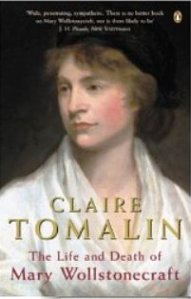
Mary Wollstonecraft by Claire Tomalin

Book jacket

Old Penguin edition, now re-jacketed

I have recently been re-reading a biography of Mary Wollstonecraft (1759 -1797) by Claire Tomalin that I bought some years ago. The Life and Death of Mary Wollstonecraft is one of several literary biographies by Tomalin that I have read and enjoyed. This biography was first published in 1974 and I came across the revised and expanded 1992 paperback edition when I was working in a Birmingham bookshop. Of Tomalin’s other books, I can also recommend The story of Nelly Ternan and Charles Dickens and Jane Austen: A Life; particularly Nelly’s story as there was a real prospect of her history being lost forever amongst the Dickens mythology. I still haven’t managed to get around to buying Claire Tomalin’s volume about the great man himself, despite having listened to her give an excellent talk about Dickens which fired my interest.

Moving away from the literary world to the stage was Mrs Jordan’s Profession, the history of actress Dorothy Jordan who became William, Duke of Clarence’s mistress. She bore him around ten children (I think) and they were a very happy family until the duke was forced to end his morganatic relationship and marry respectably. The future of the crown was at stake after the death of the Prince of Wales’ only daughter Charlotte in childbirth. Both this book and the biography of Nelly Ternan give you some idea of how precarious life on the stage was for women in the eighteenth and nineteenth centuries. Neither fish nor fowl, their place away from the theatrical world was ambiguous. Nelly Ternan and Dorothy Jordan had to live their lives around society’s expectations of ‘respectable’ women and both suffered because of these expectations.

Mary Wollstonecraft portrait

A Studious pose by J. Opie.

Mary Wollstonecraft similarly lived an unconventional life, though in her case it was for the reasons of her political and philosophical views. As a young woman, she became involved in the Dissenting circles that had grown up in Newington Green, at that time still a village outside the bustle of London. Her introduction was through Dr Richard Price, the minister from the Dissenting Chapel who was well known to radical intellectuals, reformers and scientists of the day. He corresponded internationally, with Condorcet in France and with Franklin and Jefferson in America so he was very well informed. Taken together with his local political and reforming connections, he was an ideal person to begin the process of stimulating Wollstonecraft’s yet unfocused intellect and energies.

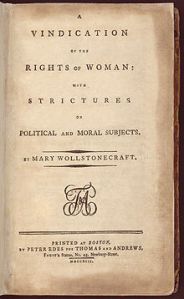
Mary Wollstonecraft was a fascinating and complicated woman, far ahead of and often out of step with the social attitudes of her time. However, I’m not sure whether we would have been bosom pals judging by Claire Tomalin’s observations on Mary’s ‘sense of grievance’ (which I feel is never an attractive character trait). But perhaps this sense of grievance was the necessary spur that drove her onwards and paved the way for Vindication of the Rights of Woman, published in 1792 as a response to Thomas Paine’s Rights of Man.

Vindication

American edition

Mary Wollstonecraft certainly had reasons to question the way things were done: her father had tended towards drinking and violence to the extent that Mary had needed at times to protect her mother. Education for Mary and her two sisters was barely adequate whereas their brother Ned attended school and went into law. Ned was also to inherit a considerable portion of his grandfather’s estate but the girls received nothing. I wonder if feminist history would have been vastly different if Mary had not experienced the unfairness of societies attitudes from such an early age? But perhaps her enquiring and lively mind would have taken her in much the same direction whatever her personal circumstances.

This was yet another diversion from reading more of the unread books on The Landing, and I am even contemplating another re-read of the books I’ve mentioned above. At this rate, the day that I can safely say that the day I have read everything tucked away on the book shelves is still a long way away!


How are your challenges going, fellow readers?

Picture credits: Wikipedia, with thanks


The Enchanted Wanderer: Adventures Aplenty

The Enchanted Wanderer

Simple and Elegant…

After becoming very sidetracked on a previous post on Nikolai Leskov, I am going to stick to my original intention of discussing The Enchanted Wanderer (Melville House, 2012) which I finished quite a while ago. The novella was a quick read as it fair rattled along with the adventures and comic miss-adventures of the protagonist Ivan Severyanych, the wanderer of the title. Ian Dreiblatt translated Leskov’s novella for this edition; first published in a serialised form in Russkiy Mir in 1873. The style of the translation gives the language a very contemporary tone, so the work has a freshness that belies its age. Being unable to read in the original Russian, I think I can safely assume that Dreiblatt has captured Leskov’s voice, as the characters leap from the page in every scene.

The story is told from the Ivan’s perspective as he relates various hair-raising episodes from his life story to fellow passengers aboard a boat sailing across Lake Ladoga. Ivan joins the boat at a place called Konevets and at first he is unregarded by the travellers. However, once he enters the general conversation they wonder how they could possibly have failed to notice him:

He was, for one thing, enormously tall, with darkish skin, an openness in his expression, and thick, curly hair the color of lead, a graying mane that poured forth in a terribly strange way. He was dressed in a short cassock, with the wide leather belt of a monk, and, in black cotton, a high ecclesiastical hat…Our new passenger, a man we would soon be fascinated by, seemed at least fifty; and from the looks of him, he was in every sense a bogatyr, and at that s humble, kindly Russian bogatyr…It seemed he would be at home not traipsing around in a cassock but rather sitting on the “dappled steed” of an adventure story…

Three Bogatyrs

Adventures await…

This quotation neatly encapsulates the basis of the plot of The Enchanted Wanderer, where we hear about all of Severyanych’s adventures (on various steeds) that lead to his present life in a monastery. I’ve put in an illustration from Wikipedia to give an idea of what our character might have looked like. A bogatyr (plural bogatyri) was a sort of hero or knight errant in epic folk stories (byliny) from Russian history. Some of the stories featured historical characters while some were purely mythological. There is an interesting article on Russiapedia if you want to know more about the bogatyri. Ilya Muromets, one of the bogatyri depicted in this painting (middle) is referenced in the description of Severyanych.  The text specifically mentions a painting of Muromets by Vasily Vereschagin, but as I can’t locate an image of that I’ve included this one by  Viktor Vasnetsov (1898) to give you an idea.

Meanwhile, our bogatyr Severyanych began his life as a serf on a Count’s estate in the Orlovsky region, where his father was one of the Count’s coachmen. The boy grew up with horses and developed an affinity with them, having a particular admiration for the wild horses from steppes who hated being broken for training. The young Ivan’s adventures really began one night, after a misguided prank that day had brought about the death of an old monk from a nearby monastery. The monk later appeared to Ivan in a dream saying, “you did me in without a chance at repentance!” Ivan isn’t particularly apologetic, saying that he didn’t mean to do it and anyway it was too late to do anything about it. During the conversation the monk reminds Ivan that he was his mother’s prayer-son (conceived after much prayer and long-awaited) and tells him that he is also a promised son (promised to God). A disbelieving Ivan asks for a sign that this message truly came from his dead mother.

“The sign,” he answers, “is that you’ll live all your life on the very brink of death, and never actually manage to die, until the day appointed you finally dawns, and then you’ll remember the promise of your mother and become a monk.”

“Wonderful,” I reply. “I’ll await that day”.

A clearly sceptical Ivan has a second encounter with the dead monk during a nap the following day. A short while later there was a near fatal carriage accident. Our hero is flung down a hillside and only survives by landing on a lump of clay that then slides to the bottom. That is just the beginning of his brushes with violent death. Ivan Severyanych goes on to wander Russia and to experience many adventures in which he comes very near to death on numerous occasions just as the monk foretold. At various times he was a Tatar slave, horse thief and a knight-errant. He even had an interesting encounter with the devil (I’ll leave you to guess who won that contest).

At the close of the wanderer’s tales, the reader is left to speculate on whether Ivan will take up arms again…

After reading this novella, I would like to read more from Leskov, but I also think that the Melville House editions of novellas from European and American literature are worth exploring. Apparently some of these appear in book form for the first time.

If anyone has any recommendations from the series, do let me know!

Picture Credit – Wikipedia (with thanks)


Fantasy art buying at the Sculpture in Context exhibition

During our visit to this year’s Sculpture in Context exhibition at the National Botanic Gardens, the Bookworm and I decided to indulge in a little harmless window-shopping. It was a variation on the ‘which one would you take home if you could afford it’ game that we often play after an exhibition. The rules were as follows: we had a budget of €20,000 to spend on art to show case Irish artists in a foreign embassy (unspecified) garden. Don’t ask me why we picked that scenario, it made sense at the time. I suppose that even in fantasy, we felt squeamish about buying things for ourselves. We felt constrained to honour our imaginary budget to the extent that we invented another commission; that of buying for a children’s hospital when we came across more art than our budget could accommodate. It was probably taking the art buying fantasy a little too seriously, but we enjoyed it nonetheless. I just hope nobody overheard us earnestly discussing our ‘purchases ‘and took us for genuine buyers.Bell

We set off for the Botanic Gardens on a dull morning, but it was at least dry, though rain threatened all afternoon. After taking one look at the louring sky, we decided to view the outdoor pieces first while the going was good. Before heading into the gardens, we detoured into the Alpine House in the little walled garden near the Visitor Centre. There, we came upon out first virtual purchase: ‘Bell’ by Deirdre Hayden and Jeremy Simmons. This was a small brass bell, coated with bluebell heads in resin, suspended above the central planting bed in the glasshouse. As we stood and admired the flower finish, we heard a bell chiming. We belatedly realised that the piece had a sound installation component (it helps if you read the exhibition programme) and immediately decided that we wanted this piece. Given that we were paying with funds even more imaginary than Monopoly money, we could afford to pay the asking price of €2,500 without wincing too much.Ruin

Our next imaginary purchase was only a short distance away, perched in the middle of a very small ornamental pond. This was Veronica Stellet’s ‘Ruin’, a miniature gothic ruined castle made from wood, metal and stone. It was a mere snip at €180 and of course, we had the required imaginary pond (in our fictitious embassy garden) upon which to site it. All we needed was a few miniature people to inhabit it, but fantasy will only stretch so far. Warming to our pretend art-buying task, we strolled around the gardens, catalogue and pens in hand. As always at Sculpture in Context, there was much to see and admire. However, inevitably we could not enthuse over some pieces for various reasons. The great delight of this exhibition is finding pieces in unexpected places. There is a magic in discovering site-specific artworks, which enhance and complement the natural surroundings. It is also brilliant to see so many families enjoying the exhibition; spotting the sculptures seems to be a great game for younger kids.

I think we did actually manage to see almost all of the 150 plus sculptures, despite running short of time and having to scoot around the indoor pieces in the Visitor Centre. The range of materials and styles of work are incredible. I’m pleased to see artists exploring ways of re-using materials and objects, such as Deirdre Hegarty’s ‘A Rose by any Other Name’ (using drinks cans)  and Joe Nagle’s ‘Floral Subversion’ (amongst other things, traffic cones). I love wood carvings and there were pieces in chestnut, pine driftwood, oak and elm. As I have probably said before, one visit to Sculpture in Context is never enough; neither is an imaginary purchase budget of €20,000 (we ran over by €1,860) so next year we may be rash and up the figure to €30,000 unless I manage a win on the Prize Bonds by then so that we can use real cash.Inner Sanctum II

And what about our extra role-playing purchases I hear you enquire? Well, when we spotted Breda Marron’s willow and wood sculpture ‘Inner Sanctum II’ we simply had to give it a good home. The piece is a large construction that you can enter, walking round a spiral into a cunningly designed private space. At €16,000 it over ran our embassy budget by miles so we decided that we ought to buy it for a therapy centre or a children’s hospital where it would, I am sure be greatly appreciated. In sheer generosity of spirit, we added Nicky Hooper’s ‘Caliope’, colourful horses made from laser cut Perspex at €85 a pair for our imaginary children’s hospital. I won’t bore you with the full list of our ‘purchases’, suffice to say that we enjoyed our choices and wished that we could really take them home!

If you’re in Dublin this week and have time for a stroll, it’s well worth a visit to the National Botanic Gardens to catch the exhibition which closes on 17 October. If you have already been, I’d love to know which were your favourite pieces!

Picture Credits: Verity, with thanks.


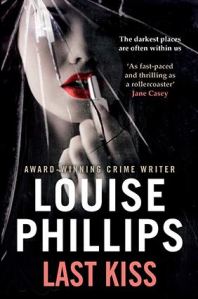
A new book from Landing Author Louise Phillips: Last Kiss

Regular readers of The Landing Book Shelves will know that Louise Phillips was a guest here after the publication of her last book The Doll’s House in 2013. She’s back with her latest novel which has been very well reviewed, with the Independent critic saying that “Louise Phillips goes from strength to strength…. Last Kiss is superior and takes her writing to another, more intense level.”  This all means that I’ve become distracted from whatever I was supposed to be reading from the Landing TBR Pile to get stuck into Louise’s novel. Many thanks to Louise and her publishers Hachette for my copy of Last Kiss; it’s always nice to answer the door to a postman bearing a parcel that looks as though it contains a book.

I admit that I did put this aside for a while before reading it as I was involved in school holiday activities and travel plans. Unfortunately I missed the launch of Last Kiss as I was away visiting my family. When I finally settled down to read my book, I became totally caught up in it to the extent of a couple of late nights when I didn’t want to stop reading. The only reason that it was over two late nights and not one, was that I didn’t want to do what I have done so many times before and crashed on reading, only to spoil the book by reading it too fast.

Last Kiss

Darkness awaits you…

Louise Phillips’ thriller Last Kiss is Dr Kate Pearson’s third outing as a criminal profiler with the Dublin police. When we meet Kate again, she is in the process of deciding (or more accurately delaying deciding) whether she and her husband Declan have a future together. They are separated and juggling childcare for their son Charlie, who misses his dad. Kate’s emotional struggle is complicated by the return to the force of DI Adam O’Connor to help in the hunt for the perpetrator of the ritualised knife murder of an art dealer in a Dublin hotel room.

The story begins with an eerie flashback to 1982 when a young girl called Ellen hides away in woodland to give birth to her child. The girl doesn’t feel as if she is quite alone as she labours in the chill of early morning but she sees nobody. The episode raises intriguing questions about what relevance Ellen and her baby will have to the events that will follow and it gives a chilling tone to the novel:

“The child wailed, scrunching its face like a piece of shrivelled rotten fruit, a primal instinct kicking in, telling it that something wasn’t right.”

The elements and motives of the murder case prove to be difficult to unravel and Kate’s work on the criminal’s profile suggests that the murder probably wasn’t the first one to be committed by this person. Will some research into cold cases reveal a similar crime that could provide a lead? Kate is intrigued by the ritual elements of the crime that indicate that the killer is using Tarot cards. But for what purpose? Revenge perhaps? I was fascinated by the details about the Tarot card readings as it’s not something I know anything about.

In her structuring of the novel, Louise Phillips takes the risk of presenting the murderers’ point of view, in alternating chapters:

“I have reasons for doing what I do. You may not know them yet, because I haven’t told you, but that doesn’t mean they don’t exist. It’s too early for judgement calls, far too early for that… I kill people. I could dress it up, say all kinds of stuff about it, but for now, all you need to know is that I do.”

I said risk, because for an author to try to create a murderer with whom a reader might feel some sympathy/empathy is a tricky manoeuvre to pull off. I think however, that Louise Phillips does so. I wanted to learn more about the killer and to understand the whys and wherefores of the elaborate crime. Why did the murderer feel driven to kill? Is the killer evil or perhaps terribly damaged? This plot device also successfully adds to the twists and tension of the action while building up the history of the murderer and a set of motives.

At the same time as Kate Pearson and Adam are working to solve this case, Sandra Regan becomes increasingly disturbed by a strange presence in her life. She has become convinced that her husband Edgar is having an affair and that the other woman is stalking her and moving objects around in her home, though her friends don’t believe her. The reader must figure out what connects Sandra Regan to the murder under investigation. Is this mysterious ‘other woman’ the Tarot killer?

I don’t want to say too  much more for fear of giving away vital clues. I’ll leave you to read the book and work it out for yourselves. I often feel a sense of dissatisfaction after reading thrillers, a sense of ‘so that’s it then’ when all the twists are over. However, I didn’t get that familiar feeling from the denouement of Last Kiss. The ending was a satisfying conclusion to the case and I have to say that I didn’t guess the killer’s identity before the plot revealed it to me.

As I mentioned above, I was lucky enough to receive a copy of Last Kiss from the publishers, so thanks again for that. If anyone out there would like to have my copy (I’m not a heavy handed reader so it’s still as good as new) then drop me a line in the comment box. Deadline is midnight Sunday and then I’ll put names in a hat on Monday morning and pick  out a winner. Good luck!

Finally, if you want to read more on Louise Phillips, here’s a link to a re-blog from Rebecca Bradley on the question of first drafts that I posted recently

Splitting books, not hairs: it’s back to school again!

Back to school bag

Back to school bag

I’m finally back on The Landing after the summer hiatus. That time of year always has a strange effect on my routine and good intentions and unfortunately, my blogging pattern has suffered as a result. I have however, been trying to get back on the straight and narrow now that the autumn term has begun. September has always seemed to me to be more of a ‘fresh start’ opportunity than the gloom of January. It’s a time of crisper mornings, new exercise books and timetables. September is the only time I feel any sort of nostalgia for my school days, when I remember the novelty of having a purpose to my days after the boredom of the school holidays. And, as I went to school in Birmingham, that was only six weeks holiday, not the three months that The Bookworm just finished here in Ireland.

There’s just one snag in all of my new term euphoria, the perennial issue of the weight of the back to school bag. In fact, I should say ‘bags’ since it took three days and some help from me to ferry all of the required books to school at the beginning of the term. Recently I wrote an opinion piece for The Journal.ie prompted by memories of last year’s culture shock of being bagged up for secondary school.

I was interested in the fact that several years ago, a government working party had investigated, reported and concluded and yet still successive governments have done nothing about the problem. The 1998 report contained much optimistic speculation that technology would improve the situation. However, the reliance of screen based learning opens up a completely new set of problems that I won’t go into here. Suffice to say that the ipad versus books question featured in a school debating session a while ago and the book side won the point.

In the absence of any government, school or educational publisher lead on the matter, one mother of four became so fed up that she researched her own solution. Margo Fleming, who is based in County Wicklow, got in touch with me after spotting my Journal piece and told me about her efforts to find a workable solution. I was intrigued to discover her idea, so I thought I’d talk a little about it on The Landing in case any readers from Ireland have similar school bag issues. I’ll put links below if you want to follow up the information.

Margo Fleming came up with the idea of dividing textbooks into halves, temporarily rebinding them and then rebinding them later to sell back to the bookshop. From this idea, she developed her own product and a company to market it, called BookSplits. The concept is blindingly simple and with the use of Margo’s sturdy covers, you can have two perfectly serviceable textbooks that will survive the rigours of the school year. As she explains in her recent press release,

BookSplits pack

BookSplits pack

 Both halves can be in school each day for class, but the half not required for homework that evening can be left in the school locker. Some of the schools currently using BookSplits have advised students to leave the other half at home for a month, a term or even a year in some cases. By taking this simple action, the weight of the schoolbooks can be halved, instantly – far better for young, developing spines.

As far as I can figure out, this is bound (no pun intended) to be much more economical than the usual solution of buying duplicate copies. Even second hand, the cost mounts up and the condition of some texts offered for sale is poor to say the least. I was lucky this year and was able to buy some excellent second hand copies (before hearing from Margo!) but I could have saved money while reducing the bag weight with the use of her BookSplits.

Check out the links below if you want to know more. I’ll be keeping an eye on BookSplits progress and wish Margo Fleming good luck in her endeavours. It just goes to show you what can be done when someone decides to take matters in hand and find a solution without waiting for the powers that be to wake up and smell the coffee!

BookSplits Logo

BookSplits Logo

Here’s Margo Fleming’s links: http://booksplits.ie/

https://www.facebook.com/booksplits

NB: I’ve just discovered another report after a survey by the Maltese Education Department which I haven’t had chance to read yet:

https://education.gov.mt/en/resources/Documents/Policy%20Documents/handling%20of%20heavy%20schoolbags.pdf

Clearly this is a problem that other governments have had to grapple with…

Picture Credits: Clipartbest.com and Margo Fleming (with thanks)

What’s Your First Draft Like? – Louise Phillips

I’m re-blogging this piece from Rebecca Bradley’s crime blog since I’ve recently finished Louise Phillips’ Last Kiss. You might remember that Louise was a guest on The Landing last year after the publication of The Dolls’ House. Last Kiss is another griping read featuring Dr Kate Pearson, who is helping the police to find a killer before she (Kate is convinced that the killer is female) strikes again. Lots of unease, darkness and twists and turns, but also compassion and empathy in the story. More on this book to follow…

Rebecca Bradley's avatarRebecca Bradley

lou_p (2)Today’s First Draft Guest is crime writer Louise Phillips.

Red Ribbons, the bestselling debut novel by Dublin-born crime author Louise Phillips, was nominated for the Ireland AM Crime Fiction Book of the Year award at the BGE Irish Book Awards in 2012. Louise won the award in 2013 for her second novel The Doll’s House. Louise returned to writing in 2006, after raising her family. In addition to her three published novels, Louise’s work has been published as part of various anthologies and literary journals. She has won the Jonathan Swift Award, was a winner in the Irish Writers’ Centre Lonely Voice platform, and her writing has been shortlisted for prizes such as the Molly Keane Memorial Award and Bridport UK.Last Kiss is her third novel and she is currently working on her fourth.


When you decide to write something new, what is the first thing…

View original post 1,703 more words

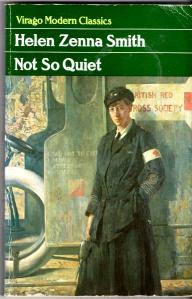
Not So Quiet by Helen Zenna Smith

While I was working on Juliet Greenwood’s guest material, I was reminded of a short review that I wrote of Not So Quiet by Helen Zenna Smith (my edition is Virago). This was published in the reader review column of Herstoria in 2009:

One of my all-time favourites...

One of my all-time favourites…


Not So Quiet  Helen Zenna Smith (Feminist Press at the City University of New York)

I first read this novel sixteen years ago and it has since stayed with me, literally and metaphorically. The title first caught my attention, its nod to Remarque’s All Quiet on the Western Front (1929) intriguing. I discovered that the author Evadne Price, a children’s writer and journalist had been asked to write a parody of All Quiet.  Fortunately for the canon of First World War literature, she declined to do so. She said, ‘that wonderful book…. anybody would be mad to make fun of.[it]’.  Instead Price, in the guise of ambulance driver Helen Smith wrote a vivid, unforgettable novel (1930) based on the war time journal of Winifred Young.

Price gives a view that complements that of Remarque‘s book. She graphically illustrates the experiences of the women struggling to get wounded soldiers to the field hospitals. They slogged day after day, night after night in appalling conditions, the night  driving often in blackout conditions under heavy bombardment. They had poor rations, lice infestation, very little sleep and a tyrannical commanding officer, nicknamed ’Mrs Bitch’ by the ambulance drivers. They may not have seen themselves as heroes, but they were. This makes it for me an inspiring read, written as it is without sentimentality.

Young’s family were proud of her ‘doing her bit’, but not keen to face the reality of her experiences. In having her journal reworked as a novel she publicised the truth. The attitude of  armchair patriots is clearly condemned in the novel. There is a terrible, chilling competitiveness amongst the committee sitting, sock knitting mothers,  about who is giving the most (in the form of their offspring) to the war effort. The book is harshly critical of both war itself and those patriotic souls who pressured others into risking both their lives and their sanity. But it also shows us the toughness, resilience, camaraderie and humanity of the women who volunteered. There were clashes of personality and perspective but the women functioned as a courageous team. I often wonder how I would have fared in the same situation.  I like to think that if the need ever arose, I would do as well as they did.


Since this is the 100th anniversary of the outbreak of World War I, it seems a good occasion to re-read Not So Quiet in tribute to the women who worked so hard for the war effort and faced dangers that they could never have imagined…