The Landing (The TBR Pile) Spring Clean

Recently I have been contemplating the prospect of tackling a spring-cleaning session in the magic realm known as  The Landing. Note, that I used the word contemplating which could suggest that my approach to cleaning is thoughtful and measured. It also quite plainly tells you that I’m procrastinating on the shelf cleaning front. Every time that I pass the shelves on my way either up or down the stairs, I sigh and say to myself, ‘I really must clean those shelves’ or ‘Look at those cobwebs’ or similar such sentiments. But has it done any good at all? The answer is no, it has done not one scrap of good. The dusty tomes of the TBR Pile on the bookcases still cry out for a little TLC (applied with a duster).

Bottom Shelf

Starting at the bottom

However, the time has come to gird my loins and fetch out the Mr Sheen in the interests of maintaining housekeeping standards on The Landing. Lovingly dusted and arranged on equally dust free shelves is no less than my books deserve. It’s just that I do wish modern science had managed to discover a method of banishing dust once and for all. No sooner do I finish cleaning all of the shelves in the house with their resident books then it’s time to start over. The literary equivalent of painting the Forth Bridge (I know that is really just an urban myth but as a child I used to believe it) goes on relentlessly.

The real problem with dusting bookshelves is, as you might have guessed that as I remove books from the shelves I get distracted. Very distracted…. I know that I began this blog to chart my voyage around the uncharted Landing territory (see The Prologue) but I do need to separate cleaning time from reading time. All too often I’ve found myself sitting on the stairs, duster in one hand and book in the other as I browse. This slows the spring/autumn/whenever cleaning down considerably. This inevitably exacerbates the Forth Bridge impression. And that’s before I get to tackle the bookshelves that don’t fall under The Landing project’s range.

Having said all of that, perhaps a good cleaning session will be the perfect way to decide what to cover on the blog in the next month or so. Rather like shops having a clear out that result in a summer sale, perhaps I should have a summer read as a by-product of my clear out. I’ll venture upstairs, with cloth and furniture polish in hand and see what turns up. Who knows what long forgotten novel might be awaiting my attention?  Whether my browsing (sorry, I meant cleaning) will reveal another Landing Eight remains to be seen.

Perhaps I might aim for a more modest ‘Spring Cleaning Four’ ? I’ll be back in due course, armed with the spoils of dusting…


Books and Grief: Talking to Ourselves by Andrés Neuman

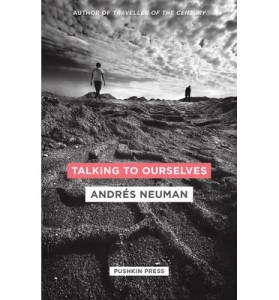
A recent addition to the Landing Bookshelves has been Andrés Neuman’s Talking to Ourselves (courtesy of the publishers, Pushkin Press). It has, I admit jumped the queue over longer residents of the TBR Pile but I hope you’ll let that pass. I became acquainted with Neuman’s work a couple of years ago when I read Traveller of the Century. This was Neuman’s first novel to be translated into English and I was delighted to discover that it has been voted onto this year’s IMPAC short list. If you haven’t come across it yet then skim back to last year’s post on Neuman’s book. He also did a brilliant Q and A for The Landing.

Talking to Ourselves

An emotional landscape…

Talking to Ourselves is a spare and compact novel; quite a contrast to the previous book’s Enlightenment wanderings, but it describes a journey nonetheless. Or rather, it describes the emotional and spiritual journeys of the protagonists as well as a physical one. Three people alternately narrate Talking to Ourselves: Mario, his wife Elena and their ten-year-old son Lito. Mario is terminally ill and his wife has agreed that he can take Lito on a road trip in a truck (called Pedro) to create a special father-son memory. Lito is thrilled to be going on the trip and does not realise that his father is so ill. He thinks that Mario has just had a virus infection, as Mario has been careful to keep his illness hidden from his son. Whether that was the right thing to do or not is a question that Mario cannot answer.

Neuman’s powerful book tackles the difficult topics of loss, grief, loneliness and aging. This sounds depressing, but it’s not; moving and thought provoking are nearer the mark. Communication, sex and books are the weapons that the adults try to use to reclaim life and self from sadness and loss. Lito’s joyful thoughts at being on the road trip provide a sharp contrast to his parents’ concerns. Watching as someone you love suffers and changes is hard for the carer to deal with, and Elena struggles with her feelings. She has always been able to find solace and answers in reading. The book is peppered with quotations from the eclectic range of writers that she explores and Neuman has included a list of the authors cited at the end of the novel. This could feel very forced and clunky, a self-help manual for grief, but in Neuman’s skilled hands this technique works well.

At times, I had to stop reading Ourselves because of the intensity of the plot, so even though it’s only a short novel (156 pages) it took longer to read than I expected. Life can throw harrowing things at us that simply we don’t want to or feel able to face. This novel describes a couple trying to find ways of facing the one thing that any parent of a young child dreads. How do you deal with grief and the way illness affects everyone? How does this affect the moral compass of the healthy person? And is there a viable future? I don’t want to reveal too much of the plot so I’m just going to give a snippet from each of the protagonists to give a flavour of the novel.

Here is Lito just before his adventure with his father and Pedro begins,

I ask Dad when we’re leaving. Right now, he says. Right now! I can’t believe it. I run up to my room. I open and close drawers. I drop my clothes on the floor. Mum helps me pack my backpack. This is going to be awesome.’ Lito sees the trip as a huge excitement and relishes the chance to miss out eating salads in favour of junk food.

Elena is anxious about the trip but has no choice about it, knowing how important it is to Mario,

If Mario accepted the limits of his strength, we would have told all our friends the truth. He prefers us to be secretive. Discreet, he calls it. A patient’s rights go unquestioned. No one talks about the rights of the carer. Another person’s illness makes us ill. And I’m in that truck with them, even though I’ve stayed at home.’

As I said above Mario has refused to publicly acknowledge his illness which has ramifications for both Elena and Lito:

‘I’ll explain, bah, can I explain this?, you’re at your grandparents’ and you don’t know why, we’ve sent you there until the end of the holidays, I’m meant to be travelling, we talk every day, I try to sound cheerful, am I deceiving you, son? yes, I’m deceiving you, am I doing the right thing?, I’ve no idea, so let’s assume I am’.

I hope that I’ve managed to convey at least a small sense of the power and scope of this beautifully written and challenging novel. The translators have played no small part in this achievement: Nick Caistor and Lorenza Garcia who also translated Traveller of the Century have again done an excellent job. As someone whose ‘O’ level Spanish is very rusty indeed I’m constantly amazed at the skill translators apply to original texts, making the resulting words flow as if they were in the author’s native language.

Fingers crossed for Traveller of the Century in the IMPAC contest (one of five translated novels on the shortlist). I’ll be back with another Landing Bookshelves selection soon but meanwhile, drop me a line if you have any IMPAC recommendations.

Credits: Thanks again to Pushkin Press for a copy of the novel.

Books are for everyone

As a bookseller my heart sank into my boots every time a customer asked for the ‘boys’ or the ‘girls’ books. I used to do my best to convince people that there’s no such thing; that stories are for everyone but I wasn’t always successful.

Here’s a recent post (re-blogged from the young bookbug in our household) about the campaign to change hearts and minds….

Daniel Seery: A Model Landing Author

As promised yesterday, and just in time to liven up a chilly Monday morning in Dublin are a few questions that I put to Daniel Seery, author of A Model Partner (Liberties Press). I was surprised to realise just how long it’s been since I had a guest post (my last was Louise Phillips in August) so I’m pleased to welcome Daniel to the #LandingAuthors club. I do feel compelled to mention that as I  now work for Liberties Press, any praise I give Daniel’s book might seem biased. Therefore, I will more or less let him speak for himself other than to say that I think Daniel has created a very engaging and sympathetic character in his main protagonist Tom Stacey.

CM: I was reading in your piece on Writing.ie that you have written and directed a play and been shortlisted in an RTE drama competition. Can I start by asking you how difficult you found it to direct your own piece?

DS: When I write a piece I tend to visualise the whole scene, the pace of the drama, the way a character will deliver a line, the tone they use, even their movement. Initially, it was difficult to let go of this and allow the actor to move forward with their interpretation of the play. And in this respect I had to stop myself from over-directing and trying to control every aspect. But I knew the actor very well. I’d seen him in plenty of plays and I trusted his judgement and his skill. In the end, a lot of the directing came down to the physical arrangement and other technical details.

A Model Partner

CM: Moving on to novel writing, how different do you find the creative process to be from writing for the stage? 

DS: I had a good idea of the themes that I wanted to have in the play so I approached it in the same way I’d approach a novel, in that I usually try to get a rough draft down as quickly as possible in an effort to capture the tone of the piece. The editing stage was very different though, imagining how everything was going to look from an audience perspective and adapting it for the stage. But it’s nice to take on a new challenge with your writing. I’ve a couple of ideas for screenplays and I hope to get the time to write them someday.

CM: In A Model Partner, you have thrown a lot of misfortune Tom’s way during his formative years. Did you plan this from the start or did events take shape as you worked?

DS: The first time I imagined Tom he was leaning against a wall, listening in on his neighbours. I pictured this character on the fringes of society and I wanted to delve into how he ended up in this situation. Because I wanted the character to have a lot of heart, it would make more sense that he was a victim of circumstance and the actions of other people. It also offers the notion that often the bad events in our lives can impact us greater than the good.  

CD: Assuming that Tom finds ‘the one’ do you think that she would be able to cope with Tom’s obsessive need to place his chair exactly so, or do you feel that he would no longer have a need to control his environment so closely?

DS: I think a large part of relationships is about understanding and allowing for a partner’s natural or emotional flaws, so Tom would need to meet someone who is patient and will give him time to change. I think there are some signs in the book that his behaviour is altering. Perhaps he just needs someone to have faith in him and to love him, just like everybody else, I guess.

CD: Following on from the last question, I wondered how much research you did in order to flesh out Tom’s psychological profile in a convincing way.

DS: I wanted Tom to have rigid mannerisms but I wasn’t sure as to what extent I could push this character. So I researched a lot of psychology and medical journals in order to find similar cases and articles relating to trauma and OCD and the unwavering need to control an environment. Once I had some understanding of similar conditions and that I wasn’t merely going on any engrained stereotypical ideas, I felt free to move forward with Tom and the book. Luckily, I work in a library so I have plenty of access to this type of material.

CD: Deciding to use a wax dummy as a model for a partner could have been tricky to pull off as a plot device for all sorts of reasons that it might be best not to go into here. Were you at all wary of introducing her/she/it into the story?

DS: I think writers can often have doubts about the avenues they are taking with their plot. There is certainly a risk when introducing a waxwork model as a character, the fact that it could turn out farcical or that it might weaken some of the themes you are building. But the positive outweighed the negative, like the humour it could add to balance out the book or as a tool to show that beauty runs much deeper than a culmination of perfect traits. It needed a lot of work to fit seamlessly into the book but I think it was a risk worth taking.

CD: This final question is out of simple curiosity: Tom’s friend J.P. carries On the Road around with him and of course, Tom and his grandfather have their own road trip. Were you inspired by a road trip of your own and are/were you a Kerouac devotee?

DS: I wasn’t inspired by a road trip but the back story was in some ways influenced by the fact that my father is a truck driver. As a kid I’d love getting the chance to sit beside him in the cab and go for a drive. If I’ve a natural talent at anything in life it is definitely the talent of being a good passenger. Although Iggy Pop’s The Passenger was released on the Lust for Life album the year I was born, I still think he must have written the song about me!

‘All of it was made for you and me…so let’s take a ride and see what’s mine’

With On the Road, I loved the novel but I wouldn’t say I was a devotee like J.P. Instead, I wanted to use Kerouac’s book as a symbol of a future that JP naively presumes he is entitled to. But with the likes of JP, their aspirations are only a mimic of someone else’s aspirations and they are reluctant to chase or work for their vision of the future. And in some ways they are forever waiting on an adventure that is never going to happen.

Many thanks to Daniel Seery for taking the time to answer a few questions about Tom Stacey and A Model Partner. I hope that you will now be intrigued enough to want to read the book for yourselves. If so, just follow the links to the Liberties Press site where you can order a copy.

Now, I’ll try not to leave it too long before my next #LandingAuthor…
Introducing Landing Author Daniel Seery

As I mentioned on Twitter earlier this week, I am due to host debut author Daniel Seery  (A Model Partner, Liberties Press) on The Landing. Daniel’s novel had a successful  launch last week at The Gutter Bookshop in Dublin by fellow Stinging Fly contributor Colin Barrett. As you will know from one of my previous posts, Daniel generously gave a guest spot on his blog in the form of a Q & A to his cover designer Karen Vaughan. This time it’s Daniel’s turn to go under the spotlight with a few questions based on A Model Partner. I’m going to post up the email interview on Monday but meanwhile here is a short introduction to Tom Stacey, whose methodical search for his perfect partner will lead him into some surreal situations…. But will he find ‘the one’?

A Model Partner

The bees are a buzzing…

Tom Stacey has moved into his neighbour’s bedsit. He wasn’t asked. It was just that the door was open and his neighbours have gone on holiday. And it is so much bigger than his own bedsit. Plus, he has a lot to think about these days. The bees for one. He hasn’t seen any but he keeps hearing them, buzzing in the fridge at work, in the overhead lights, in the test equipment in the factory where he has spent the last fifteen years of his working life. They seem to be getting louder and more insistent, and they are beginning to affect the way he goes about his business.

Then there is his search for Sarah McCarthy to worry about. Sarah was his first love when, as a teenager, he travelled around the country in the back of a horsebox with his grieving grandfather. But perhaps it is not the bees or the past which is the problem. Perhaps it is his on going loneliness. Twenty-two dates with Happy Couples dating agency and nothing to show – bar a dent in his bank balance and several complaints about ‘eccentric behaviour’. Relationships are all about the details and there are just not enough boxes to tick in the Agency’s personal profile form.

Armed with a wax model and a list of criteria, Tom sets out on a quest to create a personal profile to find his ideal match. On his journey, he meets people just like him, warm but unable to show it, lonely and unable to remedy it, the lost, the misplaced and the damaged.

Daniel Seery

Daniel Seery

About the author:

Daniel Seery is a writer from Dublin. His work has appeared in local and national publications including The Stinging Fly and REA Journal and he has worked on a number of public arts commissions. In 2012 he was the resident writer in the Axis Centre, Ballymun. He has also been shortlisted for an RTÉ drama competition, has recently been one of the winners of the Irish Writers’ Centre Novel Fair and he has written and directed a play The One We Left Behind which ran in the Irish Writers’ Centre in May 2012 and in the Helix in August 2012. A Model Partner is his first novel.

Credits: Book blurb and cover taken from Liberties Press website.
Author photograph taken from Daniel Seery’s blog.

Spoils from the Trinity College Book Sale

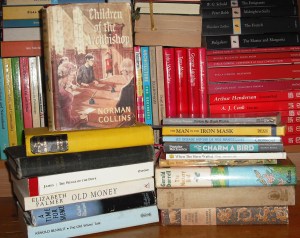
As regular readers probably realise, I  don’t need to be adding any more books to the huge TBR Pile that is the Landing Book Shelves but nevertheless I brought a few new additions home recently.  I hasten to add that the photographic evidence shown here is slightly misleading in that some of the books belong to one of the other book bugs in the household. Note that I’m attempting to fudge the numbers here.

Book Sale Purchases

Now where to put them…

I was particularly pleased to spot a Noel Streatfeild novel, When the Siren Wailed that I had not come across before. This was originally published in 1974 (William Collins) with the Collins Lions paperback edition I found dating from 1984. The book retains its Eason price sticker, originally costing £1.54. The blurb on the back from The Birmingham Post says, ‘Noel Streatfeild vividly recreates the atmosphere of blitz-torn London with all its friendliness, horror, confusion and tragedy. Her book cannot fail to impress young readers.’ The books tells the story of three children despatched with their school mates to safety as part of Operation Pied Piper.

Stories from the blitz interest me because my mum was evacuated from Birmingham during the war and she was lucky enough to make a lifelong friend as a result. I don’t think she ever had any exciting adventures as a result of being an evacuee though. I was struck by the fact that Laura the eldest sibling in the story,  was nine at the beginning of the war when the evacuation programme began. She was given the responsibility of looking after her two younger brothers Andy and Tim on a journey to an unknown destination with a train load of strangers. My mum was also nine years old at the outbreak of war but as an only child would have been sent away without the comfort of brothers or sisters. It’s hard to imagine now a circumstance where you would send a child away alone with a luggage label attached to a coat, a suitcase and a gas mask. Fortunately it all turned out well for my mother in her temporary home.

Closeup Books

Which one?

Now the only question remaining (apart from where to put the books when one bookshelf already covers the only landing window) is what to read next…I’ll keep you posted on that one.

I’d love to hear from anyone else who loves second hand book sale bargains too!

Boris Pasternak: Doctor Zhivago

As I mentioned previously I’m continuing with my Russian theme by reading Doctor Zhivago (Boris Pasternak) which I had for Christmas (it seems ages ago now!) In keeping with my usual mode of practice, the good doctor has had to give way to a couple of other reads, including Nancy Mitford, Andrés Neuman and Kader Abdolah but I do keep returning to him after straying.

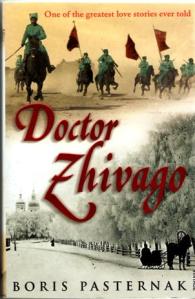
Doctor Zhivago

My Christmas Present…

Finally, I have reached the home straight in Doctor Zhivago, the penultimate chapter, at which point the revolution has the country in its tenacious grip. Life is ruled by committees and many, many regulations which it is not safe to ignore. Yuri Zhivago, now living once more in Moscow has seen his life change immeasurably by war and revolution. He has suffered hunger, violence and fear as well as experiencing great passion, as he became caught up in his nation’s struggle to throw off centuries of Tsarist rule. Given that Putin‘s Russia is so much in the news lately it has proved to be an appropriate time to read about the course of events that would eventually lead to the present political landscape.

As usual in my posts, I am trying to avoid plot spoilers but in this case, I think it is highly likely that many of you will have at least seen the film version (possibly more than once) so the broad outline of the plot will already be familiar. To many people I’m sure, Omar Sharif will always be Yuri and Julie Christie, Lara (Larissa) no matter how many times they may read the book. Apart from ‘Lara’s Theme’ and Sharif’s melting eyes my abiding memories of the film are the ambiguous personalities of Strelnikov (Lara’s husband Antipov) and Yevgraf (Yuri’s half brother) played by Tom Courtney and Alec Guinness respectively. And lots and lots of snow covering the Russian landscape against which Yuri’s wife Tonya (Geraldine Chaplin) appears luxuriously swathed in furs.

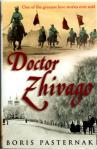
The strap line on the cover of my edition of the novel declares that Doctor Zhivago is ‘One of the greatest love stories ever told’ but there is much more to the book than that. The novel spans a period of intense upheaval in Russian history, as experienced by Yuri Zhivago, his family and friends. There is a huge cast of characters apart from those I’ve mentioned above, who participate in the momentous events described in the book. Yuri encounters people from different factions during the course of the book, some of whom he meets more than once during his various ordeals. Sometimes it seems to stretch credibility that so many coincidences of meeting seem to occur to Yuri, but overall I didn’t find that this detracted from the novel. Rather it created a sense of life not being lived in a neatly linear way; links between people who are not always apparent on the surface that affect our lives.

Doctor Zhivago: First Edition

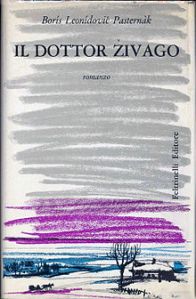
Italian First Edition

The plot teems with life and death and it gives the reader a fascinating insight to the terrible realities of the struggle between the Whites and the Bolsheviks after the carnage of World War I. Pasternak was writing from a position of uncertain safety since he had fallen foul of Stalin’s regime to the extent that his book could not be published in his own country. The manuscript was eventually smuggled to Italy for publication. The translators of my edition, Max Hayward and Manya Harari (1958) pay tribute to Pasternak’s poetic prose style fearing that they haven’t done justice to his use of language.

Here is a passage from early on in the novel when Yuri’s wife Tonya has just given birth to their first child:

Raised higher, closer to the ceiling than is usual with ordinary mortals, Tonya lay exhausted in the cloud of her spent pain. To Yuri she seemed like a barque lying at rest in the middle of a harbour after putting in and being unloaded, a barque which plied between an unknown country and the continent of life across the waters of death with a cargo of new immigrant souls. One such soul had just landed, and the ship now lay at anchor, resting in the lightness of her empty flanks. The whole of her was resting, her strained masts and hull, and her memory washed clean of the image of the other shore, the crossing and the landing. 

I think the translators certainly did justice to one of the most moving passages on childbirth that I have ever read. Having said that, my grammar checker insists that the first sentence is a fragment and needs revising…proof if it is needed, that it’s not always wise to listen to machines…

I’ll be finishing Doctor Zhivago in a day or so (provided that I can pass the ‘Quick Pick’ shelf in the library without looking) and I will need to make a decision about the next Landing Book Shelves read.

More on that soon but meanwhile do drop me a line below or on Twitter if you have any challenging suggestions…

An Interview with Karen Vaughan…

This post from Daniel Seery’s blog is an interview with one of my colleagues, graphic designer Karen Vaughan. When I discovered from reading this that we share a liking for Edmund Dulac and Arthur Rackham, of course I had to give her a mention! It’s also worth checking out more of Daniel Seeery’s blog if you have the time. His first novel A Model Partner (Liberties Press) is being launched next week in Dublin. And it does have a great cover…

danielseery's avatarDaniel Seery

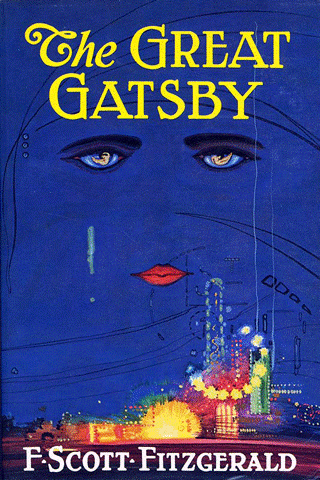
In 1925, an artist by the name of Francis Cugat was commissioned to design the cover of F. Scott Fitzgerald’s ‘The Great Gatsby’ despite the fact that the novel had yet to be completed.  When the author saw the cover, he was so enamoured with it that he told the publisher he had written it into the book. This is the power a cover illustration can have on a book.

Gatsby_1925_jacketRecently, I’ve been working with a fantastic cover artist by the name of Karen Vaughan.  Karen is an illustrator and designer working with Liberties Press. She has a particular love for pen and ink and examples of her work can be seen on her website –

http://kvaughan.com/

She is an artist to watch out for in the future and luckily I managed to get an interview with her…and here it is…

Karen, when did you first realise you wanted to…

View original post 499 more words

When Omar Met Julie: Doctor Zhivago on Film

I’m still reading Doctor Zhivago, having been side tracked by a couple of other books along the way. As I was getting further into the book, I realised that even though it is years since I last saw David Lean’s Doctor Zhivago, I still see Omar Sharif and Julie Christie in my mind’s eye as I read.

Doctor Zhivago

My Christmas Present…

That’s my excuse for this quick post featuring a lovely sequence of clips from the film. I hope you enjoy it; I’m just off to read a little more of ‘One of the greatest love stories ever told’.

I’ll post up more on Doctor Zhivago soon.

http://youtu.be/old4K4Tpo8c

Credit: Uploaded to YouTube on 17 Dec 2009 by IluvKenji (with thanks)

Books books books

This post hails from far away from The Landing Book ShelvesMombasa in fact. Anna, the daughter of a bookseller friend is teaching there at the moment and is keeping a blog of her experiences. ‘Books, books, books’ is about the excitement (and perils) of buying a new supply of school books….

annamcgettigan's avatarHakuna Matata

Over the last few weeks Michele and I have been frequent visitors to the “Mombasa School Supplies” store in town. We have been purchasing the books that the Swimathon last November raised nearly £6,000 for. Ironically, raising the money was a lot easier than spending it!
Our first challenge was deciding what books to buy. We had to take into consideration the curriculum, and the textbooks that were already in use in the schools. We then asked the headteachers to make a list of books that they required. Funnily enough, Mr Lucas, the class teacher for Standard 6, reckoned that Olives needed about three times the books for standard six than it did for any other standard, and two different textbooks for each subject. So we went back to the drawing board, asked around about what was considered the ‘best’ textbooks for each subject, and finally made our list.
The…

View original post 751 more words